
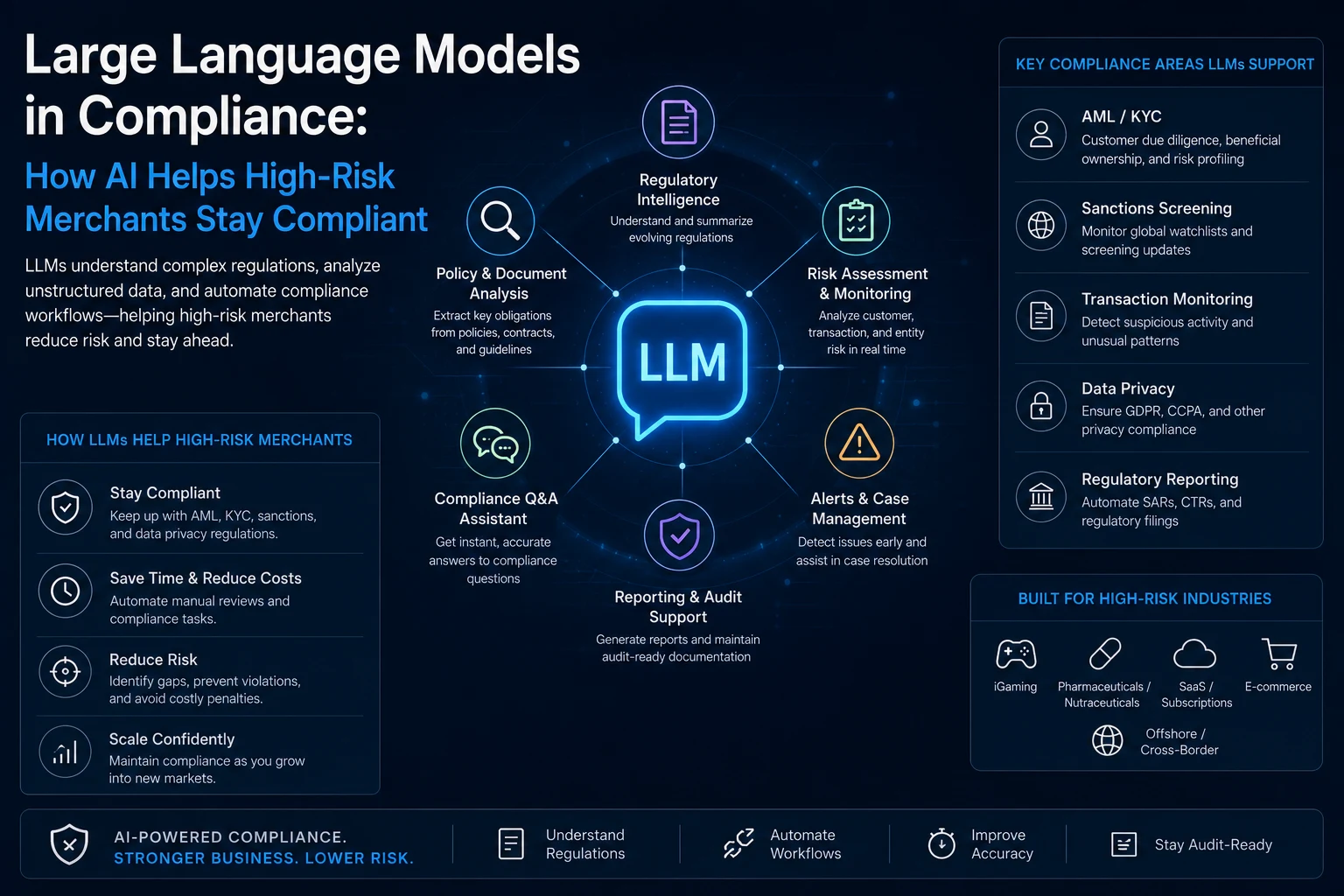
Compliance is no longer a back-office function for high-risk merchants, it is an operational constraint that directly determines whether a business can access payment infrastructure at all. In 2026, with regulatory obligations spanning AML, KYC, MiCA, DORA, and FATF Travel Rule requirements simultaneously, the compliance burden on high-risk payment operators has outgrown the capacity of manual teams to manage it. Large language models are emerging as the first technology genuinely capable of matching the scale and complexity of modern payment compliance, and their deployment is accelerating faster than most operators realise.
TL;DR
- Global AML compliance costs reached $36.1 billion annually, high-risk merchants absorb a disproportionate share through processing fees, reserve requirements, and internal compliance overhead
- LLMs process and summarise regulatory documents 40-60x faster than human reviewers, enabling compliance teams to stay current with regulatory change without headcount additions
- Key use cases in 2026: KYC/KYB document analysis, AML narrative generation, policy gap analysis, regulatory change monitoring, and audit trail documentation
- Purpose-built tools active in this space include ComplyAdvantage, Napier AI, Hummingbird, and Resistant AI, alongside bespoke LLM integrations at larger payment providers
- Hallucination risk, explainability requirements, and data residency constraints require human oversight to remain in the loop on all compliance-critical outputs
- The operators deploying LLM-assisted compliance earliest are building structural cost and speed advantages that will compound as regulatory complexity continues to increase
Why Compliance Is the Highest-Friction Problem in High-Risk Payments
High-risk merchants face a compliance environment that is structurally more demanding than standard payment operators. They operate across multiple regulatory jurisdictions simultaneously, undergo enhanced due diligence from every payment provider they work with, and face MCC-level scrutiny that standard merchants never encounter. The compliance overhead is not incidental, it is priced into every element of the high-risk payment relationship, from processing fees to rolling reserves.
Global AML compliance costs reached $36.1 billion annually for financial institutions in 2023, according to LexisNexis Risk Solutions. High-risk merchants and offshore operators absorb a significant portion of this cost both indirectly, through compliance overhead passed on by payment providers via elevated fees, and directly through their own internal compliance functions. Industry estimates place compliance workflow costs at 15-20% of total operational overhead for high-risk businesses, a proportion that has risen consistently over the past four years as regulatory frameworks have multiplied.
The pace of regulatory change has become the defining problem. The EU’s DORA regulation came into effect in January 2025, adding ICT risk obligations for payment operators. MiCA applied fully from December 2024. The FATF Travel Rule is now enforced across 40+ jurisdictions. The volume of regulatory change a compliance team must track, interpret, and embed into operational policy has grown beyond what manual processes can sustain without staffing additions that most businesses cannot commercially justify.
This is precisely the problem LLMs were built to solve.
What LLMs Actually Do in a Compliance Context
Large language models are not compliance experts, and framing them as such creates dangerous expectations. They are exceptionally capable document processing, pattern recognition, and structured text generation systems. Those specific capabilities map directly onto the most time-consuming parts of a high-risk merchant compliance function.
Regulatory Document Understanding and Policy Parsing
LLMs can ingest a 200-page regulatory update, extract the provisions relevant to a specific business type, compare those provisions against existing internal policies, and return a structured gap analysis in minutes. A compliance analyst performing the same task manually requires two to three days. The LLM output requires human review before any action is taken, but it compresses the research and drafting burden by an order of magnitude.
In 2026, compliance teams at payment providers and larger high-risk merchants are deploying LLMs to parse MiCA implementing technical standards, FATF guidance updates, and national transposition legislation as they are published. The model surfaces provisions requiring policy changes and routes them for analyst review, rather than requiring analysts to read every document in full. Thomson Reuters research (2024) found that 67% of financial compliance teams reported difficulty keeping pace with regulatory change, this is the workflow they are addressing.
AML Narrative Generation and SAR Drafting
One of the highest-value LLM applications in payment compliance is the automated generation of Suspicious Activity Report narratives and AML case documentation. Compliance analysts at high-risk merchant services providers spend a substantial proportion of their time writing structured narratives from transaction monitoring alerts, extracting data from multiple systems and translating it into a standardised regulatory format.
LLMs integrated with transaction monitoring platforms can draft these narratives automatically, pulling structured alert data and generating a compliant write-up for the analyst to review, edit, and approve. The analyst does not lose the decision, they lose the drafting. That distinction matters both operationally and regulatorily.
KYC and KYB Document Analysis
LLMs with document intelligence capabilities analyse uploaded KYC and KYB packages, corporate certificates, shareholder registers, director identification, proof of address, and flag missing documents, inconsistencies between stated and registered details, and ownership structures that carry elevated risk signals. For offshore merchants applying to payment providers across multiple jurisdictions, this automated pre-screening significantly reduces the document back-and-forth that extends onboarding timelines and tests the patience of both sides.
Five Compliance Workflows LLMs Are Transforming in 2026
1. KYC/KYB document review and gap identification: Automated pre-screening of merchant onboarding packages before a file reaches a human analyst. Flags missing documents, structure anomalies, adverse media matches, and UBO inconsistencies faster and more consistently than manual review, compressing onboarding cycles for legitimate high-risk merchant accounts.
2. SAR and AML case narrative drafting: LLMs generate structured SAR narratives from transaction alert data, reducing analyst time per case from 45-90 minutes to a review-and-edit workflow of 10–15 minutes. Alert volumes at high-risk payment gateways make this time compression commercially significant, it directly determines how many cases a team can process per day.
3. Regulatory change monitoring and policy gap analysis: Continuous ingestion of regulatory publications with model-generated gap reports that map new obligations to existing internal policies. The model identifies provisions requiring action; the analyst decides what to do about them.
4. Audit trail and compliance documentation: LLMs generate structured documentation of compliance decisions, evidence packages, and operational procedure records in formats required by regulators during examination. For high-risk payment operators under FCA, MAS, or VARA oversight, maintaining audit-ready documentation continuously is an operational burden LLMs are well-positioned to absorb.
5. Compliance training and policy communications: LLMs generate internal guidance updates, policy summaries for frontline teams, and training materials based on current regulatory frameworks. Keeping merchant-facing and operations teams current with policy changes is a recurring compliance function that LLM-generated content handles efficiently and at low cost.
LLM Compliance Tools in the High-Risk Payment Stack
| Tool | Primary Use Case | LLM Capability | High-Risk Fit |
|---|---|---|---|
| ComplyAdvantage | AML screening + transaction monitoring | AI-powered alert triage and narrative support | ★★★★★ |
| Napier AI | Transaction monitoring + case management | ML + LLM narrative generation | ★★★★☆ |
| Hummingbird | Compliance case management + SAR filing | LLM-assisted SAR drafting and workflow | ★★★★☆ |
| Resistant AI | Document fraud detection + KYC/KYB | Transformer-based document analysis | ★★★★☆ |
| Harvey | Legal and regulatory research | Deep document processing + gap analysis | ★★★☆☆ |
| Custom LLM builds | Policy parsing, audit docs, training content | Highly flexible; requires internal configuration | ★★★☆☆ |
For most high-risk merchants, the practical entry point is a purpose-built compliance platform with LLM capabilities already integrated, ComplyAdvantage and Napier AI are the most mature for the high-risk payment provider context. Custom LLM builds make sense for payment providers with dedicated compliance engineering teams and workflow-specific requirements that off-the-shelf platforms do not address.
How Payment Providers Are Actually Deploying LLMs for Compliance
Tier 1 payment providers and larger acquiring banks have been running LLM pilots in compliance functions since 2023. By 2026, several have moved those pilots into production, primarily in alert triage, narrative drafting, and regulatory monitoring workflows. These deployments share a common architectural pattern: the LLM operates as a drafter and analyst support layer within an existing compliance workflow, with all outputs reviewed and approved by a qualified human before any external filing or regulatory communication is made.
Mid-market payment providers are following a different path, procuring specialist compliance platforms with LLM features embedded rather than building proprietary integrations. This reduces implementation complexity and time-to-value, but limits the degree to which the model can be calibrated to a specific vertical’s risk profile. For offshore merchants and high-risk operators whose compliance obligations are unusual, a configurable platform or a custom build ultimately serves better than a generic compliance tool designed for standard financial services.
The most operationally mature deployments in 2026 are in the SAR drafting and KYC/KYB pre-screening use cases, where the volume of repetitive structured work is highest and the model’s output is most reliably reviewable by a human analyst. Regulatory gap analysis and policy monitoring deployments are more exploratory, valuable, but requiring more active calibration and oversight.
Risks That Compliance Teams Cannot Ignore
Hallucination in regulatory contexts: is the most serious operational risk. LLMs can generate plausible-sounding but factually incorrect statements about regulatory requirements, citing provisions that do not exist or mischaracterising the scope of an obligation. Any LLM output used in compliance documentation requires expert human review before it is acted upon, filed, or communicated to a regulator. This is not optional in regulated environments.
Explainability requirements: create friction for LLM adoption in formal compliance processes. Regulators examining a compliance programme want to understand the basis for decisions. LLM-generated SAR narratives or policy gap analyses must be fully defensible, the compliance officer signing off must be able to explain and stand behind the content, regardless of how it was drafted.
Data residency and confidentiality: are material for payment operators in the EU and UK. Processing sensitive customer transaction data through cloud-hosted LLM services requires careful legal review under GDPR Article 28 processor agreements. Several payment providers are responding by deploying locally-hosted or private-cloud LLM instances specifically to address this constraint, an approach that adds infrastructure cost but removes the regulatory uncertainty.
Pros and Cons of LLM-Assisted Compliance
Pros
- Compresses regulatory document review from days to minutes, compliance teams keep pace with regulatory change without headcount additions
- SAR and AML narrative drafting reduces analyst time per case by 60–80%, directly improving throughput capacity
- KYC/KYB pre-screening reduces onboarding friction for legitimate offshore merchants while flagging high-risk structures earlier
- Continuous regulatory monitoring reduces the window between regulatory publication and internal policy implementation
- Compliance cost per unit of work decreases over time as LLM automation absorbs volume growth
Cons
- Hallucination risk requires mandatory human oversight on all LLM compliance outputs, autonomous deployment in regulated workflows is not viable
- Regulatory acceptance of LLM-generated compliance documentation is still evolving and varies by jurisdiction
- Data confidentiality constraints restrict cloud-hosted LLM use for sensitive transaction data without appropriate contractual safeguards
- Implementation requires compliance and engineering collaboration that many mid-size high-risk merchants lack internally
- Over-reliance on LLM output risks de-skilling compliance teams whose expert judgment remains essential and irreplaceable at the decision level
FAQ: LLMs and AI Compliance for High-Risk Merchants
Can an LLM replace a compliance officer at a high-risk merchant?
No, and the distinction matters operationally and legally. LLMs are document processing and drafting tools. Compliance decisions, whether to file a SAR, exit a merchant relationship, or respond to a regulatory query, require human judgment, professional accountability, and legal expertise. The correct mental model is LLM as analyst support layer, not decision-maker.
Are regulators accepting LLM-generated SAR narratives?
Acceptance varies by jurisdiction. FinCEN has not issued guidance prohibiting AI-assisted SAR drafting, provided the filing institution takes full responsibility for the content. The FCA and EBA have both flagged AI in compliance workflows as an area under active review. Compliance teams should document their LLM usage processes and maintain clear records of all human review steps.
How do high-risk payment providers use LLMs differently from individual merchants? Payment providers process far higher volumes of compliance documentation, merchant onboarding packages, ongoing transaction monitoring alerts, periodic KYC refresh cycles, regulatory examination preparation. LLM value scales directly with volume, making the commercial case for adoption stronger at the payment provider level than for a single high-risk merchant operating through one payment gateway.
What data privacy risks apply when using LLMs for compliance work?
Any LLM processing personal or sensitive financial data must be assessed under applicable data protection law, GDPR in the EU, UK GDPR, PDPA in Singapore, and applicable local frameworks. Cloud-hosted models require a Data Processing Agreement with the LLM provider. Private-cloud or on-premises deployment eliminates most data residency concerns but adds infrastructure cost that must be weighed against the compliance risk reduction.
What should a high-risk merchant budget for LLM-assisted compliance tooling?
Purpose-built platforms like ComplyAdvantage and Hummingbird operate on SaaS pricing models, typically starting at $1,000-$3,000 per month for mid-market deployments and scaling with alert volume and user count. Custom LLM integrations via API carry lower baseline monthly costs but require engineering investment that should be included in any total cost of ownership calculation.
Comments
No comments yet. Be the first to share your thoughts.
Leave a comment