
Introduction
Chargebacks are no longer just a fraud problem, they’re a profitability problem. Global chargeback losses reached $33.79 billion in 2025 and are expected to exceed $41.69 billion by 2028. For high-risk merchants, every dispute threatens revenue, processor relationships, and account stability.
Traditional fraud rules often make things worse, blocking legitimate customers and driving unnecessary revenue loss. Machine learning changes the equation. By analyzing behavioral, transactional, and device-level signals in real time, predictive models can identify transactions likely to become chargebacks before they are approved.
This guide explores how high-risk merchants use machine learning to predict disputes, reduce false declines, protect revenue, and build smarter risk strategies in 2026.
TL;DR
- Global chargebacks hit $33.79B in 2025: up 23% by 2028, with friendly fraud driving ~75-79% of all disputes
- Machine learning chargeback prediction: works in three stages: pre-authorization scoring, post-authorization monitoring, and dispute representment prioritization
- ML outperforms static rules decisively: 0.06-2% false-positive rate vs. 15-25% for rule-based systems; 70-85% detection rate vs. 40-55%
- The key data inputs: are transaction-level features, customer behavioral signals, and merchant risk scoring, the most critical predictor at 15.5% feature importance (AISC 2026)
- For high-risk merchants:, ML is a VAMP compliance tool as much as a fraud tool, reducing TC40 + TC15 events that determine whether your payment processing account stays active
- Vendor solutions: (Chargeflow, Ravelin, Chargebacks911, Sift) deliver ROI in 60-90 days; in-house development is cost-competitive above $5M/month in processing volume
- Minimum viable data: for a supervised model: 50,000+ transactions with labeled dispute outcomes across 12 months
1. The Problem ML Is Solving: Why Chargebacks Are a Data Problem, Not Just a Fraud Problem
Ask most merchants why they receive chargebacks and the answer is “fraud.” Ask a payment data scientist the same question and the answer is different: chargebacks are a signal prediction problem. The question is not merely whether a transaction is fraudulent, it is whether a specific combination of transaction attributes, customer history, behavioral signals, and merchant context will produce a dispute seven to ninety days from now.
That reframing matters enormously for high-risk merchants. In categories like nutraceuticals, SaaS subscriptions, digital health, iGaming, and offshore commerce, the majority of chargebacks are not third-party fraud. Supervised and semi-supervised models evaluate a rich tapestry of signals in real time: device integrity, behavioral biometrics, session risk, merchant descriptors, historical support tickets, and delivery metadata. This allows them to flag likely first-party fraud before a dispute is ever filed.
Traditional fraud detection focuses on the transaction moment. Machine learning chargeback prediction focuses on the dispute moment, which is a different problem with different signals. A transaction that passes every real-time fraud check can still result in a chargeback sixty days later when a customer disputes a subscription charge, claims non-delivery on a digital product, or files a friendly fraud claim on a high-ticket purchase.
For high-risk payment processing environments, where a breach of Visa’s 0.9% VAMP threshold can trigger monitoring programs, fines, or account termination, the ability to predict and intercept disputes before they materialize is not an optimization. It is operational survival infrastructure.
2. The Scale of the Crisis: Chargeback Data in 2026
Before diving into the mechanics of ML prediction, the data context establishes why this investment is justified.
Key Chargeback Statistics (2025-2026)
The Chargeback Crisis: 2026 Snapshot
━━━━━━━━━━━━━━━━━━━━━━━━━━━━━━━━━━━━━━━━━━━━━━━━━━━━━━━━━━
Global chargeback volume (2025)          261 million transactions
Projected global volume (2028)           324 million (+24%)
Global chargeback value (2025)           $33.79 billion
Projected value (2028)                   $41.69 billion (+23%)
U.S. share of global volume              10% (~146 million by 2026)
U.S. chargeback value (2026 est.)        $15.3 billion
Friendly fraud share of all chargebacks  ~75–79%
Projected rise in friendly fraud by 2026 +40% from 2023 levels
Cost per fraud dollar (U.S. merchants)   $4.61
━━━━━━━━━━━━━━━━━━━━━━━━━━━━━━━━━━━━━━━━━━━━━━━━━━━━━━━━━━
AI/ML impact: Chargeflow's AI system reduces chargeback losses
by 80% for merchants. Average saving: $315 per dispute.
━━━━━━━━━━━━━━━━━━━━━━━━━━━━━━━━━━━━━━━━━━━━━━━━━━━━━━━━━━
The financial exposure is direct and compounding. Chargebacks will cost eCommerce $33.79 billion in 2025, projected to reach $41.69 billion by 2028. U.S. merchants face 10% of global volume, losing $4.61 per fraud dollar.
For high-risk merchants operating on merchant accounts with elevated baseline chargeback exposure, these numbers are not background statistics, they are the operational context within which every payment gateway decision, every transaction approval, and every customer interaction is made.
The Research Case for ML
A 2026 study published in the Proceedings of the Australasian Information Security Conference analyzed ML chargeback detection on anonymized merchant data at scale. Fraudulent transactions averaged $1,107, compared with $611 for legitimate transactions, indicating fraudsters target high-value purchases. At the classification threshold used, the model detected $41,540 in fraud while the model’s merchant risk scoring feature became the most critical predictor at 15.5% importance, improving F1 score from 0.554 to 0.565 while maintaining a false-positive rate of just 0.06%.
A 0.06% false-positive rate on legitimate transactions is the benchmark that separates production-grade ML chargeback prediction from academic prototypes.
3. How Traditional Rule-Based Systems Fail High-Risk Merchants
Before ML, chargeback prevention relied on static rule sets, thresholds and filters applied uniformly to every transaction. Merchants typically rely on static rules such as geolocation checks, velocity controls, or mismatched customer data to flag suspicious chargebacks. While effective against obvious fraud, such systems generate high false positives and leave many cases unaddressed. Manual reviews offer flexibility but do not scale with growing transaction volumes and complex dispute reasons.
Why Static Rules Break Down for High-Risk Merchants
They cannot adapt to evolving fraud patterns: A rule that blocks transactions from a specific IP range or country code works until fraudsters route through a different geography. Static rules require manual updates after each new fraud pattern is identified, by which point the pattern has already generated losses.
They treat all transactions in a category equally: A velocity rule that blocks more than three transactions per hour from the same card applies the same restriction to a legitimate power user and a fraudster running a carding attack. The result is either too many false positives (blocking legitimate customers) or too many false negatives (approving fraudulent transactions) depending on where the threshold is set.
They operate at transaction time only: Static rules cannot predict that a transaction that passes all real-time checks will be disputed sixty days later. They have no memory across the merchant-customer relationship, no awareness of behavioral signals that develop over a session, and no capacity to integrate post-authorization data (delivery confirmation, customer service interactions, dispute history) into future authorization decisions.
High-risk vertical patterns require different thresholds than standard retail: A rule calibrated for apparel eCommerce will generate unacceptable false-positive rates in nutraceuticals, subscriptions, or digital services, categories where high-risk payment processing environments require MCC-specific, behavioral-context-aware analysis that static rules cannot provide.
4. How Machine Learning Chargeback Prediction Works
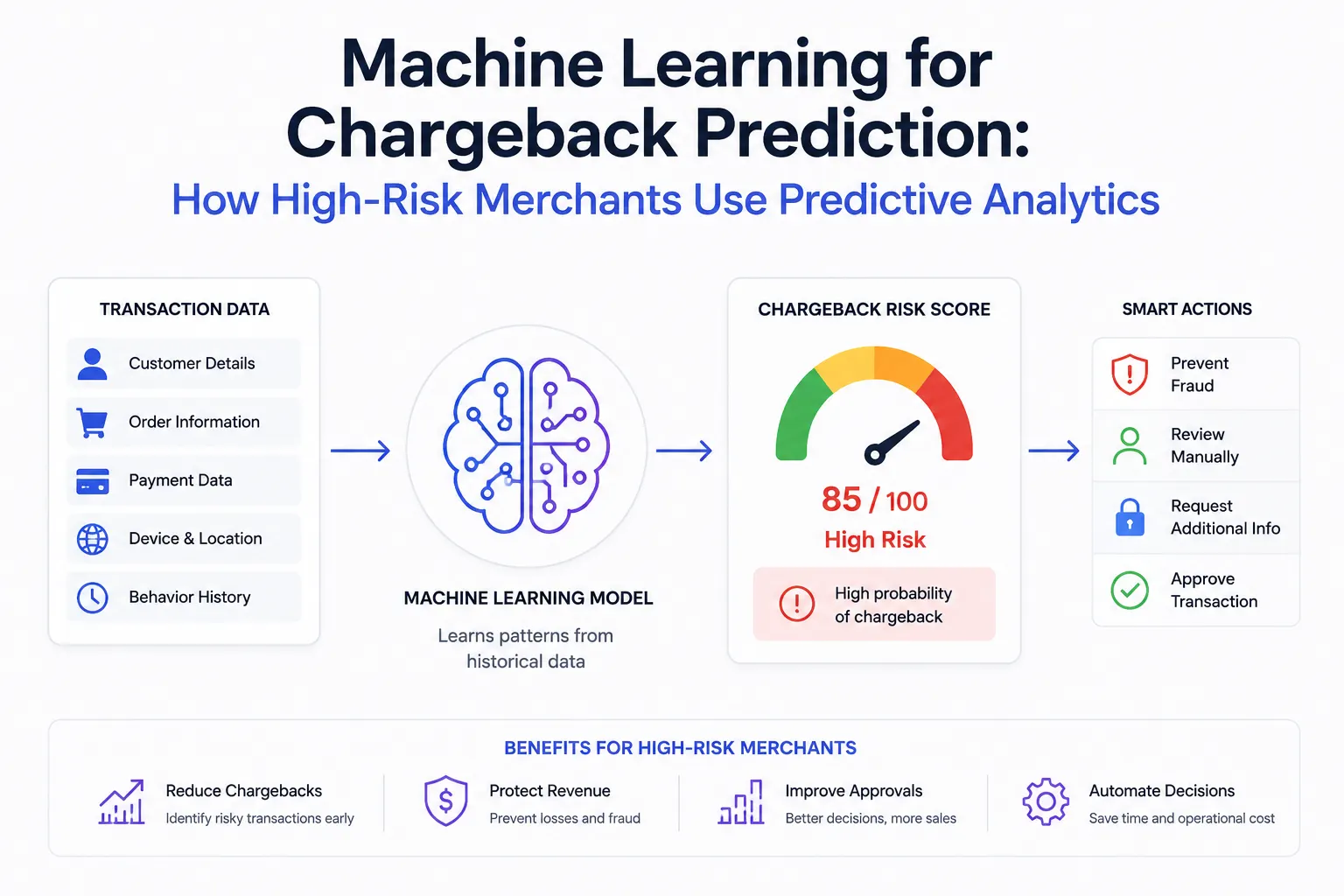
Chargeback prediction represents a cost-saving application where models identify transactions with elevated dispute risk before they’re approved, allowing merchants to take preventive action, additional verification, proactive customer service outreach, or enhanced documentation.
The core mechanism works in three stages:
Stage 1: Pre-Authorization Scoring
Before a transaction is submitted for authorization through the payment gateway, an ML model evaluates the incoming transaction against a feature vector built from hundreds of signals. The model outputs a chargeback probability score, typically expressed as a decimal between 0 and 1, where 0.80 means an 80% estimated probability that this transaction will be disputed.
The payment processing layer uses this score to route the transaction: approve frictionlessly (low risk), apply step-up authentication (moderate risk), require 3DS2 (elevated risk), or decline entirely (high risk). This is risk-based authentication, not uniform friction applied to all transactions, but friction calibrated to the actual predicted dispute probability of each specific transaction.
Stage 2: Post-Authorization Monitoring
After a transaction is approved and settled, ML models continue monitoring for dispute signals, behavioral changes in the customer account, support ticket submissions, delivery confirmation status, and account activity patterns that correlate historically with pre-dispute behavior.
Predictive analytics for chargebacks, trained on labeled disputes and their outcomes, scores transactions for their propensity to be disputed. This moves the posture from defensive to prescriptive.
When post-authorization monitoring flags a transaction as elevated-risk, the merchant can take proactive action: outreach to confirm satisfaction, preemptive refund offer for a genuinely dissatisfied customer, or escalated documentation preparation before the dispute is filed.
Stage 3: Dispute Response Optimization
Machine learning models are capable of analyzing large volumes of transactional data to identify patterns and predict the likelihood of chargeback success or failure. These models can classify chargebacks by their likelihood of being overturned, enabling merchants to focus on high-risk cases and prioritize efforts on those most likely to succeed.
When a dispute is filed despite prevention efforts, ML models prioritize the representment queue by predicted win probability, so payment teams invest effort in the cases most likely to result in recovery rather than applying equal resource to every dispute.
5. The Feature Set: What Data ML Models Actually Use
The quality of a chargeback prediction model is determined by the breadth and relevance of its input features. Here is the feature landscape that production systems use in 2026:
Transaction-Level Features
- Transaction amount and deviation from customer’s historical average
- Card type (debit vs. credit), card tier (standard vs. rewards vs. corporate)
- Merchant Category Code (MCC) and MCC-specific chargeback base rate
- Time of transaction (day, hour, day of week relative to billing cycles)
- Card-present vs. card-not-present indicator
- Authentication method used (no auth, CVV-only, 3DS1, 3DS2)
- BIN country vs. shipping/delivery address country
Customer Behavioral Features
- Session duration and navigation path before purchase
- Device fingerprint consistency with prior transactions
- Behavioral biometrics: typing speed, mouse movement, touch patterns
- Number of previously disputed transactions on this card
- Account age and prior purchase history with this merchant
- Customer service interaction history (tickets filed, refunds requested)
- Subscription status and payment history for recurring billing merchants
Merchant-Level Features
The merchant risk scoring feature becomes the most critical predictor at 15.5% importance, demonstrating that fraud is concentrated among specific merchants and the model excels at detecting fraud in high-risk merchants.
- Merchant’s historical chargeback rate by MCC
- Merchant’s ratio of card-not-present to card-present transactions
- Merchant’s prior dispute resolution win rate
- Average fulfillment timeline relative to transaction date
- Billing descriptor clarity score (based on dispute reason code analysis)
Network-Level Features
- Velocity signals across the card network (same card used across multiple merchants in a short window)
- Linked account detection (same device, email domain, or shipping address associated with prior disputes)
- Issuing bank’s historical dispute rate for transactions with this MCC
6. ML Model Types Used in Chargeback Prediction
Supervised algorithms learn to predict the probability of winning a dispute by analyzing hundreds of features: transaction details, customer history, purchase timelines, and more. Unsupervised methods, like clustering and anomaly detection, reveal patterns in behavior that don’t match known fraud signatures.
Supervised Learning Models
Gradient Boosted Trees (XGBoost, LightGBM): The most widely deployed model type in production chargeback prediction systems. Strong performance on tabular transaction data, interpretable feature importance scores, and fast inference times compatible with real-time authorization latency requirements. The dominant choice for payment providers and merchant services platforms building production fraud scoring.
Neural Networks (Deep Learning): Used primarily for behavioral biometrics and session-level signal analysis where the feature space is high-dimensional and non-linear. Strong performance on large datasets but require significant training data volumes to outperform gradient boosted trees on structured transaction data.
Logistic Regression with Feature Engineering: Remains a strong baseline for interpretability-constrained environments (regulated financial institutions, acquiring banks that must explain decisions to card networks). Lower performance ceiling than tree-based models but defensible in audit contexts.
Unsupervised Learning Models
Anomaly Detection (Isolation Forest, Autoencoders): Identifies transactions that deviate significantly from a merchant’s historical pattern without requiring labeled fraud examples. Particularly valuable for new merchants on high-risk merchant accounts that lack sufficient dispute history to train supervised models. Also effective for detecting novel fraud patterns that have not yet generated labeled training examples.
Graph-Based Methods: Analyze networks of shared attributes (same device ID, email domain, shipping address, or phone number across multiple accounts) to identify linked fraud rings. Increasingly important for detecting synthetic identity fraud and organized friendly fraud in high-volume offshore merchants and subscription platforms.
7. Real-World Performance: ML vs. Rule-Based Benchmarks
Chargeback Management Performance Comparison (2026)
━━━━━━━━━━━━━━━━━━━━━━━━━━━━━━━━━━━━━━━━━━━━━━━━━━━━━━━━━━
Metric                     Rule-Based     ML Prediction
━━━━━━━━━━━━━━━━━━━━━━━━━━━━━━━━━━━━━━━━━━━━━━━━━━━━━━━━━━
False positive rate        15–25%         0.06–2%
Chargeback detection rate  40–55%         70–85%
Win rate improvement       Baseline       +30–45 pp
Fraud loss reduction       —              Up to 80%
(Chargeflow AI, 2026)
Avg saving per dispute     —              $315
Processing latency         <5ms           20–150ms
Explainability             High           Varies by model
━━━━━━━━━━━━━━━━━━━━━━━━━━━━━━━━━━━━━━━━━━━━━━━━━━━━━━━━━━
Source: Chargeflow, AISC 2026, Chargebacks911, Ravelin
━━━━━━━━━━━━━━━━━━━━━━━━━━━━━━━━━━━━━━━━━━━━━━━━━━━━━━━━━━
The false-positive rate differential is the most commercially significant performance gap. A 15-25% false-positive rate on a rule-based system means that 15-25% of declined transactions are legitimate customers being blocked, a direct revenue loss that compounds the cost of the fraud prevention program. ML systems operating at 0.06% false positives on the production AISC benchmark eliminate this revenue bleed almost entirely.
One company forecasts 70,000 different data points monthly using data science models with a 95% accuracy threshold and realizes 98% or greater accuracy in many areas. This level of precision enables much tighter working capital management.
8. Implementation Architecture for High-Risk Payment Environments
For CTOs and payment data teams at high-risk merchants, implementation architecture is the practical constraint that determines whether ML chargeback prediction delivers its theoretical performance in production.
Core Architecture Requirements
Real-time inference pipeline (<150ms): Authorization decisions at the payment gateway must complete within card network latency tolerances, typically under 150ms for the full authorization cycle. ML inference must fit within this window. This constrains model complexity: gradient boosted trees with 1,000-3,000 leaves typically achieve 20-80ms inference; deep learning models require GPU infrastructure or ONNX optimization to meet this requirement.
Feature store with low-latency retrieval: The feature vector assembled at inference time requires access to customer history, device fingerprint, and behavioral signals stored in a low-latency database. Redis or similar in-memory stores for hot features (last 24-hour transaction history, session data) combined with columnar stores for long-horizon features (90-day dispute history, lifetime transaction patterns) is the standard architecture.
Model retraining pipeline: Unlike static rule-based systems, AI continuously evolves. It learns from new fraud patterns, ensuring your defenses stay ahead of emerging threats. Production ML chargeback models require retraining cadences of weekly to monthly, fraud patterns evolve, and a model trained six months ago on stale dispute labels will degrade in performance. Automated retraining pipelines that ingest new labeled disputes, retrain the model, validate performance against a holdout set, and deploy without downtime are essential for production environments.
Feedback loop from dispute outcomes: The model improves only if dispute outcomes feed back into the training data. A transaction predicted as low-risk that is subsequently disputed must update the training labels. A dispute that is won in representment updates the model’s understanding of which transactions are genuinely recoverable. This closed-loop feedback architecture is what differentiates continuously improving ML systems from static deployments.
Integration Points with Payment Infrastructure
- Payment gateway pre-authorization hook: API call to the ML scoring service before each transaction is submitted to the acquiring bank
- Dispute management platform: Bi-directional integration that receives dispute notifications and routes representment priorities based on ML win-probability scores
- Customer data platform (CDP): Customer behavioral history, support ticket data, and subscription status used as real-time features
- Account Updater: Card reissuance signals that distinguish failed payments from potential fraud signals in the feature vector
9. Pros, Cons & Honest Limitations of ML Chargeback Prediction
No technical approach is without tradeoffs. Payment data teams evaluating ML chargeback prediction should enter the investment with a realistic assessment of both benefits and constraints.
Pros
- Dramatically lower false-positive rates: 0.06-2% vs. 15-25% for rule-based systems; directly recovers legitimate revenue blocked by over-aggressive static rules
- Continuous adaptation: model performance improves with each new labeled dispute outcome; static rules degrade without manual updates
- Multi-dimensional pattern recognition: integrates hundreds of features simultaneously; catches fraud patterns that no individual rule or combination of rules can identify
- Chargeback probability at the transaction level: enables genuinely risk-based authentication: frictionless for low-risk, verified for high-risk, without uniform friction across the portfolio
- Representment win-rate improvement: ML-prioritized dispute queues focus human effort on recoverable cases, improving average win rates by 30-45 percentage points
Cons
- Data requirements: Supervised models require sufficient labeled dispute history to train effectively. New merchant accounts and offshore merchants entering new geographic markets lack the historical data volume needed for strong model performance. Minimum viable dataset: 50,000+ transactions with labeled dispute outcomes across at least 12 months.
- Latency constraints: Real-time inference within payment gateway authorization windows constrains model complexity and requires infrastructure investment (feature stores, model serving infrastructure) that not every merchant services team has in place
- Explainability challenges: Gradient boosted trees are interpretable at the feature importance level; neural networks are not. Acquiring banks and card networks increasingly request explainable dispute decision logic, which can conflict with the highest-performing model architectures
- Model drift: With 65% of consumers saying that AI has made it easier to falsely claim refunds, what can merchants do to protect bottom lines? Fraudsters adapt to ML detection methods, requiring continuous monitoring for model performance degradation and active adversarial testing
- Implementation complexity: Production ML infrastructure is a significant engineering investment relative to a rule-based configuration. For merchants under $500K/month in processing volume, the ROI of building in-house may not justify the cost, vendor ML solutions are the more practical path
10. Tools & Platforms: Who Is Building This in 2026
The ML chargeback prediction market in 2026 spans from horizontal fraud platforms to specialist chargeback management vendors.
Chargeflow: AI-automated chargeback management with an 80% loss reduction benchmark and $315 average saving per dispute. Integrates with payment gateways including Stripe, Braintree, and PayPal. Particularly strong for eCommerce merchants with high dispute volume requiring automated representment at scale.
Ravelin: Deep learning fraud prediction platform with strong behavioral biometrics and session-level risk scoring. Built for enterprise-scale payment processing environments. Graph-based fraud ring detection effective for offshore merchants with complex cross-border transaction patterns.
Chargebacks911: End-to-end chargeback management combining ML dispute prediction with human representment expertise. Strong track record with high-risk merchants across multiple verticals. Dispute representment win-rate improvement powered by ML case prioritization.
Sift: Real-time fraud scoring platform with ML models trained across a network of thousands of merchants. Particularly effective for network-level signal detection, linked accounts, device fingerprint sharing, and velocity patterns across the Sift merchant network provide signal that single-merchant models cannot generate.
Kount (Equifax): Enterprise fraud decisioning with ML models backed by Equifax identity data. Strong identity graph capabilities for detecting synthetic identities in high-risk payment processing environments. Widely deployed across financial services and regulated eCommerce.
Forter: Identity-based fraud prevention with a 100% chargeback guarantee for approved transactions on supported merchant accounts. Frictionless checkout optimization with ML-backed real-time decisioning. Strong for high-volume consumer eCommerce where false-positive reduction and checkout conversion are equally important objectives.
11. FAQs
Q: How much data does a high-risk merchant need before ML chargeback prediction is viable?
As a practical minimum, supervised models require at least 50,000 transactions with labeled dispute outcomes across 12 months of history. Below this threshold, unsupervised anomaly detection and vendor network-based models (which augment sparse merchant data with network-level signals from thousands of other merchants) are more practical than training a proprietary supervised model. Most specialist vendors offer viable ML scoring from day one by using their broader merchant network as the training corpus.
Q: Can ML chargeback prediction integrate with any payment gateway?
Most production ML fraud scoring systems integrate via pre-authorization API hooks that sit between the merchant’s checkout and the payment gateway. This integration is gateway-agnostic in principle but requires the gateway to support authorization-level webhooks or inline scoring calls. Confirm webhook support with your payment provider before committing to a specific ML vendor. All major high-risk processors, PaymentCloud, Easy Pay Direct, Durango, EMB, support pre-authorization scoring integrations with third-party fraud platforms.
Q: Does ML chargeback prediction work differently for offshore merchants?
Yes. Offshore merchants require geography-aware feature engineering that accounts for cross-border issuer restriction patterns, local bank behavior, and jurisdiction-specific dispute rate baselines. A model trained on U.S. domestic transaction data will underperform on cross-border transactions from LATAM, APAC, or EMEA without geographic feature normalization. Vendors with genuine international training data, Ravelin, Kount, Sift, are stronger choices for offshore merchants than those with primarily U.S.-centric training corpora.
Q: How does VAMP compliance interact with ML chargeback prediction?
Directly. Visa’s VAMP ratio measures combined TC40 fraud reports and TC15 disputes against total CNP transactions. ML pre-authorization scoring reduces both inputs: by blocking or step-up authenticating high-risk transactions before authorization, it prevents the TC40 and TC15 events from being generated. Post-authorization monitoring that enables proactive refunds on at-risk transactions removes TC15 events from the VAMP calculation. For high-risk merchants operating near the 1.5% VAMP threshold, ML chargeback prediction is a compliance tool as much as a revenue protection tool.
Q: What is the realistic ROI timeline for ML chargeback prediction investment?
For merchants using vendor solutions (Chargeflow, Chargebacks911, Ravelin), ROI is typically visible within 60-90 days as the model trains on the merchant’s dispute history and representment win rates improve. For in-house ML development, expect 6-12 months to production deployment and an additional 3-6 months of model refinement before peak performance is achieved. Vendor solutions are the correct starting point for merchants under $5 million/month in processing volume; in-house development becomes cost-competitive above that threshold.
The Bottom Line: Chargeback Prediction Is Now Infrastructure, Not Innovation
In 2026, machine learning chargeback prediction has crossed the threshold from competitive advantage to operational baseline for high-risk merchants serious about account stability. With global chargeback losses at $33.79 billion and rising, VAMP thresholds tightening, and friendly fraud projected to grow 40% from 2023 levels, static rule-based systems cannot keep pace with the scale and sophistication of the dispute environment.
ML models predict dispute probability before authorization. They monitor at-risk transactions post-authorization. They prioritize representment queues by win probability. They adapt to new fraud patterns without manual rule updates. And they do all of this at false-positive rates that static systems cannot approach, meaning legitimate customers are approved rather than blocked, and revenue that rule-based systems sacrifice to caution is preserved.
For CTOs and payment data teams at high-risk merchants and payment providers: the implementation investment is real, the data requirements are real, and the latency constraints are real. But so is the $315 average saving per dispute, the 80% fraud loss reduction achievable with production-grade ML, and the VAMP compliance protection that comes from removing high-risk transactions from the authorization pipeline before they become ratio events.
The merchants who have already built this infrastructure are not competing at a disadvantage. The ones who have not are running out of time to close the gap.
Comments
No comments yet. Be the first to share your thoughts.
Leave a comment