
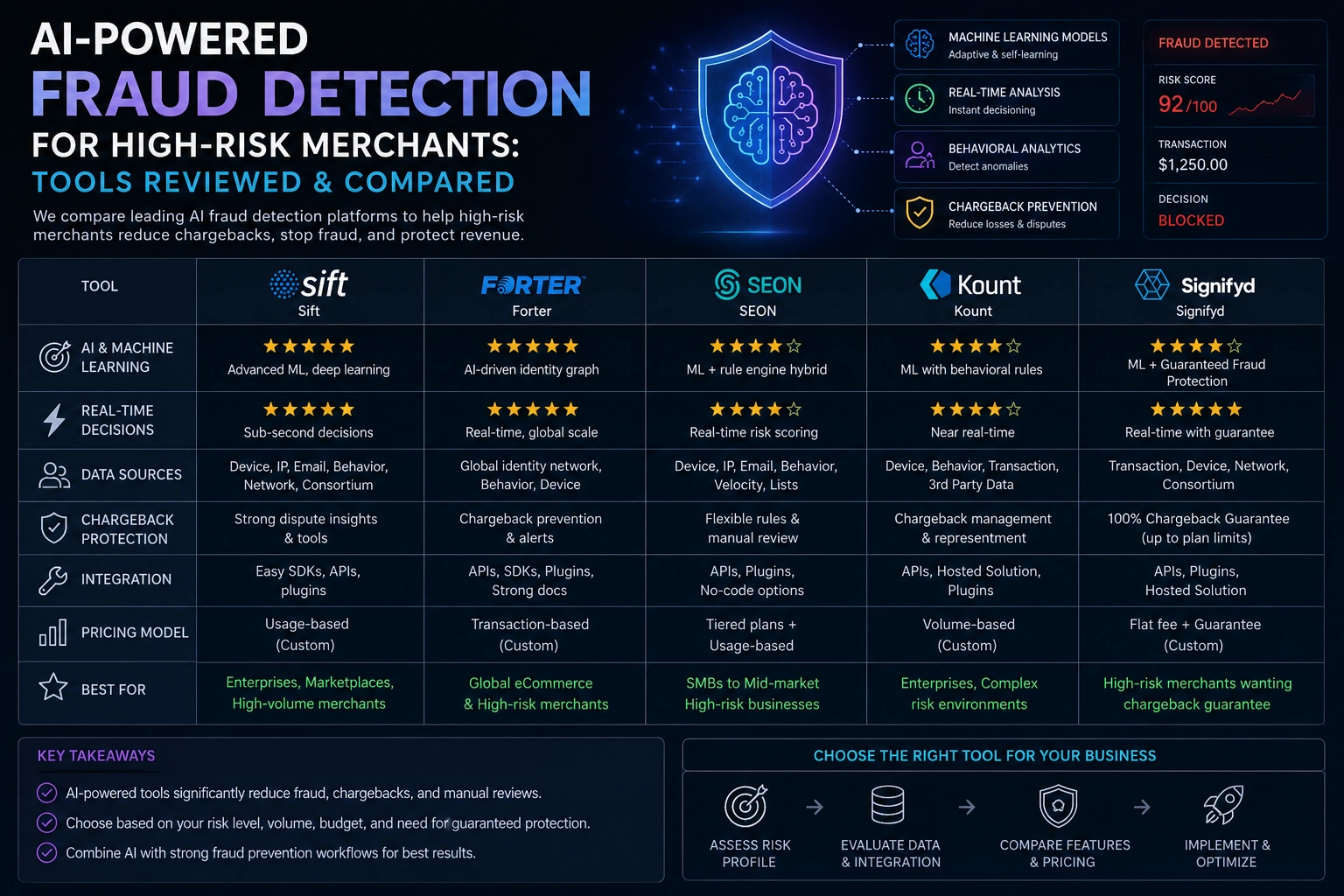
Fraud is the single largest margin threat facing high-risk merchants in 2026, and rule-based detection systems built for standard merchants are not equipped to handle the volume, velocity, or complexity of attacks targeting high-risk verticals. AI-powered fraud detection has become essential infrastructure for payment operators in gaming, forex, adult content, crypto, and nutraceuticals, where fraudsters actively probe for weak points across the entire payment processing stack. This guide reviews and compares the leading tools, focused specifically on what works for high-risk and offshore merchant use cases.
TL;DR
- Global payment fraud losses reached $48.2 billion in 2023 and are projected to exceed $107 billion by 2029, high-risk merchants absorb a disproportionate share
- AI detection tools reduce false positives by up to 70% compared to rule-based systems and catch novel attack patterns in real time
- Top tools for high-risk merchants in 2026: Kount, SEON, Sift, Featurespace, and Sardine
- Key capabilities to prioritise: real-time scoring under 20ms, behavioral biometrics, consortium network intelligence, and chargeback guarantees
- No single tool fits every vertical, match the platform to your specific fraud attack surface and transaction profile
Why High-Risk Merchants Can’t Rely on Standard Fraud Tools
Standard fraud prevention tools are calibrated for low-risk, card-present retail environments. High-risk merchants operate in a fundamentally different threat landscape, higher average transaction values, anonymous buyer bases, cross-border payment flows, and adversaries who invest heavily in bypassing static rule sets.
Global payment fraud losses reached $48.2 billion in 2023 and are projected to exceed $107 billion by 2029 according to the Nilson Report, a 122% increase in six years. High-risk payment verticals account for a disproportionate portion of those losses. Chargeback rates in online gaming, forex, and adult content run 3-5x higher than the industry average, which creates direct pressure on merchant account standing with acquiring banks.
The LexisNexis True Cost of Fraud Report (2024) found that for every $1 lost to fraud, merchants absorb an average of $3.75 in total costs when accounting for fees, operational overhead, and lost goods or services. For high-risk payment operators where margins are already compressed, this multiplier compounds quickly.
Rule-based systems are predictable, and therefore gameable. Fraudsters in 2026 run automated probing scripts specifically designed to identify threshold gaps. AI models trained across hundreds of signals, continuously retrained on new attack data, and capable of detecting behavioral anomalies are the only reliable countermeasure at transaction scale.
How AI Fraud Detection Works in High-Risk Payment Flows
AI fraud detection replaces static rule engines with dynamic scoring models that evaluate each transaction, or each user session, across a wide feature set. The output is a real-time risk score that the payment gateway uses to approve, decline, or route for manual review.
Core AI Techniques Used
Machine learning classifiers: train gradient boosted trees and neural networks on historical transaction data to predict fraud probability. These models retrain continuously as new fraud patterns emerge, meaning they adapt faster than any static rule set.
Behavioral biometrics: analyse how a user types, moves their cursor, interacts on mobile, and navigates a checkout session. Legitimate users exhibit consistent, individualistic patterns, bots and fraudsters deviate measurably from baseline behavior.
Device fingerprinting: builds persistent identifiers from browser attributes, device configurations, IP reputation, and network signals. It detects device spoofing, VPN obfuscation, and profiles matching previously flagged fraudulent devices across the merchant network.
Graph network analysis: maps relationships between accounts, payment instruments, devices, and IP addresses to surface fraud rings, synthetic identity clusters, and coordinated BIN attacks targeting merchant accounts across multiple gateways.
Velocity and sequence modeling: detects anomalous transaction sequences, including rapid card-testing activity characteristic of BIN attack fraud, before a full-scale cashout is attempted.
Top AI Fraud Detection Tools for High-Risk Merchants (2026)
Kount (Equifax)
Kount is one of the most widely deployed AI fraud platforms in high-risk payment environments. Its Omniscore model evaluates over 200 signals per transaction in real time, drawing on a network of more than 32 billion historical data interactions across Equifax’s global merchant base. Kount integrates natively with most major payment gateways and is particularly strong at chargeback reduction for subscription and recurring billing merchants.
Best for: High-volume operators, gaming, nutraceuticals, subscription merchants
Pricing: Custom enterprise contracts; volume-tiered
Chargeback guarantee: Available via Kount Complete
| Pros | Deep consortium network, strong acquiring bank relationships, robust case management and dispute tooling |
| Cons | Complex onboarding process; enterprise pricing is prohibitive for smaller high-risk operators |
SEON
SEON has established itself as a leading fraud prevention platform for fintech and high-risk merchants in Europe and globally, primarily due to its API-first design, transparent pricing, and fast integration timelines. It combines digital footprint analysis (email, phone, and social media enrichment), device fingerprinting, and a rules engine configurable without engineering support. SEON’s real-time scoring typically returns results in under 10ms, fast enough for any high-risk payment processing flow. For offshore merchants where email and phone intelligence carry high signal value, SEON’s enrichment layer is particularly effective.
Best for: Fintech, crypto, iGaming, BNPL; mid-market to scale-up operators
Pricing: From $299/month; per-transaction pricing at volume
Chargeback guarantee: Not offered
| Pros | Transparent pricing, fast API integration, strong documentation, excellent offshore merchant coverage |
| Cons | No chargeback guarantee; smaller consortium network than Kount or Sift at very high volumes |
Sift
Sift’s Digital Trust & Safety platform connects account fraud, payment fraud, and dispute management in a single system. Its ML models are trained on a consortium network of 34,000+ sites processing over 1 trillion events annually, giving it one of the deepest fraud intelligence datasets in the market. Sift is especially effective at detecting account takeover (ATO) fraud, a major attack vector for high-risk merchants with large registered user bases, including gaming platforms and forex operators.
Best for: Marketplaces, gaming platforms, fintech operators; merchants with elevated ATO risk Pricing: Volume-tiered; starts around $1,500/month for mid-market
Chargeback guarantee: Available on Payment Protection
| Pros | Best-in-class ATO detection, deep consortium data, unified payment and account fraud coverage |
| Cons | Premium pricing; implementation requires more engineering resource than lighter-weight tools |
Featurespace (ARIC Risk Hub)
Featurespace’s ARIC Risk Hub is an enterprise-grade fraud detection system built around Adaptive Behavioral Analytics (ABA), a technique that models normal behavior for each individual customer and flags real-time deviations. ARIC is widely deployed by banks and large payment service providers, making it a strong fit for high-risk merchants operating through complex acquirer chains or requiring deep integration with bank-level risk frameworks. Featurespace has documented fraud detection accuracy rates above 95% in production deployments, while significantly reducing false positive rates for legitimate high-value transactions.
Best for: Enterprise-level high-risk operators, PSPs, merchants with complex multi-channel fraud profiles
Pricing: Enterprise contract only; not publicly disclosed
Chargeback guarantee: Configuration-dependent
| Pros | Industry-leading behavioral modeling, strong regulatory compliance alignment, proven at bank scale |
| Cons | Not suitable for small-to-mid-size operators; long implementation and calibration timelines |
Sardine
Sardine is purpose-built for fintech, crypto, and high-risk payment operators, an increasingly rare focus in the fraud detection market. It combines device intelligence, behavioral biometrics, and compliance screening (KYC/AML) in a single API, broader in scope than most standalone fraud tools. Sardine’s onboarding fraud detection is a standout capability, making it particularly valuable for high-risk merchant services platforms that need to screen both merchants and end customers simultaneously. It is one of the few tools built explicitly for digital asset flows.
Best for: Crypto exchanges, neobanks, high-risk payment providers, embedded finance platforms Pricing: Usage-based; enterprise rates available on request
Chargeback guarantee: Not offered
| Pros | Combined fraud and compliance in one API, strong onboarding fraud coverage, built for crypto and high-risk flows |
| Cons | Smaller network dataset than Kount or Sift; no chargeback guarantee |
AI Fraud Detection Tools: Head-to-Head Comparison
| Tool | Best Vertical Fit | Real-Time Scoring | Chargeback Guarantee | Behavioral Biometrics | Network Scale | Pricing Model |
|---|---|---|---|---|---|---|
| Kount | High-volume, subscription | ✓ (<20ms) | ✓ | ✓ | 32B+ events | Enterprise/volume |
| SEON | Crypto, iGaming, fintech | ✓ (<10ms) | ✗ | ✓ | Medium | Transparent/per-tx |
| Sift | Marketplaces, gaming | ✓ (<20ms) | ✓ | ✓ | 1T+ events/year | Volume-tiered |
| Featurespace | PSPs, enterprise | ✓ (<20ms) | Conditional | ✓ | Bank-scale | Enterprise |
| Sardine | Crypto, neobanks | ✓ (<20ms) | ✗ | ✓ | Growing | Usage-based |
What High-Risk Merchants Should Prioritise in a Fraud Tool
Real-time scoring under 20ms: is a non-negotiable baseline. Any latency in the fraud decision introduces checkout friction and drop-off in high-risk payment flows where conversion is already difficult to sustain.
Consortium network depth: separates the top-tier tools from the rest. Platforms drawing on data from tens of thousands of merchants detect novel fraud patterns, including coordinated attacks targeting multiple high-risk gateways simultaneously, faster than isolated deployments operating on first-party data alone.
Vertical-specific calibration: matters more than general accuracy scores. A model tuned for standard ecommerce will produce excessive false positives for gaming or forex operators. Always request a pilot or proof-of-concept using your own transaction data before committing to a full deployment.
Chargeback guarantee availability: changes the risk calculation significantly for high-risk merchants. When the fraud vendor accepts liability for approved fraudulent transactions, the financial exposure of getting a borderline decision wrong shifts to the tool provider, which directly protects merchant account standing with acquirers.
Compliance layer integration: is increasingly important in 2026. Tools like Sardine that combine fraud detection with KYC/AML screening reduce the number of vendor relationships a high-risk merchant services operator needs to manage and keep risk signals consolidated in one system.
Pros and Cons of AI Fraud Detection for High-Risk Operators
Pros
- Reduces false positive rates by up to 70% compared to rule-based systems, recovering approval revenue on legitimate transactions
- Detects novel attack patterns, BIN attacks, ATO fraud, synthetic identity fraud, that static rules cannot identify
- Scales to high transaction volumes without adding manual review overhead
- Chargeback guarantees (Kount, Sift) directly protect merchant account stability with acquiring banks
- Continuous model retraining means detection accuracy improves as new attack data is observed
Cons
- Enterprise platforms (Kount, Featurespace) are cost-prohibitive for smaller high-risk operators
- AI decision opacity, understanding why a legitimate transaction was declined requires dedicated analyst tooling
- Integration complexity varies; Sift and Featurespace require meaningful engineering investment
- No tool achieves 100% detection; a layered strategy combining AI scoring with velocity rules and targeted manual review remains best practice
- Model miscalibration for a new vertical can cause elevated false positives during the initial deployment window
FAQ: AI Fraud Detection for High-Risk Merchants
Can AI fraud tools reduce chargebacks below acquiring bank threshold levels?
Yes – for most high-risk merchants, deploying a well-configured AI fraud tool is the most effective single intervention for chargeback reduction. Kount and Sift both publish case studies showing 40–60% chargeback reductions within 90 days of deployment in high-risk verticals.
Is AI fraud detection required to get a high-risk merchant account?
Not formally required, but many acquiring banks and payment providers now ask merchants to demonstrate a fraud prevention stack during underwriting. A recognised tool in place strengthens the merchant account application and can reduce rolling reserve requirements in some cases.
How well do these tools handle offshore merchant transaction profiles?
Network-based tools like Kount and Sift carry strong cross-border coverage through their consortium data. SEON performs particularly well on offshore merchant use cases because its digital footprint enrichment (email, social, phone signals) is effective regardless of geography, where card-based signals are weaker.
What is a chargeback guarantee and how does it work in practice?
A chargeback guarantee means the fraud platform accepts financial liability for chargebacks on transactions it approved as legitimate. If that transaction results in a verified chargeback, the vendor reimburses the merchant directly. Kount Complete and Sift Payment Protection both offer this model.
Can these tools integrate with high-risk payment gateways?
All five tools reviewed here offer REST API integration and most maintain pre-built connectors for the major payment gateways commonly used in high-risk merchant services environments. SEON and Sift are widely cited for the speed and quality of their integration documentation.
At what transaction volume does AI fraud detection become cost-effective for a high-risk merchant?
As a rule of thumb, the ROI on a dedicated AI fraud tool becomes clearly positive at approximately 5,000–10,000 transactions per month, where fraud-related chargeback costs and false positive revenue losses exceed the platform fee. Transparent-pricing tools like SEON make the calculation straightforward at smaller volumes.
Comments
No comments yet. Be the first to share your thoughts.
Leave a comment