
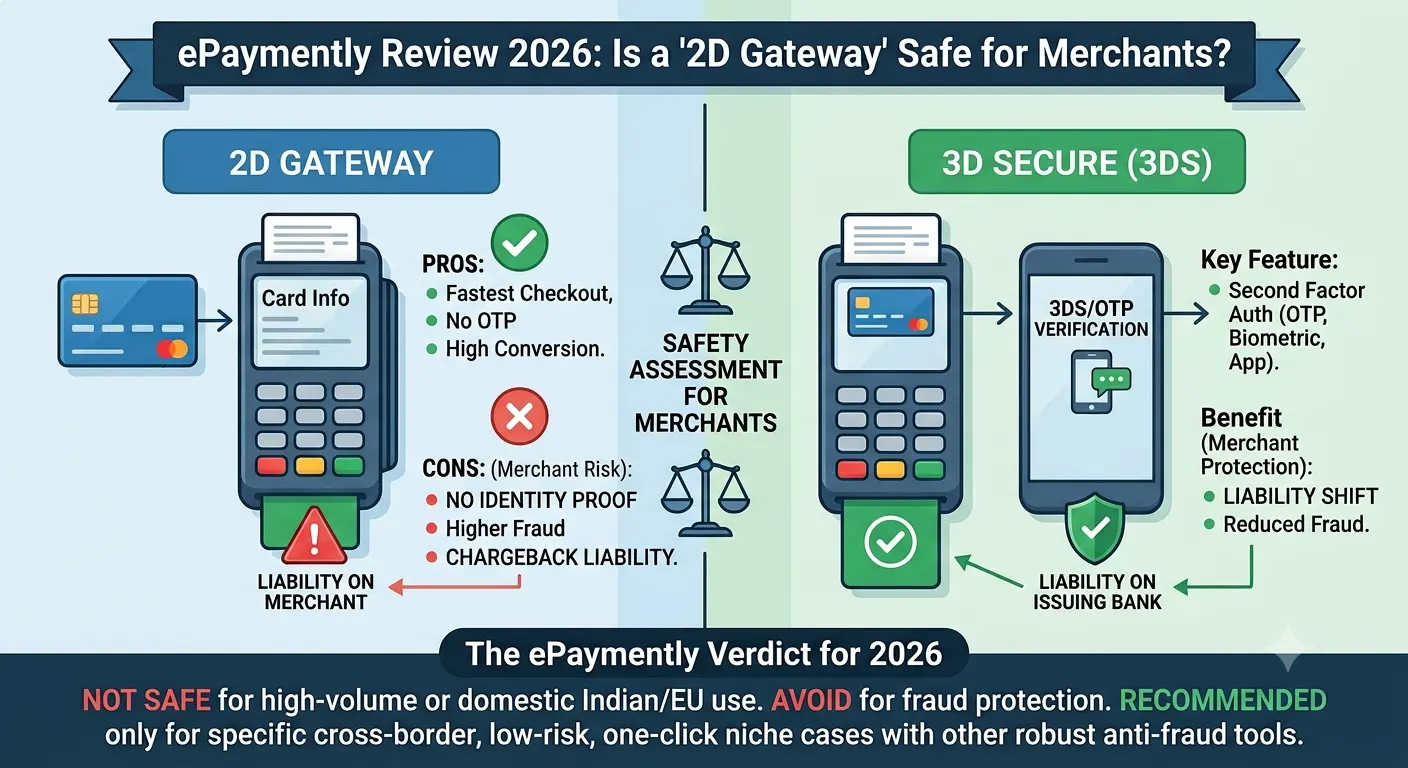
ePaymently markets itself primarily on one proposition, stated in its page title and repeated throughout its site: a “2D Payment Gateway without OTP.” In plain terms, that means card transactions processed without the one-time password step, without 3D Secure authentication.
That single positioning choice shapes this entire review, because it isn’t a neutral technical feature. It determines who bears the cost when a transaction turns out to be fraudulent, and it sits awkwardly against the direction of regulation in most major card markets. This review covers what ePaymently claims, what a merchant is actually buying, and what could be independently verified about the company behind it, which, as it turns out, is very little.
Quick Verdict
ePaymently offers a high-risk-friendly payment gateway whose central selling point is processing card payments without 3D Secure authentication. We could not identify any registered legal entity for ePaymently in any corporate registry, and the only address published on the site, in Romford, England, resolves on Companies House records to the correspondence address of a director of a small IT consultancy, and appears elsewhere as the listed address of a website-traffic and SEO service. No FCA authorisation, no named acquiring partner, no leadership, and no independent merchant reviews of any kind could be found. Several site claims are not credible as written, most notably “unlimited transactions without any account blocking.” Our assessment confidence is Low, and the combination of no verifiable corporate identity with a product built around authentication bypass places this well below the standard a merchant should accept.
| Area | Finding |
|---|---|
| Company identity | No registered legal entity identified; published address ties to an unrelated IT consultancy director (Material Concern) |
| Operating history | Domain content dates to 2024; no founding date, history, or leadership published |
| Regulatory position | No FCA authorisation or any regulatory registration found; no acquiring partner named |
| Merchant reviews | None found on any independent platform |
| Pricing transparency | No rates published; site promises “an unbelievable price” |
| Overall evidence confidence | Low |
What Is a “2D Gateway” – and Why It Matters
Because ePaymently’s entire offer rests on this term, it’s worth being precise about what it means.
A 3D Secure (“3D”) transaction routes the cardholder through an authentication step with their issuing bank, the OTP or app approval most online shoppers now expect. A “2D” transaction skips it: card number, expiry, and CVV only.
The critical consequence is liability. When a properly authenticated 3DS transaction turns out to be fraudulent, liability generally shifts to the card issuer. On a non-authenticated 2D transaction, that liability stays with the merchant. So a merchant choosing a 2D gateway to reduce checkout friction is, in exchange, accepting full financial exposure for fraudulent chargebacks.
There is a second consideration. Strong Customer Authentication is mandatory for most consumer card-not-present transactions in the European Economic Area and the UK under PSD2, and India’s RBI has extended additional-factor authentication requirements to cross-border card-not-present transactions on Indian-issued cards. A gateway whose headline feature is the absence of that authentication is, at minimum, operating in markets or transaction categories where those rules don’t bind, and a merchant needs to know exactly which, because that determines whether their own processing is compliant.
ePaymently’s site does not address liability shift or SCA anywhere we could find. For a provider whose primary product is non-authenticated processing, that omission is significant.
Corporate Identity: What We Found
This is where the review becomes difficult to write charitably.
ePaymently publishes one address: 39 Weald Way, Romford, England, RM7 9PH. No company name, no registration number, no director, no officer. Searching UK Companies House records, that address does not correspond to any registered payment company. It appears in Companies House records as the correspondence address of a director of SRM IT Solutions Ltd (company number 12426997), an IT consultancy incorporated in January 2020 and classified as a micro-entity with under ten employees, whose own registered office is in Reading, Berkshire.
The same Romford address also appears publicly as the listed business address for Webtrafficly, a website-traffic and SEO service. So the single address ePaymently publishes is a residential correspondence address associated with at least two unrelated non-financial businesses, and no payment entity.
We found no company called ePaymently, ePaymently Ltd, or any close variant on the UK register. We found no FCA authorisation or registration. We found no named acquiring bank, no named processor, and no named individual anywhere on the site.
For a business proposing to sit in the flow of merchant funds, this is a Material Concern, not a stylistic omission. A merchant signing with ePaymently would, on the available public information, be unable to identify the legal counterparty to their contract.
Claims That Don’t Hold Up
Several statements on ePaymently’s site warrant direct scrutiny.
“Unlimited transactions without any account blocking:” This is not a promise any gateway can honestly make. Account blocking in card processing is driven by acquiring bank risk decisions, card network monitoring programmes, and chargeback thresholds, none of which a gateway controls. A gateway sits between the merchant and the acquirer; it cannot guarantee the acquirer will never freeze an account. We classify this as a Critical Red Flag in marketing terms, not because it proves misconduct, but because it promises something structurally impossible and a merchant relying on it would be badly misled.
“PCI DSS Level I:” is claimed for the gateway. PCI DSS Level 1 compliance is certified through a Qualified Security Assessor and evidenced by an Attestation of Compliance. No AoC, certificate, QSA name, or certification date appears on the site. This is an unverified claim.
“We guarantee that you will receive our services at an unbelievable price:” No rates, fees, reserve terms, or settlement timings appear anywhere on the site.
Industry list: ePaymently advertises acceptance for verticals including tech support, online pharmacy, adult, online gaming/casino, credit repair, debt collection, and job portals. Several of these, technical support services and online pharmacy in particular, are categories card networks subject to heightened scrutiny precisely because of their historical association with consumer fraud. Advertising them alongside no-OTP processing is a combination worth weighing carefully.
Products and Services
Setting the concerns aside, the advertised product range is conventional for a gateway reseller: 2D and 3D gateway options, merchant accounts, eCheck and ACH, MOTO/virtual terminal, offshore merchant accounts, pay-by-link, recurring payments, chargeback and fraud tools, and a white-label gateway offering. Payment methods listed include cards, UPI, net banking, EMI, BNPL, crypto, and multi-currency support, a mix that suggests an India-oriented feature set alongside international card processing.
We could not independently verify any of these capabilities, integrations, or the existence of a functioning gateway platform, because no technical documentation, API reference, developer portal, or client implementation is publicly available.
Merchant Reviews
We found none. No Trustpilot profile, no forum discussion, no Reddit threads, no independent reviews on any payment directory carrying genuine merchant feedback. For a company whose site has been indexed since at least 2024 and which advertises across multiple verticals, a complete absence of merchant voice is itself notable.
This is not evidence of poor service, it’s an absence of evidence in either direction. But it does mean a prospective merchant has nothing to weigh beyond the company’s own marketing copy, which is precisely the position this kind of due diligence exists to avoid.
Complaints and Red Flags
- No identifiable legal entity anywhere in public records (Material Concern)
- Published address resolves to an unrelated IT consultancy director’s correspondence address and an SEO service (Material Concern)
- “Unlimited transactions without any account blocking”, a structurally impossible guarantee (Critical Red Flag as a marketing claim)
- Core product is authentication bypass, with no disclosure of the merchant liability consequences (Caution)
- Unverified PCI DSS Level 1 claim with no AoC or QSA reference (Caution)
- No named acquiring partner, processor, or leadership (Caution)
- Zero independent merchant feedback (Insufficient Evidence)
To be fair to what the evidence does and does not show: we found no regulatory warning against ePaymently, no enforcement action, no lawsuit, and no documented merchant complaint. Nothing here establishes fraud. What the evidence establishes is that essentially nothing about this company can be independently verified.
Is ePaymently a Scam?
We cannot say that it is, and we won’t. There is no regulator warning, no enforcement record, and no merchant complaint in the public record, and a provider serving high-risk verticals with an unverifiable corporate footprint is not automatically fraudulent.
But the question a merchant should ask isn’t “is this a scam.” It’s “what happens if something goes wrong.” And on the available evidence, a merchant who experiences a withheld settlement, a frozen balance, or a dispute with ePaymently would have no identifiable legal entity to pursue, no regulator to complain to, and no named acquiring bank to escalate through. That is a different and more practical problem than fraud, and it applies regardless of the operator’s intentions.
Who Might ePaymently Be Suitable For?
We are not able to identify a merchant profile for whom we would recommend this provider on the current public evidence. Merchants specifically seeking non-3DS processing should understand that they are accepting full fraud liability and should verify that their transaction profile is lawful in their target markets, and should seek that capability from a provider whose legal entity, regulatory standing, and acquiring relationships can be confirmed.
Alternatives to ePaymently
The relevant comparison isn’t feature-for-feature; it’s whether a provider can answer four questions in writing: what is your legal entity and registration number, who is your acquiring bank, what are your reserve and settlement terms, and where can I find independent merchant feedback. Providers in the high-risk space that answer all four exist, including smaller ISOs with modest review volume but verifiable sponsor-bank relationships. A merchant’s shortlist should start with that filter rather than with advertised features.
Final Verdict
ePaymently’s marketing is built around a product feature, no-OTP card processing, that transfers fraud liability onto the merchant, a consequence the site never mentions. Behind it sits a company we could not identify in any corporate register, at an address belonging to an unrelated IT consultancy director, with no regulatory standing, no named banking partner, no leadership, no verifiable technical documentation, and no merchant reviews anywhere.
What a merchant should do before engaging: request the full legal entity name and company registration number; request the PCI DSS Attestation of Compliance and the assessing QSA; ask which acquiring bank underwrites the merchant account and in which jurisdiction; obtain written reserve, settlement, and termination terms; and ask directly how merchant fraud liability is handled on non-3DS transactions. If those questions can’t be answered with documents, the answer to whether to proceed is straightforward.
Our confidence in this assessment is Low in the sense the framework intends, limited verifiable information exists. But the direction of the available evidence is consistent, and unusually so for this series.
Sources & Methodology
Based on public information reviewed September 2026: ePaymently’s own website (homepage, gateway and white-label pages), UK Companies House records for the published address and associated entities, FCA register searches, and general web search for reviews, forum discussion, and regulatory records. No legal entity, licensing status, acquiring relationship, or PCI certification could be independently confirmed; claims are labelled as company statements throughout.
Comments
No comments yet. Be the first to share your thoughts.
Leave a comment