
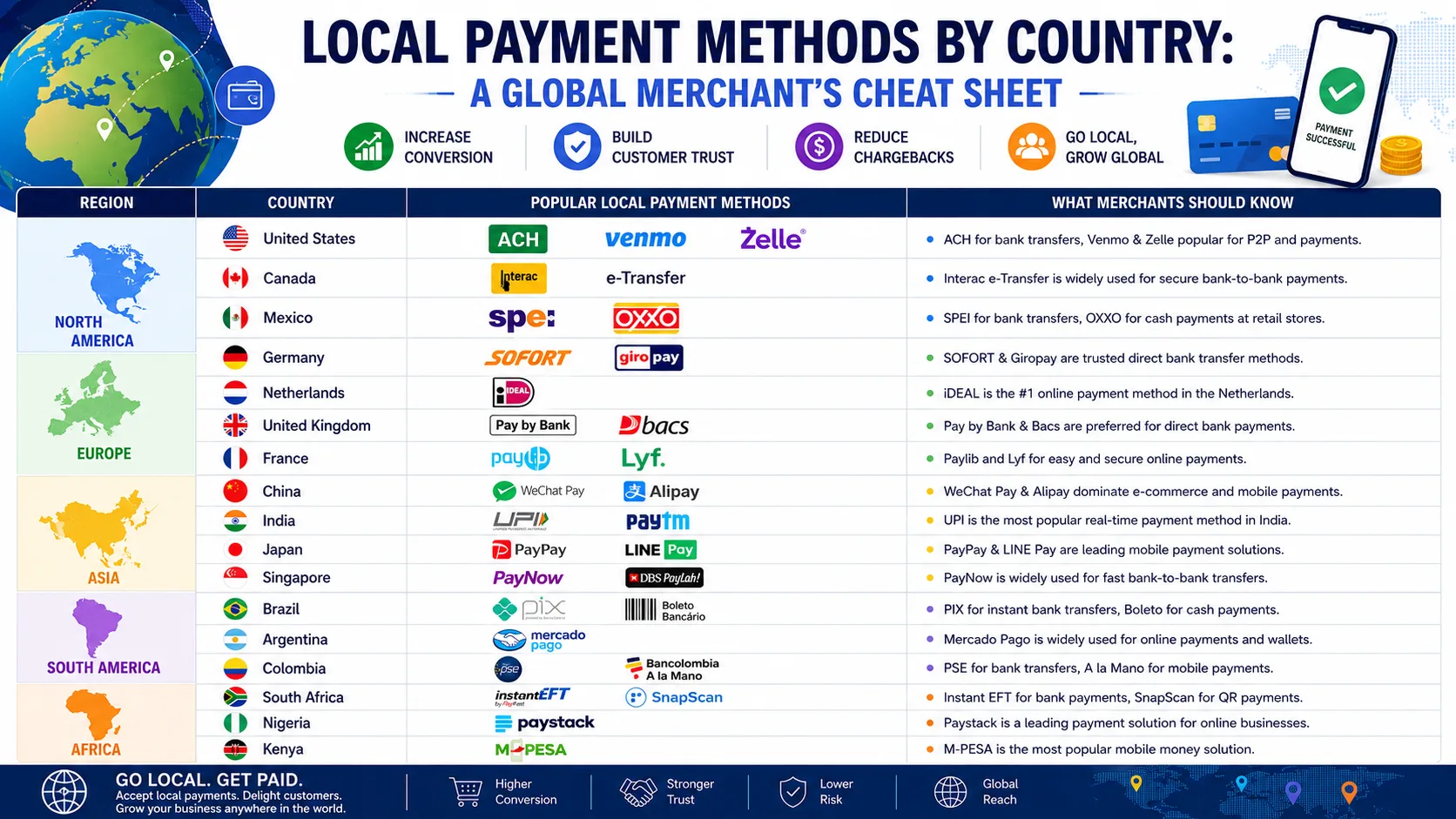
Offer the wrong payment method at checkout and the sale is already gone. In 2026, digital wallets account for over 54% of global e-commerce transactions, but that headline hides a far more granular reality that every merchant expanding internationally needs to understand.
Local payment rails now determine whether a checkout converts or abandons in dozens of major markets. This guide covers every region that matters, with real 2026 data, a clear comparison table, and a practical setup checklist.
TL;DR:
Cards are not the default worldwide. PIX owns 42% of Brazil’s e-commerce, UPI drives 75% of India’s digital payments, and iDEAL processes 70% of Dutch online transactions. Global merchants that ignore local payment methods by country leave conversion, and revenue, on the table.
Why Local Payment Methods Matter in 2026
The shift is structural, not cyclical. UPI processes 13 billion transactions a month in India, and PIX broke 252 million transactions in a single day in Brazil in December 2024. These are not alternative payment methods in the traditional sense, they are the primary payment infrastructure in their home markets.
For merchants, the cost of ignoring local rails goes beyond abandoned carts. Local payment methods like PIX, iDEAL, and UPI typically carry lower transaction fees than international card networks. Getting payment processing right in each market can simultaneously improve conversion rates and reduce the cost per transaction passed through your payment gateways.
The practical challenge is that each method creates different operational questions around settlement, refunds, reporting, and reconciliation. UPI uses app-based intent flows. BLIK uses a code-based mobile confirmation. Boleto generates a cash voucher. Every region demands a different technical and operational posture from your merchant services stack.
Local Payment Methods by Country: Region-by-Region Breakdown
Brazil – PIX, Boleto Bancário, and Parcelamento
Brazil has rebuilt its payment infrastructure faster than any comparable economy. PIX became the most-used option for online shopping in 2025, ending cards’ long-standing dominance, with 42% of total purchase value paid via PIX versus 41% by cards. That gap is widening, PIX is projected to reach 50% of transactions by 2028, compared to 36% for cards.
The full Brazil payment stack that serious merchants need:
- PIX: instant A2A transfers, free for consumers, ~0.1% cost for merchants, 24/7 settlement
- Boleto Bancário: cash voucher redeemable at banks and convenience stores; essential for the roughly 60 million Brazilians without credit cards
- Parcelamento: installment billing across 2-12 months, embedded in card rails; a non-negotiable conversion tool for higher-ticket items
- Payment wallets: Mercado Pago and PicPay are both growing rapidly alongside Apple Pay and Google Pay
A full local payment stack means PIX as the primary option, credit cards with parcelamento, boleto bancário for B2B and unbanked consumers, and digital wallets. None of these layers is optional if you want competitive conversion rates in a $346 billion e-commerce market.
India – UPI, RuPay, and the Hybrid Credit Boom
India’s payment story is about convergence, not displacement. In a country where UPI accounts for 75% of e-commerce volume, local card schemes have embedded themselves into the same UPI rails, allowing real-time transactions to draw directly on credit limits.
The result: RuPay holds 33% of the Indian card market, ahead of Mastercard (20%) and AmEx (4%), trailing only Visa at 43%. Local cards are not losing, they are growing at a CAGR of 23% through 2028 by riding UPI infrastructure.
Key methods for India:
- UPI: QR or app-based A2A transfers, dominant for online payments processing
- RuPay: domestic card scheme with deep UPI integration; essential for your payment gateways configuration
- UPI Autopay: recurring billing via UPI; critical for SaaS and subscription businesses
Europe – iDEAL, SEPA, Bancontact, and Cartes Bancaires
Europe is the most fragmented region for local payment methods by country. No single method covers the continent. Merchants need market-by-market configuration.
| Country | Dominant Method | Share |
|---|---|---|
| Netherlands | iDEAL (bank transfer) | ~70% of online transactions |
| Belgium | Bancontact | Majority of domestic card payments |
| France | Cartes Bancaires | 71M cards in circulation |
| Germany | PayPal / wallets | ~77% of online transactions |
| Poland | BLIK | 420M+ transactions in 2024 |
| EU-wide | SEPA Instant | Sub-10-second cross-border transfers |
In the Netherlands, iDEAL processes 70% of online transactions. Building a checkout without it guarantees abandonment. SEPA Instant is increasingly the backbone for cross-border payments within the EU, offering settlement in under 10 seconds at near-zero cost for merchants using direct bank integrations.
The EU’s PSD3 framework is adding strong customer authentication requirements that will reshape how payment gateways handle European online payments through 2026 and beyond.
Southeast Asia – GCash, GrabPay, and Regional Wallets
Southeast Asia is mobile-first but deeply fragmented. Each country runs on a different dominant wallet, with minimal cross-border interoperability:
- Philippines: GCash leads digital payments with rapid ecosystem expansion
- Indonesia: GoPay, OVO, and DANA compete for wallet dominance
- Malaysia: Touch ‘n Go eWallet and DuitNow for A2A transfers
- Singapore: PayNow (A2A) alongside strong card adoption
- Vietnam/Thailand: stablecoin adoption is rising; more than 15% of the population in Vietnam and Thailand already owns digital currencies.
The operational challenge in Southeast Asia is that each market may require different wallet providers, bank integrations, settlement processes, and refund rules. A single-gateway setup will almost certainly underperform across this region.
Africa – M-PESA and Mobile Money Infrastructure
Africa’s payment infrastructure is built on mobile money, not card networks. In parts of Africa and Asia, mobile money accounts let users pay via SMS on feature phones, growing 12% annually. M-PESA in Kenya and East Africa is the most developed example, serving both urban and rural populations through basic mobile connectivity.
For merchants entering African markets, card acceptance alone is structurally insufficient. Integrating M-PESA, OPay (Nigeria), and Capitec Pay (South Africa) is not a differentiation strategy, it is the baseline for reaching most of the consumer base.
China – Alipay and WeChat Pay
China is effectively a two-wallet market. Alipay and WeChat Pay collectively account for roughly 85% of digital payments volume. International card acceptance is limited in domestic commerce. For cross-border payments into China from international merchants, the practical route is integration through a licensed payment provider with direct access to both wallet ecosystems.
Local vs. International Payment Methods: Quick Comparison
| Factor | Local Methods (PIX, UPI, iDEAL) | International Cards (Visa/Mastercard) |
|---|---|---|
| Transaction fees | Very low (0-0.3%) | 1.5-3.5% |
| Settlement speed | Seconds (real-time rails) | T+1 to T+2 |
| Consumer trust | Extremely high (home market) | Variable |
| Cross-border reach | Limited (domestic) | Global |
| Chargeback exposure | Low (irrevocable transfers) | Higher (dispute rights) |
| Integration complexity | High (market-by-market) | Low (single integration) |
| Conversion impact | High lift in home markets | Stable but lower locally |
Pros and Cons of Prioritizing Local Payment Methods
Pros:
- Higher checkout conversion in each target market
- Lower processing costs versus international card interchange
- Near-instant settlement on real-time rails (PIX, UPI, SEPA Instant)
- Reduced chargeback exposure on A2A transfers
- Access to unbanked and underbanked consumer segments
Cons:
- Significant integration complexity per market
- No global interoperability (yet) between domestic rails
- Refund and reconciliation workflows differ by method
- Settlement currency risk on local rails in volatile markets
- Requires ongoing compliance monitoring per jurisdiction
High-Risk Payment Gateways and Local Methods: 2026 Update
For high-risk merchants, operating in iGaming, crypto, nutraceuticals, adult platforms, forex, or subscription billing, the intersection of local payment methods and high-risk payment gateway infrastructure is a critical 2026 challenge.
In 2026, payment performance for high-risk merchants is tied more closely than ever to real-time risk controls and regional fragmentation. Emerging markets in LATAM and APAC are adopting local instant payment rails such as PIX and UPI that traditional single-gateway setups often struggle to support efficiently.
The result is that high-risk merchants expanding globally need multi-gateway routing architecture, not just a single high-risk payment gateway. Single-gateway setups create a critical single point of failure. If the processor experiences an outage or freezes the account for a sudden compliance review, transaction processing stops immediately.
The 2026 operational requirements for high-risk merchants processing across local rails:
- Multi-acquirer routing: transactions routed by geography and method performance, not static rules
- AI-driven fraud scoring: essential because fraud patterns on local rails differ from card fraud
- PSD3 compliance: EU strong customer authentication requirements apply even to local method integrations for high-risk categories
- Rolling reserve management: typically 5-10% withheld; local method settlement timing must be factored into cash flow modeling
- Offshore acquiring relationships: for jurisdictions where domestic acquiring is unavailable to high-risk verticals
Merchants in high-risk categories must work with specialized providers that offer fraud mitigation, chargeback handling, and custom risk tolerance models. Providers that also support local payment methods across LATAM, APAC, and Europe are the rarest, and most valuable, tier of the market.
How to Choose a Payment Gateway That Supports Local Methods
When evaluating payment providers for a global merchant account setup, these are the functional checkpoints that matter most:
- Local method coverage: does the gateway natively support the rails required in each target market, or only via third-party aggregators?
- Settlement currency and timing: what is the actual settlement path for PIX, UPI, and iDEAL settlements into your operating currency?
- Reconciliation infrastructure: can the dashboard reconcile across multiple payment methods and currencies in a single reporting view?
- Compliance posture: does the provider handle PSD3, PCI DSS Level 1, and AML requirements across the jurisdictions you need?
- Routing logic: for high-volume merchants, can the gateway apply dynamic routing rules that favor local methods where they improve approval rates?
Payment orchestration platforms, which connect to multiple PSPs, acquirers, and local rails through a single API integration, are becoming the standard infrastructure for merchants operating across more than two or three markets.
FAQ: Local Payment Methods by Country
Q: What are local payment methods?
Local payment methods are payment systems that operate within a specific country or region, built for domestic consumer preferences. Examples include PIX (Brazil), UPI (India), iDEAL (Netherlands), and M-PESA (Kenya). They sit outside the standard Visa/Mastercard rails.
Q: Why do local payment methods matter for global merchants?
Offering a local payment method in a target market directly increases checkout conversion. Consumers are significantly more likely to complete a purchase when they see a familiar, trusted payment option. In markets like Brazil and India, not supporting the dominant local rail means competing with one hand tied behind your back.
Q: Are local payment methods cheaper to process than cards?
Generally yes. PIX, UPI, and iDEAL carry transaction costs of near-zero to 0.3%, compared to 1.5-3.5% for international card networks. For high-volume merchants, routing to local rails in home markets materially reduces payment processing costs.
Q: Can high-risk merchants access local payment methods?
Yes, but with additional complexity. High-risk merchants need specialized payment gateways with multi-acquirer architecture and local method integrations. Standard gateways frequently exclude high-risk categories. Providers that combine high-risk merchant account underwriting with local rail access across LATAM, APAC, and Europe represent a distinct and more capable tier of the market.
Q: How do I integrate multiple local payment methods without rebuilding my checkout each time?
Payment orchestration platforms allow merchants to connect to multiple PSPs, local rails, and acquirers through a single API layer. Routing rules can then surface the right method per market, iDEAL for Dutch buyers, PIX for Brazilian buyers, UPI for Indian buyers, without separate checkout builds per country.
Q: What is the fastest-growing local payment method in 2026?
By transaction volume growth, PIX Automático (Brazil’s recurring PIX feature) is one of the fastest-growing rails globally, growing 41% month-on-month since its June 2025 launch. UPI Autopay is expanding rapidly in India, particularly for SaaS and subscription billing use cases.
Key Takeaways for Global Merchants
Winning at cross-border payments in 2026 is not about finding a single global payment gateway — it is about building market-specific payment stacks on top of a unified orchestration layer. The merchants gaining ground are those who treat local payment methods as infrastructure, not add-ons.
Explore TheFinRate’s payment gateways comparison guide and high-risk payment gateway directory to find providers that support the local rails your target markets require.
Comments
No comments yet. Be the first to share your thoughts.
Leave a comment