
TL;DR
- Global cross-border payment volume reached an estimated $212 trillion in 2026 and is projected to hit $290 trillion by 2030, driven by e-commerce expansion into LATAM, Southeast Asia, and Africa.
- Local acquiring meaningfully improves authorization rates, North America and Europe see 91% approval with local acquiring versus 84% without, but the gap widens sharply in emerging markets: Africa drops from 79% to just 49% without it.
- Merchants who don’t support local payment methods see cart abandonment rise by 30-40% in markets like Brazil, Mexico, and Indonesia.
- Generalist payment providers typically charge 1.0-2.5% in FX markup on cross-border transactions, specialist providers with local settlement can cut this materially.
- High-risk merchants face an added layer of cross-border complexity in 2026, including FATF Travel Rule and MiCA compliance for crypto-linked settlement, on top of standard PSD2/SCA and RBI requirements.
Why Cross-Border Payments Are a Distinct Challenge
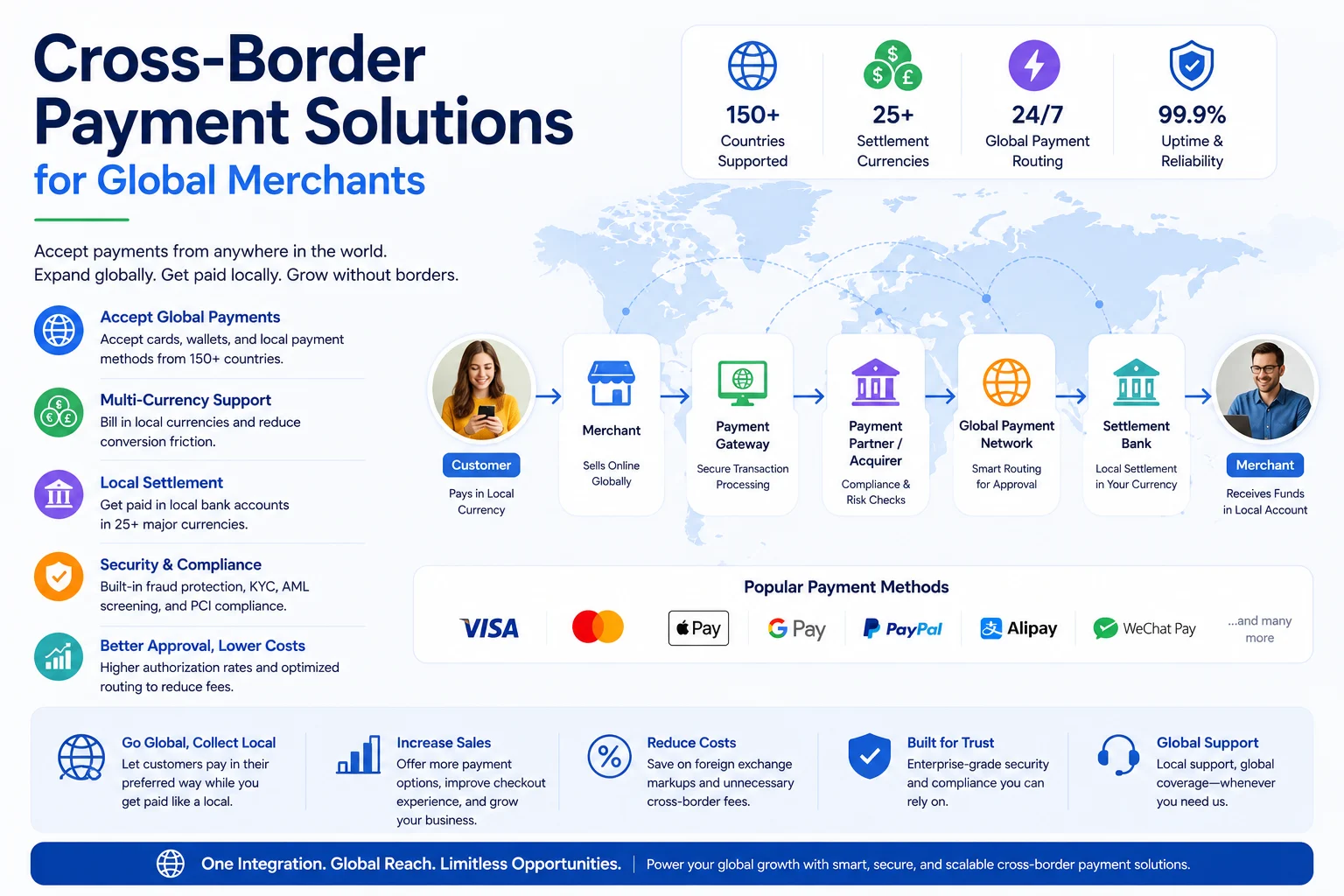
Accepting payments from customers in your home market and accepting payments from customers in Brazil, India, or Indonesia are not the same problem with a currency symbol changed. Cross-border payments introduce three compounding variables that don’t exist in domestic processing: currency conversion, local payment method coverage, and jurisdiction-specific regulation. Get any one of these wrong and the cost shows up as a declined transaction, an abandoned cart, or a compliance flag, not as a line item you can easily trace back to its source.
The Three Pillars of Cross-Border Payment Infrastructure
1. Local Acquiring
Local acquiring means routing a transaction through an acquiring bank physically located in the customer’s country, rather than processing it as an international transaction through your home-market acquirer. The impact on authorization rates is substantial and grows with market complexity.
In North America and Europe, markets with mature, interoperable card networks, local acquiring lifts authorization rates from 84% to 91%, a meaningful but modest gain. The gap widens considerably in emerging markets. In Southeast Asia, local acquiring improves authorization from 58% to 85%. In Africa, the uplift is the largest of any region: from 49% without local acquiring to 79% with it. Issuing banks in many emerging markets are simply more likely to decline a transaction that arrives flagged as cross-border or international, regardless of whether it’s legitimate, local acquiring removes that flag.
2. Local Payment Method (LPM) Coverage
Card payments are not the dominant payment method in most of the world’s fastest-growing e-commerce markets. Merchants relying solely on Visa and Mastercard rails are invisible to a meaningful share of potential customers in these regions.
- Brazil: PIX, the instant payment system run by the Central Bank, now accounts for the majority of online checkout volume.
- Mexico: OXXO Pay, a cash-voucher system redeemable at convenience stores, remains essential despite rising card penetration.
- India: UPI (Unified Payments Interface) dominates digital payments, with deep integration across nearly every Indian bank and wallet app.
- Indonesia: GoPay and other e-wallet platforms lead checkout volume, reflecting high mobile-first adoption.
- Netherlands: iDEAL is the default checkout method, with most Dutch banks integrated directly.
- China: Alipay and WeChat Pay together cover the overwhelming majority of Chinese cross-border e-commerce buyers.
Merchants without local payment method support in these markets see cart abandonment rise by an estimated 30- 40%, since customers without a card, or without trust in entering card details on a foreign-looking checkout, simply leave.
3. Multi-Currency Settlement
The third pillar is how funds actually move once a cross-border transaction is approved. Standard processing converts the customer’s payment into the merchant’s home currency immediately, often at a marked-up rate. Multi-currency settlement accounts let a merchant receive and hold funds in the currency the customer paid in, converting only when, and if, they choose to, at a time and rate of their selection.
Generalist payment providers typically charge an FX markup of 1.0-2.5% on top of the mid-market exchange rate for currency conversion. Specialist cross-border providers with local settlement infrastructure often reduce this materially, since they avoid the double-conversion that happens when a generalist provider routes funds through an intermediary currency before reaching the merchant’s home currency.
How to Choose a Cross-Border Payment Solution
The right setup depends heavily on how concentrated your international volume is and which markets matter most.
If cross-border volume is under 10% of total revenue: a generalist PSP with basic multi-currency support is usually sufficient, the cost of specialist infrastructure won’t be justified by the volume yet. Revisit this as international volume grows.
If cross-border volume is a meaningful and growing share (10-30%): prioritize a provider offering local acquiring in your top two or three international markets and native support for the dominant local payment method in each. This is the point where authorization rate gains start to materially outweigh the cost of switching providers.
If international markets are central to your business model (30%+): work with a cross-border payment specialist, providers built specifically around local acquiring networks and LPM coverage across LATAM, Southeast Asia, Africa, or the Middle East. These providers maintain direct banking relationships in-market rather than routing everything through a single international rail, which is the structural reason they outperform generalist PSPs at scale.
For high-risk merchants expanding internationally: cross-border complexity compounds with the underwriting challenges already covered in our high-risk merchant account guide. Few generalist cross-border providers accept high-risk MCCs at all, most high-risk merchants going cross-border need a specialist high-risk acquirer with multi-currency settlement capability, rather than treating cross-border and high-risk as two separate problems to solve with two separate providers.
Compliance Considerations for Cross-Border Merchants in 2026
Cross-border payment processing triggers regulatory obligations that don’t apply to purely domestic transactions, and several of these have evolved meaningfully over the past year.
- PSD2 and Strong Customer Authentication (SCA): European cross-border transactions require two-factor authentication under PSD2, enforced through 3DS2. Merchants without proper exemption-routing logic see higher friction and lower conversion on EU-bound transactions.
- RBI guidelines (India): India’s central bank imposes data residency and licensing requirements on payment providers operating in-country, which has driven a wave of local-partnership models among international PSPs seeking to serve Indian customers compliantly.
- FATF Travel Rule: Applies to cross-border transactions involving crypto-linked settlement, requiring originator and beneficiary information to be shared between payment providers above defined thresholds.
- MiCA (Markets in Crypto-Assets): The EU’s crypto regulatory framework affects merchants settling cross-border payments in stablecoins, with licensing and disclosure requirements that specifically apply to e-money tokens used in payment flows.
- Sanctions and AML screening: Cross-border transactions are screened against international sanctions lists at multiple points in the chain; merchants operating in higher-risk corridors should confirm their provider’s screening coverage extends to all relevant jurisdictions, not just their home market.
For high-risk merchants, these requirements layer on top of the VAMP and CE3.0 chargeback monitoring obligations covered in our payment processing guide, meaning a high-risk merchant processing cross-border crypto-linked subscription payments, for example, is managing compliance across several overlapping frameworks simultaneously.
Pros and Cons: Cross-Border Payment Expansion
Advantages of building proper cross-border infrastructure:
- Materially higher authorization rates, particularly in emerging markets where the local-acquiring gap is largest
- Access to LPM-dependent markets that are otherwise effectively closed to card-only merchants
- Reduced FX costs through multi-currency settlement versus repeated currency conversion
- Diversified revenue base, reducing dependency on any single market’s economic conditions
Disadvantages and friction points:
- Specialist cross-border providers typically require higher minimum volumes or longer onboarding than generalist PSPs
- Compliance overhead multiplies with each new jurisdiction, PSD2, RBI, FATF, and MiCA can all apply simultaneously to a single merchant
- Multi-currency settlement requires more sophisticated treasury management than single-currency operations
- High-risk merchants face a narrower set of viable providers, since most cross-border specialists don’t underwrite elevated-risk MCCs
Frequently Asked Questions
What is local acquiring and why does it matter for cross-border payments?
Local acquiring routes a transaction through an acquiring bank based in the customer’s country rather than the merchant’s home market. It significantly improves authorization rates because issuing banks are more likely to decline transactions flagged as international, regardless of legitimacy.
Which local payment methods should merchants prioritize?
This depends on target markets, but the highest-impact methods in 2026 are PIX in Brazil, OXXO Pay in Mexico, UPI in India, GoPay in Indonesia, iDEAL in the Netherlands, and Alipay/WeChat Pay for Chinese cross-border buyers.
How much does currency conversion cost on cross-border payments?
Generalist payment providers typically charge 1.0-2.5% above the mid-market exchange rate. Specialist cross-border providers with local settlement infrastructure can reduce this by avoiding double currency conversion.
Do high-risk merchants face additional challenges with cross-border payments?
Yes. Most generalist cross-border payment providers do not underwrite high-risk MCCs, meaning high-risk merchants typically need a specialist high-risk acquirer with cross-border and multi-currency capability, rather than separate domestic and international providers.
What compliance requirements apply to cross-border payment processing?
Depending on the markets involved, merchants may need to comply with PSD2/SCA in Europe, RBI data residency rules in India, the FATF Travel Rule for crypto-linked settlement, and MiCA for stablecoin-based payment flows in the EU.
Is it worth supporting local payment wallets if most of my customers still use cards?
In markets where a significant share of online shoppers don’t use cards at all, Brazil, Indonesia,online and India among them, yes. The 30-40% cart abandonment increase tied to missing local payment methods typically outweighs the integration cost once cross-border volume in that market becomes meaningful.
Comments
No comments yet. Be the first to share your thoughts.
Leave a comment