
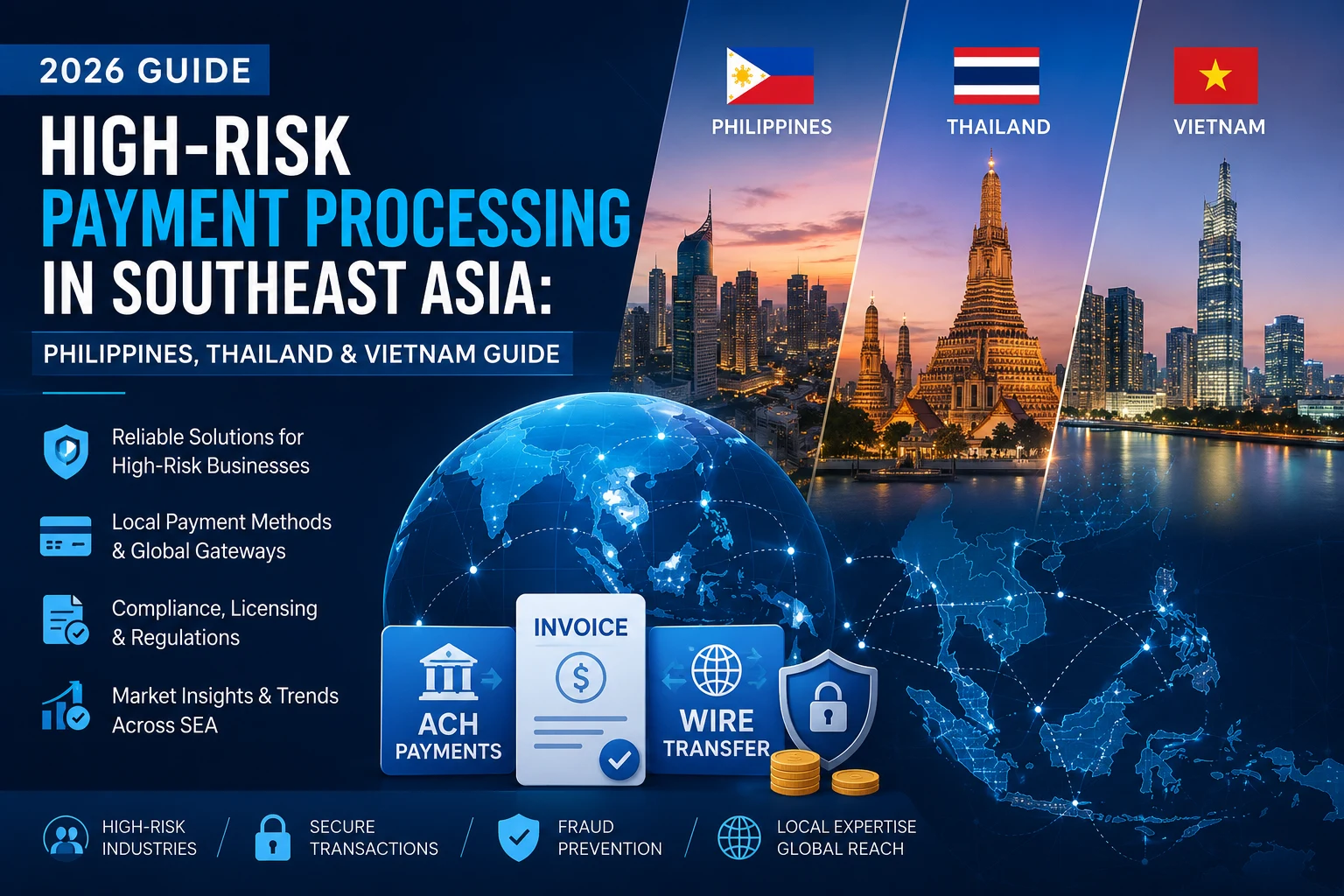
Southeast Asia is one of the fastest-growing digital payments markets in the world, but it’s also one of the most fragmented, regulated, and structurally complex regions for high-risk merchants. Whether you’re operating an online gaming platform, a nutraceutical e-commerce brand, a forex brokerage, or a subscription SaaS, setting up reliable payment processing across the Philippines, Thailand, and Vietnam demands a fundamentally different playbook than Western markets.
In 2026, the region’s combined digital payments market is projected to exceed $1.1 trillion in total payment value (Google/Temasek e-Conomy SEA Report, 2025). But regulatory divergence across ASEAN member states means that a solution that works in Manila may be unworkable in Bangkok or Ho Chi Minh City.
This guide covers the essentials: regulations, local payment methods, merchant account options, and the best payment providers for high-risk verticals in each market.
Southeast Asia High-Risk Payment Market Overview
Before diving into individual markets, it’s worth understanding the regional landscape.
Digital Payments Growth: Philippines, Thailand & Vietnam (2023–2026E)
| Market | 2023 Digital Payment Value | 2026E Value | CAGR |
|---|---|---|---|
| Philippines | $38B | $67B | ~21% |
| Thailand | $72B | $115B | ~17% |
| Vietnam | $44B | $82B | ~23% |
Sources: Google/Temasek e-Conomy SEA 2025, Statista 2025
High-risk verticals with significant SEA presence include:
- Online gaming and gambling: Large grey-market operations in PH and VN
- Forex and crypto trading: Thailand and Vietnam have active retail investor bases
- Nutraceuticals and supplements: Fast-growing e-commerce sector across all three markets
- Travel and accommodation: High chargeback exposure post-COVID recovery
- Adult content platforms: Offshore-licensed, primarily PH-based
Philippines: High-Risk Payment Processing Guide
Regulatory Environment
The Bangko Sentral ng Pilipinas (BSP) oversees payment system regulation under the National Payment Systems Act (NPSA, 2019). In 2024, the BSP expanded its Payment System Operator (PSO) licensing framework, creating clearer pathways for fintech and payment gateway operators.
For high-risk merchants:
- Online gambling is regulated: by PAGCOR (Philippine Amusement and Gaming Corporation). Licensed operators (including POGOs, Philippine Offshore Gaming Operators) require BSP-compliant payment processing
- Offshore merchants incorporated: outside the Philippines can process PH-based transactions but must use a locally licensed payment service provider or international provider with BSP passporting
- Cryptocurrency exchanges must register: with the BSP under the Virtual Asset Service Provider (VASP) framework
Local Payment Methods
High-risk merchants targeting Philippine consumers must support:
| Payment Method | Market Penetration | Use Case |
|---|---|---|
| GCash | 70M+ registered users | Consumer payments, gaming top-ups |
| Maya (PayMaya) | 50M+ users | E-commerce, digital goods |
| InstaPay / PESONet | Universal bank coverage | B2B, subscription billing |
| OTC (7-Eleven, Cebuana) | High cash-to-digital | Unbanked/underbanked consumers |
| Visa/Mastercard | 35% cardholder penetration | Cross-border, high-value purchases |
GCash and Maya are non-negotiable for consumer-facing high-risk merchants in the Philippines. Without these integrations, merchants miss a majority of the addressable market.
Top Payment Providers for High-Risk Merchants in the Philippines
- PayMongo: Local PSO, supports e-commerce, limited high-risk eligibility; best for standard verticals
- Xendit: Strong SEA coverage, high-risk support on select verticals (travel, fintech, gaming-adjacent)
- Dragonpay: OTC and e-wallet aggregator; widely used for gaming and digital goods
- Paynamics: Full-stack merchant services provider, BSP-licensed, supports higher-risk verticals
- 2C2P: Regional player with PH operations; strong for cross-border and subscription billing
Rolling reserve norms in PH: 5–10%, 90–180 days for high-risk merchants. Chargeback threshold: BSP recommends maintaining below 1%.
Thailand: High-Risk Payment Processing Guide
Regulatory Environment
Thailand’s Bank of Thailand (BOT) and the Electronic Transactions Development Agency (ETDA) jointly govern digital payments. Thailand operates a strict Payment Systems Act (2017) framework with significant amendments in 2024 targeting crypto, cross-border payments, and e-money licensing.
Key points for high-risk merchants:
- Online gambling is illegal in Thailand under the Gambling Act. This makes Thai domestic processing for gambling verticals effectively impossible through licensed channels
- Forex trading is regulated by the Securities and Exchange Commission (SEC). Offshore forex brokers serving Thai retail investors operate in a grey zone, many use offshore merchant accounts in Cyprus, Malta, or Labuan (Malaysia)
- Crypto trading is legal but exchanges must be licensed by the SEC. The BOT maintains restrictions on using crypto for payments
Thailand’s PromptPay system has become the dominant retail payment rail, with over 72 million registered users as of 2025, exceeding the country’s adult population (BOT, 2025).
Local Payment Methods
| Payment Method | Coverage | High-Risk Suitable |
|---|---|---|
| PromptPay | 72M+ users | Yes (via licensed PSPs) |
| TrueMoney Wallet | 14M+ users | Yes (gaming, e-commerce) |
| Rabbit LINE Pay | 11M+ users | Limited |
| Kasikorn/SCB bank transfers | Universal | Yes (B2B) |
| Visa/Mastercard | 45% penetration | Yes |
Top Payment Providers for High-Risk Merchants in Thailand
- 2C2P: Headquartered in Bangkok; one of the strongest regional high-risk-capable providers; supports PromptPay, QR codes, cards
- Omise (Opn Payments): Developer-friendly; strong local card acquiring; limited high-risk support
- GHL Systems: POS and e-commerce; selective on verticals
- Asiapay: Cross-border specialists; strong for forex and international subscription billing
- Paymentwall: Global platform with Thailand support; handles digital goods, gaming, and subscriptions
For offshore forex and gaming operators targeting Thai users, the standard approach is a combination of: offshore merchant account (Malta/Cyprus entity) + local bank transfer collection via a PSP with BOT compliance coverage.
Vietnam: High-Risk Payment Processing Guide
Regulatory Environment
Vietnam’s State Bank of Vietnam (SBV) regulates payment services under Decree 101/2012 and its amendments. In 2024, the SBV published a new sandbox framework for fintech payment companies, and several domestic e-wallets received upgraded licenses.
High-risk context:
- Online gambling is illegal in Vietnam (with a limited pilot for licensed domestic operators)
- Forex trading by retail investors is heavily restricted; most activity flows through offshore broker accounts
- Crypto is not recognized as a legal payment instrument; the SBV has issued multiple warnings against crypto transactions
- Cross-border payments require SBV-licensed intermediaries, a major compliance requirement for offshore merchants
Vietnam is notable for its high cash dependency despite rapid digital growth. As of 2025, cash-on-delivery (COD) still accounts for approximately 35% of e-commerce transactions (SBV Annual Report, 2025), though this is declining rapidly.
Local Payment Methods
| Payment Method | Registered Users | Market Role |
|---|---|---|
| MoMo | 35M+ | Dominant super-app wallet |
| ZaloPay | 16M+ | Zalo ecosystem integration |
| VNPay | Bank transfer aggregator | B2B, e-commerce |
| VietQR | QR-based bank transfer | Universal, low-cost |
| Visa/Mastercard | ~18% cardholder rate | International/cross-border |
MoMo is the critical integration for any consumer-facing high-risk merchant in Vietnam. Its penetration among urban consumers aged 18–35 exceeds 60%.
Top Payment Providers for High-Risk Merchants in Vietnam
- OnePAY: SBV-licensed; strong for domestic e-commerce; selective on high-risk verticals
- VNPay: Market leader for bank transfers and QR payments; limited high-risk eligibility
- Napas: Domestic interbank network; primarily for licensed entities
- 2C2P: Regional platform with VN presence; best cross-border option for high-risk
- Paymentwall: Global platform; handles gaming, digital goods, and nutraceuticals for VN-targeted campaigns
For high-risk operators targeting Vietnamese consumers from offshore structures, the typical setup involves: offshore acquiring + domestic e-wallet collection via an authorized VN PSP + local entity for compliance.
Cross-Market Comparison: Philippines vs Thailand vs Vietnam
| Factor | Philippines | Thailand | Vietnam |
|---|---|---|---|
| Gambling regulation | Licensed (PAGCOR) | Illegal | Illegal (with pilots) |
| Crypto regulation | VASP licensed (BSP) | SEC licensed | Not recognized |
| Forex regulation | Partial | SEC regulated | Heavily restricted |
| Dominant wallet | GCash | PromptPay | MoMo |
| Offshore merchant viability | High | Medium (via offshore structures) | Medium (with PSP partnership) |
| Average high-risk processing rate | 3.5 – 5.5% | 3 – 5% | 3.5 – 6% |
| Rolling reserve (typical) | 5 – 10% | 5 – 10% | 7 – 10% |
| Chargeback threshold | 1% (BSP guideline) | 1% (BOT guideline) | 0.75% (SBV guideline) |
Key Considerations for High-Risk Merchants Entering SEA
1. Entity Structure Matters: Offshore merchants should strongly consider a local entity in the Philippines for gambling-adjacent or digital goods verticals. The BSP’s licensing framework is more permissive than Thailand or Vietnam.
2. Multi-Wallet Integration Is Non-Negotiable: Any merchant expecting consumer volume across all three markets needs GCash (PH), PromptPay (TH), and MoMo (VN) integrations. Card-only processing leaves 40–60% of addressable revenue on the table.
3. Chargeback Management Is Stricter in SEA: Vietnam’s 0.75% chargeback threshold is among the lowest in Asia. High-risk merchant services providers in VN will terminate accounts faster than equivalents in the US or Europe.
4. Leverage Regional PayFac Providers: Platforms like 2C2P, Xendit, and Paymentwall operate across all three markets and offer a single integration point, critical for merchants who don’t want to manage three separate payment gateway integrations.
5. Plan for Regulatory Change: All three markets are updating their payment regulations in 2025–2026. Vietnam’s crypto framework, Thailand’s PSA amendments, and the Philippines’ VASP regulations are all active areas of change. Build compliance review cycles into your operational calendar.
Frequently Asked Questions
Q: Can an offshore merchant process payments in the Philippines without a local entity? Yes, via a BSP-licensed payment service provider. The PSP acts as the licensed intermediary. However, for gambling or gaming verticals, a PAGCOR or PSO license is required.
Q: Is PromptPay available to international merchants?
PromptPay is a domestic Thai payment rail. International merchants access it through a licensed Thai PSP like 2C2P or a bank with API access.
Q: What’s the best payment gateway for all three SEA markets?
2C2P has the broadest high-risk-capable coverage across Philippines, Thailand, and Vietnam. Xendit is strong for Philippines and Indonesia. Paymentwall is best for digital goods and gaming.
Q: Are rolling reserves negotiable in SEA markets?
Yes, particularly after 6–12 months of clean processing history. Providers in the Philippines and Thailand are more negotiable on reserve terms than those in Vietnam.
Q: How do high-risk merchants handle the cash-on-delivery issue in Vietnam?
COD fulfilment companies like GHN and GHTK offer COD collection services that can be combined with digital wallet options, allowing merchants to serve both cash-reliant and digital consumers simultaneously.
Comments
No comments yet. Be the first to share your thoughts.
Leave a comment