
Introduction
Onboarding a high-risk merchant manually takes, on average, 16 to 30 days. By that point, a significant number of merchants have already moved to a competitor.
For payment providers and acquiring banks trying to grow a high-risk or offshore merchant portfolio, slow KYC is not just an operational problem, it is a direct revenue problem. KYC automation solves both the speed issue and the accuracy issue simultaneously, and in 2026, it is no longer optional for any serious payment operator.
TL;DR
- Manual KYC onboarding takes 16–30 days for high-risk merchants; automated KYC reduces this to 2–5 days (ETA, 2025)
- 67% of merchants abandon onboarding if the process takes longer than 10 days (Signicat, 2025)
- KYC compliance failures cost the global payments industry $2.7 billion in regulatory fines in 2025
- Automated KYC reduces cost per merchant from $200–$1,000 (manual) to $15–$80 (automated)
- AI-powered KYC cuts false positives by 45% compared to manual review, reducing friction for legitimate high-risk merchants
- Real-time document verification now achieves 99.3% accuracy (Onfido, 2025)
Why High-Risk Merchant KYC Is Different
Standard KYC onboarding, verifying an individual’s identity for a basic card or bank account, is relatively straightforward. High-risk merchant KYC is an entirely different category of complexity.
Payment providers onboarding high-risk merchants must verify not just who the person is, but what the business does, who owns it, where it operates, what it has processed before, and whether it presents a risk to the acquirer’s card network relationships. That’s a multi-layer compliance exercise, not a document check.
The industries involved make it more complex still. Merchants in adult content, gambling, CBD, nutraceuticals, forex, and crypto all operate in regulatory environments that vary dramatically by jurisdiction. An offshore merchant operating legally in Malta may be restricted in Germany. A US-based CBD merchant legal under state law may be restricted under federal guidance. KYC automation for high-risk onboarding must navigate these distinctions without slowing down the process or creating unnecessary false rejections.
The Cost of Getting KYC Wrong
Compliance failures in merchant onboarding are expensive in two directions: too lax and too slow.
The cost of insufficient KYC: In 2025, the global payments industry paid $2.7 billion in regulatory fines related to KYC and AML compliance failures, according to Fenergo’s Global Financial Institution Fines & Penalties report. Acquiring banks and payment processors account for a growing share of these fines as regulators extend their scrutiny downstream from banks to payment infrastructure providers.
Visa and Mastercard both updated their merchant monitoring standards in 2025 to require acquiring banks to demonstrate documented KYC processes for every active merchant in their portfolio. Failure to comply exposes acquirers to card network fines of $25,000–$100,000 per month per violation, fines that are typically passed through to the payment processor.
The cost of slow KYC: Signicat’s 2025 Digital Identity report surveyed 10,000 merchants across Europe and North America and found that 67% abandoned a merchant onboarding process that took longer than 10 days. For high-risk merchant accounts, where the applicant has often already been rejected elsewhere and has a specific urgency, abandonment rates at the 10-day mark are even higher.
The average revenue loss from a failed high-risk merchant onboarding, accounting for the application processing cost, underwriting time, and lost long-term processing relationship, runs $8,000–$25,000 per lost merchant at the mid-market level.
What KYC Automation Actually Covers
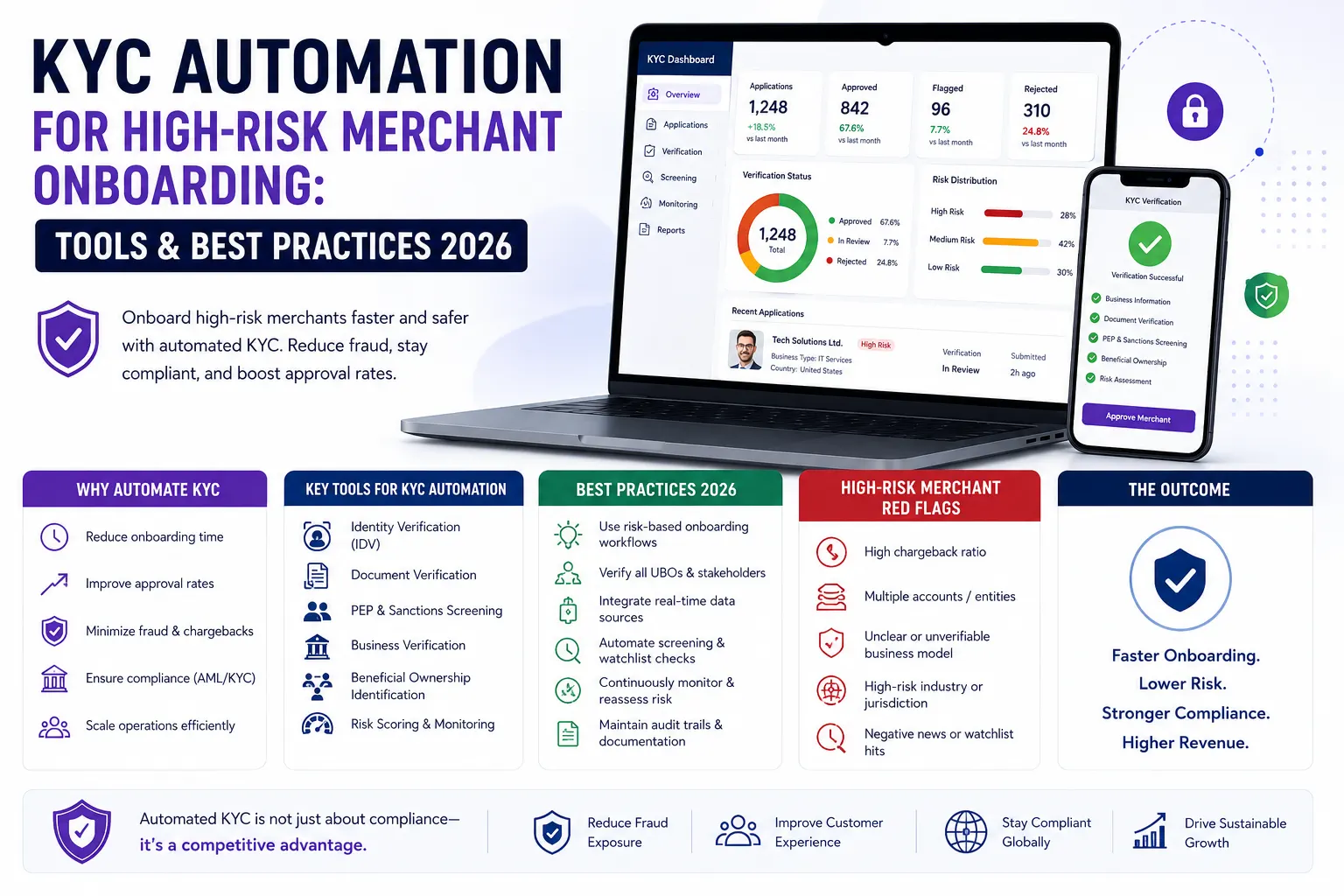
KYC automation is not a single tool, it is a set of integrated verification processes that replace manual steps with real-time, API-driven checks.
Document Verification: Automated document verification uses optical character recognition (OCR), AI image analysis, and database cross-referencing to validate government-issued ID, business registration documents, and corporate certificates in seconds. Onfido’s 2025 Identity Verification Benchmark reported 99.3% accuracy on document verification across 195 countries, significantly above the 91%–94% accuracy rate of trained manual reviewers.
Biometric Identity Verification: Biometric liveness detection confirms that the person submitting a document is the person depicted in it, preventing document fraud using photos of photos or pre-recorded video. In 2025, liveness detection accuracy across leading platforms averaged 99.7%, per Gartner’s Digital Identity Market Report.
For high-risk merchant onboarding, biometric verification is particularly important because the value of a fraudulently obtained merchant account is high enough to justify sophisticated document manipulation.
Business Verification (KYB – Know Your Business): KYB automation pulls real-time data from company registries, beneficial ownership databases, and trade databases to verify that the merchant’s business entity is legitimate, active, and correctly described. Manual KYB checks against company registries can take 3–10 days in some jurisdictions. Automated KYB completes the same checks in minutes by pulling directly from registry APIs.
Sanctions and PEP Screening: Every merchant onboarded by a regulated payment provider must be screened against global sanctions lists (OFAC, EU, UN, FATF blacklist) and Politically Exposed Person (PEP) databases. Automated screening runs these checks continuously, not just at onboarding, flagging status changes in real time. Manual screening runs at onboarding only and misses mid-relationship changes.
Adverse Media Screening: Automated adverse media screening monitors news databases, regulatory publications, and court records for mentions of the merchant entity or its principals. A high-risk merchant applying with a clean compliance record but whose director has been cited in regulatory action in a different jurisdiction is a risk signal that manual onboarding routinely misses. Automated adverse media tools scan millions of sources in the background continuously.
Best Practices for High-Risk Merchant KYC in 2026
Getting KYC automation right for high-risk onboarding requires more than plugging in a vendor. The configuration and calibration of the system determines whether it protects the portfolio or creates bottlenecks.
Tier Your Risk Model Before Automating
Not every high-risk merchant presents the same risk level. A licensed online pharmacy in the EU and an unlicensed supplement seller in an unregulated market are both technically “high-risk” by MCC classification, but they require completely different verification depth.
Build a risk-tiering model first: low-risk high-risk merchants (regulated verticals, established businesses), standard high-risk merchants, and elevated-risk merchants. Apply proportionate verification depth to each tier. Subjecting every high-risk applicant to the same intensive check creates unnecessary friction and costs without improving risk outcomes.
Automate the Straight-Through Cases, Escalate the Rest
The goal of KYC automation is not to remove humans from the process entirely. It is to ensure that humans are only reviewing the cases that genuinely require judgment.
For a well-calibrated high-risk merchant KYC system, 60%–75% of applications should pass automated checks without any manual intervention. The remaining 25%–40%, applications with conflicting data, sanctions proximity, or verification anomalies, are escalated for human review with a pre-populated risk summary. This is the configuration that reduces onboarding time to 2–5 days while maintaining compliance integrity.
Screen Continuously, Not Just at Onboarding
KYC is not a one-time exercise. A merchant who passes onboarding checks in January may be added to a sanctions list in June. A company director who was clean at application may be named in regulatory action nine months later.
Continuous monitoring, running sanctions, PEP, and adverse media checks against the entire active merchant portfolio on an ongoing basis, is now a regulatory expectation in most major jurisdictions following FATF’s 2023 guidance updates, which were adopted into national regulations across the US, UK, and EU by 2025.
Build Jurisdiction-Specific Verification Flows for Offshore Merchants
Offshore merchant onboarding requires jurisdiction-specific compliance logic. A merchant incorporated in the Cayman Islands, operating commercially from the UK, and processing payments for US customers involves three separate regulatory frameworks.
Effective KYC automation for offshore merchants must be configured to apply the strictest applicable standard across all relevant jurisdictions, not just the jurisdiction of incorporation. Payment providers that apply only the incorporation jurisdiction’s standards to offshore merchant onboarding are systematically underperforming their compliance obligations.
KYC Automation Platform Comparison (2026)
| Platform | Document Verification | KYB Coverage | Sanctions Screening | Continuous Monitoring | Best For |
|---|---|---|---|---|---|
| Onfido | 99.3% accuracy, 195 countries | Via API integrations | Yes | Yes | Mid-market payment providers |
| Jumio | 99.1% accuracy, 200+ countries | Full KYB suite | Yes – real-time | Yes | Enterprise acquirers |
| Sumsub | 96%+ accuracy, 220 countries | Comprehensive | Yes | Yes | High-risk and crypto merchant onboarding |
| Persona | Configurable, high customisation | Modular | Yes | Yes | Operators building custom flows |
| ComplyAdvantage | Specialist sanctions + adverse media | PEP + sanctions focus | Real-time | Yes | Risk-heavy offshore onboarding |
Pros and Cons: Manual vs Automated KYC for High-Risk Onboarding
| Factor | Manual KYC | Automated KYC |
|---|---|---|
| Onboarding speed | 16 – 30 days | 2 – 5 days |
| Cost per merchant | $200 – $1,000 | $15 – $80 |
| Document verification accuracy | 91% – 94% | 99.3% (Onfido, 2025) |
| Merchant abandonment rate | High (67% at 10+ days) | Low (2–5 day completion) |
| False positive rate | High, 30% – 40% on thin-file merchants | 45% lower with AI (Featurespace, 2025) |
| Continuous monitoring | Rarely – onboarding only | Standard feature |
| Scalability | Low – limited by headcount | High – API-driven |
| Explainability for regulators | High – human judgment documented | Medium – requires model documentation |
FAQ
Q: Is KYC automation compliant with FATF and regulatory requirements?
Ans: Yes, provided the system is configured to meet the verification standards required in each relevant jurisdiction. Regulators assess the outcome of the KYC process (was the identity properly verified?) not the method. Automated systems that meet accuracy and documentation standards are fully compliant. Operators should maintain audit trails of all automated decisions.
Q: Can KYC automation handle offshore merchant onboarding across multiple jurisdictions?
Ans: Leading platforms support verification across 195–220 countries with jurisdiction-specific document type handling. The configuration challenge is applying the right compliance standard to each application, which requires payment operators to build jurisdiction-specific workflow logic on top of the vendor platform.
Q: How does KYC automation handle merchants in very high-risk categories like gambling or adult content?
Ans: The KYC process itself does not change based on vertical, but the risk thresholds applied to the results do. High-risk payment providers configure their KYC platforms with stricter pass/fail thresholds and mandatory manual escalation rules for specific MCC categories.
Q: What happens when an automated KYC system returns a false positive for a legitimate high-risk merchant?
Ans: Well-designed systems route false positives to a human review queue with the full automated assessment pre-populated. A trained analyst can typically resolve a false positive in 30–90 minutes, far faster than the original manual process. The goal is to make human review the exception, not the default.
Q: How quickly can a payment provider implement KYC automation? A: API-based KYC platforms typically integrate within 4–8 weeks for a standard implementation. Custom workflow configuration for high-risk merchant onboarding, including jurisdiction-specific logic and risk-tier routing, adds another 4–6 weeks. Most operators are fully live within 3 months of contract signature.
The Bottom Line
Manual KYC is not a viable strategy for any payment provider competing for high-risk merchant accounts in 2026. The abandonment rates are too high, the compliance risk is too significant, and the cost differential is too large to justify.
The right KYC automation stack, document verification, biometric liveness, KYB, continuous sanctions screening, and adverse media monitoring, reduces onboarding from weeks to days, cuts cost per merchant by up to 85%, and provides better compliance coverage than manual review at every stage.
For high-risk merchants, a faster, cleaner onboarding experience directly translates into stronger provider relationships and lower early-stage churn. For payment operators, it translates into a more scalable, compliant, and profitable portfolio.
Explore TheFinRate’s directory of KYC automation tools and high-risk payment providers, compared by verification coverage, onboarding speed, cost, and high-risk merchant specialization.
Comments
No comments yet. Be the first to share your thoughts.
Leave a comment