
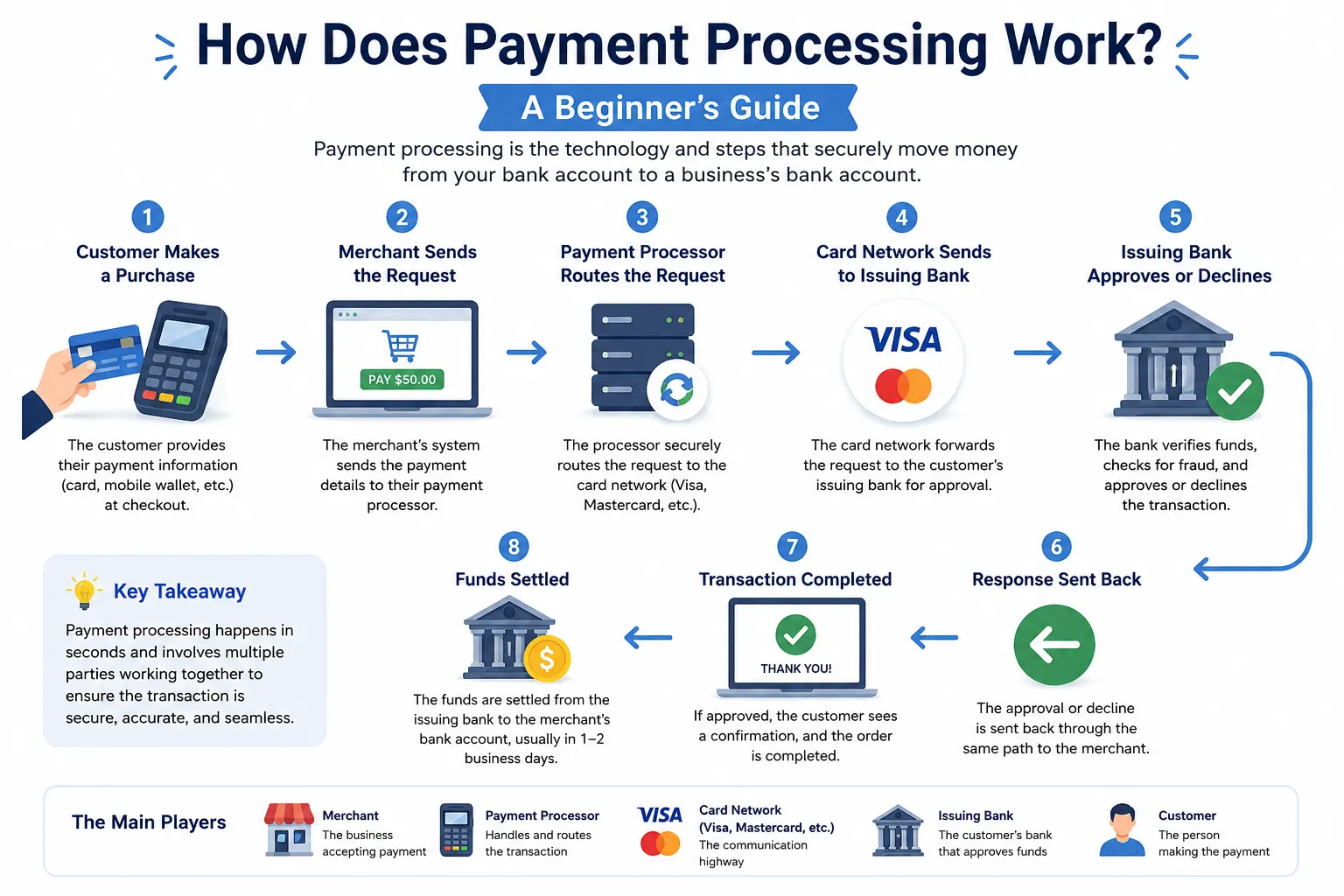
Every time a customer pays for something, online, in-store, or via an app, a chain of technology and financial infrastructure springs into action behind the scenes. It takes less than three seconds. Most business owners never think about it. But understanding how payment processing works is the foundation of every smart decision you’ll make about payment gateways, merchant accounts, fees, and provider selection. This guide explains it clearly, without the jargon.
TL;DR
- Payment processing is the system that moves money from a customer’s bank to a merchant’s account whenever a card or digital payment is made.
- It involves five parties: the customer, merchant, payment gateway, payment processor, card network, and issuing bank.
- Every transaction carries three layers of fees: interchange (to the issuing bank), assessment (to the card network), and processor markup.
- Global digital payment transaction value reached $26.89 trillion in 2026, with 5.2 billion people worldwide now using digital wallets.
- High-risk merchants face higher fees and stricter rules, and in 2026, a tightened Visa threshold means chargeback management is more important than ever.
What Is Payment Processing?
Payment processing is the end-to-end system that enables a business to accept card payments, digital payments, and online payments from customers. It covers everything from the moment a customer taps their card to the moment funds settle in the merchant’s bank account.
It’s not one thing, it’s a chain of actions performed by several parties in a coordinated sequence. At the center of this chain sit two critical pieces of infrastructure: the payment gateway (which handles data) and the payment processor (which handles money movement). Together, they form the backbone of merchant services for any business that accepts electronic payments.
The scale of this system in 2026 is staggering. Global digital payment transaction value reached $26.89 trillion this year, up from just $1.7 trillion in 2014. That tenfold expansion over a single decade represents one of the largest infrastructure shifts in modern commerce.
The Key Players in Every Transaction
Before walking through the steps, it helps to know who’s involved:
- The customer (cardholder): Initiates the payment using a card, payment wallet, or digital payment method.
- The merchant: The business accepting payment, operating through a merchant account.
- The payment gateway: Captures and encrypts the customer’s payment data at checkout.
- The payment processor: Routes the encrypted data between banks and manages authorization and settlement.
- The card network: The rails that connect everything. Visa, Mastercard, American Express, and Discover are the major networks.
- The issuing bank: The customer’s bank. It approves or declines the transaction based on available funds and fraud signals.
- The acquiring bank: The merchant’s bank. It receives settled funds on behalf of the business.
Most modern payment providers, Stripe, Adyen, Square, Worldpay, bundle gateway, processor, and acquiring bank functions into a single platform, which is why the system can feel invisible to merchants until something goes wrong.
How Payment Processing Works – Step by Step
Here’s exactly what happens in the 1-3 seconds between a customer hitting “Pay Now” and seeing a confirmation screen:
- Initiation: The customer enters card details or taps a payment wallet (Apple Pay, Google Pay) at checkout. For in-person payments, this happens at a POS terminal.
- Gateway encryption: The payment gateway encrypts the customer’s data using tokenization, replacing sensitive card details with a unique token. This protects cardholder data and ensures PCI-DSS compliance.
- Processor routing: The payment processor receives the token and routes an authorization request through the relevant card network to the customer’s issuing bank.
- Bank authorization: The issuing bank checks available funds, card status, and fraud signals. It returns an approval or decline in milliseconds.
- Response delivery: The approval or decline routes back: issuing bank → card network → processor → gateway → your checkout page.
- Capture and settlement: Once approved, the merchant captures the transaction. At end of day, the processor batches all approved transactions and initiates fund transfer to the merchant’s acquiring bank. Standard settlement in the US runs T+1 or T+2.
- Deposit: Net funds (after fees) land in the merchant’s business bank account.
For businesses handling cross-border payments, the flow adds currency conversion and local network routing, managed at the processor level, with local payment method support handled by the gateway.
The Three Layers of Payment Processing Fees
Every card transaction carries three distinct cost layers. Understanding each one is essential before comparing payment providers.
| Fee Layer | Who Receives It | Who Sets It | Typical Rate (US) | Negotiable? |
|---|---|---|---|---|
| Interchange fee | Issuing bank | Card networks (Visa, MC) | 0.8% – 2.4% + fixed | No |
| Assessment fee | Card network | Visa / Mastercard | ~0.13% – 0.15% | No |
| Processor markup | Payment processor | Your provider | 0.2% – 1.5% | Yes |
Interchange fees: account for 70-80% of total processing cost and go directly to the customer’s card-issuing bank. They vary significantly by card type, a basic debit card may carry interchange under 1%, while a premium travel rewards credit card can run above 2.4%. In 2026, Visa’s assessment rate on credit transactions is approximately 0.14%; Mastercard’s is around 0.1375%.
Assessment fees: fund the card networks’ infrastructure. They’re non-negotiable, applied to all merchants equally, and billed monthly based on volume.
Processor markup: is the only layer you can negotiate. It can be structured as flat-rate (e.g., 2.9% + $0.30), interchange-plus (interchange rate + fixed markup), or subscription-based (flat monthly fee + per-transaction cost). At volume, interchange-plus is almost always the most cost-effective model.
Payment Processing Methods in 2026
The payment landscape has expanded well beyond card payments. Here’s how the major processing methods compare:
| Method | Best For | Settlement Speed | Average Cost | 2026 Adoption |
|---|---|---|---|---|
| Credit / debit cards | Universal | T+1 to T+2 | 1.5% – 3.5% | Dominant globally |
| Digital wallets (Apple Pay, GPay) | Mobile-first, in-store | T+1 | Same as card | 53% of global online purchases |
| BNPL | Retail, high-ticket | T+1 to T+2 | 2% – 6% | $450B+ market by 2026 |
| Real-time payments (UPI, PIX, FedNow) | Emerging markets, B2B | Instant (T+0) | Near-zero to 0.5% | 428B transactions/year projected |
| Crypto / stablecoin | High-risk, cross-border | Near-instant | 1% – 3% | Growing; 19% US small business adoption |
| ACH / bank transfer | B2B, recurring billing | T+1 to T+3 | $0.20 – $1.50 flat | Strong for payroll, subscriptions |
Digital wallets deserve specific attention. By 2026, 5.2 billion people worldwide use digital wallets, over 60% of the global population. Wallets captured 53% of all global online purchases in 2025 and are projected to hold 54% by end of 2026. Any merchant not supporting payment wallets is already behind the majority of their customers’ preferred payment method.
Online Payments vs In-Person Payments: What Changes?
The core processing flow is the same, but there are important differences merchants need to understand:
Online (card-not-present)
- Higher fraud risk = higher interchange rates
- Payment gateway is required for checkout data capture
- 3D Secure authentication (3DS2) adds an extra layer of fraud verification
- Chargebacks are more common, requires active monitoring
In-person (card-present)
- Lower fraud risk = lower interchange rates due to chip and PIN or contactless tap
- POS terminal replaces the gateway’s front-end function
- Chargebacks are lower but not eliminated
- Payment wallets increasingly replace physical cards via NFC
For most startups and eCommerce businesses, online payment processing is the primary concern. The key requirement: a compliant payment gateway connected to a payment processor that supports your transaction volumes, currencies, and customer locations.
Cross-Border Payments: What Changes in the Flow?
When a customer pays from a different country than the merchant, several additional steps enter the processing flow:
- Currency conversion: The processor or acquirer converts the transaction at a rate that may include an FX markup (typically 0.5%-2% above interbank rates, depending on the provider).
- Local card network routing: Some countries use domestic networks (India’s RuPay, Brazil’s Elo) alongside Visa and Mastercard. Processing support varies by provider.
- Cross-border assessment fees: Visa and Mastercard add a cross-border fee (typically 0.4%-1.5%) on top of standard interchange for transactions where the issuing and acquiring banks are in different countries.
- Compliance: Different regulations apply: PSD2 in Europe mandates strong customer authentication; India requires local acquiring for most transactions.
The cross-border digital payments market is expanding rapidly. Cross-border digital remittances alone reached $428 billion in 2025. For businesses selling to international customers, choosing a payment processor with genuine multi-currency acquiring relationships, not just currency conversion at the gateway layer, is a material revenue decision.
High-Risk Payment Processing: 2026 Update
Not all merchants are treated equally by payment processors. Businesses in industries with elevated chargeback rates or regulatory complexity, including subscription billing, digital goods, gambling, nutraceuticals, travel, forex, and adult content, are classified as high-risk.
For these merchants, standard payment gateways like Stripe and Square are not viable. A specialized high-risk payment gateway is required. The differences matter:
- Processing rate (MDR): 3.5%-5%+ (versus 1.5%-2.9% for standard)
- Rolling reserve: 5%-10% of revenue held for 90-180 days as a chargeback buffer
- Chargeback tools: Real-time dispute alerts via Verifi (Visa) and Ethoca (Mastercard) are standard
- Approval timeline: Specialized providers approve in 24-48 hours vs. 2-4 weeks for bank-direct accounts
- Volume caps: New accounts are often capped at $50K-$100K/month initially
Critical 2026 regulatory update: Visa reduced its VAMP (Visa Acquirer Monitoring Program) excessive chargeback threshold from 1.8% to 1.5% across North America, EU, and Asia-Pacific, effective April 1, 2026. Merchants or their acquirers who breach this threshold face Visa fines and potential loss of card acceptance rights. High-risk merchants especially need real-time chargeback monitoring built into their processing stack, not monthly reports.
Pros and Cons of Common Processing Models
Flat-Rate Pricing (Stripe, Square)
Pros: Simple and predictable; no monthly minimums; fast onboarding for online payments.
Cons: Most expensive at volume; not suited for high-risk merchants; account holds are common.
Interchange-Plus Pricing
Pros: Fully transparent; the only negotiable portion is the markup; cheapest at volume.
Cons: More complex billing statements; requires understanding of interchange categories.
Subscription-Based Pricing (e.g., Stax)
Pros: No percentage markup; excellent for high-volume merchants with large average ticket sizes. Cons: Monthly flat fee makes it expensive for low-volume businesses.
High-Risk Merchant Account (Specialized Providers)
Pros: Accepts businesses declined elsewhere; includes chargeback tools; supports cross-border payments and digital wallets.
Cons: Higher rates and rolling reserves; requires documentation; contracts of 12-36 months are common.
2026 Industry Snapshot: What the Numbers Show
- The global digital payments market stands at $145.03 billion in 2026, growing at 19.34% CAGR toward $351.07 billion by 2031 (Mordor Intelligence).
- 86% of global consumers now use contactless payment methods.
- Real-time payment transactions will hit 428 billion annually in 2026, with India’s UPI holding 49% of global volume (ACI Worldwide).
- US credit card processing fees reached a record $148.5 billion in 2024, the cost ultimately borne by consumers through higher prices (Merchants Payments Coalition).
- The BNPL market is projected to surpass $450 billion in transaction volume by 2026 (GlobalData).
- Asia-Pacific captured 38.72% of global digital payments value in 2025 and is growing at 20.32% CAGR, the fastest-growing major region.
For merchants anywhere in the world, these numbers signal one thing: digital payments are the standard, not the exception. Building the right payment processing infrastructure from day one is a commercial priority.
How to Choose the Right Payment Provider
Before signing with any payment provider, answer these questions:
- What payment methods do your customers use? If your customers are in Asia, wallets and QR codes matter as much as cards. If you’re in Europe, open banking and SEPA are increasingly relevant.
- What is your monthly volume? Under $50K/month: flat-rate works. Above $100K/month: interchange-plus will almost always save money.
- Are you in a high-risk category? If yes, apply directly to a specialized high-risk payment gateway, do not start with Stripe or Square.
- Do you sell internationally? Verify that your processor provides genuine local acquiring in your target markets, not just gateway-layer currency conversion.
- How critical is settlement speed? Real-time payment rails (UPI, PIX, FedNow) offer T+0 settlement. Traditional card rails settle T+1 to T+2. For cash-flow-sensitive businesses, this difference matters.
Frequently Asked Questions
Q: How long does payment processing take?
A: Authorization happens in 1-3 seconds. Fund settlement, the point where money lands in your bank account, typically takes 1-3 business days (T+1 to T+2 for most card transactions). Real-time payment systems like UPI and PIX settle instantly.
Q: What is a merchant account and do I need one?
A: A merchant account is the business bank account that receives settled funds from card transactions before they transfer to your main bank account. Aggregators like Stripe include a pooled merchant account. Dedicated accounts from acquiring banks offer more control and are required for most high-risk businesses.
Q: What is a chargeback?
A: A chargeback is when a customer’s bank reverses a transaction, returning funds to the cardholder and debiting the merchant. Chargebacks typically cost merchants $15-$100 in fees per dispute, plus the transaction value. Keeping chargeback rates below 1% (Mastercard) and 1.5% (Visa VAMP, as of April 2026) is critical to maintaining card acceptance rights.
Q: Can I accept payments without a payment gateway?
A: For in-person transactions, a POS terminal can replace the gateway function. For online payments, a payment gateway is required, it’s the only compliant way to capture and encrypt customer card data at checkout.
Q: What’s the cheapest way to accept payments?
A: For low volumes, flat-rate processors (Stripe, Square) offer the simplest setup. For volumes above $100K/month, interchange-plus pricing with a dedicated processor is usually significantly cheaper. For very high volume or high-risk businesses, subscription-based processing or specialized merchant accounts tend to deliver the lowest effective rate.
Comments
No comments yet. Be the first to share your thoughts.
Leave a comment