
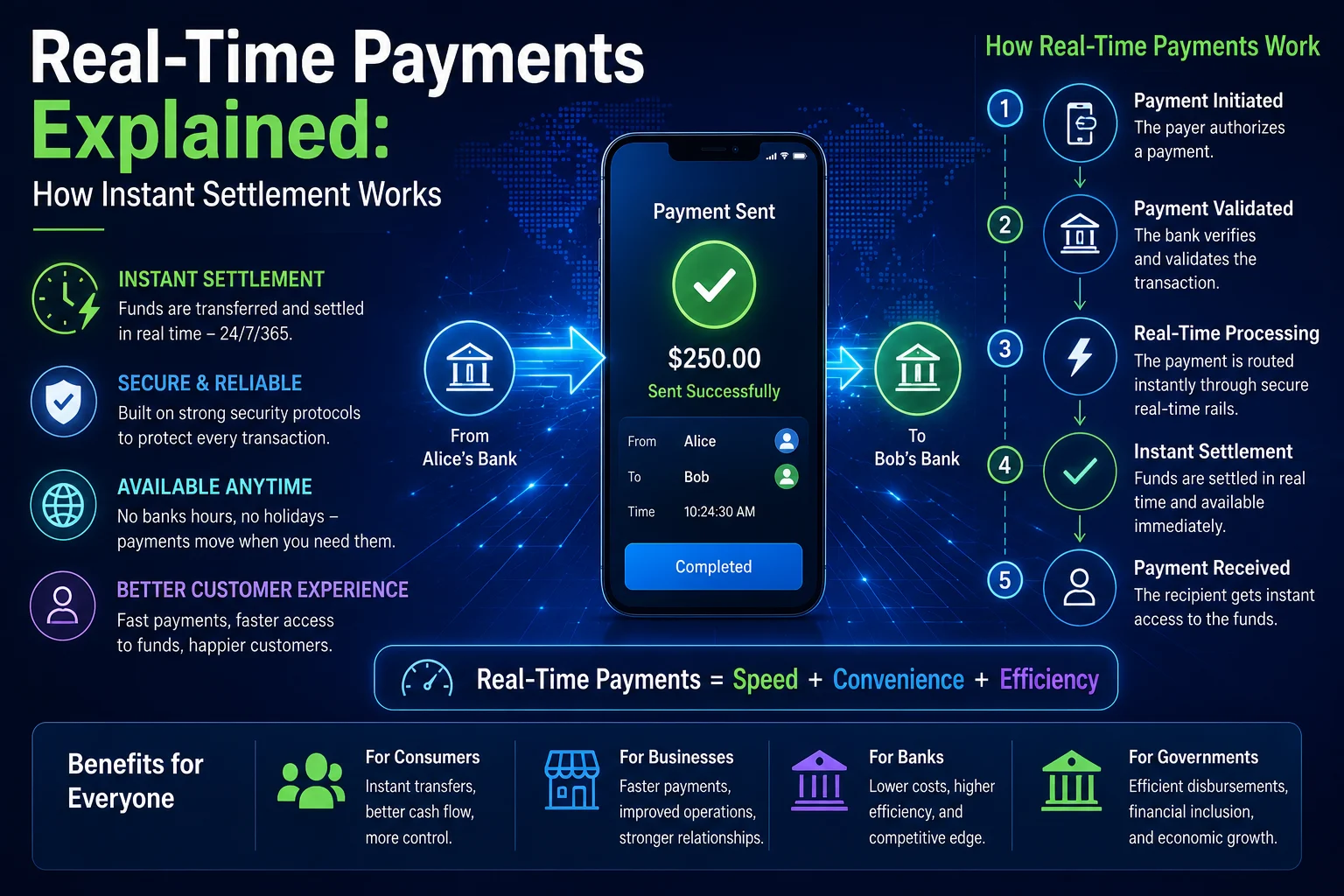
The speed of money movement has become a competitive differentiator for every business that processes digital payments. Real-time payments (RTP), transactions that settle within seconds, 24 hours a day, every day of the year, are shifting from a premium feature to baseline infrastructure. The global RTP market was valued at $25.92 billion in 2024 and is projected to reach $116.23 billion by 2029, a 35% CAGR, driven by regulatory mandates in Europe and surging B2B adoption in the US.
TL;DR
- Real-time payments settle in seconds, funds are available immediately and irrevocably
- The US operates two parallel rails: RTP Network (The Clearing House) and FedNow (Federal Reserve)
- SEPA Instant became mandatory for all euro-area PSPs in October 2025, 10-second settlement, price parity with standard transfers
- Global RTP transaction volumes grew 42.2% in 2024; US volume projected at 8 billion transactions in 2026
- High-risk merchants benefit from faster settlement but face higher fraud exposure, instant payments are irrevocable
- RTP could shift up to $19 trillion in B2B payments away from ACH and paper checks by 2028
What Are Real-Time Payments?
Real-time payments are transactions where funds transfer from sender to receiver within seconds, with immediate availability and final settlement. Unlike ACH transfers, which batch and settle in 1-3 business days, or card payments that can take 2-5 days to reach a merchant account, RTP rails operate continuously with no cut-off times, no batch windows, and no business-hour restrictions.
Three things define a genuine real-time payment system:
- Immediacy: funds credited to the recipient within seconds of initiation
- Irrevocability: once sent, the transaction cannot be reversed through the rail itself
- 24/7/365 availability: no downtime for weekends, public holidays, or end-of-day batch cycles
The irrevocability point matters for merchants and payment providers. There is no equivalent of a card chargeback on a bank-to-bank RTP transaction. This changes the fraud dynamic significantly, more on that below.
How Instant Settlement Works: The Technical Flow
Understanding the mechanics helps merchants and fintech operators choose the right payment rails for their use case.
When a payer initiates a real-time payment, the sequence runs like this:
- Initiation: the payer’s bank receives the payment instruction via their app or payment gateway
- Validation: the bank verifies account details, applies fraud scoring, and confirms available funds, all within milliseconds
- Routing: the instruction is sent to the central clearing infrastructure (FedNow, TCH’s RTP network, or a SEPA clearing mechanism)
- Settlement: the clearing system debits the sending bank and credits the receiving bank simultaneously, final and irrevocable
- Confirmation, both parties receive real-time confirmation messages; the recipient’s account is credited
The entire sequence takes under 10 seconds on most modern RTP rails. Settlement is gross and immediate, there is no netting across a batch, no overnight window, and no float.
ISO 20022, the global financial messaging standard, underpins most RTP systems. It enables rich data payloads alongside the payment, structured remittance information, invoice references, and compliance data, which is a key driver of RTP adoption in B2B payment processing.
The Big Three: RTP, FedNow, and SEPA Instant
RTP Network (The Clearing House)
The RTP Network, operated by The Clearing House (TCH), launched in 2017 as the first new core US payments infrastructure in over 40 years. Owned by a consortium of the country’s largest commercial banks, RTP is now the dominant instant payment rail by transaction value in the US.
Key 2026 figures:
- Transaction limit raised to $10 million per payment in February 2025
- 1.5 million+ payments per day processed in 2026
- Approaches $500 billion in transaction value per quarter in 2026
- Reaches nearly 75% of US bank accounts
- 1,000+ participating financial institutions
FedNow Service
FedNow launched in July 2023 as the Federal Reserve’s instant payment solution, designed to extend RTP reach to community banks and credit unions that were not part of the TCH consortium. While functionally similar to RTP, FedNow is open to any eligible financial institution, significantly broadening network coverage.
Key 2026 figures:
- 1,400+ institutions onboarded by mid-2025
- Transaction limit aligned with RTP at $10 million per payment
- Supports the same ISO 20022 messaging standard for interoperability
- Both rails now operated by major institutions in tandem, U.S. Bank, for example, uses both RTP and FedNow simultaneously to maximise recipient reach
SEPA Instant Credit Transfer (SCT Inst)
SEPA Instant is the EU’s mandatory instant payment standard, governed by the European Payments Council and regulated under EU Regulation 2024/886 (the Instant Payments Regulation, or IPR). Unlike US rails, where adoption is voluntary, SEPA Instant is now legally required.
Key 2026 milestones:
- From January 9, 2025: all euro-area PSPs must be able to receive SCT Inst payments
- From October 9, 2025: all euro-area PSPs must send SCT Inst, with Verification of Payee (VoP) mandatory and fees capped at parity with standard SEPA transfers
- 10-second settlement: hard limit defined in the EPC rulebook
- November 2026: unstructured address formats phased out; ISO 20022-compliant structured addresses become mandatory
- VoP: now required before every SCT Inst and SEPA credit transfer, returning a match, close match, or no-match result before execution
The pricing parity mandate is significant for merchants. Since many banks offer standard SEPA transfers at zero cost to retail customers, instant SEPA payments also carry effectively zero cost, well below credit card merchant discount rates of 0.5-3%.
Comparison: RTP vs FedNow vs SEPA Instant
| Feature | RTP Network | FedNow | SEPA Instant |
|---|---|---|---|
| Operator | The Clearing House (private) | Federal Reserve (public) | ECB / EPC (regulatory) |
| Launch | 2017 | 2023 | 2014 (voluntary) / 2025 (mandatory) |
| Coverage | 75% of US bank accounts | 1,400+ institutions | 34 SEPA countries, euro-denominated |
| Transaction limit | $10 million | $10 million | No cap (removed Oct 2025) |
| Settlement time | Seconds | Seconds | Under 10 seconds |
| Mandatory? | No | No | Yes (euro-area PSPs from Oct 2025) |
| Participation | TCH member banks + partners | Any eligible FI | All SEPA PSPs |
| Messaging standard | ISO 20022 | ISO 20022 | ISO 20022 |
Global Adoption in 2026: Who’s Leading?
The US is catching up, but it is not leading. Asia-Pacific dominates global RTP volume by a wide margin.
- India: UPI (Unified Payments Interface) is the world’s largest RTP network by transaction count. India accounts for the plurality of global instant payment volume.
- Brazil: Pix processed 42 billion transactions in 2023, a 74% year-over-year surge, and now constitutes the primary payment method in the country, outpacing credit cards.
- APAC overall: 185.8 billion RTP transactions in 2023, representing 24% of all electronic payments in the region; projected to reach 351.5 billion by 2028 (CAGR 13.6%).
- Nigeria: approximately 82% of all electronic transactions run through its instant payment infrastructure.
- North America: US real-time transaction volume is projected to reach 8 billion in 2026, with a 31.7% CAGR through 2028. Deloitte estimates RTP could shift $19 trillion in B2B payments from ACH and paper checks by 2028.
- Europe: SEPA Instant adoption projected to grow from current levels toward 8–13% of all euro-area payments by 2028, driven by the mandatory IPR deadlines now in force.
Global real-time transaction volumes grew 42.2% in 2024 alone. The structural shift toward instant rails is not gradual, it is accelerating.
What Real-Time Payments Mean for Merchants
Benefits for Merchant Accounts and Businesses
RTP improves cash flow fundamentally. Traditional merchant account settlement, particularly for card payments running through a standard payment gateway, involves 2-5 business days of float. RTP eliminates that entirely.
Key merchant benefits:
- Instant liquidity: funds are in the merchant’s account within seconds of a completed transaction, replacing multi-day card settlement cycles
- Reduced settlement risk: since settlement is final and irrevocable at the rail level, there is no overnight counterparty risk
- Lower transaction costs: RTP bank-to-bank transfers carry no interchange fee. SEPA Instant costs are capped at parity with zero-cost standard transfers
- Real-time reconciliation: ISO 20022-rich messaging enables automated matching against invoices and purchase orders, cutting manual reconciliation effort significantly
- Instant refunds: merchants can push refunds to customers in seconds, improving customer experience and reducing dispute escalation
High-Risk Merchants and Instant Settlement
For businesses operating on high-risk payment gateways, including iGaming, forex, nutraceuticals, adult content, and subscription platforms, RTP introduces a specific trade-off.
Standard high-risk merchant account providers hold rolling reserves (typically 5-10% of volume for 90-180 days) as protection against delayed chargebacks. On RTP rails, traditional chargebacks do not exist, the transaction is final. This removes one risk category but shifts responsibility for fraud prevention entirely upstream, before the payment initiates.
High-risk operators using RTP or FedNow for payouts, such as affiliate commissions, supplier payments, or player withdrawals in gaming, should ensure their payment provider includes real-time fraud scoring and behavioural checks before release. The absence of a chargeback mechanism is both an advantage (no chargeback fraud) and a constraint (no recourse if a legitimate error occurs).
Pros and Cons of Real-Time Payments
Pros
- Instant, irrevocable settlement eliminates payment float and improves liquidity
- 24/7/365 availability, no batch windows, no business-hour restrictions
- ISO 20022 messaging enables automated reconciliation in B2B payment processing
- Eliminates interchange fees on bank-to-bank transfers, cheaper than card rails
- Enables instant payouts to digital payment wallets, contractors, and sub-merchants
- SEPA Instant pricing mandate makes euro-area instant transfers cost-free in practice
- Reduces dispute volume from genuine settlement delays (not to be confused with fraud disputes)
Cons
- Irrevocability cuts both ways, authorised push payment fraud has no equivalent of a card chargeback safety net
- Cross-border payments on RTP rails remain limited, most networks are country or region-specific; interoperability is still developing
- Both sending and receiving banks must be on the same rail, network gaps limit reach, particularly for smaller financial institutions
- High-risk merchants lose traditional chargeback protection as a recourse mechanism
- Requires always-on payment infrastructure, any system downtime means lost transactions
- Regulatory compliance overhead is growing, VoP requirements, sanctions screening, and ISO 20022 mandates add implementation complexity for payment providers
The Fraud Challenge: Speed vs Security
The central security tension in real-time payments is irrevocability. Once a payment is sent on an RTP rail, the funds are immediately available to the recipient and cannot be recalled through the infrastructure itself.
This creates a specific fraud vector: authorised push payment (APP) fraud, where a victim is tricked, through social engineering, phishing, or impersonation, into initiating a legitimate payment to a fraudster’s account. Unlike card fraud, where the card network can reverse an unauthorised transaction, APP fraud on RTP rails is significantly harder to remedy.
The responses from infrastructure providers include:
- Verification of Payee (VoP): now mandatory across SEPA from October 2025, requiring a name-to-IBAN match check before every transfer. This directly addresses misdirected payments and account impersonation.
- Behavioural biometrics and AI fraud scoring: applied by payment providers in the milliseconds before transaction initiation, flagging unusual velocity, device mismatches, or atypical beneficiary patterns
- Confirmation of Payee (CoP): the UK equivalent of VoP, already live on the Faster Payments Service
- Request for Payment (RfP) controls: both FedNow and RTP include RfP functionality, allowing the receiver to request funds; banks apply controls on what RfP messages reach the end user
The fundamental shift is from reactive fraud management, chargebacks, dispute resolution, to pre-emptive fraud interception before the transaction is authorised. For merchants and payment providers building on RTP rails, this means fraud controls must live upstream of settlement, not downstream of it.
Frequently Asked Questions
What is the difference between RTP and FedNow?
Both are US instant payment rails with identical $10 million transaction limits and ISO 20022 messaging. RTP is operated by The Clearing House, a private consortium of major banks. FedNow is operated by the Federal Reserve and is open to any eligible financial institution, giving it broader reach among community banks and credit unions. Most large US banks now use both rails in tandem.
Is SEPA Instant mandatory in 2026?
Yes. EU Regulation 2024/886 (the Instant Payments Regulation) mandated that all euro-area PSPs receive SCT Inst payments from January 9, 2025, and send them from October 9, 2025. Fees must not exceed standard SEPA credit transfer charges, and Verification of Payee is required before every transfer. Non-euro SEPA countries face later deadlines in 2027.
Can real-time payments be reversed?
No. Settlement on RTP rails is final and irrevocable through the payment infrastructure. Unlike card payments, there is no rail-level chargeback mechanism. Dispute resolution must occur directly between parties or through the financial institution, making pre-payment fraud prevention critical.
Do real-time payments work for cross-border transactions?
Most RTP networks operate within a single country or currency zone. True cross-border real-time payments remain limited, though initiatives like SEPA Instant (34 countries), ASEAN cross-border QR code linkages, and bilateral integrations between national rails are expanding the cross-border RTP footprint. Specialist providers like Thunes and Nuvei bridge incompatible national networks for international transfers.
What does RTP mean for high-risk merchants?
Faster settlement eliminates float and improves liquidity, which is a direct benefit. However, the irrevocability of RTP transactions removes traditional chargeback recourse. High-risk operators must invest in upstream fraud prevention and should choose payment providers with robust real-time transaction screening before releasing funds on instant rails.
Comments
No comments yet. Be the first to share your thoughts.
Leave a comment