
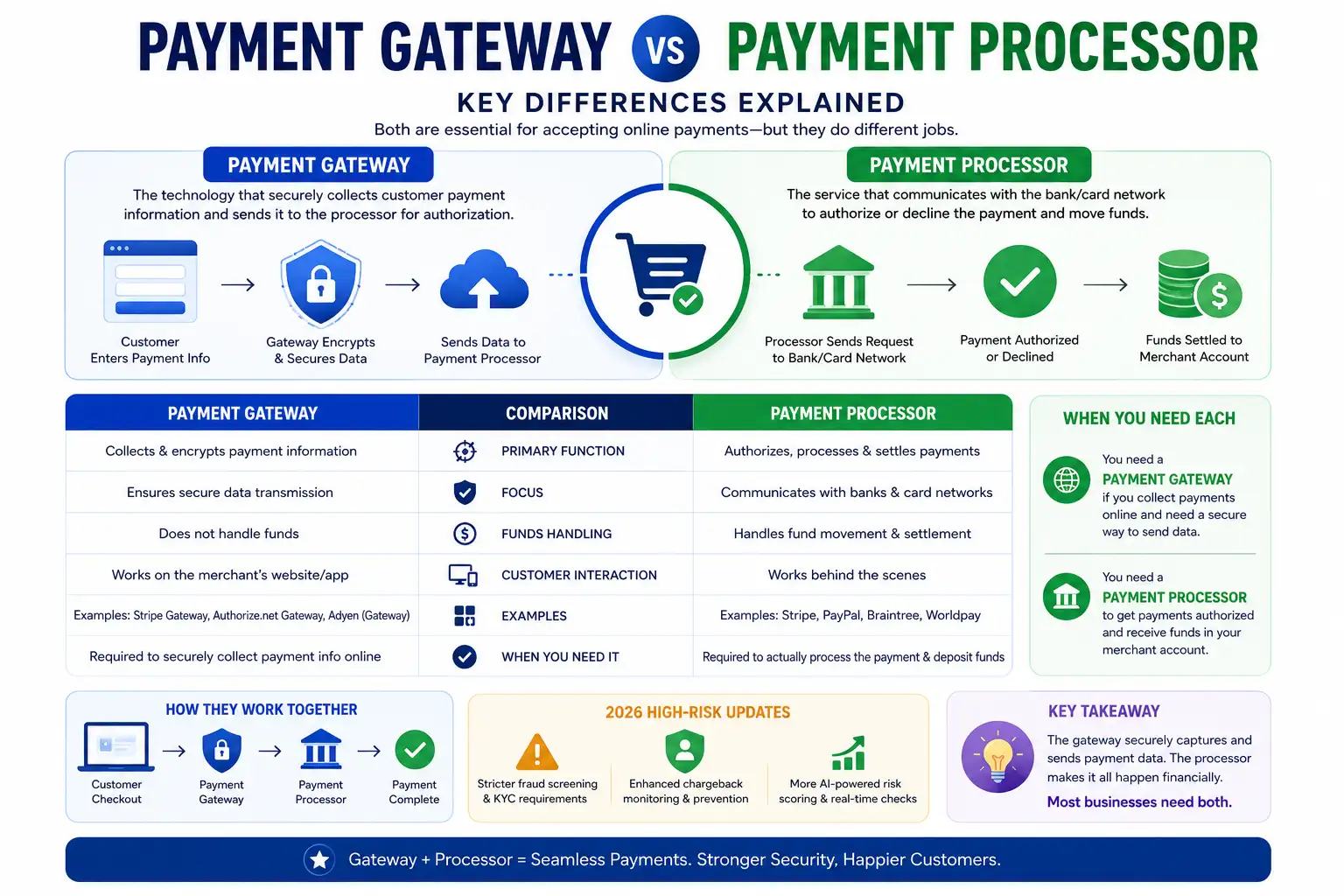
Every time a customer hits “Pay Now,” two separate systems spring into action. Most merchants use the terms interchangeably, and most get it wrong. A payment gateway and a payment processor are not the same thing. They do different jobs, carry different costs, and failing to understand which one you need can lead to the wrong vendor, broken integrations, and checkout failures that cost real revenue.
TL;DR
- A payment gateway is the secure front-end technology that captures and encrypts customer payment data at checkout.
- A payment processor is the back-end engine that routes that data, requests bank authorization, and moves funds between accounts.
- Most modern payment providers bundle both into one platform, but knowing the distinction matters when evaluating cost, control, and high-risk options.
- The global payment gateway market reached $36.2 billion in 2026; the digital payments market hit $145.03 billion the same year.
- For high-risk payment gateway setups, the distinction is especially important, specialized processors have specific underwriting and reserve requirements that differ entirely from standard solutions.
What Is a Payment Gateway?
A payment gateway is the technology layer that sits between your customer and your acquiring bank. When a customer enters card details at checkout, on your website, mobile app, or in-person terminal, the gateway is what securely captures that data, tokenizes it, and transmits it forward into the payment chain.
Think of it as the secure front door to every transaction. It doesn’t move money. It moves information, encrypted, PCI-DSS-compliant information that tells the rest of the payment system what to do.
Payment gateways handle online payments and card-present transactions alike, though the architecture differs slightly between the two. For digital payments processed online, the gateway also runs fraud signals, CVV checks, address verification (AVS), and 3D Secure authentication, before the transaction ever reaches a bank.
Types of Payment Gateways
- Hosted gateways: redirect customers to a third-party checkout page (e.g., PayPal Checkout). Lower setup complexity, less control over the checkout experience.
- Integrated (self-hosted) gateways: the payment form lives directly on your site. You control UX but take on more PCI compliance responsibility. Self-hosted gateways are growing at a 16.46% CAGR through 2031 as enterprises seek tighter control over routing and tokenization.
- API-based gateways: fully embedded via API. Maximum customization, typically used by mid-to-large merchants with developer resources. Around 49% of merchant integrations are now API-based (Global Growth Insights, 2026).
- Crypto gateways: accept standard card payments but settle merchant funds in stablecoins or cryptocurrency. Growing traction in 2026, particularly for high-risk payment gateway use cases where traditional reserves are problematic.
What Is a Payment Processor?
A payment processor is the operational infrastructure that takes the encrypted data from the gateway and executes the actual transaction. It communicates with card networks (Visa, Mastercard) and the customer’s issuing bank to request authorization, receive approval or decline, and ultimately settle funds into the merchant’s account.
Where the gateway moves information, the processor moves money. It operates entirely in the background, merchants and customers never interact with it directly during checkout.
The Three Core Stages of Payment Processing
Authorization: The processor sends transaction details through the card network to the issuing bank, which checks for available funds, fraud signals, and card validity. This happens in 1-3 seconds.
Capture: Once approved, the merchant submits a capture request. The processor records the transaction, applies relevant merchant services rules, and prepares it for batch settlement.
Settlement: The processor batches approved transactions, clears them through the card network, and transfers net funds to the merchant’s acquiring bank, and from there, into the merchant account. Standard timelines in the US run T+1 or T+2 from transaction date.
Payment providers like Worldpay, Adyen, and Stripe serve as both gateway and processor, often also acting as the acquiring bank, which is why the two terms get conflated so easily.
Payment Gateway vs Payment Processor: Head-to-Head Comparison
| Feature | Payment Gateway | Payment Processor |
|---|---|---|
| Primary role | Captures and encrypts payment data | Authorizes and settles funds |
| Customer-facing | Yes – part of checkout experience | No – operates entirely in the background |
| Data handled | Card details, billing address, CVV | Encrypted token + bank communications |
| Fraud tools | CVV checks, AVS, 3DS authentication | Chargeback management, risk scoring |
| PCI scope | High – handles raw card data initially | Lower – works with tokenized data |
| Typical cost | Monthly fee + per-transaction gateway fee | Interchange + processing markup (%) |
| Can operate standalone | Only for in-person POS (not e-commerce) | Yes – for MOTO, recurring, and in-person |
| Settlement | No – passes data only | Yes – manages fund movement |
Standard US e-commerce rates: 2.9% + $0.30 flat-rate (aggregator) or 1.8%-2.4% effective under interchange-plus. High-risk merchants pay 3.5%-5%+.
How They Work Together: The Full Transaction Flow
In the time it takes to read this sentence, a completed payment flows through the following steps:
- Customer enters card details on your checkout page.
- The payment gateway encrypts the data via tokenization and transmits it to the processor.
- The payment processor routes the encrypted token through the relevant card network (Visa, Mastercard).
- The card network forwards the authorization request to the customer’s issuing bank.
- The issuing bank approves or declines based on available funds, fraud signals, and card status.
- The decision routes back: card network → processor → gateway → checkout confirmation page.
- The full loop completes in approximately 1-3 seconds.
- At end of day, the processor batches settled transactions and initiates fund transfer to the merchant account.
For merchants handling cross-border payments, the flow adds currency conversion, local network routing, and compliance checks, all managed at the processor level. The gateway handles local payment method support and language at the front end.
Do You Need Both?
In most cases for online payments, yes. A gateway without a processor is incomplete, the data has nowhere to go. A processor without a gateway works only in specific scenarios: MOTO (mail order/telephone order), recurring billing with stored tokens, or in-person card-present transactions via a POS terminal.
For businesses accepting payments online, the practical reality in 2026 is that most payment providers bundle both functions. Stripe, Adyen, Square, and Braintree all offer end-to-end solutions. The question is not “which one do I get” but “which vendor’s combined stack fits my business model.”
Where the distinction becomes critical: when you need to mix and match. Some merchants pair a standalone gateway like Authorize.net or NMI with a separate acquiring processor for better rate negotiation or routing flexibility. This is common in high-volume eCommerce and specifically in the high-risk payment gateway space, where gateway choice and acquiring bank relationships are managed separately by design.
Pros and Cons
Standalone Payment Gateway
Pros
- Full control over the checkout experience and payment form design
- Flexibility to route to multiple processors, important for payment processing stability
- Supports multiple payment types: cards, payment wallets, BNPL, ACH
- Best suited for multi-acquirer setups and high-risk payment gateway configurations
Cons
- Requires separate processor and merchant account relationships, more vendor overhead
- PCI compliance burden increases when handling raw card data
- Gateway fees compound with processor fees, total cost modelling is essential
Standalone Payment Processor
Pros
- Handles the most operationally complex part of the chain, bank communications, settlement, dispute management
- Multi-currency and cross-border payments support operated at the processor level
- Chargeback management tools and merchant services typically built in
- Custom interchange-plus pricing becomes accessible at higher processing volumes
Cons
- Doesn’t solve front-end data capture for online payments, a gateway is still required
- Onboarding and underwriting take longer than aggregator-style solutions
- Separate vendor relationships create separate support chains during disputes
Bundled Provider (Gateway + Processor)
Pros
- One vendor, one contract, one support contact
- Fast onboarding, ideal for startups needing to accept online payments quickly
- Integrated fraud tools, reporting, and reconciliation out of the box
- Broad support for payment wallets, digital payments, BNPL, and international methods
Cons
- Bundled flat rates are rarely as competitive as custom interchange-plus at volume
- Account holds and terminations are more common with aggregators at scale
- Not suitable for high-risk verticals, and can terminate accounts without notice
High-Risk Payment Gateways in 2026: What’s Changed
For merchants in high-risk categories, subscriptions, digital goods, CBD, forex, gaming, travel, adult content, the gateway and processor distinction is not just technical. It determines whether you can accept cards at all.
What Makes a Gateway High-Risk Capable?
Standard payment gateways like Stripe and Square are configured to flag and terminate merchants who exceed chargeback thresholds or operate in restricted industry codes (MCCs). A specialized high-risk payment gateway is built with different underlying acquiring relationships and purpose-built risk tooling:
- Rolling reserves of 5%-10% of revenue held for 90-180 days as a standard term
- Processing rates of 3.5%-5%+ per transaction (MDR), reflecting elevated acquirer risk
- Multi-MID routing, splitting volume across multiple merchant IDs to reduce account suspension risk
- Built-in chargeback alerts via Verifi (Visa) and Ethoca (Mastercard), active before disputes become formal chargebacks
- Underwriting that evaluates the actual business model, not just the MCC
2026 Regulatory Shift: Visa VAMP Threshold Now 1.5%
Effective April 1, 2026, Visa reduced its VAMP (Visa Acquirer Monitoring Program) excessive threshold from 1.8% to 1.5% across North America, the EU, and Asia-Pacific. This metric combines fraud events (TC40) and dispute events (TC15) on settled transactions.
Merchants and their acquiring banks breaching 1.5% face Visa fines and potential termination from card acceptance. This change has pushed more high-risk merchants toward payment providers with proactive real-time chargeback monitoring built into the gateway layer, because staying below 1.5% now requires intervention before chargebacks are filed, not after.
Leading High-Risk Gateway + Processor Combinations in 2026
| Provider | Gateway Included | Processing Rate | Reserve Required | Best Fit |
|---|---|---|---|---|
| PaymentCloud | 3rd-party (flexible) | Custom (interchange+) | Yes (varies) | Hard-to-place and declined merchants |
| Easy Pay Direct | Proprietary | Custom | Varies | Subscription and recurring billing |
| eMerchantBroker | Included | 2.95%-3.95% | Yes | Broad verticals; ACH and crypto tools |
| Durango Merchant Services | 3rd-party options | Custom | 5%-10% | International; MATCH-listed merchants |
| Paysafe | Included | Custom | Varies | Enterprise recurring; Vindicia integration |
2026 Market Overview: Why This Distinction Matters More Than Ever
The scale of the payment market in 2026 makes architecture decisions commercially consequential:
- The global payment gateway market reached $36.2 billion in 2026, growing toward $90.28 billion by 2034 at a 12.78% CAGR (Fortune Business Insights, 2026).
- The global digital payments market hit $145.03 billion in 2026, projected to reach $351.07 billion by 2031 at a 19.34% CAGR (Mordor Intelligence, 2026).
- Total global digital payment transaction value stands at $26.89 trillion in 2026 (Statista, 2026).
- Over 72% of digital transactions globally are now processed through online payment gateways.
- 76% of online merchants integrate multiple payment gateways to reduce transaction failure risk.
- The US payment gateway market is forecast to grow at 20% CAGR through 2033, with the US accounting for 29.6% of global gateway revenue.
For businesses operating at scale, subscription platforms, cross-border merchants, high-volume eCommerce, the gateway and processor architecture directly affects authorization rates, settlement speed, and cost-per-transaction. At $26.89 trillion in global volume, even a 0.5% improvement in authorization rate or a 0.2% reduction in blended processing cost represents meaningful revenue.
How to Choose: Gateway, Processor, or Bundled?
Before committing to a vendor or architecture, work through these four questions:
- Are you processing online, in-person, or both?
Online-only businesses need a gateway. In-person-only can sometimes operate with a processor-only setup. Omnichannel businesses need both, ideally integrated. - What is your monthly processing volume?
Under $50K/month: bundled aggregator solutions are the most practical starting point. Above $100K/month: custom interchange-plus pricing with a dedicated processor almost always delivers lower total cost. - Are you in a high-risk industry?
Skip standard aggregators. Apply directly to a specialized high-risk payment gateway provider paired with an acquiring bank that actively supports your MCC. - Do you need cross-border or multi-currency support?
Cross-border payments are primarily handled at the processor level. Gateway selection matters too, verify multi-currency support, local payment method coverage, and regional acquiring relationships for your target markets.
Frequently Asked Questions
Q: Can I use a payment gateway without a payment processor?
A: Not for online transactions. A gateway captures and encrypts card data but cannot authorize or settle funds on its own. For online payments, a processor (or a bundled provider combining both) is required.
Q: What’s the difference between a payment processor and a payment provider?
A: A payment processor is a specific component in the payment chain. A payment provider typically refers to a company offering gateway, processing, and merchant account services as a unified product, Stripe, Adyen, and Square are payment providers.
Q: Do I need a separate merchant account when using a bundled provider?
A: Often no. Aggregators operate merchants under a shared master account. Dedicated merchant accounts from acquiring banks offer greater stability and control but require a separate onboarding process.
Q: How do payment wallets fit into this? A: Payment wallets like Apple Pay and Google Pay operate at the gateway layer. The wallet passes a tokenized credential to the gateway, which routes it through the processor as a standard card transaction. No change to the back-end processor flow.
Q: Why do high-risk merchants pay higher processing rates?
A: High-risk classification results in higher chargeback exposure for the acquiring bank. Rates of 3.5%-5%+ (versus 1.8%-2.9% standard) reflect the cost of managing reserves, dispute tooling, and elevated probability of transaction reversals. With Visa’s VAMP threshold at 1.5% as of April 2026, processors are also taking on greater regulatory risk for high-risk portfolios.
Q: Can a startup get a high-risk payment gateway from day one?
A: Yes. Specialized payment providers including PaymentCloud, eMerchantBroker, and Soar Payments explicitly support new businesses in high-risk verticals. Approval timelines run 24-48 hours for most providers, with rolling reserves applied as a standard rather than punitive term for new accounts.
Comments
No comments yet. Be the first to share your thoughts.
Leave a comment