
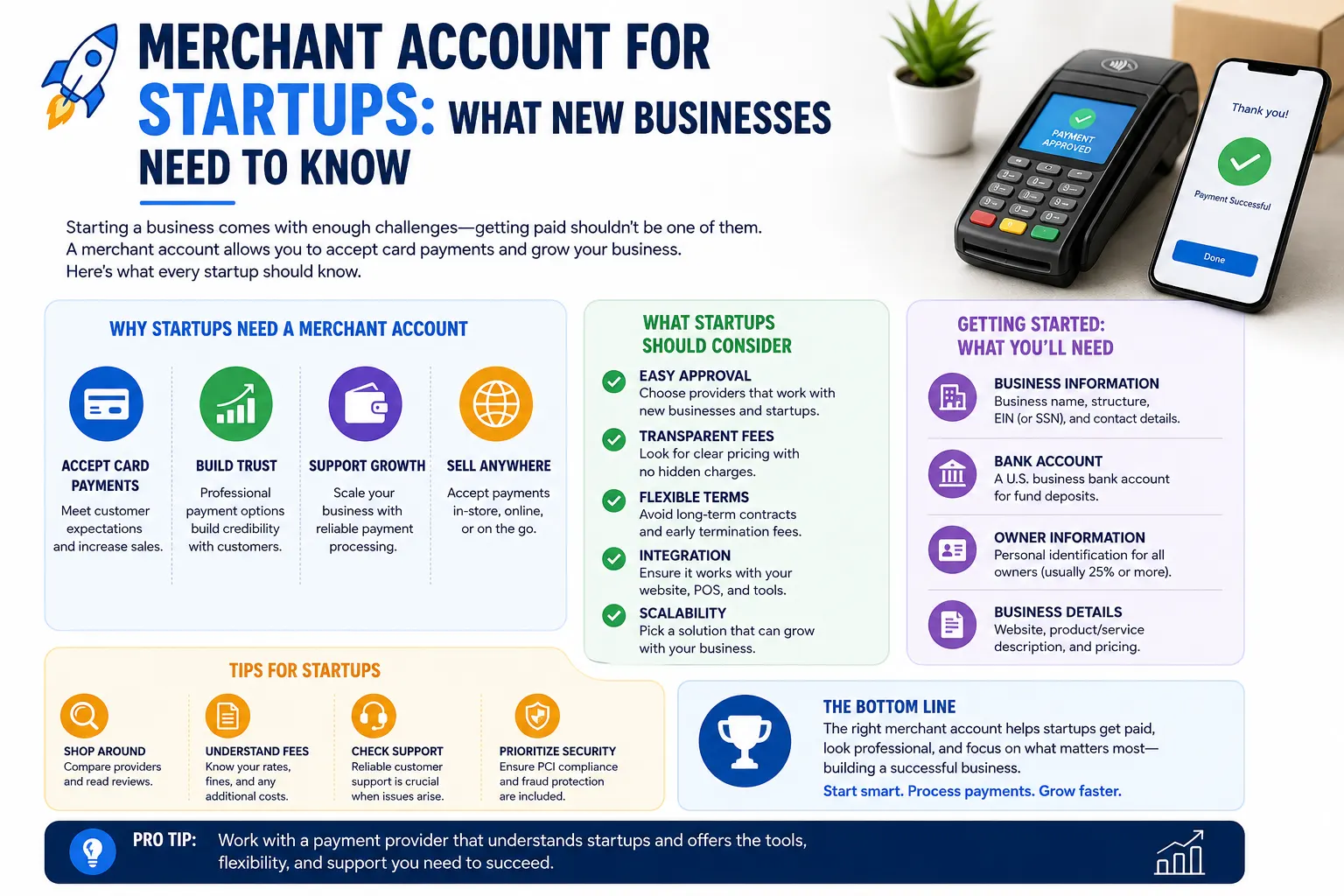
Getting paid is the first real test of any business, and for startups, that means setting up the right merchant account before the first transaction goes through. Whether you’re launching an eCommerce store, a SaaS product, or a service business, your payment infrastructure shapes customer trust, cash flow, and your ability to scale. This guide covers everything new businesses need to know about merchant accounts, payment providers, and how the high-risk payment landscape has shifted in 2026.
TL;DR
- A merchant account is a business account that enables you to accept card and digital payments from customers.
- Startups can choose between dedicated merchant accounts, payment aggregators, or high-risk-specific providers depending on their business model.
- Standard processing rates run 1.5%-2.9%; high-risk merchants typically pay 3.5%-5%+ per transaction.
- As of 2026, 92% of US merchants accept digital wallets and the global merchant services market is valued at $66.71 billion.
- Startups in regulated or high-chargeback verticals need a specialized high-risk payment gateway, not a mainstream aggregator, to build a stable payment stack.
What Is a Merchant Account and Why Does Your Startup Need One?
A merchant account is a type of business account that allows a company to accept credit and debit card payments. It acts as an intermediary holding account between your customer’s bank and your own business bank account, processing funds through card networks like Visa and Mastercard before settling to you.
For startups, a merchant account is the foundation of payment processing. Without one, you can’t accept card payments, scale to international customers, or offer modern checkout experiences. As the global e-commerce market is forecast to exceed $5.31 trillion in 2026, getting your payment infrastructure right from day one is a competitive necessity, not just an admin task.
It’s worth distinguishing between a merchant account and a payment gateway. The gateway is the technology that encrypts and transmits payment data from your checkout to the acquiring bank. Most modern payment providers bundle both into a single product, but knowing the difference helps you evaluate vendors accurately and avoid paying for tools you don’t need.
How Merchant Accounts Work: The Payment Processing Flow
When a customer completes a purchase on your site or in-store, payment processing happens in seconds across a chain of connected parties:
- The customer enters card details at checkout through a payment gateway or payment wallet.
- The gateway encrypts and routes the data to the relevant card network.
- The issuing bank approves or declines the transaction based on available funds and fraud signals.
- Approved funds are reserved and moved to your merchant account.
- After a settlement period, typically 1-3 business days, the funds transfer to your business bank account.
For startups with global ambitions, cross-border payments introduce additional layers: currency conversion, international network fees, and local compliance requirements. The cross-border payments market reached $194.6 trillion in value in 2024 and is projected to grow to $320 trillion by 2032, making multi-currency support a strategic priority for new businesses from day one.
Types of Merchant Accounts for Startups
Not every startup needs the same solution. The right type depends on your business model, risk profile, and how fast you need to get live.
Dedicated Merchant Accounts
A dedicated merchant account is issued directly by an acquiring bank or merchant services provider. You get exclusive control over your account, typically lower rates at higher volumes, and greater long-term stability. The trade-off is a more thorough application process, approval timelines of 2-4 weeks, and monthly fees.
Best for: Startups with a defined business model, consistent transaction volume, and low chargeback exposure.
Payment Aggregators
Aggregators like Stripe, Square, and PayPal pool merchants under a single master account. They offer fast onboarding (often same-day), simple flat-rate pricing, and no monthly minimums, which makes them popular for early-stage online payments and digital payments use cases. The downside is that they carry a higher risk of account holds or sudden terminations as your volume grows, since you share risk across the aggregator’s entire merchant base.
Best for: Pre-revenue or very early-stage startups testing product-market fit, low-volume sellers, and founders who need to start accepting payments within hours.
High-Risk Merchant Accounts
If your startup operates in a sector flagged as elevated-risk, subscription billing, digital goods, nutraceuticals, forex, travel, gaming, or any regulated product, mainstream payment gateways and aggregators will likely decline your application outright. A specialized high-risk payment gateway is built for exactly these scenarios, offering approvals where standard processors won’t.
Best for: Startups in restricted industries, recurring billing businesses, and companies with international customer bases and elevated chargeback exposure.
Key Fees: What Startups Should Budget For
Fee structures are one of the most consequential decisions you’ll make when choosing a merchant account. Here’s how standard and high-risk accounts compare:
| Fee Type | Standard Account | High-Risk Account |
|---|---|---|
| Processing Rate (MDR) | 1.5% – 2.9% + per-tx | 3.5% – 5%+ per-tx |
| Monthly Fee | $0 – $25 | $25 – $100 |
| Chargeback Fee | $15 – $25 per dispute | $25 – $100 per dispute |
| Rolling Reserve | None | 5% – 10% of revenue |
| Reserve Hold Period | N/A | 90 – 180 days |
| Setup Fee | $0 – $50 | $0 – $250 |
Rolling reserves: deserve particular attention for startups. A rolling reserve is a percentage of your revenue held by the processor as a risk buffer against potential chargebacks. This holdback, typically 5%-10%, is retained for 90 to 180 days before release. For a cash-strapped early-stage business, this can create meaningful strain. When negotiating with a high-risk provider, push for reserve review checkpoints: many processors will reduce your reserve from 10% to 5% after three or four clean processing months.
High-Risk Payment Gateways for Startups: 2026 Update
The high-risk payment processing market has seen significant structural changes heading into 2026. Traditional processors are tightening underwriting across several verticals due to regulatory pressure, while specialized providers have expanded coverage and cut approval timelines.
When Does a Startup Qualify as High-Risk?
Lenders and acquirers classify businesses using Merchant Category Codes (MCCs) assigned by Visa and Mastercard. Your startup may be flagged as high-risk if it operates in:
- Subscription or recurring billing models
- Digital goods, SaaS, or online gaming
- CBD, supplements, or nutraceuticals
- Forex, cryptocurrency, or financial services
- Travel agencies, event ticketing, or accommodation
- Adult content or age-restricted products
Even a startup with zero processing history and zero chargebacks can be automatically declined by mainstream processors based solely on industry classification. This is why identifying the right high-risk payment gateway before you apply saves weeks of delays and rejected applications.
Top High-Risk Merchant Account Providers in 2026
| Provider | Approval Time | Rate Range | Rolling Reserve | Notable Strength |
|---|---|---|---|---|
| PaymentCloud | 24-48 hours | Custom (interchange+) | Yes (varies) | Hard-to-place & previously declined merchants |
| HighRiskPay | 24-48 hours | Flat-rate | Varies | Simple pricing; no setup fee |
| eMerchantBroker | 24 hours | 2.95% – 3.95% | Yes | Broad vertical coverage; ACH + crypto tools |
| Easy Pay Direct | 2-5 days | Custom | Varies | Subscription billing; load balancing |
| Durango Merchant Services | 1-2 weeks | Custom | 5%-10% | International processing; MATCH-listed merchants |
2026 shift to watch – crypto settlement gateways: An emerging category of fiat-to-crypto processors now accepts standard Visa and Mastercard payments from customers and settles merchant funds directly in stablecoins like USDC or USDT. These gateways eliminate rolling reserves and fund-freeze risk entirely, with fees typically running 1%-3%. They’re gaining traction among high-risk operators who have been declined or terminated repeatedly by traditional acquirers. Tax treatment and stablecoin volatility are key considerations before adopting this route.
Merchant Account Options: Pros and Cons
Dedicated Merchant Account
Pros
- Stable account with exclusive ownership, no shared risk with other merchants
- Lower transaction rates at higher processing volumes
- Suitable for scaling operations and enterprise-level merchant services
- Greater control over settlement timelines and fund release
Cons
- Approval process takes 2-4 weeks with full documentation required
- Monthly fees and longer contract commitments (often 12-36 months)
- Many standard acquiring banks still decline high-risk business categories
Payment Aggregator
Pros
- Same-day or next-day setup, ideal for fast launches
- Flat-rate pricing with no monthly minimums
- Broad support for payment wallets, BNPL, and alternative payment methods
- No technical complexity, managed gateway and fraud tools included
Cons
- Account holds and fund freezes are far more common at scale
- Per-transaction costs become expensive above $30K-$50K/month in volume
- Not designed for high-risk business models or international-heavy merchants
- Limited chargeback dispute support compared to dedicated providers
High-Risk Merchant Account
Pros
- Accepts businesses systematically declined elsewhere
- Industry-specific compliance and fraud tools built in
- Approvals available in 24-48 hours from specialized providers
- Designed to support cross-border payments, multi-currency, and recurring billing
Cons
- Processing rates are higher (3.5%-5%+) compared to standard accounts
- Rolling reserves hold 5%-10% of revenue for 90-180 days
- Contract terms require careful review for termination clauses and hidden fees
- Documentation requirements are more extensive during underwriting
2026 Industry Snapshot: What the Data Says
A handful of data points from early 2026 illustrate how fast the payment expectations around startups have shifted:
- 92% of US merchants: now accept digital wallets, up 4 percentage points since 2024, per the JD Power 2026 U.S. Merchant Services Satisfaction Study.
- Buy Now Pay Later (BNPL): is accepted by 58% of US small businesses, rising from 54% in 2024, now ranking as the fourth most common payment method behind debit/credit cards, digital wallets, and cash.
- Crypto payment acceptance: among US small businesses stands at 19% in 2026, up 4 points from 2025, with 37% of merchants reporting a favorable view of cryptocurrency.
- The global merchant services: market is projected to reach $66.71 billion in 2026, growing at a 17.1% CAGR through 2034 (DataInsightsReports, 2026).
- The real-time payments: market is forecast to reach $44.58 billion in 2026, driven by growing demand for instant settlement and cash flow visibility (Fiserv, 2026).
For founders, these figures signal one clear direction: payment infrastructure is no longer back-office. Offering cards, wallets, BNPL, and global payment methods from launch is a direct driver of conversion, retention, and market reach.
How to Choose the Right Payment Provider as a Startup
Before committing to any provider, run through this checklist:
- Confirm industry fit: Does the provider explicitly support your vertical? Broad “high-risk” claims don’t guarantee coverage for every MCC.
- Request pricing in writing: Rates for high-risk accounts vary by risk profile. Get a formal written quote before signing anything.
- Review reserve terms carefully: Understand the holdback percentage, scheduled review points, and the release timeline before you’re locked in.
- Check for built-in chargeback tools: Real-time alerts through Verifi or Ethoca are standard for serious high-risk accounts. Confirm they’re included, not sold as expensive add-ons.
- Verify gateway and platform compatibility: Confirm the provider integrates with your eCommerce platform, Shopify, WooCommerce, Magento, or BigCommerce.
- Understand settlement speed: For startups, cash flow is critical. Know exactly when funds land in your account and what triggers delays.
The goal isn’t just getting approved, it’s building a stable payment stack that scales without surprise terminations, fund freezes, or hidden costs eroding your margins.
Frequently Asked Questions
Q: Can a startup get a merchant account with no processing history?
A: Yes. Payment aggregators and many specialized high-risk providers will approve startups with no history, though providers may impose rolling reserves or higher rates until a processing track record is established.
Q: What documents do startups typically need to apply?
A: Most providers require business registration documents, government-issued ID, recent bank statements, a functional website with clear product descriptions, and a refund and privacy policy. High-risk applications also require estimated monthly volume and sometimes a business plan narrative.
Q: How long does it take to get approved for a merchant account?
A: Payment aggregators can onboard within hours. Dedicated merchant accounts typically take 2-4 weeks. Specialized high-risk providers can often approve within 24-48 hours.
Q: What is a rolling reserve and how long is it held?
A: A rolling reserve is a percentage of your revenue held by the processor as a chargeback buffer. For high-risk accounts, this is typically 5%-10%, retained for 90-180 days before being released to your bank account.
Q: Can I switch payment providers after I launch?
A: Yes, but check your contract for early termination fees. Re-applying with a new provider resets underwriting, which may mean new reserve terms and different processing rates.
Q: Is a payment gateway the same as a merchant account?
A: No. A payment gateway is the technology that transmits transaction data securely between your checkout and the acquiring bank. A merchant account is the financial account that holds and settles those funds. Many modern payment providers offer both in a single package.
Comments
No comments yet. Be the first to share your thoughts.
Leave a comment