
TL;DR
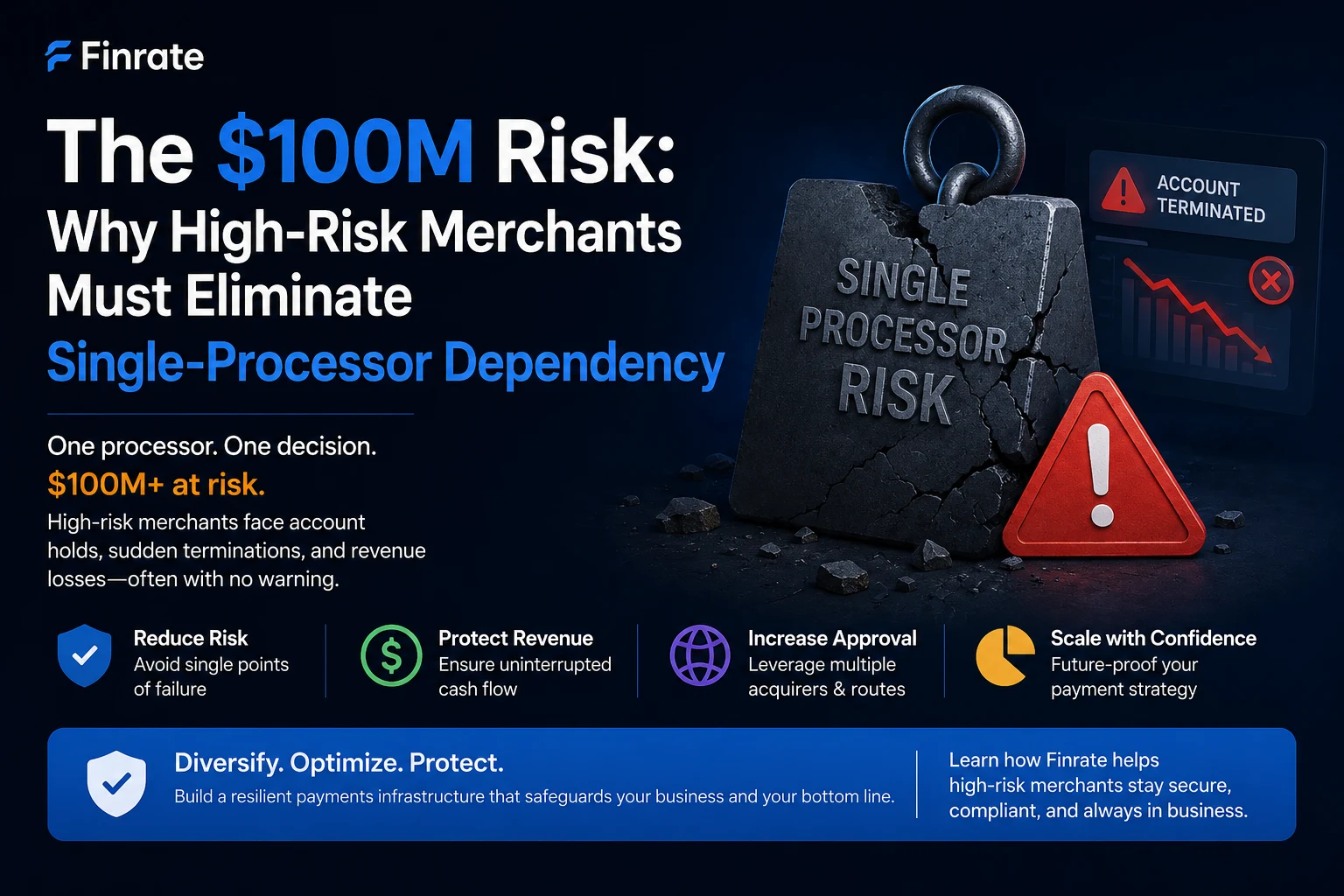
Most high-risk merchants depend on a single acquirer that can terminate with just 30 days’ notice, and over 60% get terminated within their first 24 months, often with funds frozen for 90-180 days after. Single-processor dependency is the biggest structural risk in high-risk payment processing, and the fix is building processor redundancy before you need it, not after.
The Anatomy of a $100 Million Risk
The math behind the headline number isn’t abstract. Consider a high-risk merchant processing $100 million in annual revenue, a realistic scale for an established iGaming operator, subscription platform, or global e-commerce brand in a regulated vertical.
- That’s roughly $274,000 in daily transaction volume
- A sudden termination doesn’t just stop future revenue, it also freezes existing funds, commonly for 90-180 days, to cover potential future disputes
- If termination happens during a peak sales period (a launch, a seasonal spike, a marketing push), the revenue impact compounds well beyond the frozen reserve alone
- Recovery isn’t instant either: most high-risk merchant account approvals take one to six weeks of underwriting, even with a backup application already prepared
Stack a multi-week processing gap on top of a 90-180 day fund freeze, and a business generating $100 million a year is looking at a plausible seven- and eight-figure impact from a single processor decision, one that had nothing to do with the merchant’s actual performance.
Why Single-Processor Dependency Is the Default
Most high-risk merchants don’t choose single-processor dependency; they end up there by default. It’s the path of least resistance during onboarding, and few merchants revisit the decision once payments are flowing.
- Setting up a second merchant account means a second underwriting process, a second integration, and often a second set of compliance requirements
- Payment gateways and merchant services providers rarely proactively suggest redundancy, since it doesn’t benefit their own relationship with the merchant
- Many high-risk merchants only think about processor concentration risk after their first termination, by which point the damage is already done
How and Why High-Risk Merchant Accounts Get Terminated in 2026
The 30-Day No-Cause Clause
Nearly every high-risk processor agreement contains a clause allowing termination at any time, with roughly 30 days’ notice and no cause required. For high-risk verticals specifically, this clause gets used routinely, not as a last resort, but as a standard risk-management tool.
De-Risking Is a Bank Decision, Not a Merchant Failure
A large share of terminations have nothing to do with an individual merchant’s chargeback history or compliance record. De-risking is a strategic decision by banks to exit entire categories of risk they consider operationally, legally, or reputationally costly to manage, regardless of how well any specific merchant within that category performs.
- Businesses in forex, gaming, adult content, dating, and global e-commerce are the categories most frequently de-risked
- A merchant account can be terminated even with a clean transaction history, simply because the acquiring bank decided to exit the entire merchant category
- This is precisely why individual performance can’t fully protect a merchant relying on a single processor relationship
MATCH Listing: The Consequence That Follows You
If a termination stems from fraud, card network rule violations, or chargeback ratios above specific thresholds, the merchant can be added to the MATCH list (Mastercard Alert to Control High-risk Merchants), a shared database processors use to screen new applicants. A MATCH listing doesn’t automatically follow every termination, but it can make securing a replacement account significantly harder at exactly the moment a merchant needs one fastest.
2026 Data: The Scale of the Problem
| Data Point | 2026 Figure |
|---|---|
| High-risk businesses with at least one account terminated in their first 24 months | 60%+ |
| Typical termination notice period (no-cause clause) | ~30 days |
| Fund hold period after termination | 90-180 days |
| Time to secure a new high-risk merchant account | 1-6 weeks |
| High-risk processing cost range (2026) | 3.5%-7.0% effective rate |
| Standard rolling reserve | 5%-15%, held 90-180 days |
These aren’t edge cases. For high-risk merchants, a termination event is closer to a baseline scenario than a tail risk, which is exactly why processor redundancy needs to be a standing part of payment infrastructure, not a reaction to a crisis.
Single-Processor vs. Multi-Processor: A Direct Comparison
| Factor | Single-Processor Dependency | Multi-Processor / Multi-Acquirer Setup |
|---|---|---|
| Revenue continuity | Zero backup if terminated | Traffic shifts to a live processor |
| Negotiating leverage | Low, merchant has no alternative | Higher – merchant can compare terms |
| Setup complexity | Low | Higher – multiple underwriting relationships |
| Approval rate resilience | Vulnerable to single acquirer’s risk model | Improved via routing across acquirers |
| Recovery time after termination | Weeks of downtime | Near-zero – volume reroutes automatically |
| Cost | Potentially lower admin overhead | Slightly higher operational complexity, offset by continuity |
Pros and Cons of Processor Redundancy
Pros
- Eliminates single points of failure in revenue collection
- Improves approval rates through routing across multiple acquiring relationships
- Strengthens negotiating position on merchant account fees and reserve terms
- Reduces the business impact of any one bank’s de-risking decision
Cons
- Requires managing multiple underwriting relationships and compliance requirements
- Adds operational complexity to reconciliation and reporting
- May require a payment orchestration layer to route intelligently across providers rather than manually
Building Processor Redundancy: A Practical Approach
- Apply for a backup merchant account before you need one: underwriting takes weeks, and applying while your primary account is healthy strengthens your application
- Work with a specialized high-risk payment gateway: that maintains relationships with multiple acquiring banks, rather than a single acquirer relationship resold under one brand
- Diversify payment methods: not just processors, supporting digital payments, payment wallets, and local payment methods reduces dependency on any single card scheme relationship
- Consider cross-border payments infrastructure: if your business operates internationally, since a multi-region acquiring setup naturally distributes processor concentration risk
- Track your account health proactively: chargeback ratio trends, dispute reason codes, and reserve status are the same signals processors watch before initiating a termination review
- Evaluate crypto payments settlement as a supplementary rail: some merchant services providers now offer stablecoin settlement alongside standard card processing, giving merchants a payout path that doesn’t depend on a single acquiring bank relationship
What a Resilient High-Risk Payment Stack Looks Like
A merchant that has genuinely eliminated single-processor dependency typically has:
- At least two active merchant accounts with different acquiring banks, not just two brands reselling the same underlying acquirer
- A payment gateway or orchestration layer capable of routing transactions across processors based on performance and risk
- Online payments infrastructure that supports multiple card networks and alternative payment methods, not just a single Visa/Mastercard relationship
- A documented contingency plan for what happens operationally in the first 48 hours after a termination notice
The distinction between “has a backup” and “is actually resilient” matters here. A backup account that’s never been tested, integrated, or kept current with the same product catalog and billing descriptors as the primary account isn’t a real safety net, it’s a document sitting in a drawer. Resilience means the backup processor can absorb live volume within hours of a switch, not weeks.
Key Takeaways
- More than 60% of high-risk businesses experience at least one merchant account termination within their first 24 months, this is a baseline risk, not an edge case
- Processor agreements typically allow termination with 30 days’ notice and no cause, and de-risking decisions are often about the merchant’s category, not their individual performance
- Fund holds of 90-180 days after termination compound the revenue impact well beyond the immediate loss of processing capability
- Multi-processor redundancy, diversified payment methods, and proactive backup applications are the practical fixes, not a one-time decision, but ongoing infrastructure
- A specialized high-risk payment gateway with multiple acquiring relationships offers structurally better continuity than a single-processor setup, independent of fee savings
Frequently Asked Questions
Why do high-risk merchant accounts get terminated so often?
Most terminations stem from bank-level de-risking decisions about an entire merchant category, not necessarily an individual merchant’s performance, combined with contract clauses that allow termination with 30 days’ notice and no cause.
How long are funds held after a high-risk merchant account is terminated?
Commonly 90 to 180 days, since processors hold funds in reserve to cover potential chargebacks and disputes that may arise after the account closes.
What is the MATCH list, and does every termination result in a listing?
MATCH (Mastercard Alert to Control High-risk Merchants) is a shared database processors use to screen applicants. Not every termination results in a listing, it’s typically reserved for terminations involving fraud, card network violations, or chargeback ratios above specific thresholds.
Can I apply for a second merchant account while my current one is still active?
Yes, and it’s standard practice for high-risk merchants managing processor risk proactively. Disclosing your current account status honestly is essential, since concealing a prior review or termination can itself trigger termination from the new processor.
Does having multiple processors cost more than a single processor relationship?
It typically adds some operational overhead for managing multiple relationships, but this is usually offset by improved approval rates, better negotiating leverage, and, most importantly, the elimination of a single point of failure in revenue collection.
Is crypto payment settlement a realistic backup for high-risk merchants?
For many merchants, yes, as a supplementary rail rather than a full replacement. Stablecoin settlement removes dependency on a single acquiring bank relationship, though most businesses still need traditional processing for recurring billing and multi-currency fiat settlement.
Comments
No comments yet. Be the first to share your thoughts.
Leave a comment