
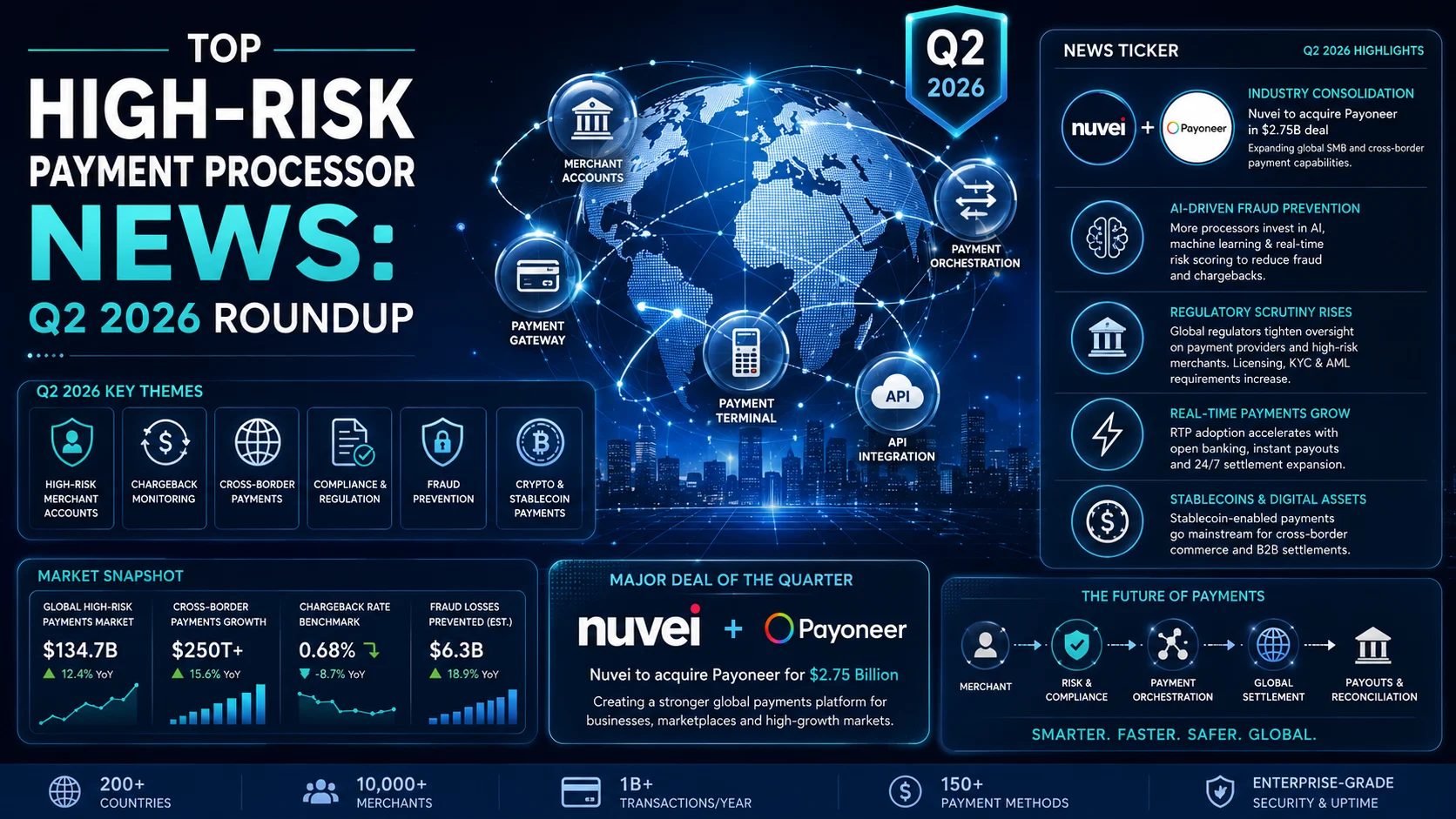
Q2 2026 delivered one of the most consequential stretches of activity the high-risk payment processing industry has seen in years, a multi-billion-dollar acquisition reshaping cross-border infrastructure, a federal court holding a processor in contempt for serving MATCH-listed merchants, and stablecoin settlement crossing fully into mainstream merchant services. For high-risk merchants and payment providers tracking where the industry is heading, this quarter offered more signal than most full years. Here is what actually happened between April and June 2026, and what it means for high-risk merchants choosing where to process.
TL;DR
- Nuvei announced a definitive agreement to acquire Payoneer for approximately $2.75 billion on June 15, 2026, a deal that would combine Nuvei’s high-risk and iGaming acquiring strength with Payoneer’s global cross-border compliance infrastructure
- A federal court held payment processor Cliq in contempt for violating a prior FTC order by processing hundreds of millions of dollars for merchants on Mastercard’s MATCH list
- Nuvei launched direct acquiring in Mexico and received approval to process for online sportsbook operators in New York, extending its high-risk and iGaming footprint
- Stablecoin transaction volume surpassed $33 trillion in 2025, with 90% of financial institutions now actively building stablecoin capability into their payment infrastructure
- Stripe’s Bridge-powered stablecoin checkout and PayPal’s expanding PYUSD payout infrastructure both moved further into mainstream merchant adoption this quarter
- Global Payments’ completed acquisition of Worldpay continues reshaping the acquiring landscape for regulated gaming operators who need licensed acquirers in restricted jurisdictions
The Biggest Story: Nuvei’s $2.75 Billion Bid for Payoneer
The single most significant development for high-risk payment processing in Q2 2026 came on June 15, when Nuvei and Payoneer announced a definitive agreement under which Nuvei will acquire all outstanding shares of Payoneer Global for $7.40 per share in cash, a total transaction value of approximately $2.75 billion.
The strategic logic is significant for high-risk merchants specifically. Nuvei has built one of the deepest acquiring networks in regulated iGaming, crypto, and forex, verticals that depend on payment providers willing to underwrite elevated chargeback and regulatory risk. Payoneer brings a different but complementary strength: a global cross-border compliance and payout infrastructure built to serve marketplace sellers, freelancers, and international suppliers across markets where regulatory documentation requirements are dense and constantly shifting.
Nuvei Chairman and CEO Phil Fayer described the deal as a step in the company’s evolution into “a global financial infrastructure leader,” combining the ability to accept payments, send funds, issue cards, manage treasury and FX needs, and access embedded financial services at scale. For offshore merchants and high-risk operators with cross-border distributor or supplier networks, MLM companies, crypto exchanges, and global e-commerce platforms among them, a combined Nuvei-Payoneer entity would offer materially more unified infrastructure than sourcing acquiring and payout capability from separate providers.
The deal had not closed as of this writing and remains subject to customary closing conditions and regulatory approval. High-risk merchants currently using either platform should monitor integration timelines closely, as historically these mergers create a transition window where account terms, API integrations, and support structures can shift meaningfully.
Enforcement: FTC Holds Processor in Contempt Over MATCH-Listed Merchants
The quarter’s clearest enforcement signal came from a federal court ruling holding payment processor Cliq in contempt for violating a prior FTC order. The court found that the defendants had unlawfully processed hundreds of millions of dollars in transactions for merchants listed on Mastercard’s Member Alert To Control High-risk merchants (MATCH) database, the industry’s primary mechanism for flagging operators terminated for chargeback or compliance violations.
According to the court’s findings, the processor assisted merchants in evading fraud and risk monitoring programmes, including processing transactions structured to mask true chargeback rates and helping merchant groups shift volume between accounts after prior accounts were closed. The ruling also found the processor failed to conduct required underwriting, neglecting to verify mandatory business information and ignoring evidence of shell company structures.
This case sits alongside a related January 2026 FTC action asking a federal court to hold other payment processors in contempt under a 2015 order, citing similar patterns: processing for MATCH-listed clients, failing to screen high-risk merchants for deceptive practices, and continuing to process for clients with elevated chargeback rates without adequate review.
For legitimate high-risk merchants and payment providers, these enforcement actions reinforce a point worth repeating: processors willing to skip proper underwriting to capture MATCH-listed or otherwise high-risk merchant volume are not a viable long-term processing strategy. Working with a payment provider that conducts genuine due diligence, even when it slows onboarding, is the more durable path, and the regulatory environment in 2026 is actively narrowing the space for processors who cut underwriting corners.
iGaming and Regional Expansion: Nuvei’s Continued Build-Out
Beyond the Payoneer deal, Nuvei had an active quarter expanding its direct iGaming and regional acquiring footprint, developments directly relevant to high-risk merchants in regulated gambling and sports betting verticals.
On April 21, 2026, Nuvei launched direct acquiring in Mexico, enabling businesses to process card transactions locally through Nuvei’s own licensed infrastructure rather than routing through a third-party acquiring relationship. The company also confirmed approval to process payments for online sportsbook operators in New York, extending its regulated US sports betting coverage following its earlier work as a pilot payment provider for Carousel Group’s US iGaming and sports betting expansion.
This pattern of direct, licensed acquiring expansion matters for high-risk merchants because it reduces dependency on intermediary acquiring relationships that can be more fragile during periods of regulatory change. A payment provider with direct local licensing in a given market generally offers more stable processing terms than one relying on a chain of partner relationships to reach the same jurisdiction.
Worldpay’s Continued Integration Under Global Payments
Global Payments completed its acquisition of Worldpay in January 2026, forming what the combined entity describes as a leading pure-play merchant solutions company serving merchants across more than 175 countries in 153 currencies. Worldpay has historically held acquiring licences in regulated gambling jurisdictions and operates formal programmes for licensed gaming operators where a licensed acquirer is a regulatory requirement, making the integration’s progress through 2026 a relevant data point for high-risk gaming merchants evaluating their acquiring options at enterprise scale.
Stablecoin Settlement Crosses Fully Into Mainstream Merchant Infrastructure
If Q1 2026 was about stablecoin regulatory clarity following the GENIUS Act’s implementation rulemaking, Q2 2026 was the quarter stablecoin merchant infrastructure became genuinely mainstream rather than crypto-native.
Market Scale
Stablecoin transaction volume surpassed $33 trillion in 2025, and industry survey data indicates 90% of financial institutions are now taking active steps toward stablecoin adoption, figures that mark a definitive shift from stablecoins as a niche settlement tool to standard payment infrastructure that high-risk merchants increasingly expect their payment providers to support natively.
Stripe and PayPal Push Further Into Stablecoin Checkout
Stripe’s stablecoin checkout, built on its Bridge acquisition, continued expanding merchant adoption through Q2 2026. The integration supports USDC and USDB settlement across Ethereum, Base, and Polygon networks, with merchants receiving settlement credited in USD and no code changes required for existing Stripe integrations. Stripe’s flat 1.5% transaction fee, with no additional fixed fee layered on top, positions it competitively against purpose-built crypto processors for merchants who want stablecoin acceptance without managing separate crypto-specific infrastructure.
PayPal continued extending its PYUSD stablecoin beyond checkout into payouts and remittances during the quarter, with its “Pay with Crypto” feature allowing merchants to accept crypto payments while receiving settlement in fiat or PYUSD. For high-risk merchants managing distributor commissions, freelancer payouts, or international supplier payments, this expansion of PYUSD into the payout side of the transaction, not just acceptance, is a meaningful infrastructure development.
Specialist High-Risk Crypto Processors Gain Recognition
0xProcessing, a crypto payment processor purpose-built for verticals traditional payment rails reject, iGaming, forex, high-risk merchants, and global B2B operators, was recognised with “Best Crypto Payment Solution 2026” at SiGMA Dubai, one of the iGaming industry’s most prominent award circuits. The platform’s Volatility Risk Control System, which converts incoming volatile crypto into stablecoins automatically at settlement, reflects the broader industry direction toward eliminating volatility risk as a barrier to crypto payment adoption among high-risk operators.
Q2 2026 High-Risk Payment Processor News: Summary Table
| Development | Date | Relevance to High-Risk Merchants |
|---|---|---|
| Nuvei agrees to acquire Payoneer ($2.75B) | June 15, 2026 | Combines high-risk acquiring strength with global cross-border payout infrastructure |
| FTC contempt ruling against processor Cliq | ~May 2026 | Reinforces enforcement risk for processors serving MATCH-listed merchants |
| Nuvei launches direct acquiring in Mexico | April 21, 2026 | Expands licensed local acquiring options for LATAM-facing high-risk merchants |
| Nuvei approved for NY sportsbook processing | Q2 2026 | Extends regulated US iGaming payment provider coverage |
| Stablecoin volume surpasses $33 trillion (2025 total) | Reported Q2 2026 | Confirms stablecoin settlement as mainstream, not niche, merchant infrastructure |
| Stripe/Bridge stablecoin checkout expansion | Ongoing through Q2 2026 | Mainstream payment gateways now offer native stablecoin acceptance at 1.5% flat fee |
| 0xProcessing wins SiGMA Dubai award | Q2 2026 | Signals continued specialist processor investment in high-risk crypto infrastructure |
Pros and Cons of the Q2 2026 Landscape for High-Risk Merchants
Pros
- Continued consolidation (Nuvei-Payoneer, Global Payments-Worldpay) is producing larger, more capitalised payment providers with deeper high-risk vertical expertise
- Stablecoin settlement moving into mainstream payment gateways gives high-risk merchants more choice beyond specialist crypto-only processors
- Active FTC enforcement against processors serving MATCH-listed merchants should reduce the population of unstable, compliance-skipping processors over time
- Direct, locally licensed acquiring expansion (Nuvei in Mexico, ongoing Worldpay gaming licences) improves processing stability for merchants in regulated verticals
Cons
- M&A integration periods historically create short-term uncertainty around account terms, API stability, and support quality for merchants on the acquired platform
- Consolidation among large processors may reduce the number of independent options for harder-to-place high-risk verticals over time
- Enforcement actions, while positive for the industry’s integrity, can create disruption for merchants whose processor is suddenly subject to a contempt finding or court order
- Mainstream stablecoin adoption increases competitive pressure on specialist high-risk crypto processors, though differentiated tools like volatility control systems remain a meaningful advantage
FAQ: Q2 2026 High-Risk Payment Processor News
Has the Nuvei-Payoneer deal closed?
No – as of this writing, the deal is a definitive agreement announced June 15, 2026, and remains subject to customary closing conditions and regulatory approval. High-risk merchants using either platform should monitor official company communications for confirmed closing and integration timelines.
What does the Cliq contempt ruling mean for merchants currently being processed by them?
Merchants processing through a provider found in contempt of an FTC order should expect significant operational disruption, potentially including account freezes, fund holds, or forced migration to a new processor. This underscores the importance of choosing payment providers with genuine underwriting practices rather than those offering unusually easy approval for high-risk or MATCH-listed merchants.
Is stablecoin settlement now a standard feature merchants should expect from any payment gateway?
It is becoming one. With Stripe, PayPal, and specialist processors all expanding stablecoin capability in 2026, high-risk merchants evaluating new payment providers should treat native stablecoin support as an increasingly standard evaluation criterion, particularly for cross-border and offshore merchant operations.
Does Nuvei’s expansion into Mexico and New York sportsbook processing affect merchants in other markets?
Not directly, but it signals Nuvei’s broader strategy of building direct, licensed acquiring relationships market by market rather than relying solely on partner banks. High-risk merchants in other regulated markets should watch for similar direct acquiring announcements as an indicator of where Nuvei and comparable processors are investing next.
How often does TheFinRate publish this roundup?
This roundup is published quarterly. The next edition will cover Q3 2026 (July–September) once that quarter concludes, ensuring all reported developments reflect confirmed, dated events rather than speculation about events that have not yet occurred.
Comments
No comments yet. Be the first to share your thoughts.
Leave a comment