
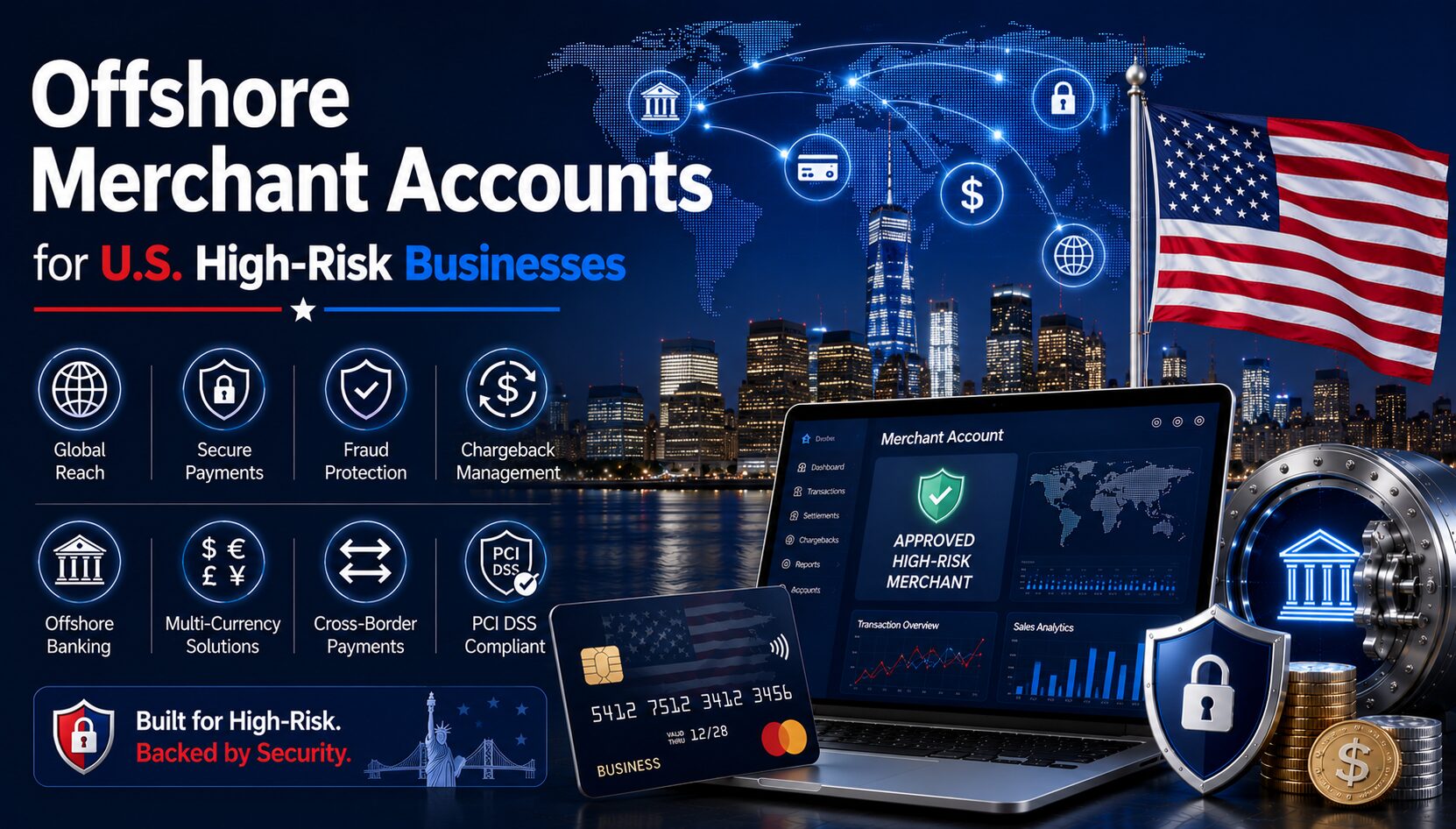
The United States presents the most fragmented high-risk regulatory picture in this entire series — not because any single rule is unusually strict, but because gambling law is decided state by state, forex and derivatives trading sits under federal CFTC/NFA oversight, crypto businesses answer to both FinCEN and a patchwork of state money transmitter licenses, and payment processors themselves carry direct legal liability for knowingly processing illegal gambling transactions under a specific federal statute. For U.S.-facing high-risk merchants, understanding which layer of this patchwork actually applies to your specific business is often more important than the offshore-vs-domestic decision itself.
This guide covers the state-by-state gambling landscape, the federal UIGEA framework that makes payment processors direct legal targets, CFTC/NFA forex regulation, FinCEN’s crypto framework, and which providers are worth evaluating for U.S. high-risk categories.
Gambling in the U.S.: 50 States, No Single Answer
There is no federal law establishing a uniform gambling policy for the United States — it has always been left to individual states, and the result since the Supreme Court’s 2018 PASPA ruling has been a genuinely fast-moving but deeply uneven expansion.
Sports betting has expanded rapidly and broadly. More than 38 states plus Washington D.C. now allow sports betting in at least one form, with roughly 30 states offering online/mobile wagering specifically, and combined annual handle across the country now exceeding $100 billion. States like New Jersey, Pennsylvania, and Michigan operate genuinely competitive markets with dozens of licensed operators including DraftKings, FanDuel, BetMGM, and Caesars, while others — Montana and New Hampshire among them — restrict the market to a single operator through a state lottery partnership. As of 2026, eleven states still allow no sports betting at all, including Alabama, Alaska, California, Georgia, Hawaii, Idaho, Minnesota, Oklahoma, South Carolina, Texas, and Utah.
Online casino gaming has moved far more slowly and remains genuinely narrow. As of mid-2026, only seven to eight states have fully regulated real-money online casino markets: New Jersey, Pennsylvania, Michigan, West Virginia, Connecticut, Delaware, and Rhode Island, with Maine authorized but not yet launched — expected in late 2026 or 2027, structured around exclusive partnerships between the state’s four federally recognized tribes and third-party operators. New Jersey remains the largest and most established U.S. iGaming market and the model most other states reference, having launched in November 2013 under the New Jersey Division of Gaming Enforcement. Illinois, Massachusetts, and New York are among the states actively weighing new online casino legislation in 2026, but land-based casino lobbying against cannibalization and political concerns about online gambling’s addictive potential have kept expansion slow.
Offshore gambling operators occupy a genuine legal gray zone that payment processors specifically cannot treat casually. Where a state hasn’t authorized online casino gaming, offshore-licensed operators (frequently Curaçao-licensed) sometimes serve U.S. players anyway, and the legality of these offshore sites for individual bettors is often described as a gray area — but for payment processors, this ambiguity does not extend to a corresponding legal safe harbor.
UIGEA: Why Payment Processors Are Direct Legal Targets, Not Bystanders
This is the single most important U.S.-specific fact for anyone in the payments industry evaluating gambling-adjacent merchants: the Unlawful Internet Gambling Enforcement Act (UIGEA) prohibits payment processors from knowingly accepting payments for unlawful internet gambling, and liability under this statute flows directly to processors — not just to the gambling operator.
“We didn’t know” is explicitly not a viable defense, and recent enforcement actions have reinforced this. If an offshore operator serves U.S. customers without the appropriate state licenses, processing their payments creates direct UIGEA violation risk for the processor itself, independent of whatever the operator’s own licensing situation looks like.
Offshore isn’t automatically disqualifying — but it carries a materially higher burden of proof. An offshore gambling operator presenting a Curaçao license and claiming to block U.S. customers isn’t automatically a red flag, but payment platforms and risk teams need to distinguish between operators with genuine, technically verifiable geo-enforcement and those with merely a stated policy that doesn’t hold up under scrutiny. Effective verification generally requires multiple layers — IP-based blocking, card BIN checks, KYC verification, and GPS-based confirmation — along with a documented chargeback and complaint analysis before treating an offshore operator’s U.S.-exclusion claims as reliable.
This means any payment provider or merchant working with a gambling-adjacent business needs a genuinely defensible verification framework for U.S. market exclusion, not just a vendor’s word that “we don’t serve U.S. customers.”
Forex and Derivatives: CFTC and NFA Set a High, Non-Negotiable Bar
Forex trading in the U.S. is regulated federally through the Commodity Futures Trading Commission (CFTC) and the National Futures Association (NFA), and this framework is considerably stricter than what many other jurisdictions in this series require.
Retail forex dealers must register as either a Futures Commission Merchant (FCM) or a Retail Foreign Exchange Dealer (RFED) with the NFA, and leverage limits are capped by regulation — historically 50:1 for major currency pairs and 20:1 for others, a materially tighter cap than jurisdictions with looser retail forex rules. This registration and leverage framework is a hard prerequisite for any legitimately operating U.S.-facing forex business; unregistered offshore brokers soliciting U.S. retail clients face the same category of enforcement risk seen in Japan’s FSA framework covered earlier in this series.
FinCEN, Crypto, and the State Money Transmitter Layer
Crypto businesses serving U.S. customers face a genuinely two-layer compliance burden that trips up many international operators.
FinCEN registration as a Money Services Business (MSB) is the federal baseline, requiring AML/KYC compliance programs, suspicious activity reporting, and ongoing transaction monitoring — a heavy regulatory scrutiny load that domestic banks cite directly as a reason for their caution around the category.
State-level money transmitter licensing is a separate, additional requirement layered on top of FinCEN registration, and this is where many offshore or newly formed crypto businesses stumble — a federal MSB registration alone does not substitute for the specific state licenses required to legally operate in individual U.S. states, each with its own application process, bonding requirements, and ongoing compliance obligations.
Beneficial ownership disclosure is treated as non-negotiable, not optional. Agencies including FinCEN, the FFIEC, and FATF all require merchants — and offshore entities specifically — to disclose beneficial ownership rather than using an offshore structure to obscure it. Any merchant approaching an offshore account with the intent to hide true ownership or sidestep KYC requirements is working directly against the stated position of every major relevant regulator, U.S. and international alike.
Card Network Rules Apply Regardless of Where the Merchant Account Sits
Independent of any specific U.S. federal or state law, Visa and Mastercard enforce their own global risk-monitoring programs that apply to U.S.-facing merchants whether they’re processing through a domestic or offshore acquirer. Visa’s VAMP program, for instance, set a 1.5% fraud-and-chargeback-rate threshold across various regions as of April 2026 — meaning a merchant can’t simply route around U.S. domestic scrutiny by using an offshore acquirer and expect to escape card network-level monitoring entirely.
Domestic vs. Offshore for U.S. High-Risk Merchants: What Changes
| Factor | Domestic U.S. High-Risk Specialist | Offshore Processing |
| State-licensed gambling operators | Well-aligned with UIGEA compliance and state licensing by default | Should complement, not replace, verified U.S. state licensing |
| Unlicensed/offshore gambling | Processing this creates direct processor UIGEA liability | Same liability applies — offshore location doesn’t provide legal cover |
| CFTC/NFA-registered forex | Standard domestic high-risk underwriting applies | Should only be considered once registration is confirmed |
| Crypto/MSB businesses | Requires FinCEN registration plus state money transmitter licenses | Same dual-layer requirement applies for any business serving U.S. customers |
| CBD, adult, nutraceutical, MLM | Domestic high-risk specialists exist but often carry higher rates | Standard offshore value proposition, still subject to card network monitoring |
| Best fit | Merchants wanting a documented MATCH-recovery path or U.S.-specific compliance support | Merchants needing broader multi-currency reach or facing repeated domestic terminations |
Providers Worth Evaluating for the U.S. Market
- SMB Global
SMB Global is frequently cited as one of the strongest U.S.-based options for merchants who process internationally or need a genuine offshore backup alongside domestic processing — a useful hybrid position for merchants who want U.S.-based support without giving up multi-currency flexibility.
- eMerchantBroker (EMB)
EMB’s experience across CBD, forex, and adult categories extends directly to U.S. merchants in these verticals, where domestic bank caution creates a genuine acceptance gap — particularly relevant given that the 2018 Farm Bill only partially moved hemp-derived CBD out of high-risk status, leaving plenty of gray area for related nutraceutical and cannabinoid products.
- PayCly
PayCly’s multi-currency support and CBD/forex/adult specialization suit U.S. merchants operating as part of a broader international strategy. For anything gambling-adjacent, PayCly should be evaluated on whether it requires verified, technically confirmed U.S. state licensing or geo-blocking evidence before onboarding, given the direct UIGEA liability processors carry.
- Nuvei
Nuvei’s deep acquiring network across regulated iGaming, crypto, and forex makes it relevant for U.S.-facing merchants with cross-border operations, particularly those managing distributor networks or international supplier relationships alongside domestic U.S. sales.
Industry-Specific Considerations for U.S. Merchants
Online gambling: Confirm actual state-by-state licensing status rather than assuming national legality — a sportsbook licensed in New Jersey has no automatic right to serve customers in Texas or Utah. For offshore operators specifically, demand technically verifiable geo-blocking evidence (IP, BIN, KYC, GPS layers), not just a policy statement, given direct UIGEA processor liability.
Forex trading: CFTC/NFA registration as an FCM or RFED is mandatory, along with adherence to the 50:1/20:1 leverage caps — materially stricter than many offshore jurisdictions, which is precisely why unregistered offshore brokers soliciting U.S. clients face real enforcement exposure.
Cryptocurrency and MSB-adjacent businesses: FinCEN MSB registration is the federal floor, not the ceiling — state money transmitter licensing is a separate, additional requirement that trips up many businesses assuming federal registration alone is sufficient.
CBD, nutraceuticals, and MLM: These categories continue to carry high chargeback rates and reputational caution from domestic banks, with regulatory status still evolving federally and by state — the 2018 Farm Bill’s partial legalization of hemp-derived CBD illustrates how category status can shift, requiring ongoing monitoring rather than a one-time compliance check.
Documentation U.S. High-Risk Merchants Should Prepare
- Business registration and corporate structure documentation, including disclosed beneficial ownership regardless of whether the entity is domestic or offshore
- State gambling license(s), where applicable, confirmed for every specific state the operator intends to serve
- CFTC/NFA registration as an FCM or RFED, where applicable, for forex businesses
- FinCEN MSB registration plus applicable state money transmitter licenses, where applicable, for crypto and money-transfer businesses
- 3–6 months of recent bank statements
- Processing history, including chargeback ratios and any prior MATCH list placement, from previous merchant accounts
- Clear terms of service, refund policy, and geo-blocking documentation for any gambling-adjacent business serving a subset of U.S. states
Choosing the Right Setup: A Practical Framework
U.S. high-risk merchants — and the payment providers evaluating them — are best served asking a genuinely U.S.-specific question that doesn’t come up quite the same way elsewhere in this series: can I actually prove state-by-state licensing or technically verified geo-blocking for this specific merchant, given that UIGEA liability flows directly to the processor, not just the operator? For forex and crypto, the equivalent question is whether both the federal layer (CFTC/NFA registration, or FinCEN MSB registration) and any applicable state-level layer (state money transmitter licenses) are genuinely in place, since federal compliance alone is frequently insufficient.
For CBD, adult content, MLM, and other non-gambling, non-financial-services high-risk categories, the U.S. market behaves more like the standard global high-risk picture — offshore and specialized domestic providers both fill a genuine acceptance gap left by cautious mainstream banks, with the added wrinkle that card network programs like Visa’s VAMP apply regardless of where the merchant account itself is located.
Conclusion
The U.S. high-risk payments landscape in 2026 is defined by fragmentation rather than a single national rulebook — 38-plus states with some form of legal sports betting but only seven to eight with legal online casino gaming, a UIGEA framework that makes payment processors direct legal targets for unlicensed gambling transactions, CFTC/NFA forex rules considerably stricter than many international jurisdictions, and a two-layer FinCEN-plus-state-licensing requirement for crypto and money-transfer businesses. For merchants and payment providers navigating this patchwork, providers like SMB Global, eMerchantBroker, PayCly, and Nuvei offer relevant experience — but the real work in the U.S. market is verifying, state by state and layer by layer, that the underlying licensing actually exists before any merchant account conversation becomes meaningful.
Frequently Asked Questions (FAQs)
Q1: Is online gambling legal across the entire United States?
A: No. There’s no federal law establishing uniform online gambling policy — sports betting is legal in some form in 38-plus states, but only seven to eight states have fully legal online casino gaming, and eleven states allow no sports betting at all.
Q2: Can a payment processor be held legally liable for processing offshore gambling transactions in the U.S.?
A: Yes, directly. UIGEA prohibits payment processors from knowingly accepting payments for unlawful internet gambling, and liability flows to the processor itself — “we didn’t know” is explicitly not treated as a viable defense in recent enforcement actions.
Q3: What license does a forex broker need to legally serve U.S. retail clients?
A: Registration as a Futures Commission Merchant (FCM) or Retail Foreign Exchange Dealer (RFED) with the National Futures Association, under CFTC oversight, along with adherence to leverage caps of 50:1 for major pairs and 20:1 for others.
Q4: Is FinCEN registration sufficient for a crypto business to operate legally across the U.S.?
A: No. FinCEN MSB registration is the federal baseline, but individual state money transmitter licenses are a separate, additional requirement — a common gap for businesses assuming federal registration alone is sufficient.
Q5: Does using an offshore merchant account exempt a U.S.-facing merchant from card network fraud monitoring?
A: No. Visa and Mastercard risk-monitoring programs, such as Visa’s VAMP threshold, apply to merchant activity regardless of whether the underlying merchant account is domestic or offshore.
Comments
No comments yet. Be the first to share your thoughts.
Leave a comment