
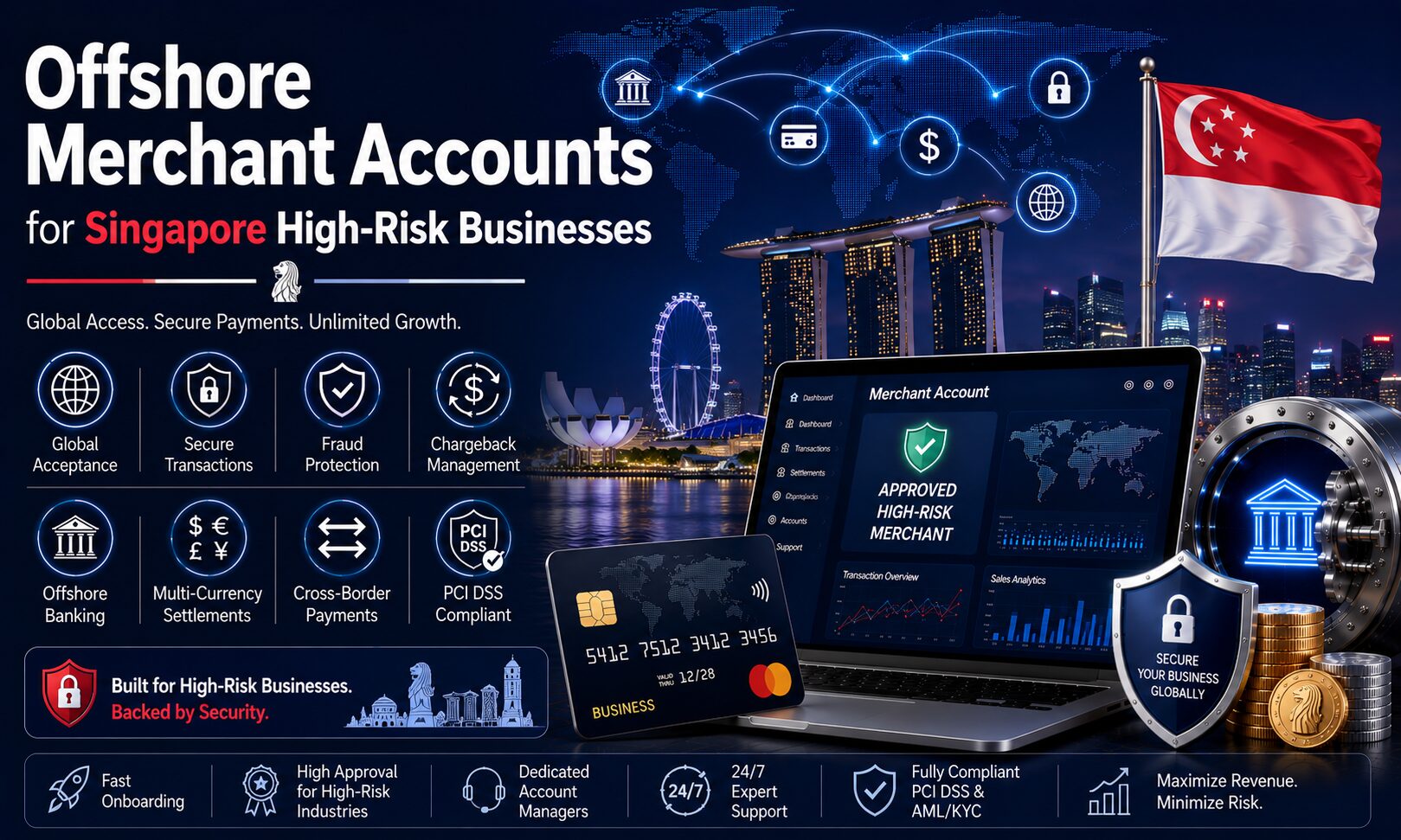
Singapore presents an unusual combination for high-risk payment strategy: it’s simultaneously one of the world’s most sophisticated fintech regulatory environments and one of the strictest gambling jurisdictions in Asia. The Monetary Authority of Singapore (MAS) has built a comprehensive, extraterritorial payment services framework that reaches offshore providers serving Singapore customers, while the Gambling Regulatory Authority (GRA) enforces a gambling prohibition so tight that only a handful of exempted operators can legally serve the market at all. For high-risk merchants targeting Singapore, understanding both of these frameworks — and how they interact with payment processing specifically — matters more here than almost anywhere else in this series.
This guide covers Singapore’s Payment Services Act framework for crypto and forex-adjacent businesses, the near-total prohibition on gambling and what it means for payment providers, and which offshore providers are worth evaluating for the categories that remain genuinely viable.
Singapore’s Payment Services Act: The Framework Behind Everything
Singapore regulates payment services — and by extension, most high-risk financial activity — through the Payment Services Act (PSA), which came into force on January 28, 2020, consolidating what had previously been a fragmented regulatory perimeter into a single licensing framework. The PSA replaced two earlier laws, the Payment Systems (Oversight) Act 2006 and the Money-Changing and Remittance Businesses Act, reflecting how far Singapore’s fintech and crypto sectors had outgrown the older framework.
The PSA covers seven defined payment service categories: account issuance service, e-money issuance service, cross-border money transfer service, domestic money transfer service, merchant acquisition service, digital payment token (DPT) service, and money-changing service. Any entity providing one or more of these services in Singapore without the appropriate license is operating outside the law, regardless of where it’s incorporated.
The PSA’s reach extends well beyond Singapore’s borders. MAS made the extraterritorial scope explicit in 2021, directing offshore exchanges serving Singapore users to apply for a license or exit the market entirely. Virtual asset service providers incorporated abroad but actively marketing to Singapore residents are squarely within scope — this is a meaningfully more aggressive extraterritorial posture than many jurisdictions take, and it directly shapes how offshore merchant account strategy needs to be thought about for anything crypto-adjacent targeting Singapore customers.
Capital and physical presence requirements are substantial. Major Payment Institution (MPI) licenses require a minimum base capital of SGD 250,000, while Standard Payment Institution (SPI) licenses require SGD 100,000, with capital required to be maintained on an ongoing basis — and MAS may demand higher capital for businesses with larger balance sheets or higher risk profiles. Crucially, applicants need a registered office address with staff who actually work there, and MAS conducts site visits as part of the application process. This rules out purely offshore, presence-free structures for any business seeking genuine Singapore licensing.
AML/CFT requirements are banking-grade. MAS Notice PSN02 sets out detailed anti-money-laundering and counter-financing-of-terrorism requirements for DPT service providers specifically, including customer due diligence for all customers, enhanced due diligence for high-risk customers, ongoing transaction monitoring, suspicious transaction reporting to Singapore’s Suspicious Transaction Reporting Office (STRO), and Travel Rule compliance for transfers above SGD 1,500.
2026 brings further regulatory development, not relaxation. MAS confirmed at the Singapore FinTech Festival in November 2025 that draft stablecoin legislation will be published in 2026, built around full reserve backing with high-quality liquid assets and reliable redemption mechanisms. MAS’s own leadership has signaled that if regulated stablecoins become systemically important, rules may need further tightening — reinforcing that Singapore’s regulatory trajectory continues to move toward more oversight, not less.
Forex Trading in Singapore: Strict by Design
Singapore is one of the world’s top financial hubs, but that reputation doesn’t translate into easy merchant account access for forex businesses specifically. Singapore banks are extremely strict with forex businesses, treating the category as high-risk due to fraud, AML exposure, and elevated chargeback potential — proper licensing is treated as non-negotiable before any serious merchant account conversation begins. This mirrors the broader pattern seen across this series: Singapore’s financial sophistication doesn’t mean forex operators get a pass on documentation or licensing status; if anything, MAS’s overall regulatory rigor makes the bar higher than in many less developed financial centers.
Gambling in Singapore: One of the Tightest Regimes in Asia
Singapore’s approach to gambling stands apart even within this series’ already-restrictive examples like the Netherlands, Australia, and Spain. All forms of gambling are prohibited in Singapore unless specifically licensed or exempted by the Gambling Regulatory Authority — a blanket prohibition, not a category-by-category restriction.
Only a small handful of operators are legally permitted. Singapore Pools and the Singapore Turf Club hold exemptions under the current framework for lottery, sports betting, and horse race betting respectively, while Marina Bay Sands and Resorts World Sentosa hold the only two licensed land-based casino operations in the country, operating under a duopoly arrangement that Singapore authorities have extended through 2030. There is no path for a third operator, online or offline, to simply apply and enter the market the way operators can in more open licensing regimes like the UK or Netherlands.
The Gambling Control Act 2022 consolidated and modernized the legal framework, replacing the earlier Remote Gambling Act 2014 and establishing three distinct regimes: a Licensing Regime for higher-risk gambling activity, a Class-Licensing Regime for lower-risk products (such as mystery boxes, which face specific safeguards like a capped retail prize value of $100), and a Social Gambling Exception — though notably, online social gambling was deliberately excluded from this exception, since regulators determined it would be too difficult to verify that individuals gambling online are sufficiently and meaningfully acquainted to qualify as genuine “social” gambling.
Enforcement combines ISP blocking with financial disruption. Offshore gambling operators are blocked at the ISP level, with over 600 sites blocked as of 2024, and responsibility for this blocking shifted to the Singapore Police Force starting in January 2025. Beyond site blocking, Singapore’s regulatory approach explicitly targets the payment layer: authorities can disrupt deposits and withdrawals tied to unlawful gambling sites, meaning Singapore residents attempting to fund offshore gambling accounts face payment failures as a deliberate enforcement mechanism, not just an inconvenience.
Scale of the enforcement challenge remains significant despite the restrictions. In 2025 alone, over 2.3 million Singaporeans logged onto offshore betting sites, and authorities recorded 4,800 prosecutions for illegal gambling that year. Individual players caught using VPNs or accessing unblocked offshore sites face fines of up to S$5,000, though enforcement against individual users remains comparatively rare — the regulatory focus is squarely on operators and payment infrastructure rather than individual bettors.
2026 brings tighter, not looser, rules. Amendments taking effect in 2026 strengthen the self-exclusion scheme, allowing bettors to block themselves from all licensed online platforms for periods ranging from six months to five years, while casinos must now display real-time gambling-addiction statistics and provide free access to counselling services. The government has also increased the mandatory revenue contribution from the integrated resorts from 10% to 12%, specifically to fund harm-prevention programs. Foreign operators are now required to register with Singapore’s regulator and demonstrate compliance with technical and financial safeguards — failure to do so triggers automatic website blocking under the nationwide internet filter.
What This Means for Payment Processing Strategy
For gambling specifically, Singapore offers essentially no viable offshore payment strategy for unlicensed operators. Unlike markets where an offshore license from Malta or Curaçao provides at least a gray-area operating basis, Singapore’s framework treats unlicensed gambling — regardless of the operator’s foreign licensing status — as squarely illegal, with active financial disruption as a stated enforcement tool. Any payment provider considering Singapore-facing gambling processing should treat this as a closed door rather than a creative workaround opportunity.
For crypto and DPT-related businesses, MAS’s extraterritorial PSA enforcement means that “processing payments from outside Singapore” doesn’t meaningfully insulate a business from licensing requirements if it’s actively marketing to Singapore residents. The 2021 directive to offshore exchanges — get licensed or exit — set a clear precedent that continues to shape MAS’s posture in 2026.
For forex, licensing comes first, exactly as it does across every market in this series, and Singapore’s financial sophistication means the underwriting bar tends to be higher, not lower, than in less developed markets.
Domestic vs. Offshore for Singapore-Facing Merchants: What Changes
| Factor | Singapore-Licensed Setup | Offshore Processing |
| Gambling | Only Singapore Pools, Singapore Turf Club, and two integrated resorts are licensed | Not legally viable — active enforcement targets both sites and payment flows |
| Crypto/DPT services | Requires MPI/SPI license, local office, MAS site visits | Cannot substitute for required licensing if targeting Singapore residents |
| Forex trading | Requires appropriate MAS-recognized licensing | Similar — licensing precedes any viable merchant account |
| CBD, adult, subscription businesses | Domestic banks often cautious, similar to global pattern | Standard offshore value proposition for acceptance gaps |
| Best fit | Genuinely licensed crypto/forex/gambling-exempt entities | Non-gambling, non-crypto high-risk categories seeking broader acceptance |
Providers Worth Evaluating for Singapore-Facing Merchants
- WebPays
WebPays markets directly into the Singapore forex merchant account space, explicitly framing its value proposition around connecting forex businesses with high-risk banking partners, supporting global transactions, and reducing compliance friction — relevant given how strict Singapore banks are known to be with forex specifically. For any forex business, WebPays should be evaluated on whether it explicitly requires confirmation of proper MAS-recognized licensing before onboarding, given the seriousness with which Singapore treats unlicensed financial services activity.
- eMerchantBroker (EMB)
EMB’s experience across CBD, forex, and adult categories extends usefully to Singapore-facing merchants in these verticals, where domestic bank caution creates a genuine acceptance gap similar to what’s seen in other developed financial markets. Its chargeback management infrastructure is relevant for subscription and adult-adjacent businesses navigating dispute patterns common to these categories internationally.
- PayCly
PayCly’s multi-currency support and CBD/forex/adult specialization suit merchants treating Singapore as one market within a broader Asia-Pacific or global strategy. Its streamlined onboarding is useful for merchants who need processing live quickly while separately confirming the correct MAS licensing pathway for anything touching crypto or forex specifically.
Industry-Specific Considerations for Singapore-Facing Merchants
Gambling: Effectively closed to any operator outside Singapore Pools, the Singapore Turf Club, and the two licensed integrated resorts. No offshore payment strategy makes unlicensed gambling legally processable for Singapore residents, and the regulatory trend for 2026 is toward tighter enforcement, not a relaxed sandbox.
Cryptocurrency and DPT services: MPI or SPI licensing under the PSA is required for any business providing regulated payment services with a genuine Singapore nexus, and MAS’s extraterritorial enforcement history means offshore incorporation alone doesn’t provide a workaround for businesses actively marketing to Singapore residents.
Forex trading: Proper licensing is treated as non-negotiable by specialized providers serving this market, reflecting Singapore’s broader regulatory rigor around financial services generally.
CBD, adult content, and subscription businesses: These follow patterns similar to other developed financial markets — domestic bank caution creates an acceptance gap that specialized or offshore providers fill, without the same hard licensing prerequisites that gambling and crypto carry in Singapore specifically.
Documentation Singapore-Facing High-Risk Merchants Should Prepare
- Business registration and corporate structure documentation
- The correct MAS license where applicable — MPI or SPI under the PSA for payment services and DPT activity, or appropriate licensing for forex-related financial services
- Evidence of genuine local presence for any Singapore-licensed entity, including a registered office with staff who actually work there, given MAS’s practice of conducting site visits
- 3–6 months of recent bank statements
- Processing history, including chargeback ratios, from any prior merchant accounts
- AML/CFT compliance documentation, including customer due diligence procedures, transaction monitoring capability, and Travel Rule compliance for relevant transfer thresholds
Choosing the Right Setup: A Practical Framework
Singapore rewards a very specific first question, much like the UAE covered earlier in this series: is this category legally processable in Singapore at all, and if so, under which MAS license? For gambling, the answer is almost always no unless the operator is one of the small handful of exempted entities. For crypto and forex, the answer determines which license — MPI, SPI, or the relevant forex authorization — needs to be secured, with genuine local presence, before any merchant account conversation is meaningful.
For CBD, adult content, and subscription businesses, Singapore behaves more like a standard developed financial market, where offshore merchant accounts solve a genuine acceptance gap left by cautious domestic banks, without the hard legal prerequisites that make gambling and crypto fundamentally different conversations in this market.
Conclusion
Singapore’s 2026 high-risk payments landscape is shaped by two powerful, converging forces: an extraterritorial Payment Services Act framework that reaches offshore crypto and DPT providers actively marketing to Singapore residents, and one of the most restrictive gambling regimes in Asia, where enforcement now deliberately targets payment flows alongside website blocking. For crypto and forex businesses, genuine MAS licensing with real local presence is the clear prerequisite before any merchant account strategy matters. For gambling, no offshore workaround exists outside the narrow set of exempted operators. For CBD, adult content, and subscription businesses, providers like WebPays, eMerchantBroker, and PayCly offer relevant experience navigating Singapore’s cautious domestic banking environment, much as they do in other developed financial markets.
Frequently Asked Questions (FAQs)
Q1: Is online gambling legal in Singapore?
A: Almost entirely no. Gambling is prohibited unless specifically licensed or exempted by the Gambling Regulatory Authority, with only Singapore Pools, the Singapore Turf Club, and two licensed integrated resort casinos permitted to operate legally.
Q2: Does Singapore’s Payment Services Act apply to offshore crypto exchanges?
A: Yes. MAS made the extraterritorial scope explicit in 2021, directing offshore exchanges actively serving Singapore users to obtain a license or exit the market, regardless of where the exchange is incorporated.
Q3: What license does a crypto business need to operate in Singapore?
A: Generally a Major Payment Institution (MPI) or Standard Payment Institution (SPI) license under the Payment Services Act, requiring minimum base capital of SGD 250,000 or SGD 100,000 respectively, along with a genuine local office and staff.
Q4: How does Singapore enforce against offshore gambling sites?
A: Through a combination of ISP-level website blocking (over 600 sites blocked as of 2024, now managed by the Singapore Police Force since January 2025) and active disruption of deposits and withdrawals tied to unlawful gambling operators.
Q5: Are forex merchant accounts difficult to get approved in Singapore?
A: Yes. Singapore banks apply strict scrutiny to forex businesses due to fraud, AML, and chargeback risk, and proper licensing is treated as a non-negotiable prerequisite by specialized payment providers serving this market.
Comments
No comments yet. Be the first to share your thoughts.
Leave a comment