
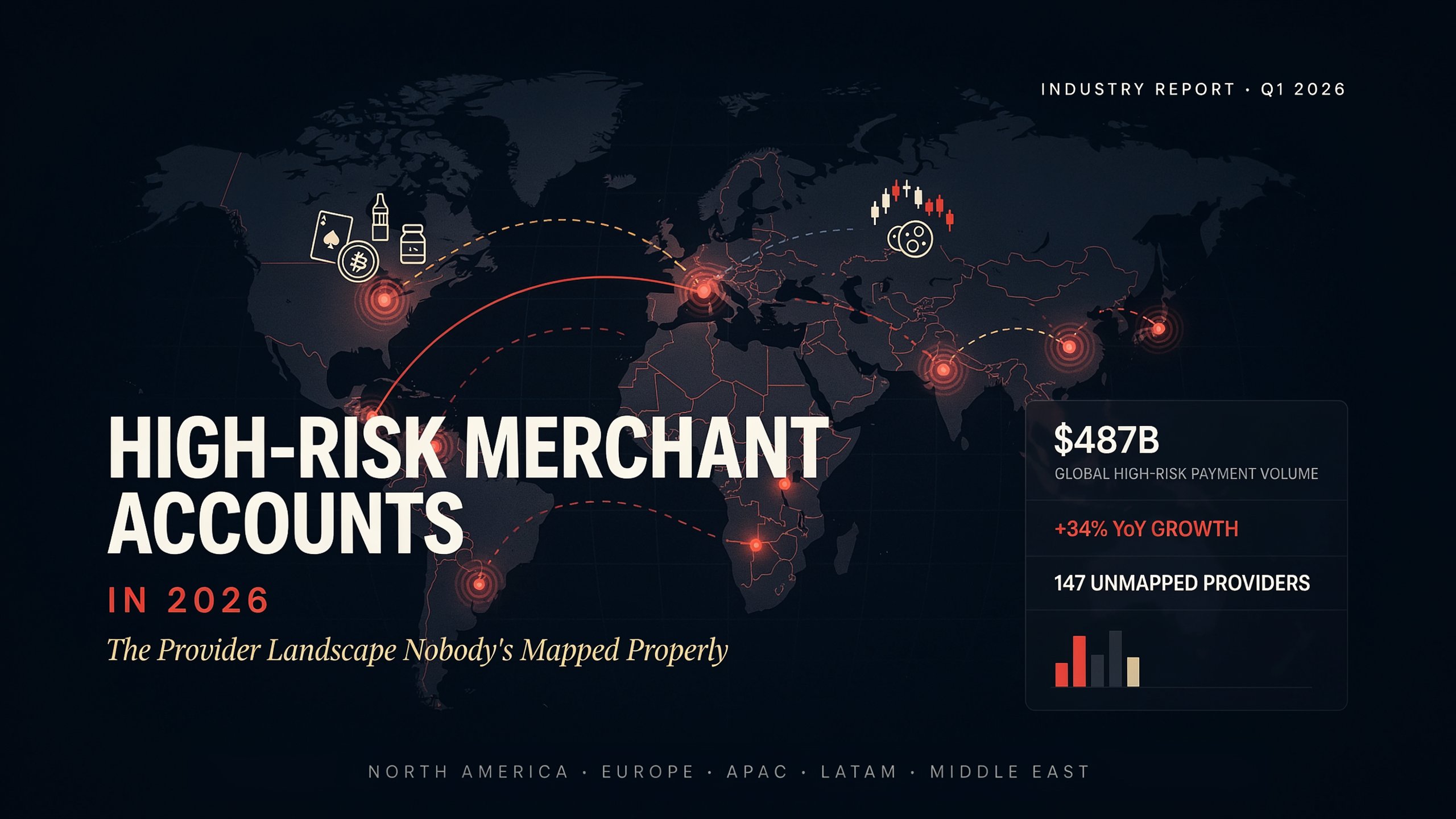
Search “best high-risk merchant account” and you’ll get the same article roughly forty times: a numbered list, a paragraph of praise per entry, a comparison table with made-up star ratings, and a CTA to “apply now.” Every one of these lists treats a fundamentally solved-differently problem as if it had one ranking.
It doesn’t. A crypto exchange founder, a CBD subscription-box seller, and a forex broker recovering from a MATCH list placement are not shopping for the same thing when they search for a high-risk merchant account — and a provider that’s genuinely excellent for one of them can be actively the wrong choice for another. The reason so many “best of” lists feel interchangeable is that they rank providers against each other instead of ranking them against you.
This piece does something different. Instead of one ranked list, it maps the entire high-risk payment gateway landscape by the actual problem each type of provider is built to solve — then places roughly three dozen real providers into that map, so you can find your own position first and your provider second.
Why “Best High-Risk Merchant Account” Is the Wrong Question
Before the map, it’s worth being honest about why ranking doesn’t work here.
High-risk merchant accounts exist because card networks and banks price risk categorically, not individually. A dating app with a 0.3% chargeback ratio and a dating app with a 2.5% chargeback ratio both get filed under “high-risk: dating” by a mainstream acquirer, and both get declined by Stripe or Square regardless of the difference between them. High-risk providers exist specifically to underwrite the individual business rather than the category label — which means the entire value of a provider is how well its underwriting appetite, banking network, and vertical experience match your specific business, not some abstract quality score.
That’s why the useful question isn’t “which provider is best” — it’s “which of the six or so distinct provider models actually fits what I’m building.” Here’s that map.
The Six Models Behind Every High-Risk Payment Gateway
- The Veteran Offshore Specialist. Built around decades of relationships with acquiring banks outside the merchant’s home country, these providers exist specifically for businesses that domestic banks won’t touch at all — MATCH-listed merchants, offshore-incorporated entities, and categories (gambling, adult, pharma) that mainstream processors decline outright. Slower onboarding, higher fees, but genuinely the only door open for some businesses.
- The Broker/Introducer. Doesn’t hold an acquiring relationship itself — instead, it shops your application across a network of dozens or hundreds of banks and processors and places you with whichever one says yes. Valuable when you don’t know which acquirer fits your specific profile; less valuable if you want a direct, long-term banking relationship rather than a middleman.
- The Vertical Specialist. Built explicitly around a small number of high-risk categories — usually gaming, forex, crypto, or adult — with underwriting, gateway features (MT4 integration, discreet billing descriptors, recurring billing for subscriptions), and compliance knowledge specific to that vertical. Excellent if you’re in their lane; often unable to help at all outside it.
- The Balanced Mid-Risk Growth Provider. Positioned between mainstream processors and true offshore specialists — designed for businesses that are “high-risk” on paper (CBD, nutraceuticals, travel, coaching, subscriptions) but not genuinely hard-to-place. Faster approvals, more modern tooling, but generally won’t touch MATCH-listed merchants or the most extreme categories.
- The Speed-and-Approval Marketer. Leans hard on approval rate and turnaround time as the pitch — “24-hour approval,” “99% approval rate.” Sometimes genuinely fast because of streamlined in-house underwriting; sometimes fast because the account terms (reserve percentage, contract lock-in, fee structure) are less favorable than a slower, more thorough placement would produce. Worth reading the actual contract, not just the approval-speed claim.
- The Enterprise/Multi-Currency Gateway. Larger, often publicly traded or venture-backed infrastructure companies offering high-risk acquiring as one line of business alongside broader payment orchestration, multi-currency settlement, and enterprise-grade compliance tooling. Built for scale rather than for the smallest or newest merchants.
None of these models is “better” in the abstract. What follows maps roughly three dozen active providers into these six categories, so you can start from your own situation and work outward — rather than starting from a ranked list and hoping your business fits somewhere in the top five.
Model 1: Veteran Offshore Specialists
These are the providers to call when you’ve already been declined elsewhere, when you’re MATCH-listed, or when your business is incorporated offshore and needs an acquiring relationship that actually understands that structure.
Durango Merchant Services has been placing high-risk merchants since the late 1990s and is probably the single most frequently cited name in this category for a reason: it runs its own payment gateway, supports processing across 200-plus countries in more than two dozen currencies, and explicitly works with MATCH-listed merchants and businesses with prior processing terminations — categories most of the providers below won’t touch at all.
Instabill focuses specifically on international high-risk merchant accounts, with acquiring bank relationships across Europe, Asia, and Latin America built for businesses that need genuinely offshore processing rather than a domestic high-risk workaround.
SMB Global occupies a useful middle ground: U.S.-based but built exclusively around high-risk and international processing, with gateway integrations reaching more than 175 shopping carts and, for merchants who qualify for its preferred underwriting tier, occasional month-to-month contracts with no rolling reserve — a genuinely rare combination in this space.
eMerchantBroker (EMB) has built one of the broadest high-risk industry portfolios in the market — CBD, forex, adult, nutraceuticals, and more — backed by a wide acquiring bank network specifically valuable for merchants who’ve bounced between two or three declined applications elsewhere.
National Merchants Association (NMA) brings a slightly different angle: a membership-style structure combined with high-risk underwriting, positioned for merchants who want ongoing account management support rather than a one-time placement and a support ticket queue.
DirectPayNet specializes specifically in performance marketing, e-commerce, and subscription-heavy high-risk verticals, with a placement model built around understanding affiliate and continuity billing structures that generalist acquirers frequently misclassify or decline outright.
Fast Offshore deserves its own note here, since it’s structurally different from the others in this section: it’s a corporate services and licensing firm first, merchant account placement second, meaning it typically pairs an offshore gaming or forex license (Curaçao, Anjouan, Nevis) with a merchant account placement once that license is in hand — genuinely useful if you’re building the corporate structure and the payment account at the same time, less useful if you already have a license and just need an acquirer.
Model 2: Brokers and Introducers
If the veteran offshore specialists are the ones who are the bank relationship, this category is the ones who find the bank relationship for you.
PayProcc operates as a bridge to a network described as 1,500-plus payment solutions and banks worldwide — you apply once, and PayProcc’s team works to place you with a suitable processor from that pool, which is genuinely valuable if you have no idea which acquirer would even consider your specific business model.
MerchantScout, operating out of the UK and Netherlands, runs a global acquiring network specifically for gambling, adult, and other high-risk verticals, with reported monthly gambling-merchant volume in the tens of millions of euros — a broker model built specifically around the gaming and adult verticals rather than high-risk generally.
The trade-off with any broker model is consistent: you get access to more potential “yes” answers than you’d find applying to individual providers one at a time, but you’re also adding a layer between you and the actual acquiring bank, which matters if you want a direct long-term relationship rather than a placement service.
Model 3: Vertical Specialists — Gaming, Forex, and Crypto
This is the most crowded and most important category to get right, because generalist high-risk providers frequently say they support gambling, forex, or crypto, but genuinely deep vertical experience shows up in specific product features — MT4/MT5 integration for forex, discreet billing descriptors and chargeback alert integration for gaming, and multi-currency settlement built around how these specific industries actually move money.
WebPays markets itself directly at forex, gaming, IPTV, and crypto-adjacent verticals, combining a payment gateway with merchant account infrastructure in a single product rather than requiring merchants to stitch the two together separately.
PayCly covers a similarly broad high-risk vertical spread — CBD, forex, adult — with a specific emphasis on fast onboarding and multi-currency acceptance across 100-plus currencies, useful for merchants whose customer base skews heavily international from day one.
GSPay has built a specific reputation around gaming, adult, and dating-adjacent verticals, with chargeback protection tooling designed around the dispute patterns those categories generate specifically (unrecognized-charge disputes on subscription billing, for instance) rather than generic e-commerce fraud tooling.
Shark Processing leans hardest into iGaming specifically, with a global banking network built around the reality that gambling operators frequently need banking redundancy — if one acquiring relationship becomes unavailable due to a regulatory shift, having a second one already in place matters more in this vertical than almost any other.
RoxPay, an Italian, OAM-registered, PCI DSS Level 1 and ISO 27001-certified fintech, is worth calling out specifically because it represents a different model within this category: a genuinely European-licensed payment institution rather than a purely offshore acquirer, offering gambling, adult, crypto, and forex processing with the regulatory standing and consumer protection framework a licensed EU entity carries that a Curaçao-based offshore acquirer typically doesn’t.
GlobalPay focuses on nutraceutical and broader health e-commerce alongside its gaming-adjacent work, with round-the-clock support that matters for verticals where transaction issues can directly affect fulfillment timelines.
QuadraPay rounds out this group with a specific focus on offshore account placement across jurisdictions like Cyprus, Hong Kong, and Mauritius, paired with crypto settlement support (Bitcoin, Ethereum, stablecoins) alongside traditional card processing — relevant for merchants who want a single provider handling both fiat and crypto rails rather than running two separate systems.
Model 4: Balanced Mid-Risk Growth Providers
This category exists for a genuinely large and under-served group: businesses that are classified as high-risk on paper — CBD, nutraceuticals, travel, coaching, subscription boxes, firearms accessories — but aren’t dealing with the elevated fraud or regulatory exposure of gambling, adult, or forex. These merchants generally don’t need offshore banking or MATCH-list recovery; they need faster, more modern underwriting than a mainstream processor offers, without the full weight (and cost) of a true offshore specialist relationship.
Soar Payments is probably the clearest example of this model done well: transparent, published pricing, a straightforward application process, and explicit coverage of categories like debt collection, tech support, firearms, CBD, and travel — while explicitly not working with MATCH-listed merchants or the most extreme risk categories. It’s a strong fit specifically because it doesn’t pretend to be something it isn’t.
PaymentCloud operates similarly — broad coverage of adult, CBD, nutraceuticals, travel, and continuity billing, built around in-house underwriting that tends to produce faster, more predictable approval timelines (24 hours to five business days) than providers relying on third-party underwriting review.
PayKings and Maverick Payments both sit comfortably in this tier, offering dedicated high-risk underwriting with modern gateway tooling and a customer support model built around assigned account managers rather than a generic support queue — useful for merchants who’ve had a frustrating experience with a faceless processor before.
Host Merchant Services (HMS) leans toward the lower-risk end of this category specifically, with broad ecommerce and point-of-sale integrations and consistently strong customer support reviews — a solid choice for businesses that are more “moderate-risk” than genuinely hard-to-place.
TailoredPay emphasizes fast approval turnaround (often within 24 hours) alongside daily payouts and a price-match guarantee, positioning itself directly against slower, more traditional high-risk applications.
Easy Pay Direct focuses specifically on SaaS, digital products, coaching, and subscription-based business models, with tooling built around approval survivability — reducing decline rates and helping merchants maintain processing continuity rather than just getting the initial account opened.
Chosen Payments and Leaders Merchant Services both offer dedicated high-risk underwriting programs alongside broader small-business merchant services, useful for merchants who want a single provider handling both their high-risk product line and any lower-risk operations under one relationship.
North American Bancard, one of the larger U.S. merchant services companies, maintains a high-risk division specifically for businesses its standard underwriting declines — a reasonable option if you already have a relationship with them for other services and want to consolidate.
Humboldt Merchant Services has built a specific reputation in nutraceuticals, CBD, and e-cigarette/vape processing — categories that sit right at the edge between “mainstream high-risk” and genuinely hard-to-place, making it a useful option specifically for merchants in that particular gray zone.
Model 5: Speed-and-Approval Marketers
This category needs the most scrutiny, not because the providers in it are illegitimate, but because “fast approval” and “high approval rate” are marketing claims that can mean genuinely efficient in-house underwriting — or can mean less favorable account terms baked in to make approval easier to grant. Read the actual contract, reserve percentage, and cancellation terms before treating a fast “yes” as automatically the better outcome than a slower one from a more selective provider.
HighRiskPay.com markets a 99% approval rate and 24-hour turnaround with explicitly no minimum credit score requirement — a genuinely useful option if you’ve been declined elsewhere for credit reasons, provided you review the fee structure closely given how aggressively the approval-speed claim is marketed.
Corepay has built a specific reputation in nutraceuticals, adult content, and continuity billing, with fast-moving underwriting and clear communication about required documentation — traits that put it slightly above the purely speed-focused end of this category, closer to a genuine specialist.
Charge.com focuses specifically on subscription and recurring billing management, with retry logic, dunning management, and chargeback prevention tools purpose-built for continuity businesses rather than one-time transaction models.
SecureGlobalPay offers a combined domestic-and-offshore account structure with Level 2/3 processing support, positioning itself around white-glove underwriting communication — realistic limits and expectations explained upfront rather than a black-box approval process.
2Accept distinguishes itself with a specific structural detail worth flagging: every merchant gets a dedicated Merchant ID rather than being pooled under a shared master account, which matters because pooled-MID structures are exactly what causes the sudden account freezes merchants experience on aggregator platforms — 2Accept’s model is built specifically to avoid that failure mode.
Model 6: Enterprise and Multi-Currency Gateways
This final category is for merchants who’ve outgrown the “high-risk specialist” conversation entirely and need enterprise-grade payment infrastructure that happens to include high-risk underwriting as one capability among many.
Nuvei, publicly traded and operating one of the deepest acquiring networks in regulated iGaming, crypto, and forex specifically, offers a genuinely comprehensive stack — payment acceptance, fund disbursement, card issuance, treasury and FX management — positioned for high-risk operators with real international distributor or supplier networks, not first-time merchant account applicants.
ECOMMPAY, a European payment gateway provider, brings tailored high-risk solutions with advanced fraud prevention and broad e-commerce platform integrations, functioning more like an orchestration layer than a single acquiring relationship.
Total Processing, UK-based, occupies similar territory — high-risk acquiring bundled into a broader payment processing infrastructure offering, useful for merchants who want one relationship covering both standard and high-risk payment flows.
Allied Wallet rounds out this tier with a global payment processing footprint and multi-currency support marketed around low fees and international reach — a genuinely large-scale option, though one where, as with any enterprise provider, the actual high-risk underwriting appetite is worth confirming directly rather than assuming from the marketing page alone.
eLotPay fits here too, specifically for merchants wanting a hybrid crypto-and-fiat settlement model — accepting both traditional cards and crypto, with automatic conversion to stablecoins or local currency, aimed at high-risk merchants (adult, in particular) who want crypto optionality without running two entirely separate payment stacks.
The Comparison Table Nobody Else Publishes: Question, Not Rank
Rather than a 1-to-36 ranking that implies false precision, here’s the framework worth actually using — a single question that narrows the field faster than any star rating:
| Your situation | Model to start with |
| Already declined or MATCH-listed elsewhere | Veteran Offshore Specialist (Durango, Instabill, SMB Global, EMB) |
| Not sure which acquirer would even say yes | Broker/Introducer (PayProcc, MerchantScout) |
| Gaming, forex, or crypto specifically | Vertical Specialist (WebPays, PayCly, Shark Processing, RoxPay) |
| CBD, nutraceuticals, travel, coaching — “paper” high-risk | Balanced Mid-Risk Growth Provider (Soar Payments, PaymentCloud, Host Merchant Services) |
| Need the fastest possible yes and will scrutinize the contract | Speed-and-Approval Marketer (HighRiskPay.com, Corepay, 2Accept) |
| Enterprise scale, international distributor network | Enterprise/Multi-Currency Gateway (Nuvei, ECOMMPAY, Allied Wallet) |
Red Flags Worth Knowing Before You Apply Anywhere
A few patterns show up repeatedly across this entire landscape, regardless of which model a provider fits:
“99% approval” and “instant approval” claims deserve a follow-up question, not automatic trust. A genuinely high approval rate can reflect efficient underwriting — or it can reflect a provider approving nearly everyone at terms (higher reserve, longer contract lock-in, steeper per-transaction fees) that make the approval decision easy for the provider precisely because the merchant absorbs more of the risk. Ask directly what the rolling reserve percentage and release timeline are before treating speed as the deciding factor.
Pooled Merchant ID structures are the single most common cause of sudden account freezes. If a provider doesn’t specify that you’ll receive your own dedicated MID, assume you’re being pooled with other merchants under a shared account — meaning another merchant’s chargeback spike can freeze your funds even though your own account is in good standing.
“Zero KYC” and “funds can never be frozen” claims, especially from crypto-settlement gateways, deserve real skepticism. Genuine regulatory compliance — AML, KYC, sanctions screening — exists precisely because payment infrastructure moving real money is subject to real oversight. A provider marketing the explicit absence of these controls as a feature is either operating outside normal compliance expectations or overstating what it can actually deliver once it scales, and either scenario is worth treating as a risk signal rather than a selling point.
A broker is not a bank. If a provider’s core offering is “we’ll find you a processor,” that’s a genuinely useful service, but it’s structurally different from a direct acquiring relationship — understand which one you’re actually signing with before assuming you have a long-term banking partner rather than a placement service that may not be the one servicing your account two years from now.
What Actually Determines a Good Fit
Across every model above, the same four questions determine whether a provider will actually work for your business, and none of them are “which one is ranked highest”:
Does this provider’s stated vertical experience match your specific business, not just your broad category? “Works with gaming merchants” can mean deep sportsbook experience or a single skill-gaming client three years ago — ask for specifics.
What’s the actual reserve structure, and does it decrease over time? A rolling reserve that never adjusts down as you build a clean processing history is a meaningfully worse deal than one with a documented improvement path.
Is this a direct acquiring relationship or a broker placement, and does that match what you’re looking for? Neither is wrong, but they’re different products.
What happens if you get one significant chargeback spike? Ask this directly before signing anything — the difference between a provider that works with you through a rough month and one that terminates on the first violation is the single biggest practical difference between a good and bad high-risk merchant account relationship, and it never shows up in the marketing copy.
Conclusion
The high-risk merchant account and high-risk payment gateway market isn’t one competitive field with thirty-some entrants racing for the top slot — it’s six genuinely different service models, each solving a different version of the same underlying problem: getting paid in an industry mainstream processors won’t touch. Veteran offshore specialists like Durango, Instabill, and EMB exist for the merchants everyone else declined. Brokers like PayProcc and MerchantScout exist for merchants who need someone else to do the shopping. Vertical specialists like WebPays, PayCly, Shark Processing, and RoxPay exist for gaming, forex, and crypto specifically. Balanced growth providers like Soar Payments, PaymentCloud, and Host Merchant Services exist for “paper” high-risk businesses that don’t need the full offshore treatment. Speed-focused marketers like HighRiskPay.com and 2Accept exist for merchants who need a fast yes and know to read the fine print. And enterprise gateways like Nuvei and ECOMMPAY exist for merchants who’ve outgrown the “which processor will accept me” conversation entirely. The right next step isn’t picking a name off a ranked list — it’s figuring out honestly which of these six situations actually describes your business, and starting the provider conversation from there.
Comments
No comments yet. Be the first to share your thoughts.
Leave a comment