
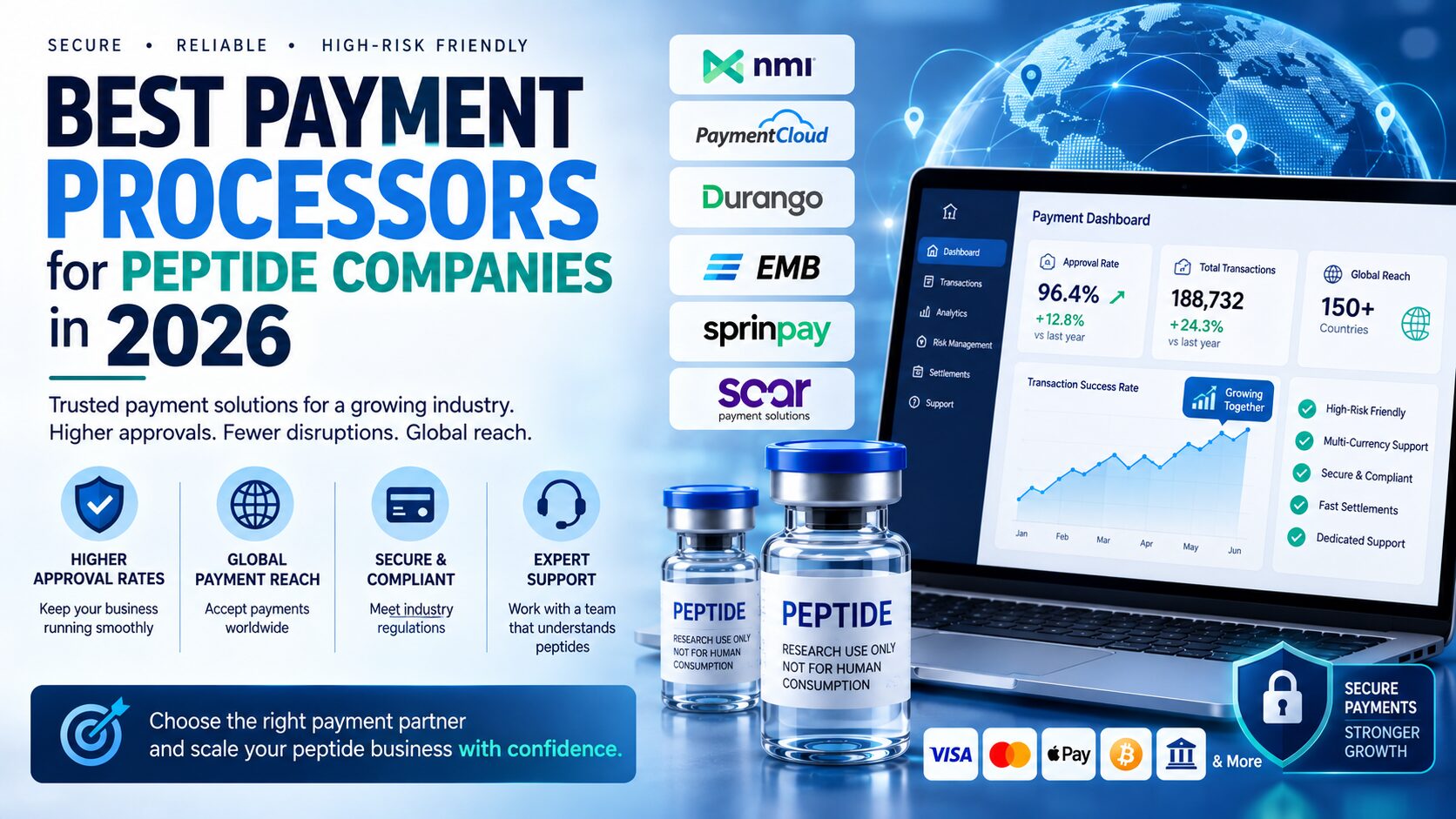
Every peptide business owner eventually hits the same wall: Stripe, PayPal, or Square approves the account, processing runs smoothly for a while, then the account gets frozen without warning. Funds held for months. No clear explanation beyond “high-risk category review.”
The fix isn’t finding a workaround, it’s going directly to processors that actually underwrite peptide businesses instead of discovering them after the fact. This guide compares the providers worth evaluating in 2026, what each one is actually good at, and how to choose based on your specific business stage and geography.
Why “Best” Depends Entirely on Your Business Stage
Before ranking anything, it’s worth being upfront: there’s no single “best” processor for every peptide business. A startup with no processing history needs different things than an established brand doing $200,000 a month across multiple countries. This guide is organized so you can match the right provider type to where your business actually is, not just pick whichever name shows up first in search results.
What Makes a Processor Actually Good for Peptides
Before comparing specific providers, here’s what separates a genuinely useful high-risk payment gateway from one that will eventually cause the same problems as a mainstream processor:
- Category-specific underwriting experience: not just general high-risk tolerance, but documented history with peptides, nutraceuticals, or research chemicals specifically
- Transparent reserve terms: a clearly stated percentage and hold period in writing, not vague language you only discover after signing
- Multiple acquiring bank relationships: providers that can shop your application across several banks have meaningfully better approval odds than one tied to a single bank
- ACH and eCheck support: since some banks restrict card processing for peptides entirely, a provider offering verified eCheck as a backup digital payments channel adds real resilience
- Multi-currency and international capability: essential for any peptide business selling beyond one country
- A real compliance review process: checking your website, labeling, and disclaimers before approval rather than after a chargeback spike triggers a review
Top Payment Processor Categories for Peptide Companies
1. Established High-Risk Specialists (Best for Long-Term Stability)
These are veteran high-risk merchant services providers with track records spanning well over a decade, serving nutraceuticals, supplements, and adjacent categories alongside peptides specifically.
What this category typically offers:
- Multi-currency merchant accounts for businesses selling globally, not just domestically
- Dedicated account managers who guide underwriting and gateway setup rather than pure self-service signup
- Interchange-plus pricing structures, generally more cost-effective at scale than flat-rate alternatives
- Fraud screening and velocity controls built specifically to reduce chargeback exposure in high-dispute categories
- Backup processing options for merchants who’ve already been shut down by Stripe, Shopify Payments, PayPal, or Square
Typical fee ranges: setup fees from $0-$500 depending on risk profile, monthly fees around $10–$45, transaction fees roughly 2.5%-5.5% plus $0.20-$0.50 per transaction, and chargeback fees generally starting around $25 per incident.
Best fit: peptide businesses that want a long-term processing relationship with a provider that has genuinely seen every version of this problem before, rather than a newer entrant still building its underwriting playbook.
2. Category-Focused Peptide and Nutraceutical Specialists (Best for Fast, Tailored Approval)
A newer cohort of providers has built underwriting frameworks specifically around peptides and adjacent research-chemical or nutraceutical categories, rather than treating high-risk as one broad bucket.
What this category typically offers:
- Faster onboarding, often in the 1-5 business day range for well-documented applications
- Domestic U.S. processing with meaningfully higher authorization rates than generalist international processors
- Underwriting teams that understand LegitScript certification requirements and “research use only” labeling conventions specific to peptides
- Custom-built solutions rather than a one-size-fits-all high-risk template
Tradeoffs to watch: some providers in this category are newer to the market with shorter track records, and a few rolling reserve structures run higher (in the 5-10% range, held for 3-6 months) than what an established generalist might offer a business with strong processing history.
Best fit: peptide businesses that want a provider whose entire underwriting model is built around this specific product category, and who value approval speed and category fluency over the longest possible track record.
3. eCheck and ACH-First Providers (Best When Card Processing Is Restricted)
Because some banks won’t support card processing for peptides at all, providers offering verified eCheck and ACH as a primary or backup rail fill a genuine gap.
What this category typically offers:
- Lower chargeback exposure than card transactions, since ACH disputes require a higher evidentiary bar
- A viable path to accepting payments even when card processing options are limited or unavailable
- Often paired with card processing as a diversification layer rather than a full replacement
Best fit: businesses that have struggled specifically with card processor terminations, or B2B peptide sellers (labs selling to labs, research institutions, wholesale buyers) where ACH is a natural fit anyway.
4. Offshore and International Processors (Best for Global Reach or Post-Termination Recovery)
For peptide businesses selling worldwide, or those already declined by domestic providers, an offshore merchant account or dedicated international processor is worth evaluating as a complement to, or backup for, a primary domestic relationship.
What this category typically offers:
- Approval paths for merchants already rejected domestically, sometimes with meaningfully higher approval rates than trying again domestically
- Access to acquiring banks outside U.S. card network restrictions
- Multi-currency settlement, useful for genuinely global cross-border payments flows
Tradeoffs to watch: offshore and less-specialized international processors have historically shown lower per-transaction authorization rates (in some cases 50-70%) compared to a well-matched domestic high-risk payment gateway, a real cost worth weighing against the access it provides.
Best fit: businesses with meaningful international sales volume, or those using an offshore relationship specifically as a secondary processor for redundancy rather than a sole processing solution.
5. Blockchain and Crypto Settlement Options (Best as a Supplementary Channel)
A smaller but growing set of providers route peptide payments through blockchain infrastructure, settling outside traditional card network classification entirely.
What this offers:
- A way to reduce total dependence on card network MCC-based rejection
- Appeal for higher-value repeat customers already comfortable transacting in crypto
Tradeoffs to watch: this is not a full replacement for card acceptance, most customers still expect standard card checkout, and this option is best treated as a supplementary payment wallets channel rather than a primary processing strategy for most peptide businesses.
Comparison at a Glance
| Provider Type | Best For | Typical Approval Time | Reserve Range | Global Capability |
|---|---|---|---|---|
| Established high-risk specialists | Long-term stability, backup processing | Several business days to 2 weeks | Moderate, often negotiable with history | Strong – multi-currency support |
| Peptide-focused specialists | Fast, tailored approval | 1-5 business days | 5-10%, 3-6 month hold | Primarily domestic U.S. |
| eCheck/ACH-first providers | Card-restricted businesses | Varies by provider | Lower chargeback-driven reserves | Domestic-focused |
| Offshore/international processors | Global reach, post-termination recovery | Varies, often longer underwriting | Can run higher | Strong, built for cross-border |
| Blockchain/crypto settlement | Supplementary channel | Fast, but limited customer reach | N/A (non-card settlement) | Global by design |
What to Ask Before Signing With Any Provider
Regardless of which category you’re evaluating, get clear answers to these before committing:
- What is the exact rolling reserve percentage and hold period, in writing?
- Does the provider have documented experience with peptide or nutraceutical accounts specifically, or is this “general” high-risk experience?
- Is LegitScript certification required, and if so, does the provider assist with that process?
- What acquiring bank relationships does the provider maintain, and can they move your account to a different bank if one relationship sours?
- What’s the early termination fee if you need to switch providers later?
- Does the provider support ACH/eCheck as a backup rail if card processing gets restricted?
- What’s the actual chargeback threshold before your account gets flagged for review?
Common Mistakes When Choosing a Processor
- Choosing based on advertised rate alone: A slightly lower headline percentage rate means little if the reserve terms or termination risk are worse
- Skipping LegitScript certification when required: Several providers explicitly require it for peptide accounts, skipping this step is a fast path to rejection or later termination
- Relying on a single processor with no backup: The same account-freeze risk that pushed you toward specialized providers in the first place can still happen with any single provider, redundancy matters even within the high-risk category
- Not reading the full fee schedule: Flat-rate offers can look attractive at low volume and become dramatically more expensive than interchange-plus pricing once volume scales
- Underestimating website compliance requirements: Missing business address, unclear refund policy, or ambiguous product claims are common, avoidable reasons for delayed or denied approval
Decision Framework: Which Type of Provider Fits Your Business
If you’re launching a new peptide business with no processing history:
- Start with a peptide-focused specialist or an established high-risk generalist that explicitly supports the category
- Get your website, LegitScript certification (if required), and documentation fully compliant before applying
- Expect moderate reserves until you build a track record
If you’ve already been terminated by a mainstream or previous high-risk processor:
- Consider an offshore or international processor specifically built for post-termination recovery
- Address whatever triggered the original termination, chargeback rate, labeling, documentation, before reapplying anywhere
- Layer in ACH/eCheck as a backup rail to reduce total dependence on card processing
If you’re an established peptide business scaling globally:
- Prioritize providers with genuine multi-currency and cross-border payments infrastructure, not just domestic U.S. processing
- Negotiate interchange-plus pricing rather than flat-rate structures, which get significantly more expensive at higher volume
- Maintain at least two active payment providers so a review or termination on one doesn’t halt revenue
If card processing keeps getting restricted regardless of provider:
- Build ACH/eCheck as a primary rail rather than a backup, particularly for B2B and wholesale transactions
- Explore blockchain settlement as a supplementary channel for customers comfortable with it
Looking Ahead: Where Peptide Payment Processing Is Heading
The regulatory and card network environment around peptides has tightened steadily, and there’s no strong signal that trend reverses in the near term. Mastercard’s BRAM program has added stricter controls specifically targeting research peptide accounts, and processors that once accepted the category with looser standards are increasingly exiting it or re-underwriting existing merchants more conservatively.
That means the gap between mainstream processors (unusable for this category) and dedicated high-risk specialists (increasingly essential) is widening, not narrowing. Peptide businesses that build proper payment infrastructure now, rather than treating it as a problem to solve after the first termination, will be in a materially stronger position as scrutiny continues to increase.
Conclusion
There’s no single “best” payment processor for every peptide company, there’s a best fit for your specific stage, geography, and risk profile. Established high-risk specialists offer the deepest track records and global reach. Category-focused peptide specialists offer speed and tailored underwriting. eCheck-first and offshore options fill specific gaps that card-only strategies can’t cover.
What matters most isn’t picking the single highest-rated name on a list, it’s matching the provider type to your actual business situation, reading the reserve and fee terms carefully, and building redundancy so no single account review can stop your revenue.
Frequently Asked Questions
Q: Do all peptide businesses need LegitScript certification to get a merchant account?
A: Some processors require it, others work with research-only peptide sellers under alternative compliance frameworks. Requirements vary by provider, so confirm this specifically before applying rather than assuming one standard applies everywhere.
Q: How much do peptide payment processors typically charge?
A: Transaction fees commonly range from roughly 2.5% to 5.5% plus a per-transaction fee, with monthly account fees typically between $10 and $45. Some flat-rate offerings run significantly higher, reviewing the full fee schedule against your expected volume matters more than comparing headline rates alone.
Q: Is it better to use a domestic or offshore processor for a peptide business?
A: Domestic U.S. processors generally offer higher authorization rates and faster onboarding for well-documented businesses. Offshore or international processors are typically better suited as a secondary option, for businesses already declined domestically, or those with significant international sales volume.
Q: Why do peptide merchants need ACH or eCheck options?
A: Some banks restrict card processing for peptide businesses entirely, and even where card processing is available, ACH transactions generally carry lower chargeback exposure than card payments, making it a valuable backup or supplementary payment rail.
Q: What happens if a peptide business gets placed on the MATCH list?
A: MATCH list placement makes it significantly harder to get approved by any new processor for an extended period. Businesses in this situation typically need to work with offshore or recovery-focused high-risk specialists rather than reapplying to mainstream platforms.
Q: Should a peptide business use more than one payment processor?
A: Yes, in most cases. Relying on a single processor recreates the same single-point-of-failure risk that pushed many peptide businesses toward specialized providers in the first place. Maintaining a primary and backup processing relationship protects against a single account review stopping all revenue.
Comments
No comments yet. Be the first to share your thoughts.
Leave a comment