
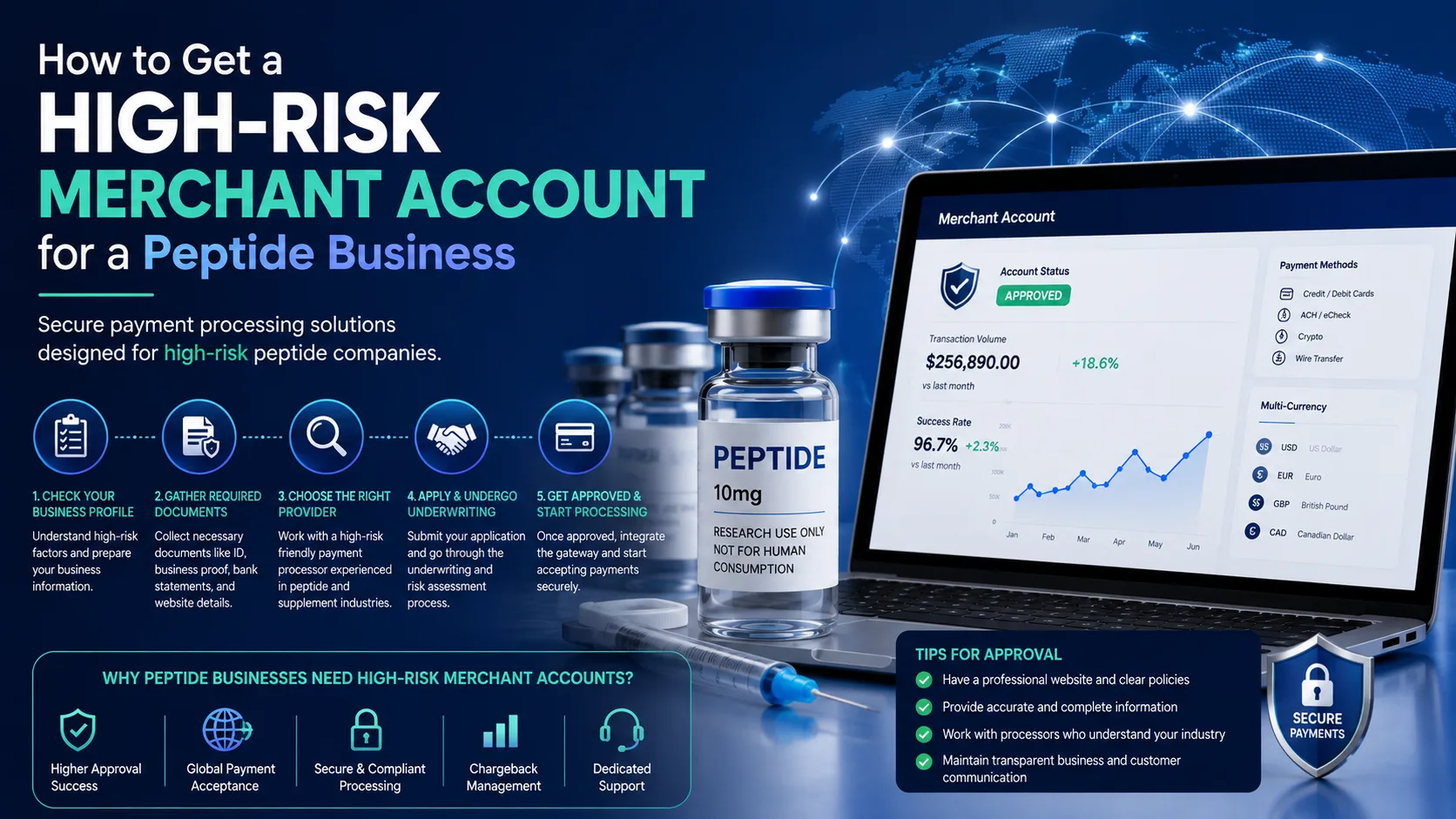
Open a Stripe account for a peptide business today, and there’s a good chance you’re on borrowed time. Mainstream processors routinely approve peptide merchants initially, then terminate the account weeks or months later, often holding funds for 90 to 180 days once they do.
This isn’t bad luck. It’s a structural mismatch between how peptide businesses actually operate and how mainstream processors are built to underwrite risk. This guide walks through exactly why peptide companies get flagged, what a proper high-risk payment gateway actually looks like, and the concrete steps to get approved and stay approved in 2026.
Why Peptide Businesses Get Classified High-Risk
It’s the MCC, Not Your Chargeback Rate
Here’s the part most peptide business owners don’t realize until they’ve already been declined: mainstream processors categorize peptides using Merchant Category Codes that also cover pharmaceuticals and research chemicals broadly. A risk algorithm scanning applications doesn’t distinguish between a GMP-certified peptide laboratory with a clean track record and an unlicensed operation selling unregulated substances, it sees the MCC and rejects, regardless of actual business quality.
This means even peptide companies with genuinely low dispute rates get filtered out before a human ever reviews the application.
Regulatory Pressure Has Intensified
The regulatory backdrop has tightened meaningfully heading into 2026:
- The FDA expanded its 503A Category 2 list in 2024 to include additional peptides, placing them under a “significant safety risks” designation that affects how compounding pharmacies and adjacent sellers can operate
- Mastercard’s BRAM (Business Risk Assessment and Mitigation) program specifically flags unapproved pharmaceuticals, research peptides, and nutraceuticals as high-risk categories requiring additional scrutiny
- Mastercard updated BRAM controls further in 2026 to apply stricter oversight specifically to research peptide accounts, and processors that previously accepted the category with looser standards are now either exiting it entirely or re-underwriting existing merchant accounts
For a business owner, the practical effect is the same regardless of the specific policy driving it: the pool of processors willing to work with peptide merchants is shrinking, while the ones remaining are underwriting more carefully.
Chargeback Patterns Specific to the Category
Beyond MCC classification, peptide businesses do face some genuine elevated risk factors:
- Customers who misunderstand “research use only” labeling and later dispute charges when a product doesn’t perform as expected for off-label use
- Efficacy disputes, since peptide effects vary significantly by individual and aren’t FDA-approved for the outcomes customers often expect
- Recognition-based disputes, where a customer doesn’t recognize the billing descriptor and files a chargeback rather than contacting the merchant first
None of this makes peptide businesses inherently fraudulent or poorly run, but it does mean a high-risk payment gateway provider needs real chargeback monitoring and prevention tooling built in, not bolted on as an afterthought.
What Happens When You Use the Wrong Processor
It’s worth being direct about the consequences of getting this wrong, because they’re more severe than a simple account closure.
- Sudden termination: Mainstream processors like Stripe, PayPal, and Square typically decline or terminate peptide merchant accounts, sometimes after weeks or months of apparently normal processing
- Extended fund holds: Terminated accounts commonly see funds held for 90 to 180 days rather than released immediately, real revenue the business has already earned, inaccessible for months
- MATCH list placement: Merchants added to Mastercard’s MATCH list (Member Alert to Control High-Risk Merchants) face significant difficulty getting approved by any processor for years afterward, a single bad termination can follow a business for a long time
- Compounding cash flow damage: For a growing peptide business, a mid-month termination with no access to already-earned revenue isn’t a minor inconvenience, it can be an existential cash flow event
This is the core argument for getting the payment infrastructure decision right the first time, rather than treating it as a quick signup task.
What a Proper High-Risk Payment Gateway Actually Provides
Underwriting Built for the Category, Not Generic High-Risk
There’s a meaningful difference between a processor that broadly “accepts” high-risk businesses and one that has built underwriting frameworks specifically for peptides, research chemicals, and adjacent categories like med spas and regulated wellness. The specialized providers understand how to structure reserves, set realistic monitoring thresholds, and place merchants with acquiring banks that already understand the category rather than treating every application as a fresh risk assessment.
Domestic vs. International Processing
Peptide businesses generally have two paths for merchant accounts:
Domestic U.S. processing:
- Significantly higher authorization rates, often in the 95%+ range for established, well-documented businesses
- Faster onboarding, typically 1-5 business days depending on the provider
- Generally lower rolling reserve requirements than offshore alternatives, though still elevated compared to low-risk categories
International / offshore processing:
- Useful when a business has been declined domestically or needs banking relationships outside U.S. card network restrictions
- Approval rates from dedicated offshore processors can be meaningfully higher for merchants otherwise rejected domestically
- Typically lower authorization rates on individual transactions (historically in the 50–70% range for less specialized international processors) compared to a well-matched domestic high-risk payment gateway
- An offshore merchant account is often used strategically as a secondary or backup processor rather than the sole processing relationship
Understanding Rolling Reserves
Nearly every peptide merchant account comes with a rolling reserve, a percentage of each transaction held back by the processor as a buffer against future chargebacks. This is standard practice across high-risk categories, but the terms vary significantly:
- Reserve percentages for peptide merchants commonly range from 5% to 10% of processing volume
- Reserve hold periods typically run 3-6 months before released funds become fully accessible
- On $100,000 in monthly processing volume, a 10% reserve means $10,000 held back on an ongoing basis, meaningful working capital tied up at any given time
This is a real cost of doing business in the category, not a red flag specific to any one provider, but it’s worth comparing reserve terms carefully across providers rather than accepting the first offer.
Step-by-Step: How to Get Approved
1. Prepare Documentation Before You Apply
High-risk underwriters review far more than a basic business application. Have ready:
- Certificate of incorporation and business licensing
- Product documentation, including certificates of analysis (COAs) for peptide purity and sourcing
- Clear “research use only” labeling and disclaimers, consistently applied across your website and packaging
- Processing history if you have any prior payment processing relationship, even if that account was later terminated
- Bank statements demonstrating financial stability
- A clearly documented refund and dispute resolution policy
2. Get Your Website Compliance-Ready
A professionally presented website with transparent policies significantly improves approval odds. Underwriters specifically look for:
- Accurate, non-misleading product descriptions that don’t imply unapproved therapeutic or performance claims
- Visible terms of service, refund policy, and shipping policy
- Clear “for research use only, not for human consumption” disclaimers where legally required
- Secure checkout infrastructure and SSL certification
- No language that could be read as marketing peptides for unauthorized human use
3. Apply With Category-Specific Providers First
Rather than starting with a mainstream payment gateway and hoping it works, go directly to processors with documented experience underwriting peptide, nutraceutical, or research chemical accounts. This dramatically reduces the risk of the approve-then-terminate cycle that wastes time and creates chargeback and MATCH list exposure down the line.
4. Understand the Full Fee Structure Before Signing
High-risk peptide processing fees vary widely, and headline rates don’t always tell the full story:
- Percentage-based processing fees commonly range from roughly 3.5% to 4% plus a per-transaction fee, though flat-rate offerings from some providers can run significantly higher — reportedly up to 10% in some cases, which adds thousands of dollars in monthly cost at meaningful volume
- Monthly account fees typically range from $10 to $50
- Rolling reserve terms (covered above) function as an additional, ongoing cost of capital
- Compare interchange-plus pricing against flat-rate offers carefully, at higher volumes, flat-rate structures can cost tens of thousands of dollars more annually than a negotiated interchange-plus arrangement with a specialized provider
5. Build Redundancy From Day One
Don’t wait for a termination to learn this lesson. Many peptide businesses now diversify payment providers deliberately rather than relying on a single processor:
- Maintain a primary domestic high-risk payment gateway relationship
- Add a secondary processor, potentially including an offshore merchant account, so a review or termination on one account doesn’t stop revenue entirely
- Consider alternative payment gateways and payment wallets as supplementary funding options, reducing total dependence on card network processing
- Building relationships with experienced high-risk processors up front is generally more valuable than repeatedly switching between mainstream providers after each termination
Alternative and Supplementary Payment Options
Crypto and Blockchain Settlement
Some peptide businesses are increasingly exploring blockchain-based payment settlement as a way to reduce dependence on traditional card network classification entirely, since transactions settle outside the card network risk framework that drives MCC-based rejection. This isn’t a wholesale replacement for card acceptance, most customers still expect to pay by card, but it can function as a genuine supplementary digital payments channel, particularly for higher-value repeat customers comfortable with crypto.
ACH and Bank Transfer Options
For B2B peptide sales (labs selling to other labs, research institutions, or wholesale buyers), ACH and direct bank transfer can reduce chargeback exposure significantly compared to card transactions, since ACH disputes generally require a higher evidentiary bar than card chargebacks.
Cross-Border Considerations
Peptide businesses selling internationally face additional complexity layered on top of the high-risk classification itself. Cross-border payments introduce currency conversion costs, regional card network variances, and, depending on the destination country, potentially different regulatory treatment of peptide products entirely. A provider experienced in online payments across multiple regions, not just domestic U.S. processing, is worth prioritizing for any peptide business with a meaningfully international customer base.
Red Flags to Avoid When Choosing a Provider
- Processors that don’t ask detailed questions about your product line: A provider that approves instantly without reviewing your COAs, labeling, or business model is often the one most likely to terminate later once their own risk monitoring catches up
- Vague reserve term: If a provider won’t clearly state the reserve percentage and hold period in writing before you sign, that’s a signal to keep looking
- Processors with no documented peptide or nutraceutical experience: General high-risk experience isn’t the same as category-specific underwriting expertise
- Pressure to sign quickly without reviewing the full contract: High-risk processing agreements often include early termination fees and other terms worth reading carefully before committing
Decision Framework: Choosing the Right Setup for Your Business
If you’re an early-stage peptide business with limited processing history:
- Prioritize a domestic high-risk payment gateway with peptide-specific underwriting experience, even if the rates are less competitive than what you’d eventually qualify for with a longer track record
- Expect and budget for rolling reserves in the 5-10% range
- Keep documentation (COAs, licensing, website compliance) airtight from day one to build a clean processing history
If you’ve already been terminated by a mainstream processor:
- Go directly to specialized high-risk or offshore processors rather than reapplying to mainstream platforms, repeated declines can compound negative signals in shared risk databases
- Be prepared for potentially lower initial authorization rates and higher reserves until you’ve established a track record with the new provider
- Address whatever triggered the original termination (labeling, chargeback rate, documentation gaps) before reapplying anywhere
If you’re scaling and processing meaningful monthly volume:
- Diversify across multiple payment providers, including a backup domestic processor and potentially an offshore merchant account, to avoid single-point-of-failure risk
- Negotiate interchange-plus pricing rather than accepting flat-rate fee structures, which get significantly more expensive at scale
- Consider supplementary payment options (ACH for B2B, crypto settlement) to reduce total card network dependency
Conclusion
Getting a high-risk merchant account for a peptide business isn’t about finding a loophole or a shortcut, it’s about matching your payment infrastructure to the actual risk profile mainstream processors won’t underwrite. The businesses that struggle most in this category are the ones that treat payment processing as an afterthought, sign up with whatever platform is easiest, and get blindsided by a termination months later.
The businesses that build durable infrastructure do the opposite: they document thoroughly, choose processors with real category expertise, understand exactly what reserves and fees they’re agreeing to, and build redundancy before they need it rather than after a termination forces the issue.
Frequently Asked Questions
Q: Why do mainstream processors like Stripe and PayPal reject peptide businesses?
A: Mainstream processors classify peptides under Merchant Category Codes shared with pharmaceuticals and research chemicals broadly, triggering automatic rejection or later termination regardless of a specific business’s actual chargeback performance or compliance quality.
Q: What is the MATCH list, and how does it affect a peptide business?
A: MATCH (Member Alert to Control High-Risk Merchants) is a Mastercard database that flags merchants terminated for certain risk reasons. Placement on this list makes it significantly harder to get approved by any new processor for an extended period, making it critical to work with an experienced provider before a termination happens rather than after.
Q: How long do rolling reserves typically last for peptide merchant accounts?
A: Reserve hold periods commonly run 3 to 6 months, with reserve percentages typically ranging from 5% to 10% of processing volume, depending on the provider and the business’s documented processing history.
Q: Is an offshore merchant account necessary for a peptide business?
A: Not always, but it’s commonly used as a secondary processing relationship, particularly for businesses already declined domestically, or those wanting redundancy so a single account review or termination doesn’t stop revenue entirely.
Q: What documentation improves approval odds for a peptide merchant account?
A: Certificates of analysis (COAs), clear business licensing, consistent “research use only” labeling across the website and packaging, a documented refund and dispute policy, and any prior processing history all meaningfully improve underwriting outcomes.
Q: Are crypto payments a realistic alternative to card processing for peptide businesses?
A: Crypto settlement can work as a supplementary channel that reduces dependence on card network risk classification, but it’s rarely a full replacement, since most customers still expect standard card payment options at checkout.
Comments
No comments yet. Be the first to share your thoughts.
Leave a comment