
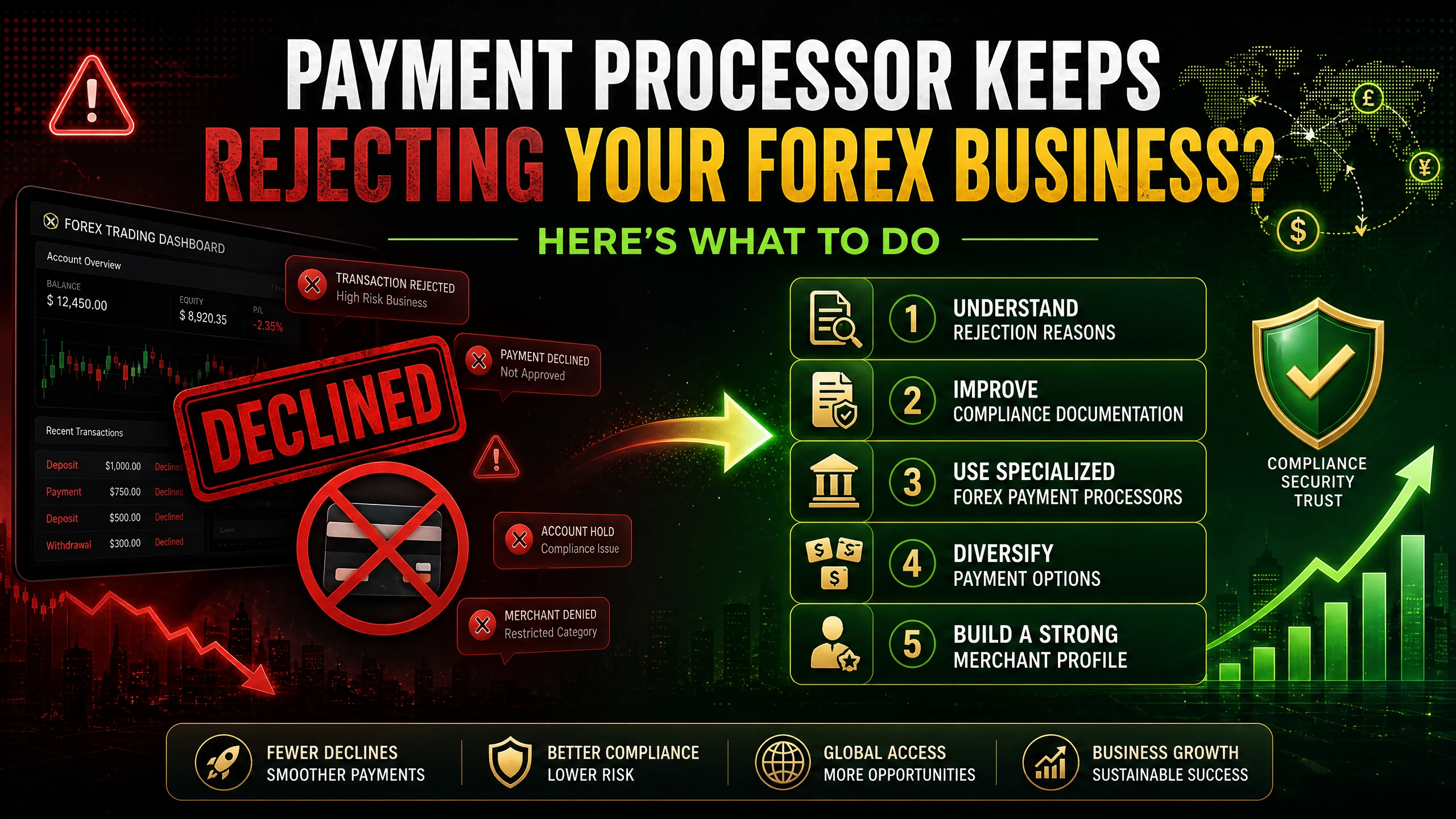
Getting declined by yet another payment provider is one of the most common frustrations in the forex trading industry. It’s rarely personal, and it’s almost never random, forex sits on nearly every “high-risk” list that banks and processors maintain. Understanding why rejections happen is the first step to fixing them for good.
Forex businesses get rejected mainly due to high chargeback risk, regulatory uncertainty, and past history with other processors, not because of anything the merchant is doing wrong today. The fix isn’t finding a lucky mainstream processor, it’s applying directly to a high-risk payment gateway built for forex payment and merchant accounts in this category. Preparing clean documentation, licensing proof, and a chargeback plan speeds up approval significantly. The right payment providers treat forex as a normal, fundable vertical, not a red flag.
Why Payment Processors Reject Forex Businesses
Most rejections come down to risk exposure, not the quality of the business itself. Mainstream payment gateways are built for low-risk retail transactions, and forex simply doesn’t fit that model.
High Chargeback and Dispute Rates
Forex trading involves leveraged positions, rapid price movement, and clients who sometimes dispute losses as unauthorized transactions. That pattern raises chargeback ratios above what standard payment processing networks tolerate.
Regulatory Complexity
Forex brokers operate under different regulatory regimes depending on jurisdiction, and some regions have inconsistent or evolving oversight. Processors without in-house compliance teams for forex payment flows would rather decline than manage that exposure.
MATCH List History
If a forex business, or its owners, appeared on the Mastercard MATCH list from a previous account termination, most standard processors will auto-reject the application before even reviewing it.
Card Network Risk Classification
Visa and Mastercard classify forex trading under high-risk merchant category codes (MCCs). Many acquiring banks simply avoid these MCCs entirely rather than underwrite them individually.
Cross-Border Complexity
Forex businesses typically serve clients across multiple countries, which means handling multiple currencies, local payment preferences, and compliance rules at once. Standard online payments infrastructure isn’t built for that volume of cross-border payments complexity.
What to Do When You Keep Getting Rejected
1. Apply to Processors Built for High-Risk Merchants
Stop applying to general-purpose payment providers and go directly to a high-risk payment gateway that already underwrites forex, trading platforms, and similar verticals. These providers price in the risk upfront instead of declining after the fact.
2. Consider an Offshore Merchant Account
An offshore merchants account can offer more flexible underwriting, multi-currency settlement, and banking relationships better suited to forex’s global client base. This isn’t a workaround, it’s a standard structure for offshore merchants operating internationally.
3. Prepare a Compliance-Ready Application
Processors approve faster when the paperwork is already in order. Have ready:
- Regulatory licensing or registration documents
- Business bank statements and processing history
- Clear terms of service and risk disclosures
- AML/KYC procedures documentation
- Chargeback and refund policy details
4. Build a Chargeback Prevention Plan
A documented chargeback strategy, clear billing descriptors, proactive client communication, and dispute response procedures, signals lower risk to underwriters reviewing merchant services applications.
5. Diversify Payment Rails
Relying on a single processor is risky. Layering in alternative payment methods, including crypto payments, gives forex businesses a backup rail if one account is suspended or under review, and reduces dependency on any single payment gateway.
6. Expect a Rolling Reserve
Most high-risk merchant account providers hold back a percentage of processing volume as a rolling reserve. This isn’t a rejection risk, it’s standard practice that protects the processor against future disputes and is usually released after a set holding period.
Choosing the Right High-Risk Payment Partner
| Factor | Why It Matters |
|---|---|
| Forex-specific underwriting experience | Faster approval, fewer surprise declines |
| Multi-currency settlement | Supports global client base and digital payments flows |
| Transparent reserve and fee structure | Avoids unexpected holdbacks |
| Chargeback and fraud tooling | Reduces long-term account risk |
| Optional crypto trading rail support | Adds redundancy beyond card processing |
FAQ
Why do banks consider forex a high-risk business?
Forex trading involves leverage, volatility, and higher dispute rates than typical retail transactions, which pushes it into standard high-risk merchant category classifications used by card networks.
Can a forex business get a normal merchant account?
Rarely with mainstream providers. Most successful forex businesses use high-risk merchant account providers that specifically underwrite trading and financial services verticals.
What is a rolling reserve and is it avoidable?
A rolling reserve is a percentage of transaction volume held back to cover potential chargebacks. It’s standard for high-risk verticals and generally can’t be avoided entirely, though rates vary by provider.
Does an offshore merchant account help forex businesses?
Yes, it often provides more flexible underwriting and better support for international cross-border payments, though it should be set up through a licensed, compliant provider.
Can forex businesses accept crypto payments as a backup?
Yes. Adding crypto payments alongside card processing gives forex operators a fallback option if a primary account is restricted or under review.
How long does high-risk forex payment approval typically take?
Timelines vary, but businesses with complete compliance documentation and clean processing history generally move through underwriting faster than those applying with gaps in their paperwork.
Comments
No comments yet. Be the first to share your thoughts.
Leave a comment