
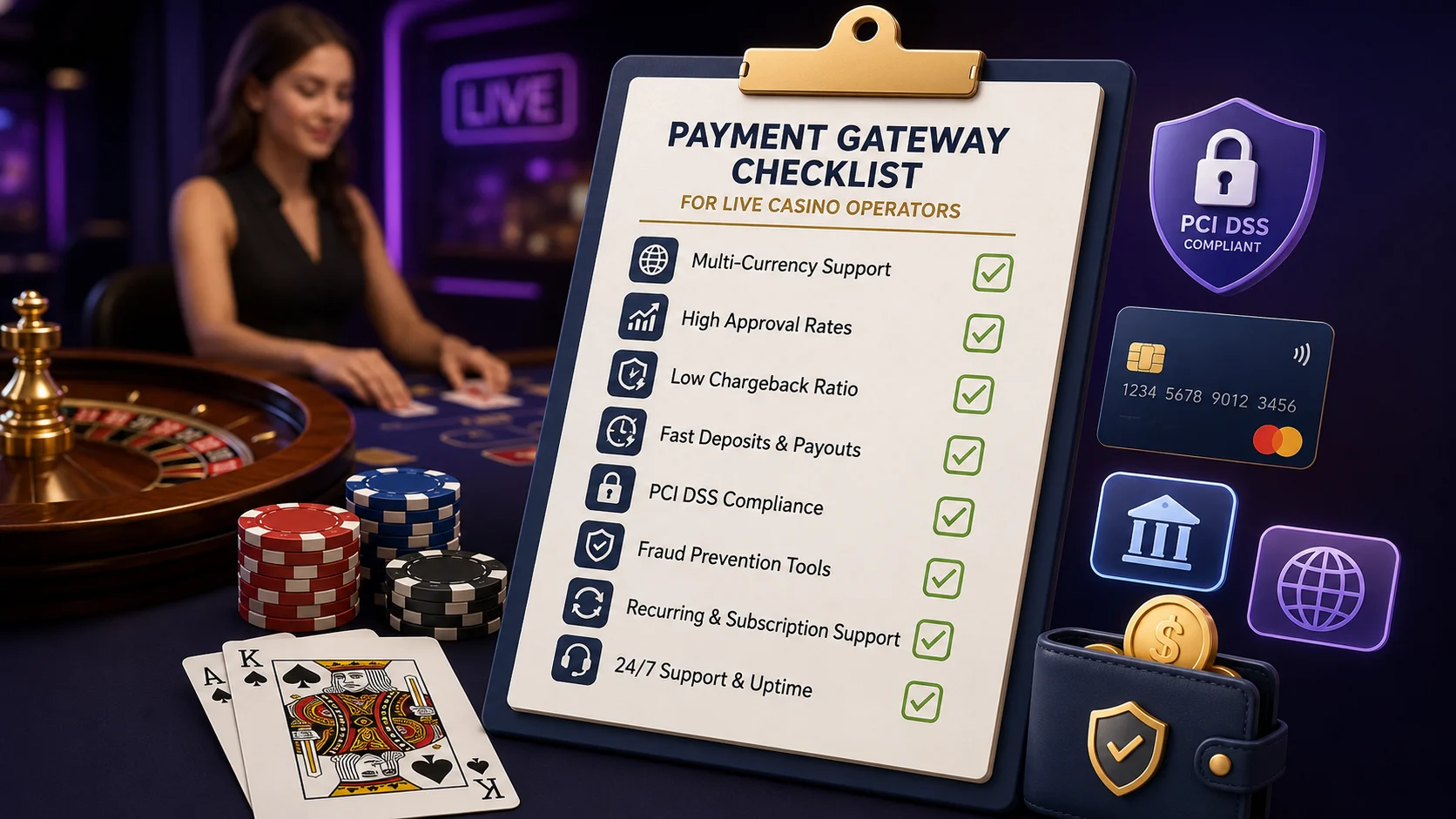
TL;DR:
Live dealer games run 30-40% longer sessions than RNG slots, which means a failed deposit or slow withdrawal mid-table costs you more than it would on a quick slot spin, players are engaged, watching a real dealer, and far less forgiving of friction. This checklist covers the nine things to verify before committing to a payment gateway for live casino operations, from licensing fit to settlement speed to chargeback tooling.
If you’re building or scaling a live casino product, you already know payments aren’t a backend detail, they’re part of the product experience. A player mid-session at a live blackjack table who can’t top up their balance doesn’t wait patiently; they close the tab, and a slow withdrawal after a big win is exactly the kind of friction that turns a loyal player into a one-time visitor. This checklist is built around that specific pain point: what actually needs to be true about your payment processing stack before you scale live dealer content.
Key Terms Before You Start
A few terms come up constantly in this process, worth defining upfront:
- Merchant account: the account a provider sets up to let your business accept card payments. High-risk merchant accounts involve stricter underwriting than standard retail accounts.
- Rolling reserve: a percentage of your processing volume the provider holds back for a set period (commonly 90-180 days in gambling) as a buffer against chargebacks, released back over time.
- Chargeback: when a player disputes a transaction with their card issuer and funds are pulled back from your account, often with a fee. In gambling, most chargebacks are “friendly fraud”, players disputing losses they authorized.
- MCC (Merchant Category Code): the four-digit code card networks use to classify your business. Gambling sits under MCC 7995, triggering stricter underwriting and higher fees by default.
- Settlement: the actual movement of funds into your account (deposits) or to the player (withdrawals), separate from authorization, which can happen instantly while settlement still takes days.
- FX markup: the margin a provider adds above the real exchange rate when converting currencies, often undisclosed as a separate line item.
Why Live Casino Payments Need a Different Checklist Than RNG
Live dealer content changes the payment equation in ways that matter for vendor selection specifically. Sessions run longer, so players are more likely to need a mid-session top-up rather than a single pre-game deposit. Bet sizes at live tables often skew higher than casual slot play, which raises both the stakes of a failed transaction and the scrutiny from card networks. And because the format hinges on real-time trust, a visible dealer, a live stream, an authentic experience, any friction in the payment layer undermines the exact sense of immediacy live dealer is built to deliver. A payment gateway that works fine for RNG slots can quietly become a retention problem once you scale live tables.
The Nine-Point Checklist
1. Gambling-Specific Underwriting, Not a Generic High-Risk Label
What this means: underwriting is the process a provider uses to assess your business’s risk before approving you, reviewing licensing, processing history, and business model. Verify the provider actively underwrites gambling and live casino specifically, rather than lumping it into a generic “high-risk” category alongside unrelated verticals. Providers built for high-risk merchants broadly may still decline live casino once they see real volume, so ask whether live dealer and iGaming are named, approved categories in their underwriting policy, not just something a sales rep confirmed verbally. Request the actual underwriting criteria document if one exists.
2. Licensing and Jurisdiction Compatibility
What this means: confirm the provider actually supports your specific licensing jurisdictions, not just “international coverage” in marketing language. A provider comfortable with a Curaçao-licensed operator may have real gaps supporting markets requiring UKGC or MGA-level compliance, since those regulators impose stricter reporting on the payment side too. Ask for a list of jurisdictions they currently support gambling transactions in, then cross-check it against your licensing footprint and expansion roadmap. Mismatches here surface late, often after you’ve built player acquisition around a market the provider can’t actually support.
3. Settlement Speed for Withdrawals Specifically
What this means: settlement is distinct from authorization, a card transaction can authorize instantly while the actual movement of funds into your account (or out, for withdrawals) takes considerably longer. Ask for actual withdrawal settlement timelines in writing, not marketing language like “fast payouts.” Live casino players who just won at a table are the most sensitive segment to withdrawal delay in your entire platform, this is where trust is won or lost fastest, since the win itself creates a moment of heightened attention to whether the platform delivers. Prioritize providers offering real-time or near-real-time settlement rails, open banking transfers, or select crypto payments options that settle on-chain, for withdrawal flows specifically, even if your deposit rail runs on standard card acquiring, where multi-day settlement is more tolerable since it happens before the player is emotionally invested in the outcome.
4. Local Payment Method and Currency Coverage
What this means: card processing alone rarely covers a global player base, alternative payment methods like Pix in Brazil, iDEAL in the Netherlands, or local e-wallets across Southeast Asia are often the dominant deposit method in a given market, not a nice-to-have addition. Check which specific methods a provider supports per region rather than assuming broad “international coverage” translates into real local relevance. The verification process here: request a market-by-market breakdown of supported payment methods, not a global count, and compare it directly against where your live studio content and marketing spend are actually concentrated. Cross-border payments coverage that looks complete on a sales deck often has real gaps once you check specific markets.
5. Chargeback and Fraud Tooling Built for Gambling’s Dispute Pattern
What this means: most fraud-prevention tools are built around stolen-card fraud, someone using a card that isn’t theirs. Gambling’s dominant fraud pattern is different: “friendly fraud,” where a player disputes a transaction for a loss they actually authorized, hoping the bank sides with them over the operator. Confirm the provider’s fraud tooling is specifically tuned to detect and contest this pattern, not just generic transaction anomalies. This matters more than ever given Visa’s tightened VAMP (Visa Acquirer Monitoring Program) threshold, lowered from 2.2% to 1.5% as of April 2026 for merchants across the US, Canada, the EU, and Asia-Pacific, cross that chargeback ratio and you face per-event fines and risk losing Visa acquiring access outright. Ask specifically whether the provider offers real-time chargeback-ratio monitoring and pre-dispute alerts (where you’re notified before a dispute becomes a formal chargeback, giving you a chance to resolve it directly with the player) rather than monthly reporting that surfaces problems only after they’ve already accumulated.
6. Fee Structure and Reserve Terms, in Writing
What this means: get exact numbers on processing fees (the percentage taken per transaction), rolling reserve percentages (the portion of your volume held back as a buffer), and reserve hold periods (how long that money is held before release) before signing anything. High-risk gambling processing typically runs 2.5-6.5% in fees with 5-20% rolling reserves held 90-180 days, vague “competitive” language in a sales conversation isn’t a substitute for contract terms, and the gap between a verbal estimate and the actual contract is where many operators get caught off guard on cash flow. This is also where offshore merchants account structures can differ meaningfully from onshore ones, an offshore account may offer more flexible underwriting but different reserve and dispute-resolution terms, so confirm exactly which structure you’re actually being offered and what recourse you have if a dispute arises.
7. Multi-Currency and FX Transparency
What this means: when a player deposits or withdraws in a currency different from your settlement currency, the provider converts it, and the exchange rate used often includes a hidden markup above the actual market rate, separate from any disclosed transaction fee. For any operator running cross-border payments across multiple currencies, confirm whether FX conversion is transparent and itemized as a disclosed rate, or embedded invisibly into the exchange itself. The process to check this: request a sample transaction breakdown showing the exact rate applied versus the market mid-rate at that moment. Live casino’s higher average bet sizes make FX margin erosion more costly at scale than it would be for a lower-stakes RNG-only operation, so this line item deserves direct scrutiny rather than assumption.
8. Redundancy – Never a Single Point of Failure
What this means: relying on one processor or one banking relationship for your entire payment flow creates a structural vulnerability, if that provider changes its risk policy, gets acquired, or exits the gambling category, your entire cashier can go offline with little warning. Bank de-risking (when a bank decides to stop serving an entire category of merchant, regardless of individual compliance) and sudden processor terminations are a recurring, documented pattern across the high-risk payments industry generally, not a hypothetical. The process here: build a multi-acquirer setup from the start, potentially including a secondary offshore merchant account relationship as backup, so you have the technical and contractual ability to reroute volume if any single relationship changes, rather than scrambling to onboard a replacement processor mid-crisis while revenue is frozen.
9. Direct Regulator Verification, Not Just Marketing Claims
What this means: licensing and registration claims made on a provider’s own website or a directory listing aren’t independently verified by default, they’re self-reported. Before finalizing any provider, verify their stated licensing directly with the named regulator’s public registry rather than relying on marketing copy. This is true for every payment providers claim in this space, licensing type, registration number, and current status should all be independently checkable in a few minutes of research. A provider unwilling or unable to help you complete this verification, or one that becomes evasive when asked for specifics, is itself a signal worth weighing heavily in your decision.
Pros and Cons of Running This Checklist Before You Sign
Full checklist before signing:
- Avoids the common pattern of onboarding, then discovering gaps (jurisdiction mismatch, missing local methods) months later
- Reduces chargeback and Visa VAMP threshold risk through upfront fraud-tooling verification
- Protects retention on live dealer content specifically, where payment friction costs more than on RNG
- Slower vendor onboarding, since it requires documentation most providers don’t volunteer upfront
Skipping it for a faster launch:
- Higher risk of a mid-scale account termination or frozen funds once real volume reveals underwriting gaps
- Retention losses from payment friction that only becomes visible once live dealer volume ramps up
- No fallback plan if your single processor relationship changes unexpectedly
Playing Strategy: How to Sequence This in Practice
Rather than treating this as a one-time checklist before your first contract, the strongest merchant services strategy for live casino operators treats it as an ongoing playbook:
- Start with jurisdiction and underwriting fit: this filters your realistic provider shortlist before you evaluate anything else.
- Build redundancy into your initial setup: not as a later addition, a secondary acquiring relationship from day one is cheaper than an emergency migration later.
- Prioritize withdrawal-speed infrastructure specifically for live dealer flows: even if your deposit-side setup stays more conservative initially.
- Layer in local payment methods incrementally: prioritized by where your live studio content and player acquisition spend are actually concentrated.
- Review chargeback ratios and fee terms quarterly: not just at contract renewal, Visa’s tightened threshold means this needs active monitoring, not periodic review.
Practical Takeaway
Live casino’s core value proposition, real-time, human, trustworthy gameplay, only holds up if the payment layer behind it is equally reliable. Before you scale live dealer content, run this checklist against any payment gateway you’re considering, and don’t treat a polished sales deck as a substitute for verified licensing, written fee terms, and confirmed settlement speeds. The operators winning in live casino right now are the ones who treat casino payment infrastructure as inseparable from the player experience itself, not backend plumbing bolted on after the studio investment is already made.
Comments
No comments yet. Be the first to share your thoughts.
Leave a comment