
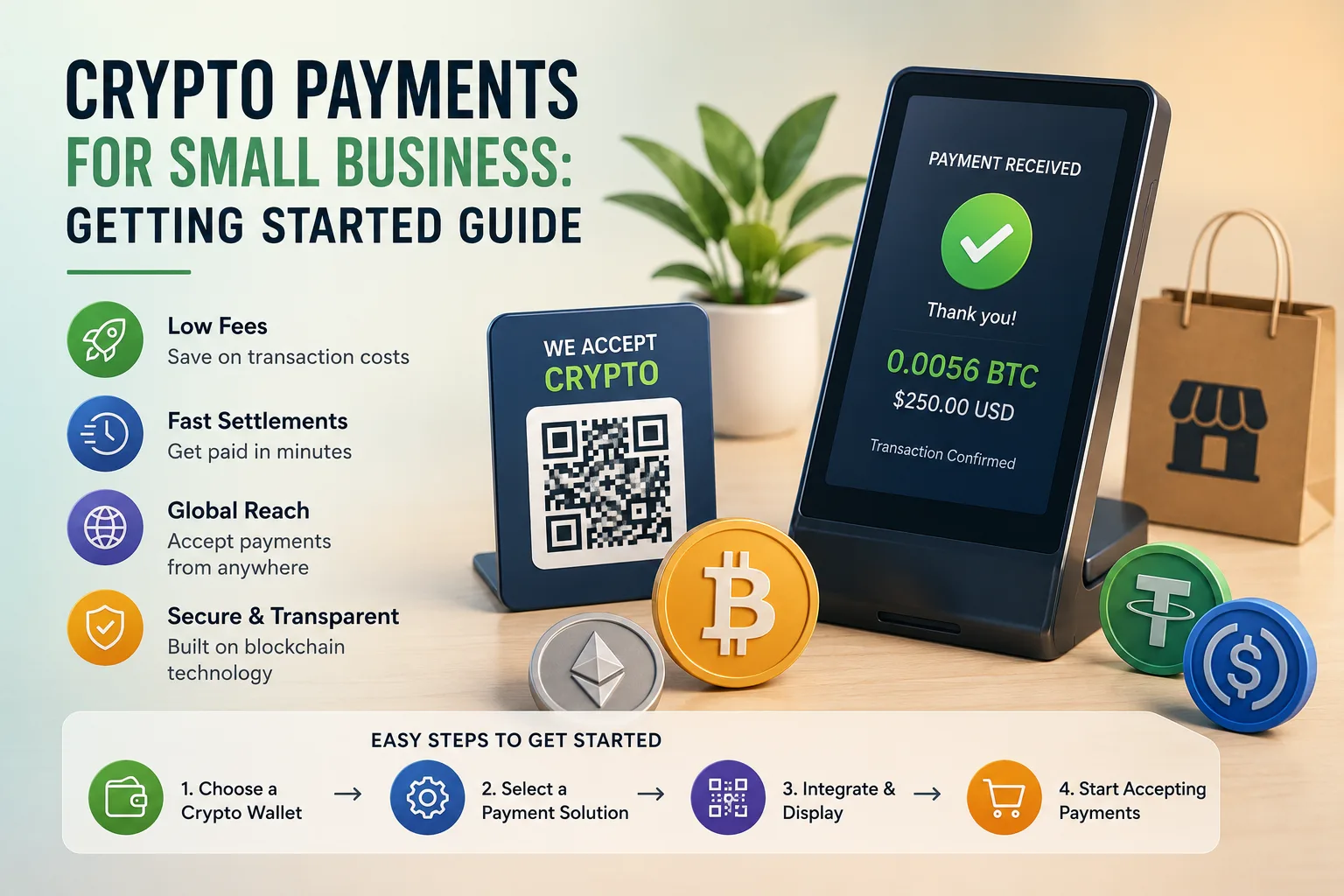
Crypto payments for small business used to sound like something reserved for tech startups and Web3-native brands. That’s no longer true. With over 700 million people worldwide now holding cryptocurrency, accepting digital assets has moved from experimental to a practical option any small business can evaluate, no blockchain expertise required.
TL;DR:
Small businesses can start accepting crypto payments through a payment provider or dedicated crypto payment gateway, with no need to hold digital assets or manage wallets manually. The biggest benefits are lower fees than card networks, faster cross-border settlement, and access to customers underserved by traditional banking. The biggest considerations are volatility (largely solved by stablecoins), tax reporting, and choosing a provider with the right compliance coverage for your markets.
Why Small Businesses Are Looking at Crypto Payments in 2026
Three practical forces are driving small business interest in crypto payments, and none of them require a business to become “crypto-native” to benefit.
- Cost efficiency: Traditional card processing typically runs 2-3% plus fixed fees. Crypto payment processing is often meaningfully cheaper, particularly for cross-border payments or high-ticket transactions, even after accounting for network and conversion fees.
- Faster settlement: Crypto payments settle over blockchain networks without the multi-day delays common with international bank transfers, and many providers now offer instant conversion into fiat currency or stablecoins.
- Customer demand and reach: A growing segment of global consumers actively prefer paying with digital assets, and crypto payments give small businesses a way to reach customers in markets where card infrastructure is limited or unreliable.
The volatility concerns that made businesses hesitant in earlier years have also largely been addressed. Most established crypto payment gateways now offer instant conversion, and stablecoins, cryptocurrencies pegged to a fiat currency like the US dollar, have become the dominant option for everyday merchant payments precisely because they remove price-swing risk from the equation.
Do You Need to Hold Crypto to Accept It?
No, and this is the single biggest misconception holding small businesses back. Any business with internet access and a crypto wallet can accept digital payments, but in practice, most small businesses let a crypto payment gateway handle the technical details: checkout, wallet management, blockchain transaction processing, and converting crypto to fiat currency automatically.
That means a small business can accept crypto payments and never actually hold volatile digital assets on its balance sheet. Funds settle into a bank account or virtual account just like they would from a traditional merchant account, just through a different rail.
Three Ways Small Businesses Can Accept Crypto Payments
There isn’t one single way to accept crypto, the right path depends on how much control you want versus how much complexity you’re willing to manage.
- Through an existing payment provider: The simplest option for most small businesses. Several major payment processors now support crypto acceptance directly inside the same dashboard used for card payments, often requiring only a small settings change or a minor API update. The provider handles blockchain details and settles funds to you in fiat.
- Through a dedicated crypto payment gateway: Purpose-built tools that integrate with ecommerce platforms and point-of-sale systems, supporting multiple cryptocurrencies including stablecoins. These gateways handle exchange rate locking, blockchain monitoring, payment confirmation, and fiat conversion, and typically offer more reporting and reconciliation detail than a general payment provider.
- Directly into a self-managed wallet: Gives a business full control over funds, but also full responsibility, securing private keys, monitoring for incoming payments, managing conversions, and handling compliance independently. This path is generally best suited to businesses with dedicated technical resources, not a typical small business just getting started.
For most SMBs, starting with an existing payment provider or a hosted gateway is the fastest, lowest-friction path, full integration can often go live in a matter of days, compared to several weeks for a custom setup.
Choosing Which Cryptocurrencies to Accept
You don’t need to accept every cryptocurrency that exists. Most small businesses starting out settle on a short, practical list:
- Bitcoin (BTC): still the most widely recognized digital asset, useful for credibility with crypto-native customers even if transaction volume for it specifically is modest
- Stablecoins (USDT, USDC): increasingly dominant in actual transaction volume, since they eliminate volatility concerns for both the merchant and the customer, making them a strong choice for invoicing and B2B payments
- Ethereum (ETH): if your customer base skews more technical or crypto-native, particularly given faster, lower-cost transactions available through Layer 2 networks
If you want to keep things simple, a stablecoins-only starting point is a completely valid approach, many small businesses skip volatile assets entirely and only accept USD-pegged stablecoins.
What to Look for in a Crypto Payment Gateway
Not all crypto payment gateways are built the same way, and the right fit depends on your business model. When evaluating payment providers, small businesses should compare:
- Supported cryptocurrencies and stablecoins: matched to what your target customers are actually likely to use
- Fiat settlement options: so you’re never forced to hold volatile crypto on your balance sheet unless you choose to
- Fee structure: since rates vary meaningfully by provider, factor in network fees and any conversion costs, not just the headline percentage
- Ecommerce and POS integration: particularly plugin support for platforms like Shopify or WooCommerce if you’re selling online
- Compliance coverage: including whether the provider is built for your specific regulatory region (for example, MiCA compliance if you operate in the EU)
- Chargeback and dispute handling: since crypto transactions are generally irreversible once confirmed, worth understanding upfront, not after a dispute arises
Cross-Border Payments: Where Crypto Solves a Real Small Business Problem
Domestic online payments were never the strongest case for crypto, card networks already handle those well. Cross-border payments are a different story, and it’s where small businesses tend to see the clearest benefit.
Traditional cross-border payments often fail for international customers due to declined transactions, currency conversion fees, and banking restrictions in markets with weaker card infrastructure. Crypto payments move over global networks without relying on a chain of intermediary banks, which makes them considerably more reliable for reaching customers outside your home market.
For small businesses selling internationally, this translates into fewer failed transactions, lower FX costs, and access to customers who may not have reliable access to traditional card-based payment providers at all.
Why Travel and Booking SMBs Should Pay Close Attention
Small travel and booking businesses face a version of the cross-border payments problem that’s more acute than most other SMB categories, international customers, currency mismatches, and long gaps between booking and departure that leave plenty of room for costs to shift.
Crypto payments, particularly stablecoins, address several of these pain points directly:
- Reduced FX exposure: between the time a customer books and the time a trip is delivered
- Lower-cost supplier payments: to international hotels, operators, and local vendors, without routing through multiple correspondent banks
- Access to customers in underserved markets: where card-based payment providers may decline transactions or apply steep surcharges
- Fewer failed international transactions: since crypto rails don’t depend on the same banking restrictions that cause card declines for cross-border bookings
A small travel agency or independent tour operator doesn’t need to overhaul its entire merchant payment setup to benefit, even accepting stablecoins as a secondary option alongside existing merchant accounts can meaningfully reduce cross-border friction for the international bookings that cause the most payment headaches.
Compliance and Tax Basics Small Businesses Shouldn’t Skip
Accepting crypto payments is legal in most jurisdictions for legitimate goods and services without requiring special licensing, but that doesn’t mean compliance is optional. A few fundamentals every small business should understand before going live:
- Tax treatment: Crypto payments are generally taxable events, recorded at fair market value in local currency at the time of receipt. If you later convert or hold the asset, any change in value can trigger a separate capital gain or loss. Work with an accountant familiar with digital asset taxation in your jurisdiction.
- KYC and AML thresholds: Larger transactions may require identity verification of the payer under regulations like the FATF Travel Rule, which sets international standards for information sharing on crypto transfers above certain thresholds.
- Regional regulation: If you operate in the EU, confirm your provider is compliant with MiCA (Markets in Crypto-Assets) regulation, which came into full effect in 2026 and applies to any business accepting crypto payments commercially.
- Record-keeping: Use crypto accounting software or reconciliation tools provided by your gateway to track every transaction, this becomes far more important at tax time than most small businesses initially expect.
Getting Started: A Simple First Step
For a small business dipping a toe into crypto payments for the first time, the lowest-risk starting point is usually the same:
- Choose a payment provider or gateway that already supports fiat settlement, so you’re never holding volatile assets by default
- Start with stablecoins only, to remove price volatility from the equation entirely while you learn the process
- Run a small test transaction before going live publicly
- Add crypto as one option alongside your existing digital payments and card acceptance, not a replacement for them
- Review your first month of transactions with your accountant to confirm your tax and reconciliation process is working as expected
Frequently Asked Questions
Do I need technical or blockchain expertise to accept crypto payments?
No. Most small businesses use a payment provider or crypto payment gateway that handles wallet management, blockchain monitoring, and fiat conversion automatically, similar to how a traditional payment gateway works for card payments.
Is accepting crypto payments legal for small businesses?
In most jurisdictions, yes, without special licensing for legitimate goods and services. Standard business regulations, tax reporting, and KYC/AML obligations for larger transactions still apply.
What’s the biggest risk of accepting crypto payments?
Price volatility if you hold digital assets rather than converting them, and navigating a regulatory environment that continues to evolve. Most small businesses avoid this by working with providers that settle payments in fiat automatically.
Can crypto payments help with cross-border payments specifically?
Yes, this is where the clearest small business benefit shows up, since crypto rails don’t rely on the chain of intermediary banks that often cause failed transactions and high fees for international customers.
Should a small business accept every type of cryptocurrency?
No. Most small businesses start with a short list, typically Bitcoin and one or two major stablecoins, rather than trying to support every asset a gateway offers.
Comments
No comments yet. Be the first to share your thoughts.
Leave a comment