
Introduction
As businesses expand into international markets, accepting payments in the way customers prefer has become a major competitive advantage. While credit and debit cards remain widely used, they are not the preferred payment option in every country. In many regions, consumers rely on bank transfers, digital wallets, mobile payment apps, cash-based vouchers, or local payment schemes for their everyday purchases. Businesses that fail to support these preferences often experience lower conversion rates and higher cart abandonment.Local Payment Methods (LPMs) allow merchants to offer country-specific payment options that customers already know and trust. By supporting familiar payment methods, businesses can improve the checkout experience, increase customer confidence, and boost sales in both domestic and international markets.
As cross-border e-commerce continues to grow, integrating local payment methods has become an essential strategy for businesses seeking global expansion.
What Are Local Payment Methods?
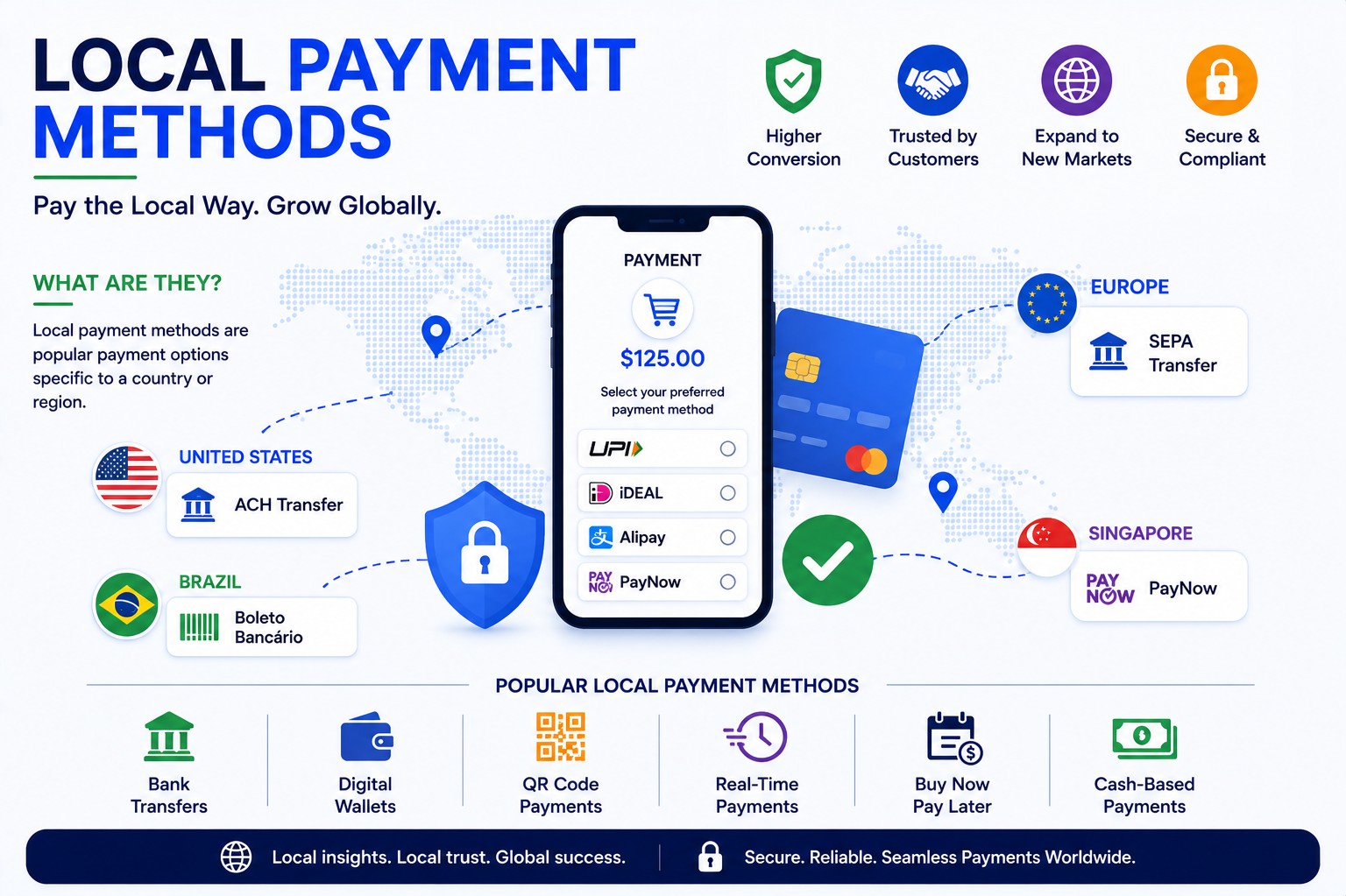
Local Payment Methods are payment options that are widely used and preferred within a specific country or region.
Unlike international card networks, local payment methods are designed to meet regional banking habits, consumer preferences, regulatory requirements, and payment infrastructure.
These methods may include bank transfers, digital wallets, mobile payment applications, direct debit systems, QR code payments, instant payment networks, Buy Now Pay Later (BNPL) services, or cash-based payment solutions.
Offering local payment methods helps businesses create a more localized and customer-friendly checkout experience.
Why Local Payment Methods Matter
Consumer payment preferences vary significantly across different countries.
While customers in some regions primarily use payment cards, others prefer bank-based payments or digital wallets. If shoppers cannot pay using their preferred method, they are more likely to abandon their purchase.
Supporting local payment methods increases customer trust by providing familiar payment options that align with local financial habits.
For businesses, this translates into higher conversion rates, improved customer satisfaction, and stronger international growth.
How Local Payment Methods Work
When a customer selects a local payment method during checkout, the payment gateway redirects or connects the customer to the appropriate local payment network.
The customer authorizes the payment using the selected method, such as logging into online banking, approving a mobile wallet transaction, scanning a QR code, or confirming payment through a banking application.
Once authorized, the payment provider securely processes the transaction and notifies the merchant of the payment status.
Funds are then settled according to the payment provider’s processing schedule.
Types of Local Payment Methods
Local payment methods come in many forms depending on regional financial infrastructure.
Some countries rely heavily on online bank transfers, while others prefer digital wallets linked to mobile devices. Real-time payment networks allow instant account-to-account transfers, and Buy Now Pay Later solutions enable consumers to spread payments over time.
Cash-based payment vouchers remain popular in regions with lower banking penetration, while QR code payments continue gaining adoption in mobile-first markets.
This diversity reflects the unique payment ecosystems that exist around the world.
Benefits for Businesses
Supporting local payment methods offers numerous advantages for merchants.
Businesses can improve checkout conversion by reducing payment friction and giving customers familiar ways to pay. Local payment acceptance also expands market reach, enabling companies to serve customers who may not use international credit cards.
Higher payment success rates, improved customer loyalty, and stronger regional competitiveness further contribute to business growth.
For companies operating internationally, local payment methods have become a critical component of successful market expansion.
Benefits for Customers
Customers value convenience, familiarity, and trust during online purchases.
Local payment methods allow shoppers to pay using options they already use in their daily financial activities. This reduces uncertainty while making checkout faster and more comfortable.
Many local payment methods also provide additional security features such as bank authentication, biometric verification, or instant payment confirmation.
These advantages improve the overall customer experience.
Local Payment Methods and Cross-Border Commerce
International businesses often struggle to serve customers with diverse payment preferences.
Local payment methods eliminate many barriers by allowing merchants to accept region-specific payment options while receiving centralized settlement through a single payment provider.
Combined with multi-currency processing, localized checkout pages, and regional language support, local payment methods help businesses create seamless international shopping experiences.
This localization significantly improves global conversion rates.
Security and Compliance
Security remains a top priority for payment providers offering local payment methods.
Modern payment platforms use encryption, tokenization, secure authentication, fraud detection systems, and compliance with industry standards such as PCI DSS.
Many local payment schemes also incorporate bank-level authentication and multi-factor verification to protect customer accounts.
Businesses benefit from secure payment processing while maintaining compliance with local financial regulations.
Integration with Payment Gateways
Most modern payment gateways provide access to multiple local payment methods through a single API integration.
Instead of integrating each payment method individually, businesses can connect to one payment platform that supports numerous regional payment options.
This simplifies implementation, reduces development effort, and enables merchants to expand into new markets more efficiently.
Flexible APIs also support mobile applications, websites, marketplaces, and subscription platforms.
Artificial Intelligence and Payment Optimization
Artificial intelligence is helping businesses optimize local payment performance.
AI-powered payment orchestration systems analyze transaction behavior to recommend the most effective payment method for each customer based on geography, payment history, and approval rates.
Machine learning also improves fraud detection, payment routing, and transaction authorization while reducing failed payments.
These intelligent capabilities increase payment efficiency and enhance customer satisfaction.
Challenges of Supporting Local Payment Methods
Although local payment methods offer substantial benefits, businesses should consider several implementation challenges.
Different countries have unique regulations, settlement timelines, technical integration requirements, and customer expectations.
Managing multiple payment providers independently can become complex as international operations expand.
Choosing a payment platform with broad local payment coverage simplifies these challenges while reducing operational overhead.
Future of Local Payment Methods
The future of payments is becoming increasingly localized, digital, and real-time.
Open Banking, instant payment networks, embedded finance, digital wallets, biometric authentication, and Central Bank Digital Currencies (CBDCs) are expected to further diversify local payment ecosystems.
Businesses that adapt to evolving consumer payment preferences will be better positioned to compete in global digital commerce.
Supporting local payment methods will remain a key strategy for improving customer experiences and driving international growth.
Choosing the Right Payment Provider
Businesses selecting a payment provider should evaluate global coverage, supported local payment methods, API quality, security standards, fraud prevention tools, settlement speed, reporting capabilities, scalability, and customer support.
A provider with strong regional expertise and broad payment method coverage can simplify international expansion while improving payment performance.
Investing in the right payment infrastructure helps businesses deliver seamless checkout experiences across multiple markets.
Conclusion
Local Payment Methods have become essential for businesses serving customers across different countries and regions. By offering familiar, trusted, and region-specific payment options, merchants can improve conversion rates, enhance customer satisfaction, and expand successfully into new markets.
Whether through bank transfers, digital wallets, QR code payments, real-time payment networks, or other regional solutions, local payment methods create a more personalized and accessible checkout experience.
As global e-commerce continues to evolve, businesses that embrace localized payment strategies will be better equipped to build customer trust, increase sales, and achieve long-term international success.
Comments
No comments yet. Be the first to share your thoughts.
Leave a comment