
Introduction
In today’s global economy, businesses operate across multiple countries, currencies, and banking systems. Whether paying suppliers overseas, managing international payroll, collecting customer payments, or expanding into new markets, companies require financial infrastructure that supports seamless cross-border transactions.One of the most important components of modern international banking is the IBAN (International Bank Account Number). Originally introduced to simplify international transfers and reduce payment errors, the IBAN has evolved into a fundamental element of global financial architecture.
For businesses engaged in international trade and digital commerce, adopting an IBAN-based banking strategy offers far more than payment standardization. It provides operational efficiency, stronger compliance capabilities, improved transaction accuracy, and enhanced scalability.
As organizations increasingly seek streamlined financial operations, understanding the core benefits of using an IBAN has become essential for building a modern B2B financial framework.
What Is an IBAN?
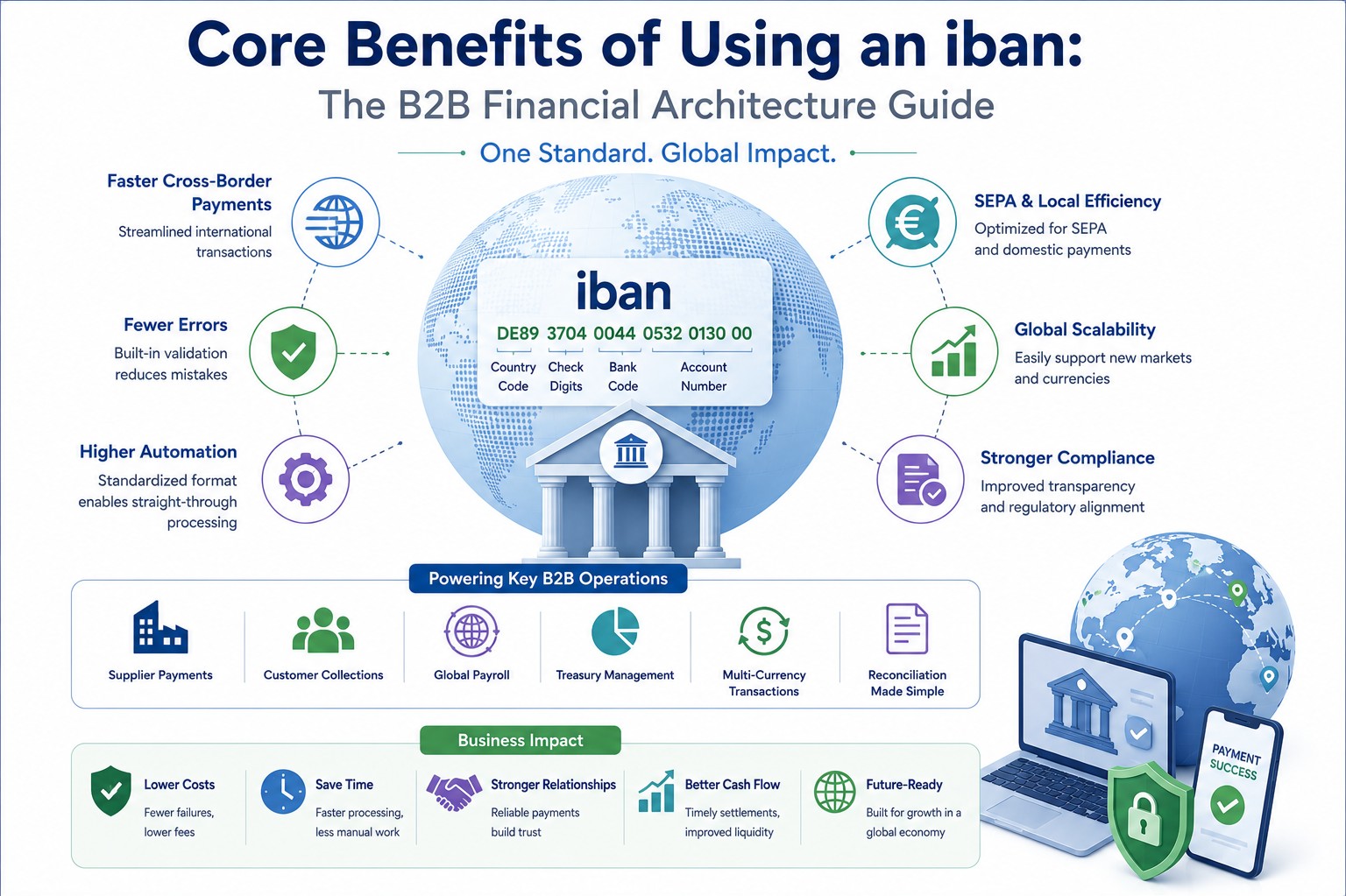
An IBAN is a standardized international bank account identifier used to facilitate domestic and cross-border transactions. It contains a combination of country codes, check digits, bank identifiers, and account information that uniquely identify a specific bank account.
The primary objective of the IBAN system is to ensure payment instructions are processed accurately and efficiently across different banking networks.
Today, IBANs are widely used throughout Europe and many other regions worldwide, forming a critical component of international payment infrastructure.
The Growing Importance of IBAN in B2B Finance
Global commerce continues to become more interconnected.
Businesses frequently work with international suppliers, remote teams, overseas customers, and multinational partners. Managing these relationships requires financial systems capable of handling transactions efficiently across borders.
Traditional account structures often create complexity when processing international payments. Different account formats, routing requirements, and banking standards can lead to delays and operational inefficiencies.
The IBAN addresses these challenges by introducing a standardized framework that simplifies payment processing and improves transaction reliability.
Improved Cross-Border Payment Efficiency
One of the most significant advantages of using an IBAN is the improvement in cross-border payment efficiency.
International transactions frequently involve multiple financial institutions and payment networks. Without standardized account information, payment processing becomes more complex and error-prone.
IBANs provide a universally recognized format that allows banks and payment providers to validate account details more effectively.
This standardization reduces manual intervention, accelerates transaction processing, and minimizes payment delays.
For businesses managing international payment flows, these efficiency gains can have a substantial operational impact.
Reduced Payment Errors
Payment errors remain a major challenge for organizations handling large transaction volumes.
Incorrect account details can result in failed payments, returned funds, administrative costs, and strained business relationships.
The structured format of an IBAN helps reduce these risks.
Built-in validation mechanisms, including check digits, allow payment systems to identify errors before transactions are processed.
This verification capability improves payment accuracy and reduces costly mistakes.
For finance teams responsible for supplier payments and customer settlements, error reduction translates directly into improved productivity.
Enhanced Financial Automation
Modern businesses increasingly rely on automation to improve operational efficiency.
Financial workflows such as invoice payments, payroll processing, treasury management, and reconciliation benefit significantly from standardized banking information.
The consistent structure of an IBAN enables payment systems, enterprise resource planning platforms, and accounting software to automate transaction processing more effectively.
Organizations can streamline payment workflows while reducing manual workloads and administrative overhead.
As automation becomes a competitive advantage, IBAN standardization supports broader digital transformation initiatives.
Stronger Support for SEPA Payments
For businesses operating in Europe, the IBAN is a cornerstone of the Single Euro Payments Area (SEPA).
SEPA enables euro-denominated payments to move across participating countries with the same ease as domestic transfers.
IBANs allow businesses to access this unified payment environment while benefiting from:
- Faster payment processing
- Lower transaction costs
- Standardized payment formats
- Improved operational efficiency
Companies that frequently conduct business within Europe often view IBAN adoption as essential to effective financial management.
Better Scalability for Global Expansion
International growth requires financial infrastructure capable of supporting increasing transaction volumes and geographic complexity.
As businesses expand into new markets, payment requirements become more sophisticated. Managing multiple banking relationships and account formats can create operational challenges.
Using an IBAN helps simplify expansion by providing a standardized banking framework recognized across numerous jurisdictions.
This consistency reduces complexity and supports scalable financial operations.
Organizations pursuing international growth strategies often leverage IBAN-enabled banking solutions to facilitate market entry and global payment management.
Improved Banking Relationships
Banks and financial institutions increasingly prioritize efficiency, compliance, and transparency.
Businesses using IBAN-based payment structures often benefit from smoother banking operations because account information is easier to validate and process.
Standardized payment data improves communication between financial institutions and reduces transaction-related issues.
These advantages contribute to stronger banking relationships and more reliable financial operations.
For multinational organizations, maintaining efficient banking partnerships is essential for long-term success.
Enhanced Compliance and Transparency
Regulatory compliance has become a major priority for organizations operating internationally.
Financial institutions must comply with anti-money laundering regulations, sanctions requirements, transaction monitoring obligations, and financial reporting standards.
The structured format of an IBAN improves transaction transparency and supports regulatory oversight.
Accurate account identification helps financial institutions track payment flows and maintain compliance with evolving regulatory requirements.
For businesses, stronger transparency contributes to improved risk management and governance practices.
Supporting Multi-Currency Operations
Many modern businesses operate across multiple currencies.
International suppliers, overseas customers, and global workforce structures require efficient management of foreign currency transactions.
IBAN-enabled banking solutions often integrate with multi-currency accounts that allow organizations to send, receive, and manage funds in various currencies.
This flexibility supports better treasury management while reducing foreign exchange complexities.
As international commerce continues to expand, multi-currency capabilities have become increasingly valuable.
Improved Customer and Supplier Experiences
Efficient payment operations directly impact business relationships.
Suppliers expect timely payments, while customers demand reliable transaction experiences.
By reducing payment failures and improving processing speed, an IBAN helps create smoother financial interactions.
Reliable payment execution enhances trust, strengthens partnerships, and contributes to improved customer satisfaction.
These benefits become particularly important for businesses operating in competitive global markets.
Cost Savings Through Operational Efficiency
While the benefits of IBAN adoption extend beyond direct financial savings, operational efficiencies often generate measurable cost reductions.
Reduced payment errors, faster processing times, lower administrative workloads, and improved automation can significantly decrease operational expenses.
Businesses handling high transaction volumes may realize substantial savings through more efficient payment infrastructure.
Over time, these efficiencies contribute to stronger financial performance and increased profitability.
Future-Proofing Financial Infrastructure
The financial services industry continues to evolve rapidly through digital banking, open banking, real-time payments, and fintech innovation.
Organizations require financial architectures that can adapt to these changes while supporting future growth.
The IBAN remains a foundational element of modern banking infrastructure and is likely to play an increasingly important role in future payment ecosystems.
Businesses that adopt standardized financial frameworks today will be better positioned to capitalize on tomorrow’s opportunities.
Conclusion
The IBAN has become far more than a standardized bank account identifier. It is a critical component of modern B2B financial architecture that supports payment efficiency, automation, compliance, scalability, and international growth.
From reducing payment errors and accelerating cross-border transactions to improving transparency and enabling financial automation, the benefits of using an IBAN extend across every aspect of business finance.
As global commerce continues to expand and digital financial services evolve, organizations that leverage IBAN-based banking strategies will be better equipped to build resilient, efficient, and future-ready financial operations.
Comments
No comments yet. Be the first to share your thoughts.
Leave a comment