
Introduction
As businesses expand beyond domestic markets, managing multiple currencies becomes a critical part of financial operations. Companies that work with international clients, suppliers, marketplaces, and remote teams often face challenges related to currency conversion, cross-border payments, and banking fees.
Traditional banking systems were not designed for today’s global digital economy. Businesses frequently encounter delays, high foreign exchange costs, and complex payment processes when operating across multiple countries.
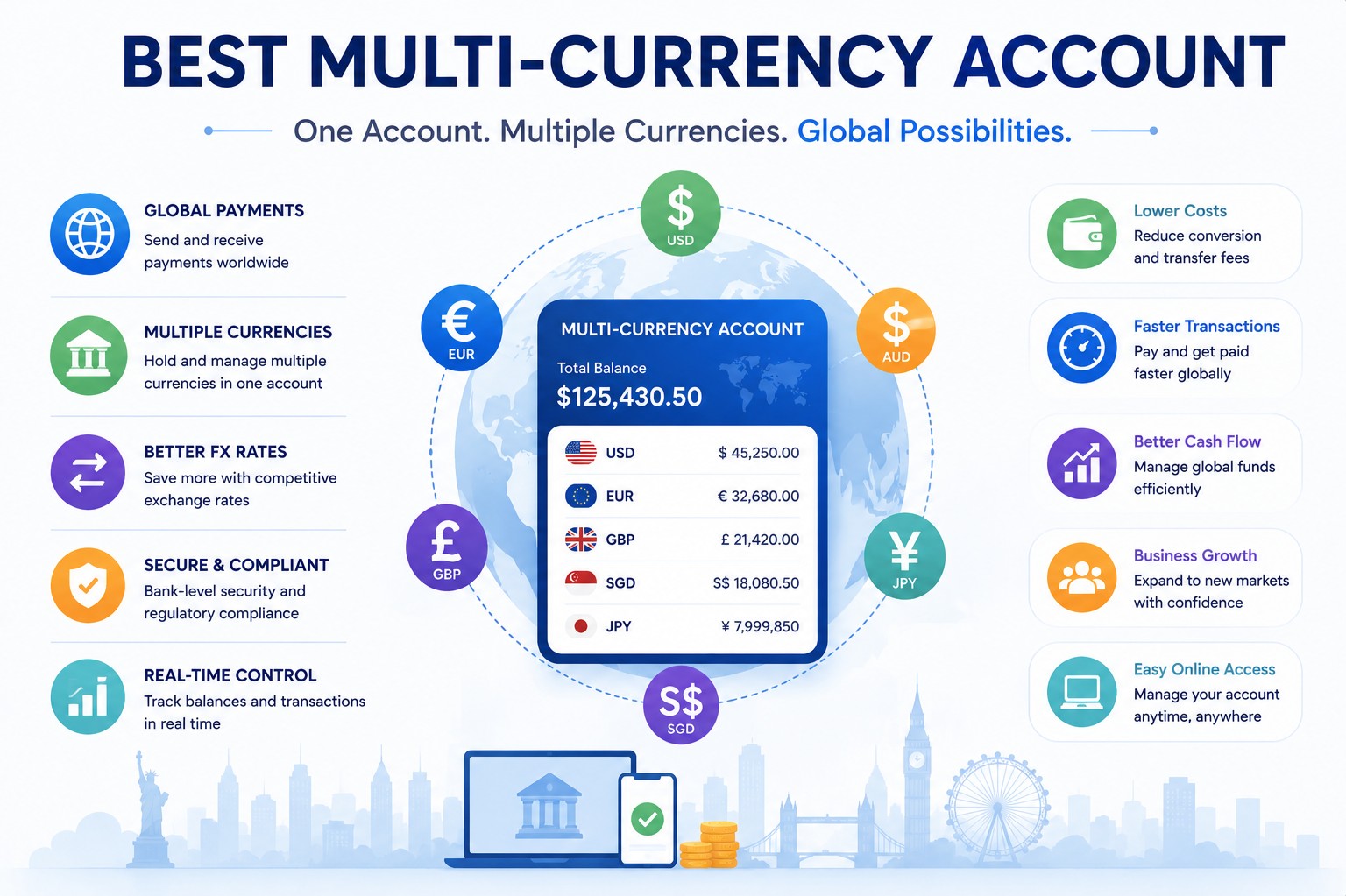
This is why many organizations are searching for the best multi-currency account. These accounts allow businesses to hold, send, receive, and manage multiple currencies through a single platform, simplifying international financial operations while improving efficiency.
As global commerce continues to grow, multi-currency accounts are becoming an essential financial tool for modern businesses.
What Is a Multi-Currency Account?
A multi-currency account is a banking or financial account that enables users to hold balances in multiple currencies simultaneously.
Instead of opening separate accounts in different countries, businesses can manage various currencies through one centralized solution.
Commonly supported currencies include:
- US Dollar (USD)
- Euro (EUR)
- British Pound (GBP)
- Canadian Dollar (CAD)
- Australian Dollar (AUD)
- Singapore Dollar (SGD)
- Japanese Yen (JPY)
This flexibility helps businesses streamline international transactions and reduce unnecessary currency conversions.
Why Businesses Need Multi-Currency Accounts
Global business operations create financial complexity.
Companies regularly deal with:
- International customers
- Overseas suppliers
- Foreign contractors
- Global marketplaces
- Cross-border investments
Without a dedicated solution, businesses may lose money through repeated currency conversions and banking fees.
A well-designed multi-currency account helps simplify these processes while providing greater financial control.
Key Features of the Best Multi-Currency Account
Not all providers offer the same capabilities.
The best solutions typically include:
Multiple Currency Balances
Businesses can hold funds in different currencies without immediate conversion.
International Payment Capabilities
Users can send and receive payments globally.
Competitive FX Rates
Lower conversion costs help improve profitability.
Local Receiving Accounts
Businesses can collect payments as if they had local bank accounts in multiple countries.
Digital Access
Modern platforms provide online dashboards and mobile access.
These features help businesses operate more efficiently in international markets.
Benefits of Using a Multi-Currency Account
Reduced Currency Conversion Costs
Holding funds in multiple currencies minimizes unnecessary exchanges and associated fees.
Faster International Payments
Businesses can process transactions more efficiently across borders.
Improved Cash Flow Management
Companies gain better visibility and control over global balances.
Simplified Financial Operations
Managing multiple currencies from one account reduces administrative complexity.
Enhanced Customer Experience
International customers can often pay in their preferred currency.
These advantages contribute directly to business growth and operational efficiency.
Supporting Cross-Border Commerce
Cross-border payments are a vital part of modern commerce.
Businesses selling internationally must navigate:
- Different currencies
- Banking systems
- Payment regulations
- Settlement processes
Multi-currency accounts help overcome these challenges by providing a centralized platform for managing international transactions.
This flexibility enables companies to expand into new markets with greater confidence.
Multi-Currency Accounts for E-Commerce
E-commerce businesses are among the largest users of multi-currency solutions.
Online merchants often receive payments from customers located in different countries.
A multi-currency account allows them to:
- Accept international payments
- Hold foreign currency balances
- Reduce conversion expenses
- Improve global customer experiences
As online commerce becomes increasingly international, these capabilities become even more valuable.
Managing Foreign Exchange Risk
Currency fluctuations can significantly impact business profitability.
Companies that frequently convert currencies may face unexpected losses due to changing exchange rates.
Multi-currency accounts provide greater flexibility by allowing businesses to hold funds in specific currencies until conversion becomes advantageous.
This approach can help improve foreign exchange management and financial planning.
Important Factors When Choosing a Provider
When evaluating the best multi-currency account, businesses should consider:
Supported Currencies
Ensure the provider supports key markets and currencies.
Payment Coverage
Review international transfer capabilities and geographic reach.
Fees and Pricing
Compare account fees, transfer costs, and FX margins.
Security and Compliance
Verify regulatory oversight and security standards.
Integration Options
Consider compatibility with accounting, ERP, and payment platforms.
Choosing the right provider can significantly improve international financial operations.
The Role of Fintech Innovation
Fintech companies have transformed the multi-currency account market.
Modern providers leverage technology to offer:
- Faster onboarding
- Real-time payment tracking
- Automated currency management
- Integrated payment solutions
- Improved user experiences
These innovations have made international banking more accessible for businesses of all sizes.
Challenges to Consider
Although multi-currency accounts provide significant benefits, businesses should remain aware of potential challenges.
These may include:
- Regulatory requirements
- Currency restrictions
- Provider-specific fees
- Compliance obligations
- Foreign exchange volatility
Careful provider selection and financial planning can help minimize these risks.
The Future of Multi-Currency Banking
Global commerce continues to evolve rapidly.
Future developments are expected to include:
- Real-time international payments
- AI-driven currency management
- Embedded finance solutions
- Enhanced treasury tools
- Greater payment automation
These innovations will further simplify international financial operations and support global business expansion.
Conclusion
Finding the best multi-currency account is becoming increasingly important for businesses operating in a connected global economy. By enabling organizations to hold, manage, send, and receive multiple currencies from a single platform, these accounts reduce complexity and improve financial efficiency.
As international trade, digital commerce, and cross-border payments continue to grow, multi-currency accounts will remain a valuable tool for businesses seeking greater flexibility, lower costs, and stronger global financial management. Organizations that adopt modern multi-currency solutions will be better positioned to compete and thrive in the evolving world of international commerce.
Comments
No comments yet. Be the first to share your thoughts.
Leave a comment