
Introduction
As digital commerce continues to expand, payment infrastructure has become one of the most critical components of business operations. Customers expect fast, secure, and seamless payment experiences regardless of where they shop or which device they use. To meet these expectations, businesses must ensure their payment systems remain efficient, scalable, and reliable.This need often leads organizations to undertake a payment gateway migration. Whether driven by cost optimization, performance improvements, security requirements, international expansion, or access to new features, migrating to a new payment gateway can significantly impact a company’s financial operations.
However, payment gateway migration is not simply a technical project. It involves careful planning, risk management, customer experience considerations, and compliance requirements.
When executed correctly, a successful migration can improve transaction success rates, reduce operational costs, and create a stronger foundation for future growth.
What Is Payment Gateway Migration?
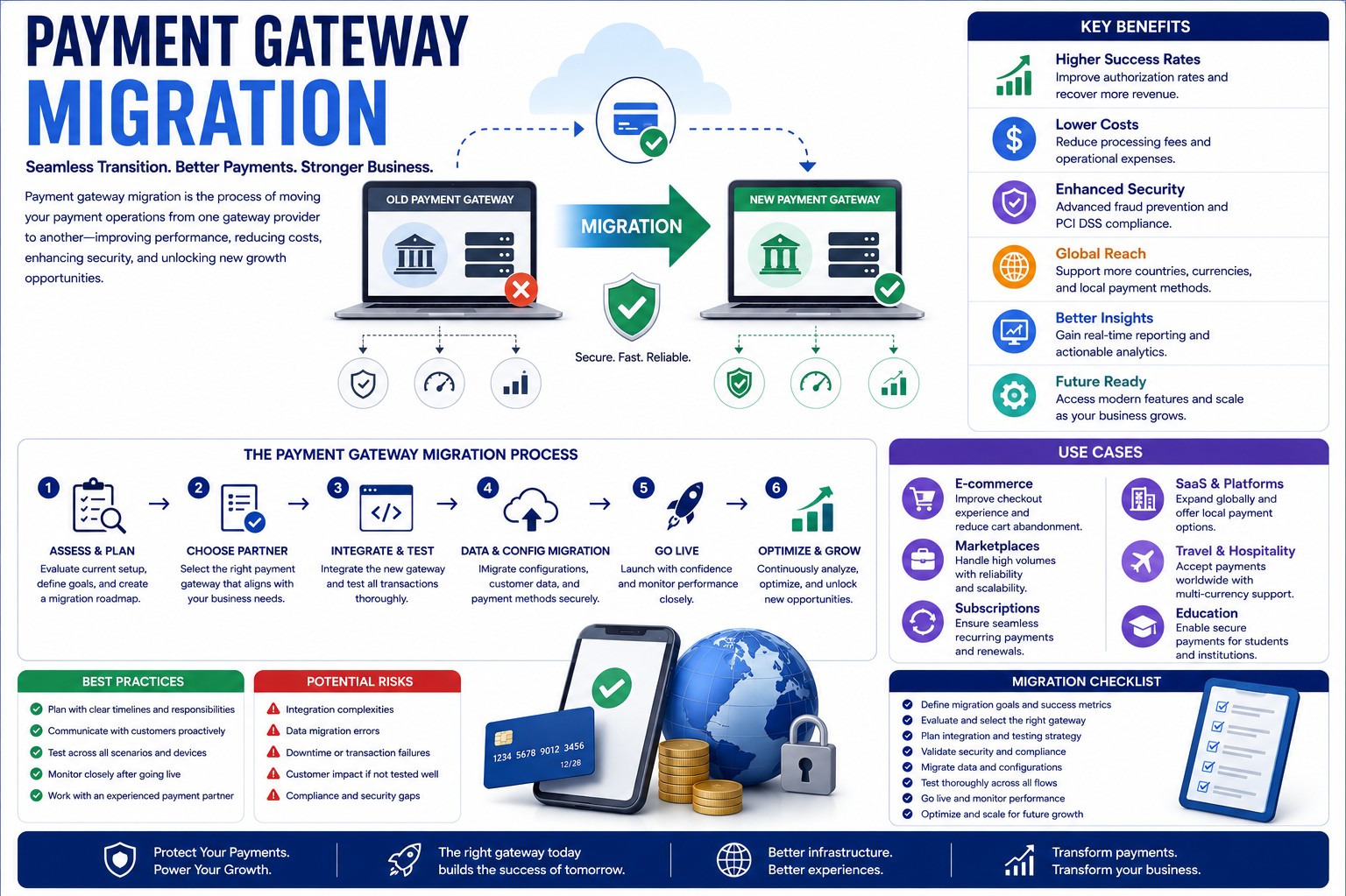
Payment gateway migration refers to the process of moving payment processing operations from one payment gateway provider to another.
A payment gateway acts as the technology bridge between merchants, customers, acquiring banks, card networks, and payment processors. It securely transmits transaction information and facilitates payment authorization.
When businesses migrate payment gateways, they replace their existing payment infrastructure with a new provider or payment platform.
This migration may involve transferring payment workflows, integrating new APIs, updating checkout systems, migrating recurring payment tokens, and ensuring compliance with security requirements.
The goal is to achieve a smooth transition without disrupting customer transactions.
Why Businesses Consider Payment Gateway Migration
Organizations choose to migrate payment gateways for various strategic reasons.
One common driver is cost reduction. Payment providers may charge different processing fees, settlement fees, and operational costs. Businesses often seek more competitive pricing structures as transaction volumes grow.
Another reason is performance optimization. Higher authorization rates, improved payment routing, and faster transaction processing can significantly impact revenue.
Businesses may also migrate to gain access to advanced features such as:
- Multi-currency support
- Alternative payment methods
- Real-time reporting
- Fraud prevention tools
- Subscription management
- Global payment capabilities
- Enhanced analytics
As customer expectations evolve, modern payment infrastructure becomes increasingly important.
Signs It May Be Time to Migrate
Several indicators suggest a business may benefit from payment gateway migration.
Frequent transaction failures, slow settlement times, limited international payment capabilities, and poor customer experiences can all signal infrastructure limitations.
Businesses may also face challenges when scaling into new markets if their existing gateway lacks support for local payment methods or regional compliance requirements.
Outdated technology, inadequate fraud protection, and insufficient reporting capabilities are additional reasons companies consider migration.
A gateway that once supported business growth effectively may eventually become a constraint as operational requirements evolve.
Benefits of Payment Gateway Migration
A successful payment gateway migration can provide substantial business advantages.
One major benefit is improved payment performance. Better authorization rates can directly increase revenue by reducing declined transactions.
Enhanced fraud detection capabilities can reduce financial losses while improving customer trust.
Modern gateways often provide more advanced reporting and analytics, allowing businesses to gain deeper insights into transaction activity and customer behavior.
Additional benefits may include:
- Lower processing costs
- Better customer experiences
- Faster settlement times
- Improved scalability
- Enhanced security controls
- Greater payment method coverage
- Increased operational efficiency
These advantages contribute to stronger business performance and long-term competitiveness.
Planning a Successful Migration
Effective planning is one of the most important factors in payment gateway migration success.
Businesses should begin by clearly defining migration objectives. Whether the goal is cost reduction, international expansion, improved security, or enhanced functionality, clear objectives help guide decision-making.
Stakeholders from technology, finance, operations, compliance, and customer service teams should be involved throughout the process.
A comprehensive migration plan should include:
- Project timelines
- Technical requirements
- Risk assessments
- Testing procedures
- Rollback strategies
- Customer communication plans
Thorough preparation helps minimize disruption during implementation.
Evaluating a New Payment Gateway
Selecting the right provider is a critical step.
Businesses should evaluate potential gateways based on functionality, reliability, scalability, pricing, security, and geographic coverage.
Key considerations include:
Security Standards
The provider should maintain strong security controls and support PCI DSS compliance requirements.
Global Payment Support
International businesses should assess support for local payment methods, currencies, and regional acquiring relationships.
Integration Capabilities
Modern APIs and developer tools simplify implementation and reduce operational complexity.
Reporting Features
Comprehensive reporting supports financial management, reconciliation, and strategic decision-making.
Careful evaluation helps ensure the chosen solution aligns with long-term business objectives.
Managing Customer Experience During Migration
Customer experience should remain a top priority throughout the migration process.
Payment disruptions can negatively impact conversion rates, customer satisfaction, and brand reputation.
Businesses should conduct extensive testing before launching the new gateway to ensure transactions process correctly across all payment methods and customer segments.
For subscription-based businesses, special attention should be given to recurring billing arrangements and stored payment credentials.
Maintaining a seamless checkout experience is essential for preserving customer trust during the transition.
Security and Compliance Considerations
Security is one of the most critical aspects of payment gateway migration.
Organizations must ensure sensitive payment information remains protected throughout the process.
PCI DSS compliance requirements should be reviewed carefully, particularly when transferring payment data or implementing new payment infrastructure.
Encryption, tokenization, secure authentication mechanisms, and fraud prevention controls should be incorporated into migration planning.
Working closely with compliance teams and payment providers helps reduce security risks and regulatory exposure.
Challenges Associated with Payment Gateway Migration
Despite its benefits, migration can present challenges.
Technical integration issues may arise when connecting the new gateway with existing systems, including e-commerce platforms, billing solutions, customer relationship management systems, and accounting software.
Data migration can be particularly complex for businesses with recurring payment models.
Operational disruptions, employee training requirements, and customer communication challenges may also occur.
To address these risks, businesses should implement phased migration strategies whenever possible and maintain contingency plans throughout the project.
The Role of Testing
Testing is arguably the most important stage of any payment gateway migration.
Organizations should conduct extensive testing across multiple transaction scenarios, payment methods, currencies, devices, and customer segments.
Testing should verify:
- Payment authorization
- Transaction settlement
- Refund processing
- Chargeback handling
- Subscription billing
- Fraud monitoring
- Reporting accuracy
Comprehensive testing helps identify issues before they affect customers and revenue streams.
Future Trends in Payment Gateway Migration
The payments industry continues to evolve rapidly.
Artificial intelligence, machine learning, real-time payments, open banking, and embedded finance are reshaping payment infrastructure worldwide.
Businesses increasingly seek payment gateways capable of supporting these innovations while maintaining flexibility and scalability.
Future migration projects may focus on adopting cloud-native payment platforms, intelligent routing systems, and AI-powered fraud prevention technologies.
Organizations that modernize payment infrastructure proactively will be better positioned to compete in the evolving digital economy.
Conclusion
Payment gateway migration is a strategic initiative that can significantly improve payment performance, customer experiences, operational efficiency, and business scalability. While the migration process requires careful planning, testing, and risk management, the long-term benefits often outweigh the challenges.
By selecting the right payment provider, maintaining strong security controls, and prioritizing customer experience throughout implementation, businesses can successfully transition to modern payment infrastructure.
As digital commerce continues to expand globally, payment gateway migration will remain an important strategy for organizations seeking to optimize payments, reduce costs, and support sustainable growth.
Comments
No comments yet. Be the first to share your thoughts.
Leave a comment