
Introduction
The rapid growth of digital commerce has transformed how businesses accept and process payments. Whether a customer purchases products online, pays through a mobile application, or uses a card at a retail store, a sophisticated financial infrastructure works behind the scenes to ensure that funds move securely and efficiently.At the center of this infrastructure is the merchant account, a specialized financial account that enables businesses to accept electronic payments from customers. While many merchants focus on payment gateways, card readers, and checkout experiences, it plays an equally critical role in facilitating successful transactions.
As digital payments continue to dominate global commerce, understanding how merchant accounts work has become essential for businesses seeking to expand their payment capabilities, improve customer experiences, and support long-term growth.
What Is a Merchant Account?
A merchant account is a type of business account that allows merchants to accept payments made through credit cards, debit cards, digital wallets, and other electronic payment methods.
Unlike a traditional business bank account, it is specifically designed to process payment card transactions. It acts as an intermediary between the customer’s payment method and the merchant’s business bank account.
When a customer completes a purchase, the funds do not move directly into the merchant’s bank account. Instead, the transaction is first processed through the merchant account, where it undergoes authorization, verification, and settlement before being transferred to the merchant’s primary business account.
This process helps ensure payment security, fraud prevention, and transaction accuracy.
Why Merchant Accounts Are Important
In today’s digital economy, consumers expect convenient and secure payment options.
Businesses that cannot accept card payments or digital transactions risk losing customers and limiting growth opportunities. A merchant account enables organizations to participate fully in modern commerce by supporting multiple payment methods across various channels.
Beyond payment acceptance, it help businesses improve cash flow management, expand customer reach, and create seamless checkout experiences.
For e-commerce businesses, subscription platforms, software providers, and retail stores, merchant accounts have become a fundamental requirement rather than an optional service.
How a Merchant Account Works
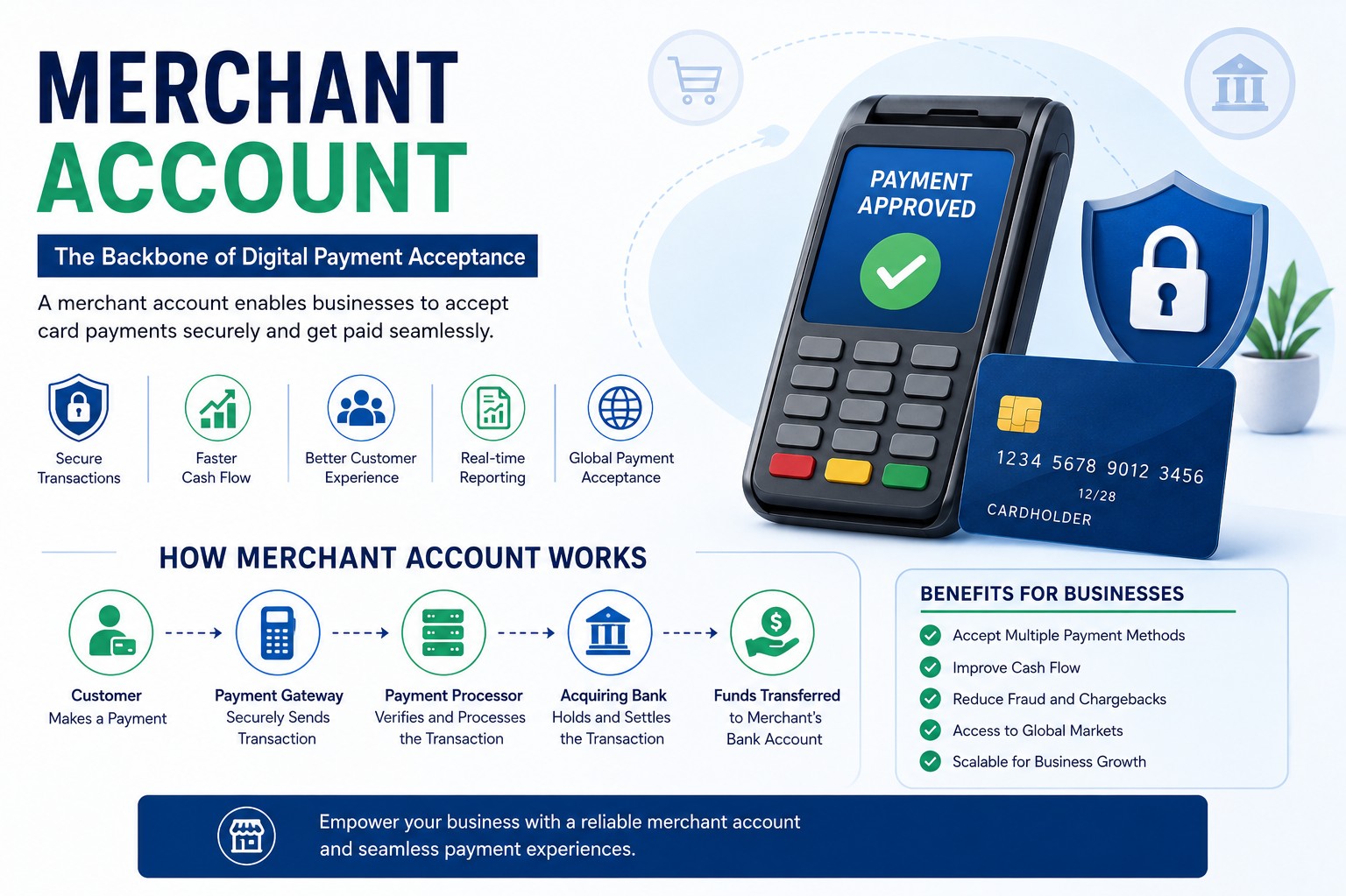
The payment process begins when a customer initiates a transaction using a card or digital payment method.
The transaction data is transmitted through a payment gateway or point-of-sale system to the payment processor. The processor communicates with the customer’s issuing bank to verify available funds and approve the transaction.
Once approved, the funds are temporarily held within the merchant account while the transaction moves through the settlement process. After settlement is completed, the funds are transferred to the merchant’s business bank account.
Although this process takes only seconds from the customer’s perspective, multiple financial institutions and technology providers work together behind the scenes to complete the transaction securely.
Key Components of Merchant Account Infrastructure
Several participants contribute to the operation of a merchant account.
The merchant initiates the payment request through its website, application, or physical store.
The payment gateway securely transmits transaction information between the merchant and payment processor.
The payment processor facilitates communication between financial institutions and payment networks.
The acquiring bank provides the merchant account and manages transaction settlements.
The issuing bank verifies and approves customer payments.
Together, these participants create a secure and efficient payment ecosystem that enables businesses to accept electronic payments at scale.
Benefits of Having a Merchant Account
One of the primary advantages of this is the ability to accept a wide range of payment methods.
Customers increasingly prefer card payments, contactless transactions, and digital wallets over cash. Businesses with accounts can accommodate these preferences and improve customer satisfaction.
They also support faster payment processing, helping businesses access funds more quickly than traditional invoicing methods.
Security is another major benefit. Merchant account providers typically offer fraud detection tools, transaction monitoring, encryption technologies, and compliance support to protect both merchants and customers.
Additionally, businesses gain access to valuable transaction reporting and analytics that can support financial planning and operational decision-making.
Merchant Accounts and E-Commerce Growth
The rise of online shopping has significantly increased demand for merchant accounts.
E-commerce businesses rely on this to process online payments securely and efficiently. Without, accepting card payments through websites and mobile applications becomes difficult or impossible.
Modern account providers often support multiple currencies, international payment methods, recurring billing, and subscription management features.
These capabilities allow businesses to expand into new markets and serve customers across different regions.
As global e-commerce continues to grow, merchant accounts remain a critical component of digital commerce infrastructure.
Risk Management and Fraud Prevention
Payment fraud remains a major concern for businesses operating in digital environments.
Fraudulent transactions, chargebacks, account takeovers, and identity theft can create financial losses and operational challenges. Merchant account providers help mitigate these risks through various security measures.
Advanced fraud detection systems monitor transaction activity in real time and identify suspicious patterns. Risk management tools may include velocity checks, device fingerprinting, address verification systems, and machine learning-based fraud analysis.
These protections help businesses reduce fraud exposure while maintaining smooth customer experiences.
Understanding Chargebacks
Chargebacks are one of the most important considerations for merchants accepting card payments.
A chargeback occurs when a customer disputes a transaction and requests a reversal through their issuing bank. While chargebacks help protect consumers from unauthorized transactions, excessive chargeback rates can negatively impact merchants.
Merchant account providers monitor chargeback activity closely and may impose penalties or additional requirements on businesses with high dispute levels.
To minimize chargebacks, merchants should provide clear product descriptions, transparent billing practices, responsive customer support, and strong fraud prevention controls.
Effective chargeback management contributes to healthier performance and improved operational stability.
Choosing the Right Merchant Account Provider
Selecting the right merchant account provider requires careful evaluation of business needs.
Organizations should consider factors such as transaction volume, payment methods supported, settlement speed, pricing structures, international capabilities, and customer support.
Security and compliance capabilities are equally important. Providers should support industry standards such as PCI DSS compliance and offer tools that help businesses manage fraud risks effectively.
Scalability should also be considered. As businesses grow, payment infrastructure must be capable of supporting increased transaction volumes and expanding customer bases.
A well-chosen account provider can become a valuable long-term partner in business growth.
Emerging Trends in Merchant Accounts
The merchant account landscape continues to evolve alongside broader payment industry innovation.
Artificial intelligence is improving fraud detection and risk management capabilities. Real-time payment systems are accelerating settlement speeds. Open banking is creating new payment opportunities, while embedded finance is integrating payment services directly into business platforms.
Cross-border commerce is also driving demand for multi-currency that simplify international transactions.
As payment technologies continue to advance, merchant accounts will become even more intelligent, automated, and integrated into digital business ecosystems.
The Future of Merchant Accounts
Future solutions will focus on speed, flexibility, and enhanced customer experiences.
Businesses increasingly expect unified platforms that combine payment acceptance, fraud prevention, reporting, analytics, and financial management within a single environment.
Artificial intelligence and automation will continue to streamline payment operations, reduce manual intervention, and improve transaction success rates.
As consumer expectations evolve and digital commerce expands globally, merchant accounts will remain a fundamental pillar of payment infrastructure.
Organizations that invest in modern payment solutions will be better positioned to compete in an increasingly digital marketplace.
Conclusion
A merchant account is far more than a simple payment processing tool. It serves as the foundation that enables businesses to accept electronic payments securely, efficiently, and at scale.
From supporting e-commerce growth and improving customer experiences to enhancing fraud prevention and cash flow management, it play a vital role in modern business operations.
As digital payments continue to reshape commerce worldwide, businesses that understand and leverage merchant account capabilities will be better equipped to adapt, grow, and succeed in an increasingly connected economy.
Comments
No comments yet. Be the first to share your thoughts.
Leave a comment