
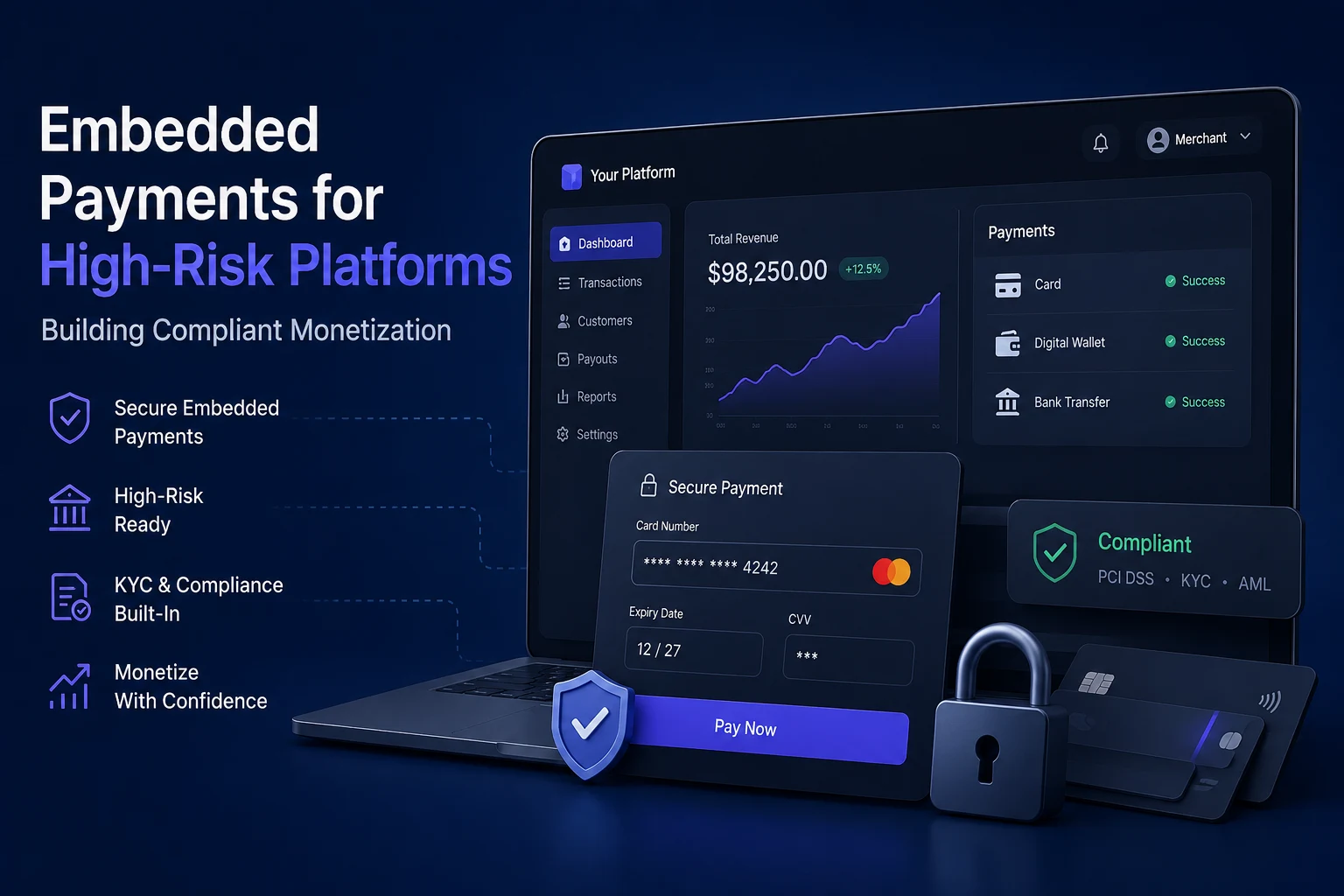
Most platforms treat payments as plumbing. Something that has to work, quietly, in the background. High-risk platforms cannot afford that mindset.
When your platform serves iGaming operators, adult content creators, CBD merchants, forex traders, or any other high-risk vertical, payment processing is not background infrastructure, it is the product. Getting it wrong does not just cost you revenue. It can shut down the entire platform overnight.
Embedded payments offer a more durable solution. By building payment processing directly into your platform rather than relying on third-party gateways that can terminate access, you create compliant monetization infrastructure that high-risk merchants on your platform can actually depend on.
TL;DR Embedded payments let platforms build payment processing directly into their product rather than relying on third-party gateways that can terminate high-risk merchants without notice. For platforms serving high-risk verticals, embedded payments create compliant monetization infrastructure, generate transaction revenue, and reduce dependency on external payment providers. This blog covers the architecture, compliance requirements, provider options, and economics for high-risk platforms in 2026.
What Are Embedded Payments and Why Do High-Risk Platforms Need Them?
Embedded payments integrate payment processing directly into a platform’s product experience — rather than redirecting users to an external payment page or relying on a standalone payment gateway that operates independently of the platform.
For mainstream platforms, embedded payments are primarily a UX and revenue optimization play. For high-risk platforms, the stakes are different.
When a high-risk platform relies on an external payment gateway, it inherits that gateway’s acceptable use policy. If the gateway changes its terms, as Stripe, PayPal, and Square regularly do for high-risk categories, the platform loses payment processing capability for its entire merchant base simultaneously. That is not a UX problem. It is an existential operational risk.
Embedded payments change the equation by giving the platform direct control over payment infrastructure. The platform becomes the payment layer rather than depending on one.
The Market Context in 2026
The embedded payments market is growing at a scale that validates the infrastructure investment for high-risk platforms:
- Global embedded payment transaction values are projected to surpass $2.5 trillion by 2028, up 134% from 2024, according to Juniper Research
- McKinsey projects global revenues from embedded finance could exceed $7 trillion by 2030
- Vertical SaaS platforms embedding payments are becoming the primary distributors of merchant accounts in their sectors
- Platforms with embedded payments report higher merchant retention and stronger revenue diversification than those relying on external payment providers
The High-Risk Platform Payment Problem: Why Standard Solutions Fail
Standard payment providers bundle sub-merchant risk exposure into platform-level termination decisions. One high-risk merchant on your platform triggering a policy violation can result in termination of payment processing for your entire merchant base.
| Payment Provider | High-Risk Platform Policy | Termination Risk |
|---|---|---|
| Stripe Connect | Prohibits many high-risk sub-merchant categories | Very High |
| PayPal for Platforms | Strict sub-merchant category restrictions | Very High |
| Square for Developers | Prohibits most high-risk verticals | High |
| Adyen for Platforms | Enterprise; selective high-risk acceptance | Medium |
| Embedded Custom Build | Platform-controlled | Low |
The pattern is consistent across all standard providers. For high-risk platforms, this is not a manageable risk, it is a structural vulnerability that embedded payments directly solves.
Building Embedded Payments for High-Risk Platforms: The Architecture
A compliant embedded payment infrastructure for a high-risk platform has four core components. Each needs to be chosen with your specific vertical in mind.
Component 1: PayFac-as-a-Service or Full PayFac Registration
The foundation of embedded payments is your position in the payment processing chain. High-risk platforms have two primary options:
- Full PayFac Registration: register as a Payment Facilitator directly with Visa and Mastercard. Maximum control, maximum margin, maximum compliance burden. Best suited for large platforms with internal risk and compliance teams processing $100M+ annually
- PayFac-as-a-Service (PFaaS): use a third-party provider to handle sub-merchant onboarding, risk management, and settlement while the platform controls the user experience and monetization model. Faster path to market, lower compliance burden, reduced margin compared to full PayFac
For most high-risk platforms in 2026, PayFac-as-a-Service is the realistic starting point. Full PayFac registration typically requires $100M+ in annual processing volume to justify the compliance infrastructure investment.
Component 2: High-Risk Compatible Payment Gateway
The payment gateway connects your embedded payment infrastructure to acquiring banks. For high-risk platforms, the gateway must support your specific merchant categories at the sub-merchant level, not just at the platform level.
- NMI (Network Merchants Inc.): widely used for high-risk platforms; broad category support via API
- Finix: designed specifically for software platforms embedding payments; strong compliance tooling
- Adyen for Platforms: enterprise-grade; accepts high-risk sub-merchants with sufficient platform volume
- PayKings: supplement, CBD, and nutraceutical platform focus
- Stripe Connect (approved high-risk program): viable for select categories with prior approval; limited for broader high-risk
Component 3: Sub-Merchant Onboarding and KYC
High-risk embedded payments require robust sub-merchant onboarding. Each merchant on your platform is effectively a sub-merchant under your payment facilitator umbrella, which means their compliance failures become your liability.
Compliant sub-merchant onboarding for high-risk platforms must include:
- Automated KYC verification at merchant onboarding, identity, business registration, beneficial ownership
- AML transaction monitoring at the sub-merchant level
- Category-specific documentation requirements, licenses, certifications, product compliance evidence
- Ongoing monitoring for chargeback velocity and dispute rates
- Clear acceptable use policies with enforceable termination provisions
Component 4: Risk and Chargeback Management
High-risk payment processing carries structurally higher chargeback rates than standard e-commerce. For platforms with embedded payments, chargeback management is a platform-level responsibility.
- Chargeback threshold management: monitor sub-merchant chargeback rates individually; terminate merchants approaching Visa/Mastercard thresholds before they damage platform-level processing relationships
- Fraud detection integration: tools like Sift, Kount, and Signifyd integrate at the transaction level via API
- Rolling reserve management: high-risk acquiring banks hold reserves at the platform level; pass-through reserve policies to sub-merchants need to be clearly documented in merchant agreements
Monetization Models for High-Risk Embedded Payments
One of the strongest arguments for embedded payments on high-risk platforms is the monetization opportunity. Payments shift from being an operating cost to being a direct revenue line.
| Model | How It Works | Typical Platform Take Rate | Best For |
|---|---|---|---|
| Revenue Share | Platform earns % of transaction fees collected | 0.2%–0.5% of GMV | Early-stage platforms |
| Interchange Plus (Buy Rate) | Platform sets merchant pricing above buy rate; keeps the spread | 0.3%–0.8% margin | Mid-to-large platforms |
| Flat Rate Markup | Platform charges merchants flat rate; negotiates lower buy rate | Varies by volume | Simplified pricing models |
| SaaS + Payments Bundle | Payment processing bundled with platform subscription | Revenue uplift on SaaS | Vertical SaaS platforms |
The true cost of embedded payments extends beyond processing fees. It includes risk, staffing, compliance, and operational complexity, it is not just about what you earn per transaction, but what it takes to responsibly support, monitor, and scale the entire payments operation behind the scenes.
Compliance Architecture for High-Risk Embedded Payments
Compliance is where most high-risk embedded payment programs fail. When you embed payments into a platform serving high-risk merchants, you inherit a portion of their compliance exposure.
Essential Compliance Components
- PCI DSS compliance: platforms handling card data must be PCI compliant; use tokenization and hosted payment pages to minimize PCI scope
- AML program: documented AML policies, transaction monitoring, and suspicious activity reporting are required at the platform level for payment facilitators
- OFAC and sanctions screening: screen all sub-merchants and high-value transactions against sanctions lists
- Data privacy compliance: GDPR for EU-facing platforms; CCPA for California; emerging state-level requirements across the US
- Category-specific licensing: iGaming platforms need gambling license compliance; CBD platforms need agricultural and FDA compliance documentation from sub-merchants
Embedded Payments vs. External Gateway: Cost Comparison
| Factor | External Gateway | Embedded Payments |
|---|---|---|
| Setup Cost | Low ($0–$5K) | High ($50K–$500K+) |
| Time to Market | Weeks | 3–12 months |
| Per-Transaction Take Rate | Platform earns 0%–0.1% | Platform earns 0.3%–0.8%+ |
| High-Risk Merchant Support | Limited; external AUP risk | Platform-controlled |
| Termination Risk | High – external AUP changes | Low – platform controls |
| Offshore Sub-Merchant Support | Restricted | Available |
| Revenue at $10M Monthly GMV | ~$0–10K platform revenue | ~$30K–80K platform revenue |
Pros and Cons of Embedded Payments for High-Risk Platforms
Pros
- Platform controls payment infrastructure, no external gateway can terminate your merchant base
- Transaction revenue becomes a direct monetization stream
- Sub-merchant onboarding and compliance managed at platform level
- Deeper product integration improves merchant retention and lifetime value
- Multi-acquirer routing at platform level maximizes approval rates for high-risk sub-merchants
- Offshore merchant account integration available for cross-border sub-merchants
Cons
- Full PayFac registration requires $100M+ annual processing volume to be economically viable
- PFaaS reduces margin compared to full PayFac
- Platform inherits sub-merchant compliance exposure
- Rolling reserves apply at platform acquiring level, capital requirement for high-risk categories
- Significant ongoing compliance infrastructure investment required
- High-risk acquiring relationships require more negotiation than standard platforms
Final Verdict
Embedded payments are the most durable infrastructure choice for high-risk platforms in 2026. The ability to control your payment processing environment, rather than depending on external gateways that can terminate access without notice, is not a competitive advantage for high-risk platforms. It is an operational necessity.
The investment is real. PayFac registration or PFaaS implementation requires meaningful upfront cost and ongoing compliance infrastructure. But the economics at scale are compelling, and the alternative, building a high-risk platform on top of external payment gateways that can pull the rug at any time, is ultimately the more expensive choice.
Platforms that build embedded payment infrastructure in 2026 own their payment processing destiny. Platforms that do not are perpetually one policy update away from losing their entire merchant services capability overnight.
Frequently Asked Questions
What is the difference between embedded payments and a standard payment gateway? A standard payment gateway is an external service your platform connects to, subject to that provider’s acceptable use policies. Embedded payments integrate payment processing directly into your platform, giving you control over sub-merchant onboarding, compliance, and pricing without external dependency.
Do high-risk platforms need full PayFac registration? Not necessarily. PayFac-as-a-Service providers allow platforms to embed payments without the full compliance burden of PayFac registration. Full PayFac registration makes economic sense at approximately $100M+ in annual processing volume. Below that, PFaaS typically delivers better economics with lower overhead.
How do embedded payments generate revenue for high-risk platforms? Embedded payments generate revenue through the spread between the buy rate negotiated with acquiring banks and the rate charged to sub-merchants. At scale using an interchange plus model, platforms can earn 0.3%–0.8%+ on processed GMV, shifting payments from a cost center to a significant revenue stream.
Can embedded payment programs support offshore sub-merchants? Yes. Platforms with embedded payments can integrate offshore merchant account acquiring relationships covering multiple jurisdictions, giving sub-merchants in markets with restricted domestic acquiring access to cross-border payment processing through the platform infrastructure.
What compliance obligations does a platform take on with embedded payments? Platforms operating as payment facilitators take on AML program obligations, PCI DSS compliance, sub-merchant KYC responsibilities, OFAC sanctions screening, and ongoing chargeback monitoring. The compliance burden scales with payment volume and the risk profile of the sub-merchant base.
Comments
No comments yet. Be the first to share your thoughts.
Leave a comment