
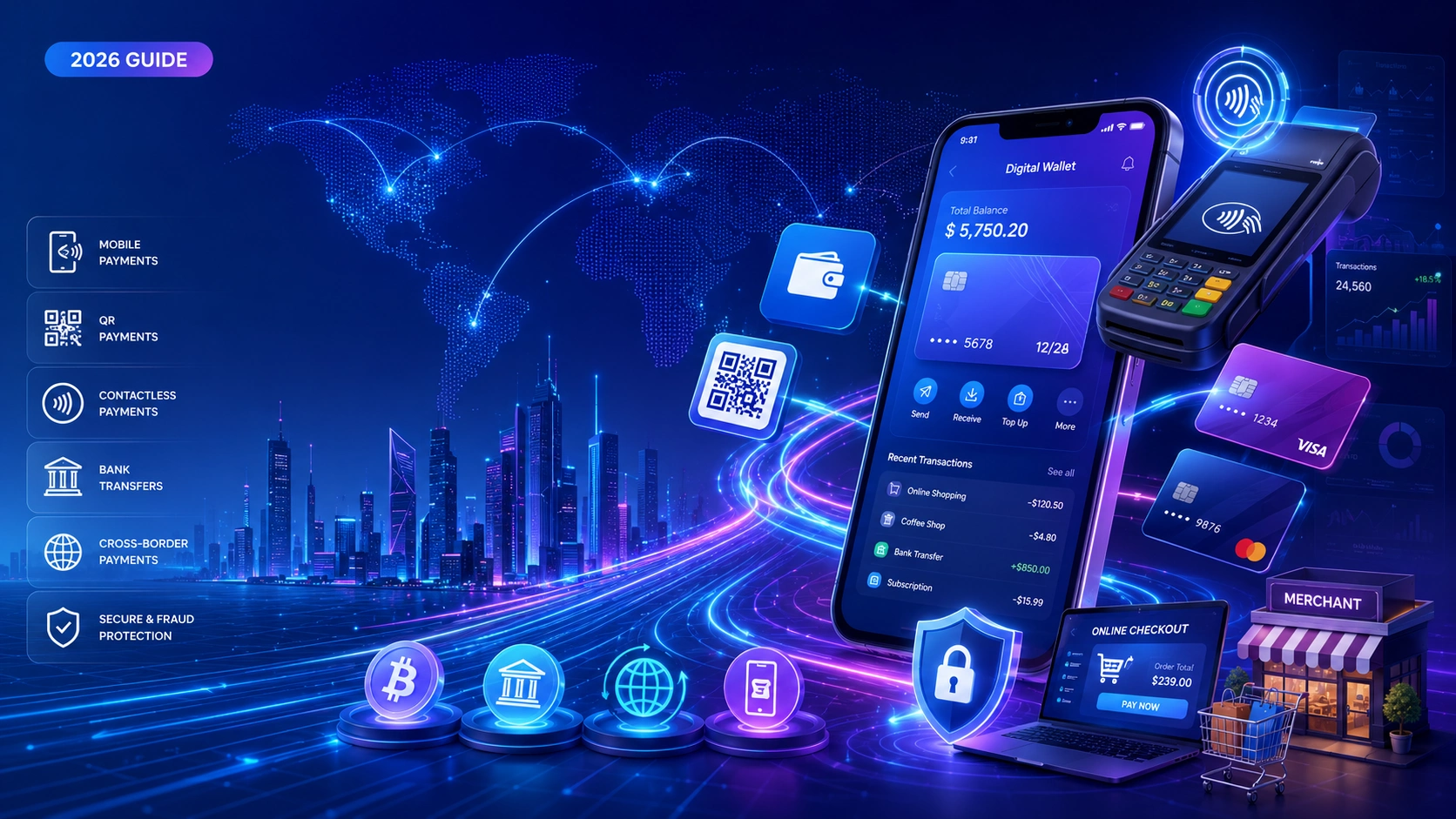
Global digital payment transaction values surpassed $9 trillion in 2023 and are forecast to reach $14.8 trillion by 2028, according to the FIS Worldpay Global Payments Report. Behind that number is a structural shift that is already complete for much of the world: cash is no longer the default, and for a growing share of consumers and businesses, it is not even an option.
Digital payments: transactions conducted electronically, without the exchange of physical currency, now underpin virtually every corner of commerce. You use them when you tap your phone at a coffee shop, when you split dinner via an app, when your employer pays your salary via bank transfer, and when you buy something from an overseas retailer you will never physically visit.
This guide explains how digital payments work, breaks down every major payment type, and gives both consumers and merchants a practical framework for choosing the right solution in 2026.
What Are Digital Payments?
A digital payment is any transfer of value between a payer and a payee conducted through electronic means, no physical cash, cheque, or paper instrument required. The payer’s device (phone, computer, card reader) communicates with a payment network, which verifies the transaction and moves funds between accounts.
Digital payments are not new. Electronic wire transfers have existed since the 1870s. What has changed in the past decade is the speed, accessibility, and diversity of digital payment methods, from sub-second mobile wallet taps to cross-border real-time transfers that take less time than sending an email.
The term is often used interchangeably with “electronic payments,” but the two are not identical. All digital payments are electronic, but not all electronic payments are digital, older automated clearing house (ACH) batch transfers, for example, are electronic but operate on infrastructure that predates modern digital payment systems.
How Do Digital Payments Work?
Every digital payment, regardless of method, involves the same fundamental sequence: the payer authorises a transfer, that authorisation is verified, and funds move (or are committed to move) from one account to another. What differs between payment types is the speed, the intermediaries involved, and the rails those funds travel across.
The key players in every digital payment
Understanding who is involved in a transaction helps both consumers and merchants make sense of why fees exist and where delays occur.
- Payer: the person or business initiating the payment
- Payee: the person or business receiving the payment
- Issuing bank: the bank that issued the payer’s card or holds the payer’s account
- Acquiring bank: the bank that holds the merchant’s account and receives the funds
- Payment processor: the company that routes transaction data between the issuing and acquiring banks and the card networks
- Payment gateway: the technology (often a software layer or API) that captures and encrypts payment data at the point of sale or online checkout
- Card networks: Visa, Mastercard, American Express, and UnionPay operate the rails over which card-based transactions travel, setting interchange rules and fees
Not every transaction involves all of these parties. A bank transfer between two accounts at the same institution, for example, never touches a card network. A peer-to-peer (P2P) payment via Venmo moves money through PayPal’s internal ledger before settling to a bank account.
What happens when you tap to pay – step by step
When a consumer taps an NFC-enabled phone or card at a point-of-sale terminal, the following happens in approximately 500 milliseconds:
- The device generates a one-time encrypted token, a stand-in for actual card data, via a process called tokenisation. No real card number is transmitted.
- The terminal forwards the token and transaction details to the payment gateway.
- The gateway passes the authorisation request to the payment processor.
- The processor routes the request to the relevant card network (Visa, Mastercard, etc.).
- The card network forwards it to the issuing bank, which checks: Is the account valid? Are funds available? Does the transaction pass fraud checks?
- The issuing bank sends an approval or decline back through the same chain.
- The terminal displays “Approved.” Funds are not yet transferred, they are only authorised.
- Settlement (actual fund transfer) typically occurs within one to two business days via batch processing through the card network.
Real-time payment rails, covered below, compress steps 4 through 8 into seconds, with immediate settlement rather than next-day batching.
Types of Digital Payments – A Full Breakdown
Digital payments are not a single technology. They are a family of distinct methods, each with different mechanics, speeds, costs, and ideal use cases. The table below provides a structured comparison before each type is examined in detail.
| Payment Type | Example Providers | Best For | Typical Speed | Typical Consumer Cost |
|---|---|---|---|---|
| Digital wallets | Apple Pay, Google Pay, Samsung Pay | In-store and in-app purchases | Instant | Free (funded by card) |
| Bank transfers / ACH | Plaid, Dwolla, direct bank | Bills, payroll, recurring payments | 1–3 business days | Low or free |
| Real-time payment rails | Zelle (US), FPS (UK), PIX (Brazil), FedNow | Instant A2A transfers | Seconds | Free or near-free |
| P2P payment apps | Venmo, Cash App, PayPal | Splitting bills, personal transfers | Instant (in-app) | Free (bank-funded) |
| Buy Now Pay Later (BNPL) | Klarna, Afterpay, Affirm | Retail purchases on instalment | Instant approval | Free if on time |
| Crypto payments | BitPay, Coinbase Commerce | Borderless, high-value, unbanked | Seconds–minutes | Network fees vary |
| Card-not-present (CNP) | Any card via a payment gateway | E-commerce, phone orders | Seconds | Embedded in price |
| QR code payments | PayPay, PhonePe, Mercado Pago | Emerging markets, restaurants | Instant | Free or minimal |
Digital wallets
A digital wallet stores payment credentials, card numbers, bank account details, loyalty cards, in an encrypted environment on a device. When the user pays, the wallet generates a tokenised transaction request, meaning no real card data is ever transmitted to the merchant.
Apple Pay, Google Pay, and Samsung Pay are the dominant digital wallet providers in Western markets. In China, Alipay and WeChat Pay have achieved near-universal adoption, processing the majority of urban consumer transactions. WeChat Pay alone processed over $1.67 trillion in payments in 2022, according to Statista.
Digital wallets are among the most secure payment methods available for everyday purchases, combining tokenisation with biometric authentication (Face ID, fingerprint).
Bank transfers and ACH payments
The Automated Clearing House (ACH) network in the United States, and its equivalents in other countries, such as BACS in the UK and SEPA Credit Transfer in the eurozone processes payments in batches, typically settling within one to three business days. ACH is the backbone of payroll, utility bill payments, mortgage debits, and B2B invoicing.
ACH is not fast, but it is cheap. Transaction fees are typically $0.20–$1.50 per transfer, making it economical for high-value or recurring transactions where speed is less critical.
Real-time payment rails
Real-time payment (RTP) systems are national infrastructure projects that enable instant, 24/7, irrevocable fund transfers between bank accounts, with settlement in seconds, not days.
Key systems in operation as of 2026:
- FedNow (United States): launched in 2023, now adopted by over 1,000 financial institutions, enabling instant A2A transfers across the US banking system
- Zelle (United States): a bank-backed P2P network that uses existing account infrastructure; processed $806 billion in transactions in 2023, according to Early Warning Services
- Faster Payments Service (United Kingdom): handles over 4 billion transactions annually, settling in seconds around the clock
- PIX (Brazil): launched in 2020 by the Banco Central do Brasil; now the country’s most-used payment method, with over 760 million transactions per month
- UPI (India): Unified Payments Interface; processed over 130 billion transactions in FY2024
Real-time rails are reshaping both consumer payments and business cash flow by eliminating the float, the gap between when a payment is initiated and when it settles.
Peer-to-peer (P2P) payment apps
P2P apps allow individuals to send money to each other directly from a smartphone, typically linked to a bank account, debit card, or prepaid balance held within the app.
Zelle, Venmo, and Cash App dominate the US market. PayPal operates across 200 markets. Revolut and Wise have gained strong traction in Europe and for cross-border transfers. Most P2P apps offer free transfers funded by a bank account, with a small fee (typically 1.5%–3%) for instant card-funded transfers.
Buy Now Pay Later (BNPL)
Buy Now Pay Later allows consumers to split a purchase into equal instalments, typically four payments over six weeks, or monthly instalments over 6–36 months, often with no interest if payments are made on time. BNPL providers (Klarna, Afterpay, Affirm, Sezzle) pay the merchant the full amount upfront and assume the credit risk.
BNPL adoption has grown sharply among 18–34-year-olds who either lack credit cards or prefer not to use revolving credit. However, regulators in the UK (FCA), US (CFPB), and EU are increasingly scrutinising BNPL for potential consumer harm from missed payment fees and debt accumulation.
Cryptocurrency payments
Cryptocurrency payments use blockchain networks to transfer digital assets directly between wallets, without an intermediary bank. Merchants accepting crypto payments typically use a payment processor such as BitPay or Coinbase Commerce, which converts the crypto to fiat currency at the point of sale to eliminate volatility risk.
Crypto payments remain a niche payment method for mainstream commerce, but are significant for cross-border transactions, remittances to underbanked markets, and high-value B2B settlements where traditional rails are slow or restricted.
Card-not-present (CNP) payments
Any card transaction where the physical card is not present at the point of sale is a card-not-present payment, the dominant mechanism in e-commerce. The customer enters card details (or uses a saved card) at checkout; the merchant’s payment gateway encrypts and submits the data for authorisation.
CNP transactions carry higher fraud risk than contactless payments (no tokenisation, no biometric) and therefore attract higher interchange fees. Strong Customer Authentication (SCA), a requirement under PSD2 in the UK and EU, adds an additional verification layer (typically a one-time code or biometric) to reduce CNP fraud.
QR code payments
QR code payments allow a consumer to scan a merchant’s code (or vice versa) to initiate a payment directly from a bank account or digital wallet. They have achieved mass adoption in Asia (Alipay, WeChat Pay, PhonePe) and Latin America (Mercado Pago), particularly where card infrastructure is limited. Adoption is growing in Western markets as an alternative to contactless for smaller merchants who lack POS terminals.
Digital Payments for Consumers – How to Get Started
How to send money instantly
The fastest way to send money to another person depends on your location and the recipient’s bank.
In the United States, Zelle is the fastest option for bank-to-bank transfers, funds arrive in minutes if both parties use banks enrolled in the Zelle network. Cash App and Venmo offer instant transfers for a 1.5%–1.75% fee; free transfers settle in one to three business days.
For international transfers, Wise (formerly TransferWise) consistently offers mid-market exchange rates with transparent fees, making it one of the most cost-effective options for sending money abroad. PayPal is widely available but typically charges higher FX margins. Revolut offers competitive rates for users within its fee tier.
Choosing the right digital payment app
When evaluating a payment app as a consumer, consider:
- Fees: is the transfer free? What does the instant transfer fee cost? What is the FX markup for international transfers?
- Speed: is settlement instant, or one to three days?
- Geographic coverage: does the recipient’s country support the app?
- Security: does the app use biometric authentication and two-factor verification (2FA)?
- Recipient compatibility: does the person you are paying use the same app or network?
Digital payment safety tips for consumers
Digital payments are statistically safer than cash (no risk of physical theft), but they carry distinct risks. The following practices reduce exposure significantly:
- Enable two-factor authentication (2FA): on every payment app. An SMS code or authenticator app adds a critical second barrier.
- Never send money to strangers via P2P apps: Legitimate businesses do not request payment via Venmo or Cash App. Overpayment scams, where a fraudster sends too much and asks for a refund, are among the most common P2P fraud types.
- Use digital wallets over typing card numbers: Apple Pay and Google Pay never transmit your actual card number. Typing a card number into an unfamiliar checkout page carries far greater risk.
- Verify the checkout URL: Before entering any payment details online, confirm the page URL uses HTTPS (padlock icon in the browser bar) and that the domain matches the retailer exactly.
- Check for PCI DSS compliance: Any merchant handling card payments is required by the Payment Card Industry Data Security Standard (PCI DSS) to meet a defined set of security controls. Established checkout providers (Stripe, PayPal, Adyen) are PCI DSS Level 1 certified.
Digital Payments for Merchants – How to Accept Them
What merchants need to accept digital payments
Accepting digital payments requires at minimum:
- A payment gateway: the technology that captures, encrypts, and transmits payment data from the customer to the payment network. In e-commerce, this is typically an API or hosted checkout page provided by a company such as Stripe, Adyen, or Braintree.
- A merchant account or payment facilitator account: the bank account into which funds from card transactions are settled. Payment facilitators (PayFacs) such as Square and Stripe bundle the merchant account and gateway into a single product, simplifying setup for small businesses.
- PCI DSS compliance: any business that accepts, stores, or transmits cardholder data must comply with PCI DSS. Most small merchants achieve compliance through a simplified self-assessment questionnaire (SAQ) when using a PCI-compliant gateway that handles card data directly.
For in-store acceptance, merchants additionally require a point-of-sale (POS) terminal capable of accepting contactless payments and chip & PIN.
Payment gateway vs payment processor – what is the difference?
These terms are frequently confused, even by experienced merchants.
A payment gateway is the interface layer, it securely captures payment data from the customer and passes it, encrypted, to the payment processor. Think of it as the digital equivalent of a card machine at the front of the store.
A payment processor is the back-end engine, it takes the authorisation request from the gateway, routes it through the card networks to the issuing bank, receives the approval or decline, and manages the settlement of funds into the merchant’s account.
In practice, most modern payment platforms, Stripe, Square, PayPal, Adyen – provide both functions in a single integrated product. However, understanding the distinction matters when a merchant is building a custom checkout on existing banking infrastructure, where gateway and processor may be separate contracts with separate fees.
How to choose a digital payment solution as a merchant
The right solution depends on four key variables:
1. Sales channel: Online-only businesses need a gateway with strong API documentation and hosted checkout options. Brick-and-mortar merchants need a POS system with NFC terminal support. Omnichannel businesses need a platform that unifies online and in-store reporting.
2. Transaction volume and average order value: High-volume merchants with large average order values should evaluate interchange-plus pricing (where the merchant pays the actual interchange cost plus a fixed markup), which is typically cheaper than flat-rate pricing at scale. Low-volume merchants often benefit from flat-rate simplicity (e.g., Stripe’s 2.9% + $0.30) with no monthly fees.
3. International reach: Merchants selling cross-border need a processor that supports multi-currency settlement, local payment methods (iDEAL in the Netherlands, SEPA Direct Debit in Europe, PIX in Brazil), and competitive FX conversion rates. Adyen and Stripe are the strongest options for international merchants.
4. Industry type: Standard-risk merchants (retail, SaaS, professional services) have broad provider choice. High-risk merchants, those in industries such as adult content, gambling, nutraceuticals, travel, or forex, require specialist high-risk merchant account providers. Most mainstream processors will terminate accounts in these categories without notice.
Fees merchants should understand
Every digital payment carries a cost, and understanding the fee structure prevents margin erosion.
- Interchange fee: paid by the acquiring bank to the issuing bank on every card transaction. Set by card networks; varies by card type, geography, and transaction method. Typically 0.2%–2.0% in the UK/EU (regulated under interchange fee caps); 1.5%–2.5% in the US.
- Scheme fee: a small fee charged by Visa and Mastercard on top of interchange. Often bundled into the overall processing rate.
- Processor markup: the payment processor’s margin, added on top of interchange and scheme fees. This is where providers differentiate: Stripe charges a flat 2.9% + $0.30; interchange-plus models quote markup separately (e.g., interchange + 0.4% + $0.10).
- Gateway fee: a monthly or per-transaction fee for use of the payment gateway. Some providers (Stripe, Square) bundle this into their processing rate; others (Authorize.Net) charge separately.
- Chargeback fee: charged when a customer disputes a transaction and the issuing bank reverses it. Typically $15–$25 per chargeback. High chargeback rates can result in account termination.
- Currency conversion fee: applies when accepting payments in a currency different from the merchant’s settlement currency. Typically 1%–3% on top of the mid-market exchange rate.
Digital Payment Security – What You Need to Know
How digital payments are protected
Modern digital payment infrastructure employs multiple overlapping security layers:
Tokenisation: replaces a card’s primary account number (PAN) with a unique, non-sensitive token that is worthless to anyone who intercepts it. Used in digital wallets (Apple Pay, Google Pay) and in stored-card e-commerce checkouts.
Encryption: protects data in transit (TLS 1.2/1.3) and at rest (AES-256). Any payment data transmitted between a customer’s browser and a payment gateway is encrypted end-to-end.
3D Secure 2 (3DS2): is an authentication protocol for card-not-present transactions. It triggers an additional verification step, typically a biometric prompt or one-time passcode, to confirm the cardholder’s identity, reducing fraud liability for the merchant. In the UK and EU, 3DS2 is mandatory under Strong Customer Authentication (SCA) rules enforced by the FCA and EBA.
Biometric authentication: in mobile wallets (Face ID, Touch ID, fingerprint readers) ensures that even a stolen unlocked phone cannot be used to make payments without the owner’s biometric data.
Regulatory standards and oversight
- PCI DSS (Payment Card Industry Data Security Standard): the global security standard for any organisation handling cardholder data. Administered by the PCI Security Standards Council. Non-compliance can result in fines of $5,000–$100,000 per month from card networks.
- PSD2 (Payment Services Directive 2): EU and UK regulation mandating Strong Customer Authentication on electronic payments and enabling Open Banking. Enforced by the FCA in the UK and national competent authorities in EU member states.
- CFPB (US): the Consumer Financial Protection Bureau supervises non-bank payment providers, including digital wallet and BNPL providers, under the Electronic Fund Transfer Act (EFTA).
Common digital payment scams
Fake payment confirmations: a fraudster sends a forged PayPal or bank transfer screenshot claiming payment has been sent. Merchants should never release goods until funds appear in their actual account.
Smishing: SMS phishing messages impersonating banks or payment apps (“Your account has been locked, verify now”) that direct users to credential-harvesting websites. Legitimate payment providers never request passwords or full card numbers via SMS.
Overpayment scams: a buyer sends more than the requested amount via a P2P app and asks for a refund of the difference, claiming a mistake. The original payment is later reversed; the merchant has already sent real money.
Digital Payments Around the World
Payment preferences, dominant rails, and regulatory environments vary significantly by region. What works in one market may be irrelevant or unavailable in another.
Digital payments in the United States
The US digital payments market is fragmented by comparison with single-rail markets like Brazil’s PIX. Key rails include ACH (for bank transfers), Zelle (P2P via banks), FedNow (launched 2023, enabling real-time settlement), and the card networks (Visa, Mastercard, American Express). Apple Pay has achieved 90%+ acceptance at major US retailers.
Regulatory oversight sits with the CFPB (consumer protection), FinCEN (anti-money laundering), and the Federal Reserve (payment system oversight).
Digital payments in the United Kingdom
The UK has one of the most advanced real-time payment infrastructures globally. Faster Payments (FPS) has enabled instant bank transfers since 2008. Contactless card payments now account for over 80% of in-store card transactions, according to UK Finance.
Open Banking: mandated by the FCA following PSD2, is accelerating account-to-account (A2A) payment adoption, reducing reliance on card rails for online transactions. Providers including TrueLayer, Token, and GoCardless are building on Open Banking infrastructure to offer merchants lower-cost alternatives to card acceptance.
The New Payments Architecture (NPA), currently in development, will replace FPS and CHAPS with a unified ISO 20022-based rail by the late 2020s.
Digital payments in LATAM
Latin America is the fastest-growing digital payments region globally, driven by high smartphone penetration and large unbanked populations seeking alternatives to cash. Brazil’s PIX, launched in November 2020 by the Banco Central do Brasil, became the country’s most-used payment method within two years of launch, processing over 5 billion transactions per month by 2024.
Mexico’s CoDi and DiMo real-time payment systems, Argentina’s CVU, and Colombia’s Transfiya are following a similar model. Mercado Pago is the dominant multi-country fintech wallet across the region.
Digital payments in Canada
Canada’s primary real-time transfer system is Interac e-Transfer, which enables instant bank-to-bank payments between individuals and businesses. Interac Debit is the dominant debit payment rail. Visa and Mastercard dominate credit card payments.
Real-time payment infrastructure is expanding through Payments Canada’s Real-Time Rail (RTR) project, which is expected to enable instant settlement for a broader range of transaction types.
The Future of Digital Payments in 2026 and Beyond
Several structural shifts are reshaping payment infrastructure:
Real-time payment adoption is becoming the global baseline: FedNow in the US, NPA in the UK, and the BIS’s Project Nexus, a multilateral initiative connecting national instant payment systems for cross-border real-time transfers, are systematically eliminating the one-to-three-day settlement window that has characterised payments for decades.
Embedded payments are removing the checkout moment: Payments are increasingly invisible, built into platforms where commerce already happens, ride-hailing apps, subscription services, B2B procurement systems, marketplace platforms. The distinct act of “paying” is becoming a background function.
Central Bank Digital Currencies (CBDCs) are approaching pilot scale: The European Central Bank’s Digital Euro project entered a preparation phase in 2023. India’s e-Rupee has processed tens of millions of transactions. China’s digital yuan (e-CNY) is in wide circulation. CBDCs could fundamentally alter the role of commercial banks in the payments chain.
AI is being deployed at scale in fraud detection. Machine learning models now analyse hundreds of data points in real time, device fingerprint, geolocation, transaction history, behavioural patterns, to identify fraudulent transactions with significantly lower false-positive rates than rule-based systems.
Open Banking is enabling A2A payment alternatives: As open banking infrastructure matures in the UK, EU, Australia, and beyond, account-to-account payments are becoming a viable lower-cost alternative to card acceptance for merchants, with interchange fees replaced by small flat transaction costs.
Frequently Asked Questions
What is the difference between digital payments and electronic payments?
All digital payments are electronic, they use electronic infrastructure to transfer value. However, not all electronic payments are digital. Traditional ACH batch transfers, SWIFT wire transfers, and legacy EDI (Electronic Data Interchange) systems are electronic but predate modern digital payment design. “Digital payments” typically refers to newer, software-driven payment methods built for the internet and smartphone era.
What is the safest digital payment method?
For everyday consumer purchases, digital wallets (Apple Pay, Google Pay) using NFC tokenisation and biometric authentication are among the most secure methods available, they never transmit actual card numbers to the merchant. For online transactions, using a digital wallet at checkout (where available) or a virtual card number generated by your bank adds comparable protection against CNP fraud.
How do merchants pay for accepting digital payments?
Merchants pay a processing fee on each transaction, typically 1.5%–3.5% of the transaction value, depending on the provider, pricing model, and card type. For example, Stripe charges 2.9% + $0.30 per online card transaction in the US. Some providers also charge monthly gateway fees, chargeback fees, and currency conversion fees for international transactions. Interchange-plus pricing is typically more transparent and cheaper at higher volumes than flat-rate pricing.
Can I send money internationally using digital payment apps?
Yes. Apps including Wise, PayPal, Revolut, and Western Digital (via its digital channels) support international money transfers to varying countries. Fees and exchange rate margins differ significantly: Wise typically offers the closest rate to the mid-market rate with a transparent percentage fee, while PayPal’s FX margin can be 3%–4% above mid-market. Always compare the total cost, including both the stated fee and the exchange rate applied, before choosing a provider.
What is a digital wallet and how is it different from a bank account?
A digital wallet stores payment credentials (card numbers, bank account details, loyalty cards) in an encrypted environment on a device. It is not a bank account, it is a tool for accessing and using payment accounts. When you pay with Apple Pay, you are using your linked credit or debit card, processed by your bank; Apple Pay is the secure interface that handles the transaction. Some digital wallets (PayPal, Revolut, Cash App) also hold a balance, functioning more like a stored-value account.
How fast are digital payments?
Speed varies by method: digital wallet and P2P app transactions are effectively instant at the point of payment, though settlement to the recipient’s bank account may take one to three business days depending on the method used. Real-time payment rails (Zelle, FedNow, Faster Payments, PIX) settle in seconds. Standard ACH bank transfers take one to three business days. International wire transfers (SWIFT) typically take one to five business days, though correspondent banking relationships affect timing.
Do small businesses need a payment gateway and a payment processor separately?
Most small businesses do not need to source these separately. Platforms such as Stripe, Square, PayPal, and Adyen bundle the payment gateway and processing function into a single product with unified pricing. Sourcing them separately, from, for example, Authorize.Net (gateway) and a bank processor, was common practice a decade ago but is now primarily relevant for large enterprises with existing banking relationships and bespoke integration needs.
Start Accepting or Sending Digital Payments Today
Digital payments are no longer the future of commerce, they are the present. Whether you are a consumer looking for the fastest way to split a bill internationally, or a merchant evaluating payment infrastructure for a growing e-commerce operation, understanding how digital payments work gives you a material advantage in choosing the right tools and avoiding unnecessary costs.
Comments
No comments yet. Be the first to share your thoughts.
Leave a comment