
Introduction
The rapid growth of digital commerce has transformed how consumers and businesses make payments. From online shopping and mobile wallets to subscription services and digital marketplaces, electronic transactions have become an essential part of everyday life. While this evolution has created greater convenience, it has also increased the need for stronger network tokenization payment security.
Cybercriminals continuously target payment data, making card information one of the most valuable assets in the digital economy. As a result, payment networks, financial institutions, and merchants are investing heavily in technologies that protect sensitive customer information.
One of the most important innovations in payment security is network tokenization. This technology helps reduce fraud, improve transaction security, and enhance the overall payment experience by replacing sensitive card data with secure digital tokens.
As digital payments continue to grow worldwide, network tokenization is becoming a critical component of modern payment infrastructure.
What Is Network Tokenization?
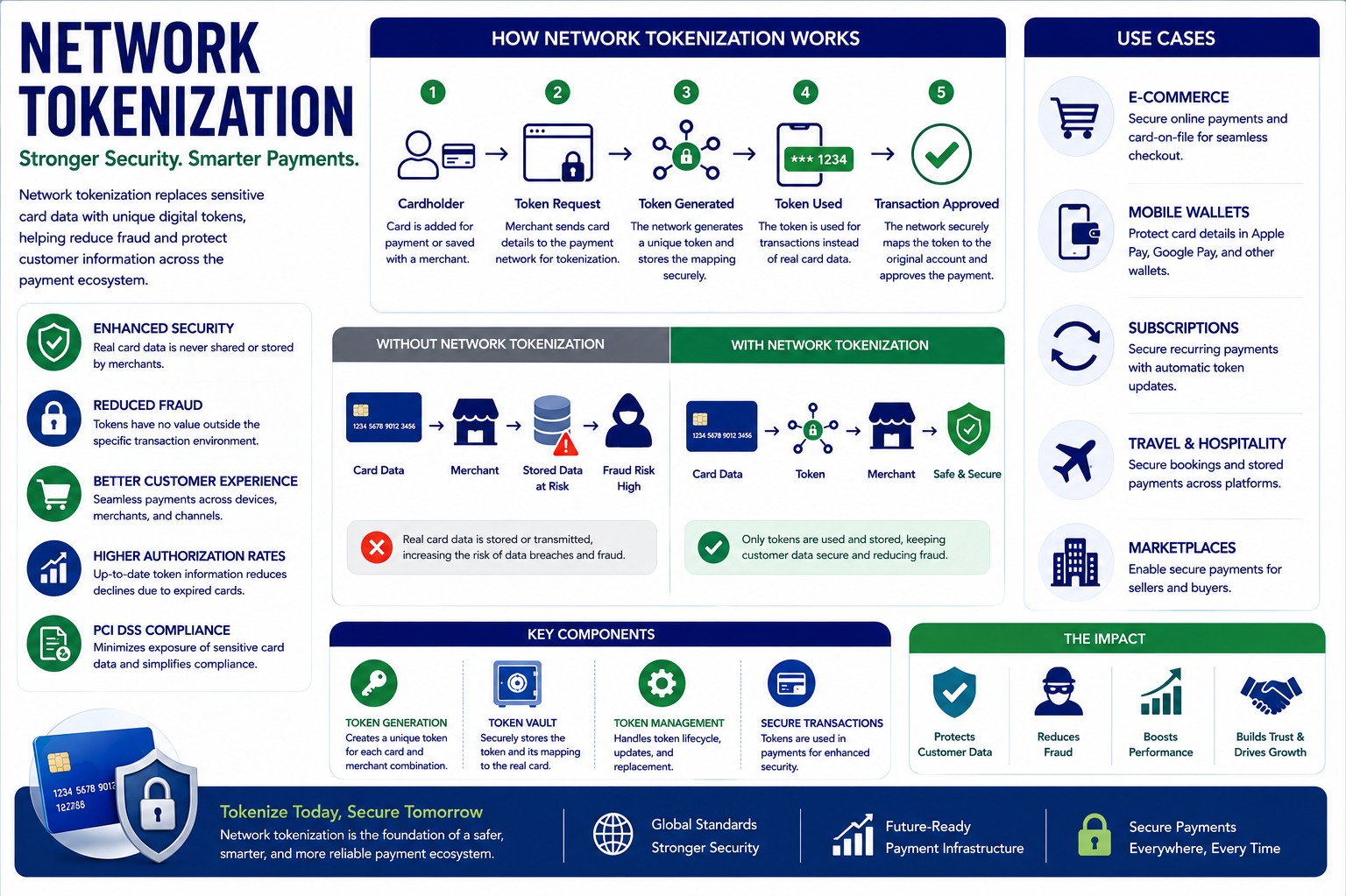
Network tokenization is a payment security technology that replaces a card’s primary account number (PAN) with a unique digital token.
Instead of transmitting or storing actual card details during a transaction, payment systems use the token as a substitute. The token has no value outside its intended payment environment, making it significantly less useful to fraudsters if intercepted.
Unlike traditional tokenization systems managed by merchants or payment providers, network tokenization is administered directly by card networks. This creates a more secure and standardized approach to protecting payment credentials.
The result is stronger security without compromising customer convenience.
Why Network Tokenization Was Developed
Digital payments have experienced tremendous growth over the last decade.
As transaction volumes increased, so did the frequency and sophistication of payment fraud. Data breaches affecting retailers, payment processors, and online platforms exposed millions of payment cards, creating substantial financial losses and reputational damage.
Traditional security measures alone were not sufficient to address evolving threats.
Network tokenization was developed to reduce the exposure of sensitive card information by ensuring that actual card numbers are rarely transmitted or stored within payment ecosystems.
By limiting access to real account data, tokenization significantly reduces opportunities for fraud and data compromise.
How Network Tokenization Works
The tokenization process begins when a customer saves a payment card for future use or initiates a digital transaction.
Rather than storing the actual card number, the card network generates a unique payment token linked to the underlying account.
When future transactions occur, the token is used instead of the card number. Behind the scenes, the card network securely maps the token to the original account and facilitates payment authorization.
Because the token contains no meaningful card data, it cannot be used outside the specific transaction environment for which it was created.
This approach dramatically improves payment security.
Key Components of Network Tokenization
Several elements contribute to the effectiveness of network tokenization.
Token Generation
A unique token is created to represent the original payment card.
Token Vault
Sensitive mapping information between the token and actual card data is stored securely within network-controlled systems.
Token Management
Payment networks oversee token lifecycle management, including issuance, updates, and replacement.
Transaction Processing
Tokens are transmitted during payment authorization instead of actual card credentials.
Together, these components create a secure framework for protecting payment information.
Benefits of Network Tokenization
One of the most significant advantages of network tokenization is enhanced payment security.
Because actual card numbers are not exposed during transactions, the risk associated with data breaches is significantly reduced.
Additional benefits include:
- Reduced payment fraud
- Improved transaction security
- Lower data breach exposure
- Better customer trust
- Enhanced authorization rates
- Simplified credential management
- Improved digital payment experiences
- Stronger compliance support
These benefits make network tokenization increasingly attractive for merchants, financial institutions, and payment providers.
Reducing Payment Fraud
Fraud prevention is one of the primary drivers behind network tokenization adoption.
Stolen payment credentials have traditionally been a major source of fraud across e-commerce and digital payment channels.
When payment tokens replace actual card data, intercepted information becomes far less valuable to criminals.
Even if a token is compromised, its usage is typically restricted to specific merchants, devices, or transaction environments.
This significantly limits fraud opportunities and helps reduce unauthorized payment activity.
As fraud threats continue evolving, tokenization provides an important layer of defense.
Supporting Digital Commerce
Digital commerce relies heavily on stored payment credentials.
Consumers increasingly expect frictionless checkout experiences, recurring billing capabilities, and one-click payment functionality.
Network tokenization supports these expectations while maintaining strong security controls.
Merchants can offer convenient payment experiences without storing sensitive card information directly.
This balance between security and convenience has made tokenization an important technology for e-commerce growth.
As online purchasing continues to expand globally, tokenization adoption is expected to increase further.
Network Tokenization and Mobile Wallets
Mobile wallets have become a major use case for network tokenization.
When customers add payment cards to digital wallets, tokenization helps protect underlying account information.
Transactions are processed using tokens rather than actual card numbers, reducing exposure to fraud and unauthorized access.
This approach allows consumers to make secure contactless payments while maintaining a seamless user experience.
The widespread adoption of mobile wallets has accelerated awareness and implementation of network tokenization technologies worldwide.
Improving Authorization Rates
In addition to enhancing security, network tokenization can improve transaction performance.
Payment networks often maintain updated token information when underlying card details change due to expiration, replacement, or account updates.
This capability reduces transaction declines caused by outdated payment credentials.
Higher authorization rates contribute to better customer experiences and increased merchant revenue.
For subscription-based businesses and recurring payment providers, improved credential continuity can significantly reduce payment disruptions.
Network Tokenization and PCI DSS Compliance
Payment Card Industry Data Security Standard (PCI DSS) compliance remains a major priority for organizations handling payment information.
Network tokenization helps reduce the amount of sensitive card data that merchants store or process directly.
While tokenization does not eliminate compliance obligations entirely, it can reduce security risks and simplify certain aspects of payment data management.
Organizations often view tokenization as an important component of broader payment security and compliance strategies.
Challenges and Considerations
Despite its many benefits, network tokenization requires careful implementation.
Merchants may need to update payment systems, integrate with token service providers, and coordinate with acquiring institutions.
Operational processes must also support token lifecycle management and payment credential updates.
Organizations should evaluate technical requirements, provider capabilities, and long-term scalability before implementing tokenization solutions.
Proper planning helps maximize the benefits while minimizing implementation challenges.
The Future of Network Tokenization
The future of digital payments is increasingly tied to tokenization.
As fraud threats continue evolving and digital transaction volumes grow, payment networks are expected to expand tokenization capabilities across additional payment channels and use cases.
Artificial intelligence, real-time payments, open banking, and embedded finance initiatives will likely further enhance tokenization ecosystems.
Many industry experts view network tokenization as a foundational technology for the next generation of secure digital payments.
Its role within global payment infrastructure is expected to become even more significant in the years ahead.
Conclusion
Network tokenization has emerged as one of the most important innovations in payment security. By replacing sensitive card information with secure digital tokens, it helps reduce fraud, protect customer data, improve authorization rates, and support seamless digital payment experiences.
As e-commerce, mobile payments, and digital financial services continue to grow, businesses must prioritize security without compromising convenience. Network tokenization enables organizations to achieve both objectives while strengthening trust throughout the payment ecosystem.
For merchants, financial institutions, and payment providers seeking to build secure and scalable payment infrastructures, network tokenization is rapidly becoming an essential technology for the future of digital commerce.
Comments
No comments yet. Be the first to share your thoughts.
Leave a comment