
Introduction
Every time a customer taps a card, sends money through a banking app, or completes an online purchase, a complex system works behind the scenes to ensure the transaction reaches its destination. Most consumers never see this infrastructure, yet it plays a crucial role in the global economy. This underlying framework is commonly known as payment rails.
As digital commerce expands and real-time transactions become the norm, businesses are paying closer attention to the systems that move money efficiently and securely. Understanding these networks is no longer limited to banks and financial institutions. Merchants, fintech companies, payment providers, and technology platforms increasingly rely on robust financial infrastructure to deliver seamless customer experiences.
Understanding Payment Rails
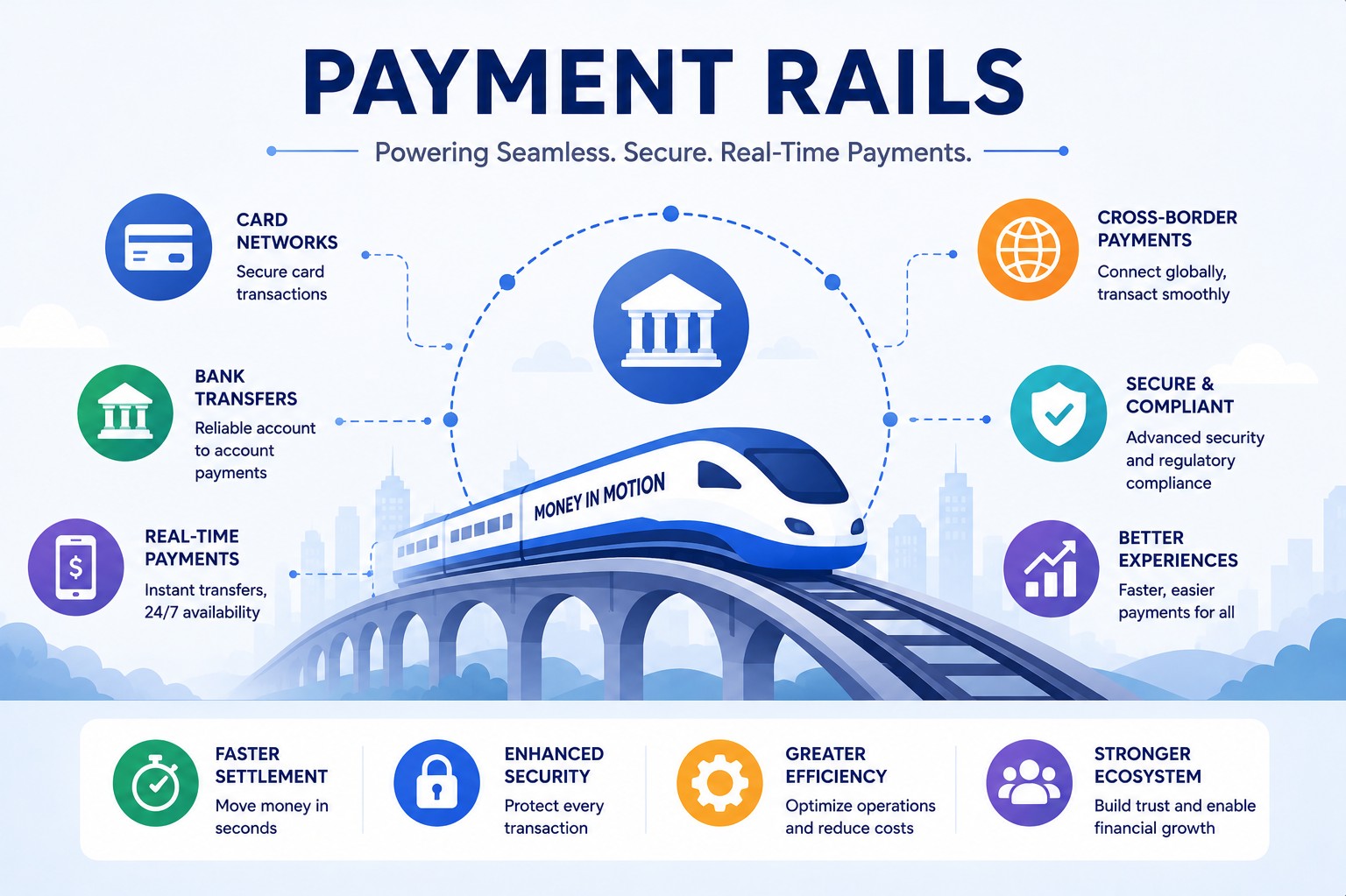
Payment rails are the networks and technologies that facilitate the movement of money between individuals, businesses, and financial institutions. They provide the pathways through which transaction information travels and funds are transferred.
Much like roads connect cities and enable transportation, financial networks connect participants within the payment ecosystem. These systems ensure that money can move safely from a payer to a recipient while maintaining security, compliance, and accuracy.
Whether processing a local bank transfer or an international business payment, these networks make modern commerce possible.
Why They Matter in Today’s Economy
The speed and reliability of money movement directly affect businesses and consumers. Delayed transactions can disrupt cash flow, impact customer satisfaction, and create operational challenges.
Modern commerce demands:
- Faster transaction processing
- Secure payment execution
- Reliable settlement mechanisms
- Greater transparency
- Global accessibility
Efficient infrastructure supports all these requirements while enabling economic growth and innovation.
As digital transactions continue to increase, the importance of strong financial connectivity becomes even more apparent.
How Money Moves Behind the Scenes
When a customer initiates a transaction, multiple parties work together to complete the payment successfully.
The process generally involves:
- Payment initiation by the customer
- Authentication and authorization
- Data transmission through the payment network
- Verification by financial institutions
- Clearing and settlement
- Fund delivery to the recipient
Although the process may appear instantaneous to users, sophisticated technology coordinates each stage to ensure accuracy and security.
Major Types of Payment Infrastructure
Different transaction types rely on different systems depending on speed, geography, and payment method.
Card Networks
Card-based transactions remain among the most widely used payment methods globally. These networks connect merchants, acquiring institutions, issuing banks, and processors.
When a customer uses a debit or credit card, transaction information passes through these networks for authorization and settlement.
Bank Transfer Systems
Account-to-account transfers are facilitated through banking infrastructure that connects financial institutions.
These systems support payroll payments, supplier settlements, bill payments, and consumer transfers.
Real-Time Payment Networks
The demand for instant transactions has accelerated the adoption of real-time payment systems.
Unlike traditional methods that may require several business days, real-time networks enable immediate transfer and settlement of funds.
This capability improves liquidity and customer satisfaction while reducing transaction delays.
International Transaction Networks
Cross-border payments require specialized infrastructure capable of handling multiple currencies, regulatory requirements, and financial institutions.
These systems facilitate global trade and support businesses operating across multiple markets.
Supporting the Growth of Digital Commerce
E-commerce has transformed consumer behavior and created new opportunities for businesses worldwide.
Every online transaction relies on dependable financial infrastructure to ensure payments are processed accurately and securely.
A strong payment ecosystem helps merchants:
- Improve checkout experiences
- Reduce transaction failures
- Increase customer trust
- Expand internationally
- Support multiple payment methods
As online commerce continues growing, the reliability of these systems becomes increasingly important.
The Rise of Real-Time Transactions
Consumers and businesses increasingly expect immediate access to funds.
Waiting several days for payments to settle is becoming less acceptable in a digital-first economy. As a result, many countries are investing heavily in real-time transaction capabilities.
The benefits include:
- Faster cash flow
- Improved liquidity
- Enhanced customer experiences
- Better operational efficiency
- Reduced settlement delays
Real-time capabilities are rapidly becoming a standard expectation rather than a premium service.
Security and Risk Management
Financial transactions involve sensitive information and significant monetary value. Security therefore remains a top priority.
Modern systems incorporate various protective measures, including:
- Data encryption
- Tokenization
- Fraud detection technologies
- Multi-factor authentication
- Transaction monitoring
- Risk analysis tools
These safeguards help protect businesses and consumers from fraud, cyber threats, and unauthorized activity.
As financial crime techniques evolve, payment infrastructure must continuously adapt to maintain trust and security.
The Role of Fintech Innovation
Financial technology companies have accelerated innovation across the payments landscape.
Many fintech firms build solutions that enhance existing networks while introducing new capabilities such as:
- Digital wallets
- Embedded finance
- Payment orchestration
- Open banking services
- Automated payment management
These innovations improve accessibility, increase efficiency, and create more flexible payment experiences for users.
Rather than replacing traditional systems entirely, fintech companies often work alongside established financial institutions to modernize money movement.
Challenges Facing Modern Payment Infrastructure
Despite significant progress, several challenges remain.
Legacy Systems
Many financial institutions still rely on older technology that can limit flexibility and scalability.
Cross-Border Complexity
International transactions often involve multiple intermediaries, resulting in higher costs and longer processing times.
Regulatory Compliance
Financial organizations must comply with evolving regulations related to security, privacy, and anti-money laundering requirements.
Fraud Prevention
As digital payments increase, fraudsters continue developing more sophisticated attack methods.
Addressing these challenges requires ongoing investment in technology and innovation.
Future Trends Shaping Money Movement
The future of payments is being influenced by several emerging trends.
These include:
- Artificial intelligence-driven payment optimization
- Real-time global settlement systems
- Open banking ecosystems
- Embedded financial services
- Blockchain-based settlement solutions
- Enhanced payment orchestration platforms
These developments aim to create a more connected, efficient, and transparent financial environment.
Organizations that embrace modernization will be better positioned to meet changing customer expectations and compete effectively in the digital economy.
Conclusion
Payment rails serve as the invisible foundation of modern commerce. They enable businesses, consumers, banks, and financial institutions to move money securely and efficiently across local and global markets.
As technology continues to evolve, the underlying infrastructure supporting transactions will become even more important. Real-time capabilities, fintech innovation, improved security, and global connectivity are transforming how money moves around the world.
Businesses that understand and leverage modern payment systems can improve operational efficiency, enhance customer experiences, and prepare for the future of digital finance.
Comments
No comments yet. Be the first to share your thoughts.
Leave a comment