
Introduction
In today’s fast-paced digital economy, speed and convenience have become essential expectations in financial transactions. Consumers want bills paid automatically, businesses need vendors compensated on time, and organizations seek efficient ways to manage recurring financial obligations without manual intervention.This demand has fueled the rapid adoption of Automated Payment systems. From subscription services and utility bills to payroll and supplier payments, automation is transforming how money moves across the financial ecosystem. By reducing manual effort and improving accuracy, automated payments help organizations streamline operations while delivering a more seamless payment experience.
As digital banking, real-time payments, and fintech innovation continue evolving, automated payment solutions are becoming a core component of modern financial management.
What Is an Automated Payment?
An Automated Payment is a transaction that is scheduled and processed electronically without requiring manual action each time a payment is due.
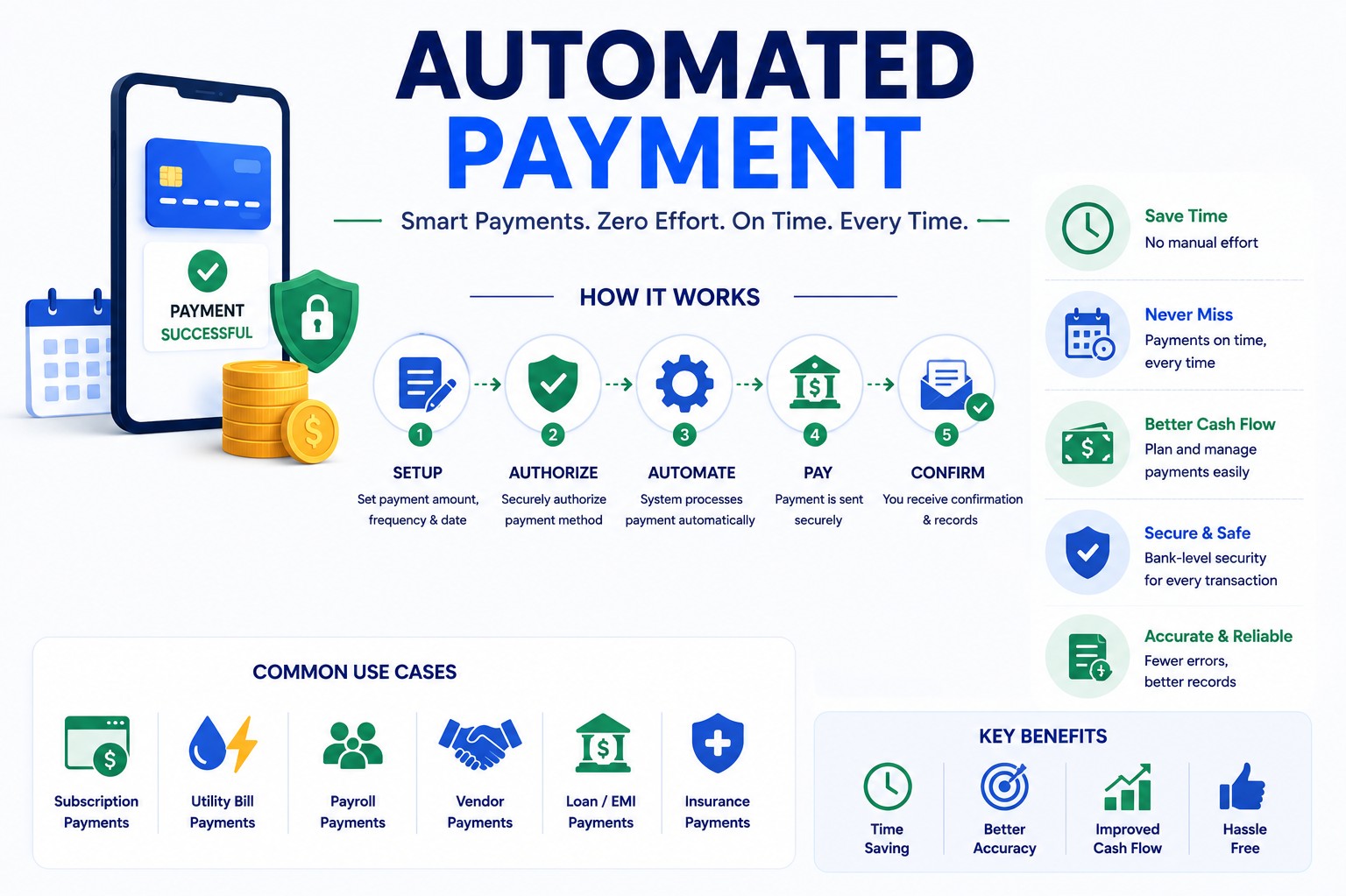
Instead of initiating individual payments repeatedly, a user authorizes a system to execute payments according to predefined rules such as amount, frequency, recipient, and payment date.
Automated payments are commonly used for recurring obligations, including subscriptions, utility bills, insurance premiums, loan repayments, payroll, and vendor payments.
Once authorization is provided, the payment system handles the transaction automatically, reducing the need for ongoing manual involvement.
Why Automated Payments Are Growing
Several factors are driving the increasing adoption of payment automation.
Consumers increasingly prefer convenience and want to avoid missed payments and late fees. Businesses seek operational efficiency, predictable cash flow, and reduced administrative workloads.
The growth of digital banking, mobile payments, cloud-based accounting platforms, and embedded finance solutions has also made automation easier to implement than ever before.
As organizations process larger volumes of transactions, automation becomes essential for maintaining efficiency and scalability.
How Automated Payments Work
The automated payment process typically begins when a customer or business provides authorization to a payment provider, bank, or financial platform.
The payer specifies key details such as the payment amount, schedule, recipient, and payment method. The system then stores these instructions securely and executes transactions automatically when the scheduled payment date arrives.
After processing, confirmation records are generated and shared with the relevant parties. Many modern systems also provide real-time notifications and transaction tracking.
This creates a streamlined workflow that minimizes manual intervention while maintaining visibility and control.
Common Types of Automated Payments
Subscription Payments
Streaming services, software platforms, memberships, and other subscription businesses rely heavily on automated recurring payments.
Customers authorize recurring billing, allowing payments to be collected automatically according to the subscription schedule.
Utility Bill Payments
Electricity, water, internet, and other utility providers often offer automated payment options that help customers avoid missed due dates.
Loan and EMI Payments
Banks and lenders commonly use automated payments for mortgage installments, personal loans, and credit obligations.
Payroll Automation
Businesses use automated payment systems to distribute salaries and wages efficiently across employee accounts.
Vendor and Supplier Payments
Organizations can schedule recurring supplier payments to improve operational efficiency and strengthen vendor relationships.
Benefits for Businesses
Automated payments provide significant advantages for organizations of all sizes.
One of the biggest benefits is time savings. Finance teams spend less time processing invoices, initiating transfers, and managing payment schedules.
Automation also improves cash flow management by ensuring payments occur consistently and predictably. Businesses gain better visibility into upcoming obligations and can plan liquidity more effectively.
Another important benefit is accuracy. Automated systems reduce the risk of manual data-entry errors and missed payments.
In addition, businesses often experience lower operational costs and improved supplier relationships due to more reliable payment execution.
Benefits for Consumers
For consumers, convenience is the primary advantage.
Automated payments eliminate the need to remember multiple due dates and manually process recurring bills each month.
They also help reduce the risk of late fees and service interruptions caused by missed payments.
Many users appreciate the predictability and simplicity that automation brings to personal financial management.
Automated Payments and Cash Flow
Predictable payment timing is valuable for both payers and recipients.
Businesses receiving automated payments often benefit from more consistent revenue streams and improved forecasting. Subscription companies, in particular, rely on recurring payment automation to stabilize cash flow.
On the payer side, scheduled payments help individuals and organizations plan their finances more effectively.
As financial planning becomes increasingly data-driven, payment automation plays an important role in improving cash flow visibility.
Security Considerations
Because automated payments involve ongoing access to financial accounts, security is critical.
Modern payment systems use encryption, tokenization, authentication protocols, and fraud monitoring tools to protect sensitive payment information.
Users should review payment authorizations regularly and ensure they are working with reputable financial institutions and payment providers.
Strong security practices help maintain trust while supporting the convenience of automation.
Compliance and Regulatory Requirements
Payment providers must comply with regulations related to data protection, consumer consent, anti-money laundering requirements, and payment security standards.
Automated payment systems typically include authorization records, audit trails, and cancellation mechanisms to support regulatory compliance.
Businesses operating internationally may also need to consider regional payment regulations and consumer protection laws.
Compliance has become an integral part of modern payment automation infrastructure.
Challenges of Automated Payments
Despite their advantages, automated payments are not without challenges.
Insufficient account balances can lead to failed transactions, while outdated payment information may cause payment disruptions.
Consumers sometimes lose visibility into recurring charges, making it important to review payment activity regularly.
Businesses must also manage authorization changes, payment retries, and customer communication effectively.
Successful automation requires both strong technology and clear operational processes.
The Role of AI and Payment Automation
Artificial intelligence is increasingly enhancing automated payment systems.
AI-powered platforms can predict payment failures, optimize collection timing, detect unusual activity, and personalize payment experiences.
Machine learning algorithms also help improve fraud detection and reduce false declines.
As AI capabilities continue advancing, payment automation is becoming smarter, more adaptive, and more efficient.
Future Trends in Automated Payments
Several trends are shaping the future of payment automation.
Real-time payment networks are enabling faster settlement, while open banking APIs are creating new opportunities for account-to-account payment automation.
Embedded finance is integrating payment capabilities directly into business platforms, and AI-driven systems are improving payment optimization and risk management.
These innovations are moving the industry toward a future where many routine financial transactions occur seamlessly in the background.
Conclusion
Automated Payment systems are transforming the way individuals and businesses manage financial transactions. By reducing manual effort, improving accuracy, supporting predictable cash flow, and enhancing convenience, payment automation has become a fundamental component of modern financial operations.
From subscriptions and utility bills to payroll and supplier payments, automated payments help organizations operate more efficiently while delivering better experiences for customers and employees.
As digital finance, real-time payments, and artificial intelligence continue evolving, automated payment solutions will play an increasingly important role in creating faster, smarter, and more connected financial ecosystems.
For businesses seeking scalability and consumers seeking simplicity, payment automation is no longer just a convenience—it is becoming the standard for modern financial management.
Comments
No comments yet. Be the first to share your thoughts.
Leave a comment