
Introduction
The payments industry has undergone remarkable transformation over the past decade. Consumers increasingly expect payment experiences that are seamless, secure, and flexible, while businesses seek efficient ways to collect recurring payments without introducing unnecessary friction. Traditional payment methods such as direct debits and card-on-file arrangements have served these needs for years, but they also come with limitations related to flexibility, transparency, and customer control. As open banking continues to reshape the financial landscape, a new payment innovation is attracting significant attention from banks, fintech companies, merchants, and regulators alike: Variable Recurring Payments (VRPs).
Variable Recurring Payments represent a major step forward in payment automation. Unlike traditional recurring payment methods that often require fixed payment amounts or extensive administrative processes for changes, VRPs enable consumers to authorize ongoing payments with predefined limits while retaining greater control over how and when money moves from their accounts.
With growing adoption of open banking infrastructure, Variable Recurring Payments are poised to become a critical component of the future payments ecosystem.
What Are Variable Recurring Payments?
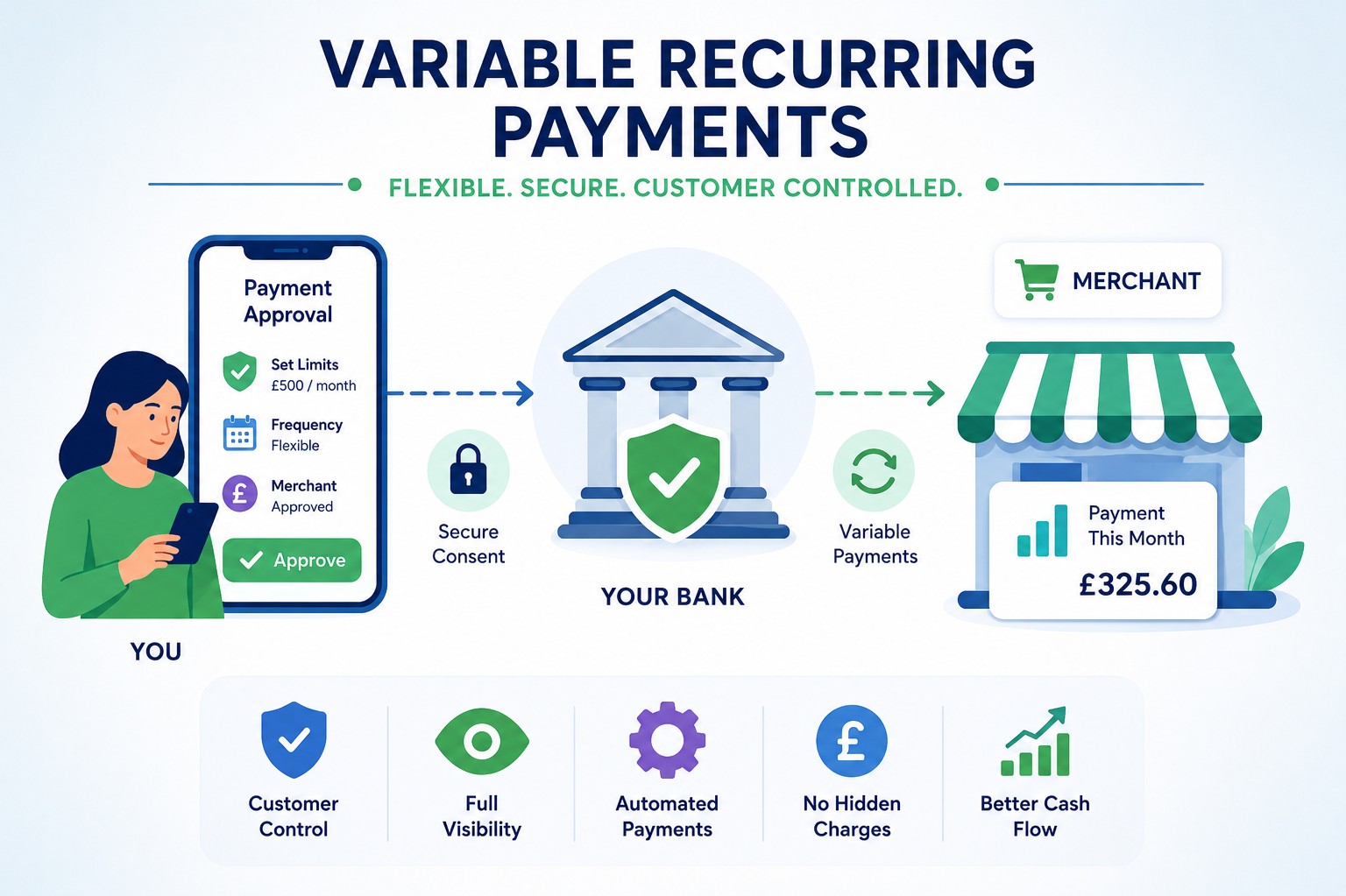
Variable Recurring Payments are an open banking-powered payment mechanism that allows customers to grant consent for recurring payments directly from their bank accounts while setting specific conditions and spending limits.
Rather than requiring authorization for every individual transaction, customers provide ongoing permission for approved payments within agreed parameters. These parameters may include transaction frequency, maximum payment amounts, overall spending caps, or specific merchant restrictions.
The key distinction is flexibility. While traditional recurring payments are often fixed in value, Variable Recurring Payments allow payment amounts to vary based on actual usage, consumption, or billing requirements.
This makes VRPs particularly suitable for modern digital services where payment amounts may change from month to month.
How Variable Recurring Payments Work
The process begins when a customer grants permission through their banking application or an authorized open banking provider.
The customer establishes predefined rules governing future transactions. These rules might specify the maximum amount that can be charged per payment, the total amount allowed over a specific period, or the frequency with which transactions can occur.
Once consent is granted, authorized businesses can initiate payments directly from the customer’s bank account without requiring repeated approvals for every transaction, provided all transactions remain within the agreed limits.
Because VRPs operate through open banking APIs, payment initiation occurs directly between bank accounts without relying on traditional card networks.
This creates a more streamlined payment experience while maintaining customer control and transparency.
Why Variable Recurring Payments Matter
The emergence of Variable Recurring Payments reflects broader changes in consumer expectations and payment technology.
Customers increasingly want greater visibility into their financial commitments. They expect to understand who has access to their accounts, how much money can be collected, and under what conditions payments may occur.
At the same time, businesses seek reliable payment collection methods that minimize failed transactions and reduce operational complexity.
VRPs address both objectives by creating a payment framework that balances automation with customer empowerment. This combination has the potential to improve trust, enhance payment experiences, and drive wider adoption of account-to-account payments.
Benefits for Consumers
One of the most significant advantages of Variable Recurring Payments is increased control.
Unlike traditional recurring payment arrangements that may require customers to contact merchants or banks to make changes, VRPs allow users to define clear payment parameters from the outset.
Consumers benefit from:
- Greater transparency into recurring payment arrangements
- Enhanced control over spending limits
- Reduced risk of unexpected charges
- Improved visibility through banking applications
- Easier consent management
This customer-centric approach aligns closely with the principles of open banking and digital financial empowerment.
Benefits for Businesses
Businesses also stand to gain substantial advantages from adopting Variable Recurring Payments.
Payment failures are a common challenge for subscription-based businesses. Expired cards, replaced payment methods, and insufficient funds can disrupt recurring revenue streams and increase operational costs.
Because VRPs are linked directly to bank accounts, businesses can potentially reduce payment failures while improving collection efficiency.
Organizations may also benefit from lower transaction costs compared to certain card-based payment methods. Direct account-to-account payments eliminate several intermediaries, creating opportunities for greater efficiency.
Additionally, the improved customer experience associated with transparent payment arrangements can strengthen trust and long-term customer relationships.
Use Cases Across Industries
The flexibility of Variable Recurring Payments makes them suitable for a wide range of industries.
Subscription-based businesses are among the most obvious beneficiaries. Streaming platforms, software providers, digital publications, and membership organizations can use VRPs to collect recurring fees while allowing payment amounts to vary when necessary.
Utility providers can also benefit significantly. Electricity, gas, water, and telecommunications bills often fluctuate based on consumption. VRPs allow customers to authorize payments within predefined limits while accommodating variable monthly charges.
The travel sector, insurance providers, wealth management platforms, and fintech applications are also exploring opportunities to integrate Variable Recurring Payments into their customer journeys.
As adoption expands, new use cases are expected to emerge across multiple sectors.
Variable Recurring Payments and Open Banking
The growth of Variable Recurring Payments is closely tied to the development of open banking ecosystems.
Open banking enables secure data sharing and payment initiation through regulated APIs. This infrastructure provides the foundation required for VRPs to operate efficiently and securely.
The United Kingdom has emerged as one of the leading markets for VRP innovation due to its advanced open banking framework. Regulators, financial institutions, and fintech companies continue collaborating to expand VRP capabilities beyond initial use cases.
As other regions accelerate open banking adoption, Variable Recurring Payments are likely to gain broader international traction.
Challenges and Adoption Barriers
Despite their significant potential, Variable Recurring Payments still face several challenges.
Consumer awareness remains relatively low compared to traditional payment methods. Many customers are unfamiliar with open banking payment mechanisms and may require education before adopting VRPs.
Financial institutions must also continue investing in API infrastructure, security standards, and interoperability frameworks to support widespread implementation.
Regulatory consistency across markets will play a crucial role in encouraging adoption and fostering innovation.
Additionally, merchants may need to adapt existing payment processes and customer onboarding experiences to accommodate VRP functionality.
The Future of Variable Recurring Payments
Industry experts increasingly view Variable Recurring Payments as a cornerstone of next-generation payment ecosystems.
As open banking matures, VRPs are expected to support a growing range of payment scenarios beyond subscription services. Innovations in embedded finance, real-time payments, and account-to-account transaction networks will further enhance their value proposition.
Artificial intelligence may eventually help optimize payment scheduling and spending controls, creating even more personalized payment experiences.
The continued shift toward digital-first financial services is likely to accelerate demand for payment methods that combine automation, transparency, and customer control.
Conclusion
Variable Recurring Payments represent one of the most promising innovations to emerge from the open banking movement. By enabling flexible, customer-controlled recurring payments directly from bank accounts, VRPs address many of the limitations associated with traditional payment methods.
For consumers, they offer greater transparency and financial control. For businesses, they provide a more efficient and potentially lower-cost way to manage recurring payment collections. As open banking ecosystems continue evolving worldwide, Variable Recurring Payments are well positioned to become a fundamental component of the future payments landscape.
Organizations that understand and embrace this emerging payment model today will be better prepared to meet the expectations of tomorrow’s digital economy.
Comments
No comments yet. Be the first to share your thoughts.
Leave a comment