
Introduction
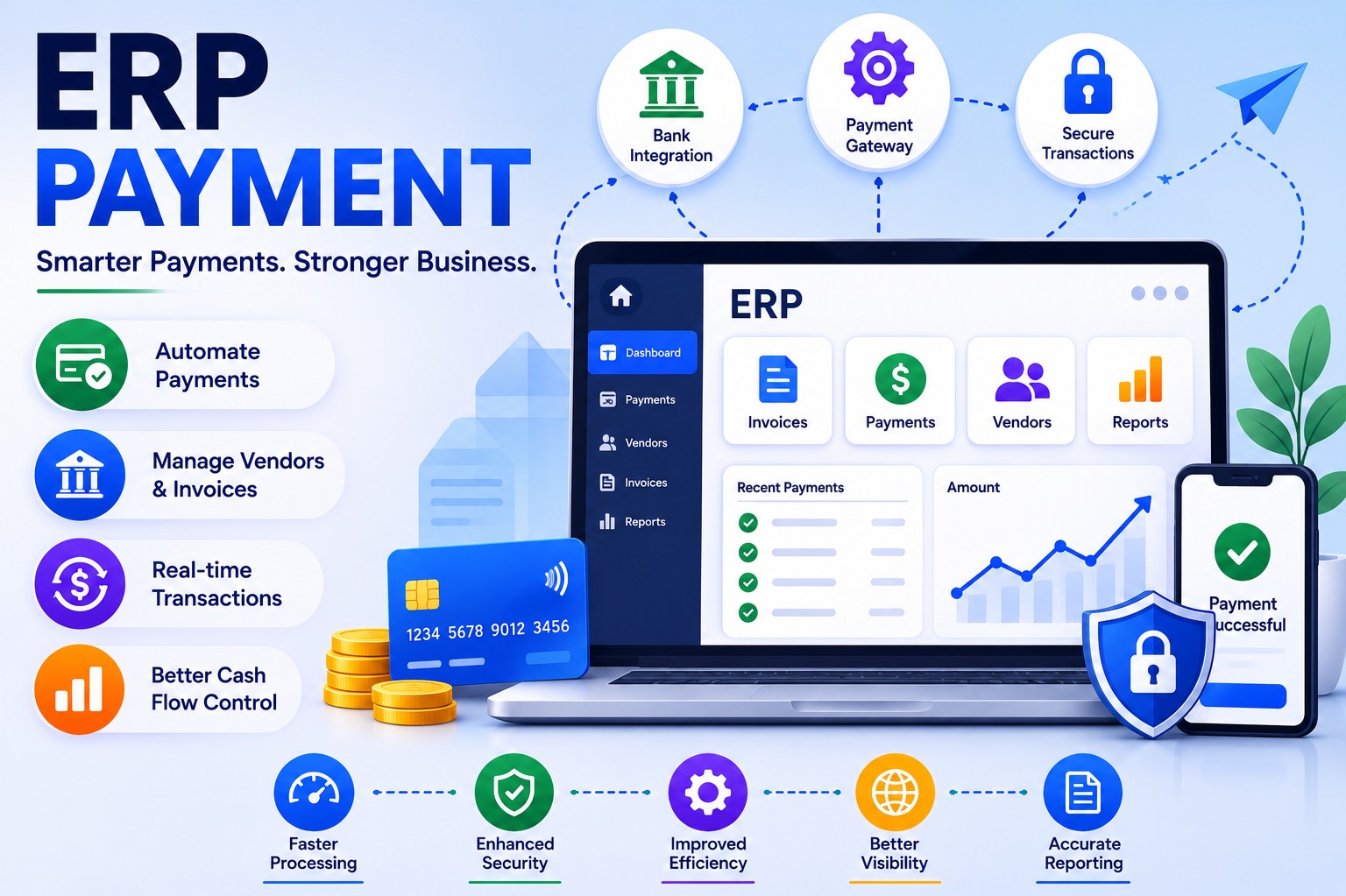
Modern businesses manage thousands of financial transactions every month, from supplier payments and payroll to customer invoices and tax obligations. Handling these payments manually can be time-consuming, prone to errors, and difficult to scale as an organization grows. To overcome these challenges, companies increasingly rely on ERP Payment solutions that integrate financial operations into a single, centralized system.
ERP (Enterprise Resource Planning) payment capabilities allow organizations to automate payment workflows, improve financial visibility, and reduce administrative effort. By connecting accounting, procurement, banking, and payment processing into one platform, businesses can manage the complete payment lifecycle more efficiently.
As digital transformation accelerates, ERP payment systems have become an essential tool for organizations seeking greater operational efficiency, stronger financial control, and improved cash flow management.
What Is ERP Payment?
ERP Payment refers to the payment management functionality integrated within an Enterprise Resource Planning (ERP) system. It enables businesses to initiate, process, monitor, and reconcile financial transactions directly from their ERP platform.
Instead of using multiple disconnected systems, organizations can manage invoices, vendor payments, customer collections, payroll, and bank transactions from one centralized environment.
ERP payment solutions help streamline financial operations while improving accuracy and reducing manual intervention.
How ERP Payment Works
The process usually begins when an invoice or payment request is generated within the ERP system. After internal approval workflows are completed, the ERP platform communicates with connected banks or payment gateways through secure integrations or APIs.
The payment is processed electronically, and confirmation is automatically recorded in the ERP. The system updates financial records, reconciles transactions, and generates reports without requiring manual data entry.
This end-to-end automation reduces delays and ensures that financial information remains accurate and up to date.
Why ERP Payment Is Important
As businesses grow, financial operations become increasingly complex. Managing payments manually across multiple systems can lead to duplicate entries, payment delays, and reconciliation challenges.
ERP payment functionality centralizes financial processes, providing greater visibility into cash flow and payment status. It also improves collaboration between finance, procurement, and accounting teams by ensuring everyone works from the same data.
For organizations processing large transaction volumes, ERP payment automation significantly improves efficiency and reduces operational costs.
Key Features of ERP Payment Systems
Modern ERP payment solutions include a wide range of capabilities designed to simplify financial management.
Businesses can automate accounts payable and accounts receivable processes, schedule recurring payments, manage supplier invoices, reconcile bank transactions, and generate detailed financial reports.
Many ERP platforms also integrate with payment gateways, banking APIs, and real-time payment networks, enabling seamless payment execution without leaving the ERP environment.
These features improve productivity while supporting better financial decision-making.
Benefits for Businesses
ERP payment systems help organizations save time by automating repetitive financial tasks. Finance teams spend less time processing invoices and reconciling payments, allowing them to focus on strategic activities.
Automation also improves payment accuracy by reducing manual data-entry errors. Businesses benefit from better cash flow visibility, stronger financial controls, and faster payment processing.
Integrated reporting provides real-time insights into outstanding invoices, payment schedules, and account balances, enabling more informed financial planning.
As a result, ERP payment systems contribute to improved operational efficiency and business growth.
ERP Payment and Accounts Payable
Accounts payable is one of the most common applications of ERP payment automation.
Supplier invoices can be captured electronically, matched with purchase orders, routed through approval workflows, and paid automatically according to agreed payment terms.
This reduces administrative effort, minimizes late payments, and strengthens supplier relationships while maintaining complete visibility into payment obligations.
Automated accounts payable also improves audit readiness through detailed transaction records and approval histories.
ERP Payment and Accounts Receivable
ERP systems also streamline customer payment collection.
Invoices can be generated automatically, payment reminders scheduled, and incoming payments matched with customer accounts in real time.
This improves collection efficiency while reducing outstanding receivables and enhancing cash flow.
Integrated payment tracking also helps finance teams quickly identify overdue accounts and resolve payment discrepancies.
Banking and Payment Gateway Integration
ERP payment solutions increasingly connect directly with banks and payment providers.
Through secure APIs, businesses can initiate payments, verify account balances, receive transaction confirmations, and reconcile bank statements automatically.
Payment gateway integration enables organizations to accept digital payments while maintaining centralized financial records.
This connectivity reduces manual processing while supporting faster and more secure payment execution.
Security and Compliance
Security is a critical component of ERP payment systems.
Modern platforms use encryption, role-based access controls, multi-factor authentication, and audit trails to protect sensitive financial information.
Compliance features help organizations meet accounting standards, payment security requirements, tax regulations, and internal governance policies.
Continuous monitoring and automated controls reduce financial risks while supporting regulatory compliance.
Challenges of ERP Payment Implementation
Although ERP payment systems provide significant benefits, implementation requires careful planning.
Organizations must integrate existing banking relationships, migrate financial data, configure approval workflows, and train employees on new processes.
Legacy systems may also require modernization to support API-based payment connectivity.
Working with experienced implementation partners can help reduce deployment risks and accelerate adoption.
Artificial Intelligence in ERP Payments
Artificial intelligence is making ERP payment systems even more intelligent.
AI-powered solutions can predict cash flow trends, detect fraudulent transactions, automate invoice processing, optimize payment timing, and identify unusual financial activity.
Machine learning also improves reconciliation accuracy by automatically matching invoices and payments with minimal human intervention.
These capabilities enhance efficiency while reducing operational risk.
Future Trends in ERP Payments
The future of ERP payments is increasingly connected and automated.
Real-time payments, Open Banking APIs, embedded finance, and cloud-native ERP platforms are transforming enterprise financial operations.
Businesses are adopting AI-driven automation to improve forecasting, payment optimization, and compliance monitoring.
As digital finance evolves, ERP payment systems will become more integrated, data-driven, and capable of supporting global business operations.
Conclusion
ERP payment solutions have become an essential component of modern enterprise finance. By integrating payment processing with accounting, procurement, banking, and financial reporting, businesses can automate routine tasks, improve accuracy, and gain greater control over cash flow.
As organizations continue embracing digital transformation, ERP payment systems will play an increasingly important role in improving efficiency, strengthening financial governance, and supporting scalable business growth.
For companies seeking faster, smarter, and more secure financial operations, ERP payment integration is no longer just an advantage it is a strategic necessity.
Comments
No comments yet. Be the first to share your thoughts.
Leave a comment