
Introduction
The payments industry is entering a new era where transactions are no longer initiated solely by humans. Advances in artificial intelligence, automation, and digital commerce are creating systems capable of making decisions, executing actions, and managing financial activities with minimal human intervention. At the center of this transformation lies a concept that is rapidly gaining attention across fintech, banking, and commerce ecosystems: Agentic Payments.
For decades, payment innovation focused on making transactions faster, safer, and more convenient. From credit cards and digital wallets to real-time payments and open banking, every advancement sought to reduce friction in the customer journey. Agentic Payments represent the next logical evolution. Instead of merely facilitating payments, intelligent agents can now analyze needs, compare options, make purchasing decisions, and complete transactions on behalf of individuals or businesses.
As AI capabilities continue to mature, Agentic Payments have the potential to redefine how money moves through the digital economy.
What Are Agentic Payments?
Agentic Payments refer to payment transactions initiated, managed, or executed by autonomous AI agents acting within predefined permissions and objectives.
Unlike traditional payment automation, which follows rigid rules and workflows, agentic systems can evaluate context, analyze alternatives, and make intelligent decisions before initiating transactions.
For example, an AI assistant could automatically purchase software subscriptions, renew business services, pay utility bills, replenish inventory, or book travel arrangements based on user-defined preferences and spending limits.
The payment itself becomes the final step in a broader decision-making process handled by an intelligent agent.
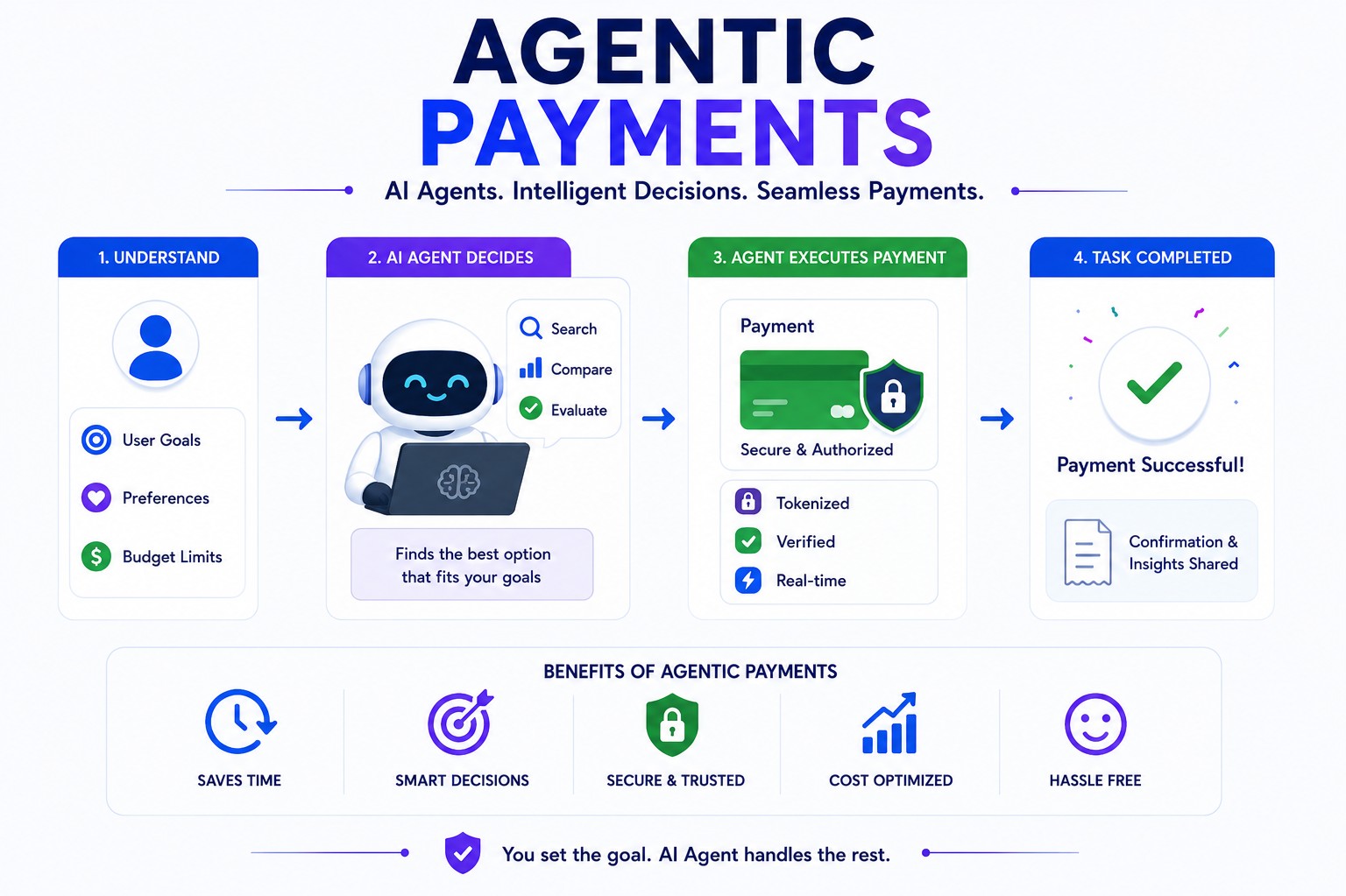
Rather than requiring constant manual input, users establish goals, budgets, and permissions while AI systems manage execution.
Why Agentic Payments Matter
Modern consumers and businesses face growing complexity when managing purchases and financial decisions. Individuals subscribe to multiple services, compare thousands of products online, and navigate countless payment options. Businesses handle procurement processes, vendor management, recurring expenses, and operational spending at scale.
Agentic Payments help address this complexity by reducing manual effort and enabling more intelligent financial decision-making.
Instead of spending time evaluating every transaction individually, users can delegate routine purchasing activities to trusted AI systems. This allows consumers and businesses to focus on higher-value decisions while automation handles repetitive tasks.
The result is greater efficiency, improved convenience, and potentially better financial outcomes.
How Agentic Payments Work
The process begins when users define specific objectives, permissions, and financial boundaries.
An individual might instruct an AI agent to find the best mobile phone plan under a certain monthly budget. A business may authorize an agent to reorder office supplies whenever inventory levels fall below a predefined threshold.
The AI agent continuously monitors relevant data sources, evaluates available options, and identifies optimal purchasing opportunities.
Once a decision aligns with the established rules and spending limits, the agent initiates payment through integrated financial systems such as digital wallets, bank accounts, virtual cards, or open banking payment rails.
Throughout the process, the user retains control through configurable permissions, approval workflows, and spending restrictions.
This balance between autonomy and oversight is critical for successful adoption.
The Technologies Powering Agentic Payments
Several emerging technologies are converging to make Agentic Payments possible.
Artificial intelligence provides the decision-making capability. Machine learning models analyze data, recognize patterns, and evaluate alternatives based on user objectives.
Open banking infrastructure enables secure access to payment initiation services through standardized APIs. This allows AI agents to interact directly with banking systems while maintaining regulatory compliance.
Embedded finance solutions integrate payment capabilities directly into digital platforms, enabling seamless transaction execution.
Real-time payment networks further enhance the experience by supporting immediate payment processing and settlement.
Together, these technologies create an ecosystem where intelligent agents can perform increasingly sophisticated financial activities.
Benefits for Consumers
For consumers, Agentic Payments offer a significant reduction in effort.
Routine financial tasks such as subscription renewals, bill payments, price comparisons, and service purchases can be managed automatically. AI agents can continuously search for better deals, identify cost-saving opportunities, and optimize spending decisions.
Consumers may also benefit from improved personalization. Intelligent agents can learn preferences over time and make recommendations that align with individual needs and financial goals.
Additionally, Agentic Payments can reduce decision fatigue by automating repetitive purchasing activities while maintaining transparency and user control.
As digital lifestyles become increasingly complex, these advantages are likely to become more valuable.
Benefits for Businesses
Businesses are expected to be among the largest beneficiaries of Agentic Payments.
Procurement processes often involve significant manual effort, approvals, and administrative overhead. AI agents can streamline these workflows by monitoring inventory levels, evaluating suppliers, negotiating pricing, and initiating purchases automatically.
Finance teams can use intelligent agents to manage recurring expenses, optimize vendor payments, and improve cash flow planning.
Customer-facing businesses may also benefit as AI-powered purchasing agents become more common among consumers. Companies that optimize payment experiences for autonomous agents could gain competitive advantages in emerging digital marketplaces.
The operational efficiencies created by Agentic Payments have the potential to generate substantial cost savings and productivity improvements.
Security and Trust Considerations
Despite their promise, Agentic Payments introduce important security and governance challenges.
Users must trust that AI agents will operate within authorized boundaries and make decisions aligned with their objectives. Financial institutions, payment providers, and technology companies therefore need to implement strong safeguards.
Key protective measures may include:
- Multi-factor authentication
- Spending limits and transaction caps
- Real-time monitoring
- Permission-based access controls
- AI activity auditing
- Fraud detection systems
Transparency is equally important. Users should understand why decisions are being made and retain the ability to override or modify agent behavior when necessary.
Trust will ultimately determine the pace of adoption.
Challenges Facing Agentic Payments
Several obstacles remain before Agentic Payments become mainstream.
Regulatory frameworks are still evolving to address autonomous financial decision-making. Questions surrounding liability, consumer protection, and accountability must be resolved as AI agents gain greater financial authority.
Interoperability presents another challenge. Agentic ecosystems require seamless integration across banks, payment networks, merchants, fintech platforms, and AI providers.
Consumer confidence may also take time to develop. Many users remain cautious about allowing AI systems to control purchasing decisions, particularly when financial resources are involved.
Addressing these concerns will be critical to widespread adoption.
The Future of Agentic Payments
The future of payments is becoming increasingly intelligent.
Industry leaders envision a world where AI agents act as personal financial assistants capable of managing large portions of daily financial activity. Consumers may simply define goals and preferences while intelligent systems handle purchasing decisions, payment execution, and financial optimization.
Businesses will likely deploy agentic systems to automate procurement, treasury operations, and expense management. Combined with open banking, embedded finance, and real-time payments, Agentic Payments could significantly reduce friction across the global economy.
As artificial intelligence continues advancing, the distinction between commerce, payments, and decision-making will become increasingly blurred.
Conclusion
Agentic Payments represent one of the most significant innovations emerging at the intersection of artificial intelligence and financial technology. By enabling intelligent agents to initiate and manage transactions within predefined parameters, they offer new levels of efficiency, automation, and convenience for both consumers and businesses.
While challenges related to security, regulation, and trust remain, the momentum behind autonomous financial transactions continues to accelerate. Organizations that begin preparing for this shift today will be better positioned to thrive in a future where payments are not just digital but increasingly intelligent, proactive, and autonomous.
Comments
No comments yet. Be the first to share your thoughts.
Leave a comment