
Introduction
Digital commerce has evolved dramatically over the past two decades. Consumers have moved from shopping in physical stores to purchasing products through websites, mobile apps, social media platforms, and connected devices. At the same time, payment technologies have become faster, safer, and more convenient through digital wallets, real-time payments, embedded finance, and Open Banking. The next major transformation is being driven by artificial intelligence—not just as a recommendation engine, but as an autonomous decision-maker capable of completing entire purchasing journeys.Agentic Commerce & Payments refers to a new model of digital commerce where AI agents can independently search for products, compare prices, negotiate offers, place orders, manage subscriptions, and even initiate payments on behalf of users within predefined permissions and spending limits. Instead of simply assisting customers, AI agents become active participants in commercial transactions.
As generative AI, large language models, and autonomous software agents continue to mature, Agentic Commerce is expected to reshape how businesses sell products and how consumers interact with financial services.
What Is Agentic Commerce & Payments?
Agentic Commerce & Payments is a technology framework that enables AI-powered software agents to perform commercial and financial activities autonomously while operating under user-defined rules and permissions.
These AI agents can analyze customer preferences, evaluate products, recommend purchases, monitor recurring expenses, manage subscriptions, schedule payments, and complete transactions using secure payment infrastructure.
Unlike traditional automation, agentic systems make contextual decisions based on goals, real-time information, and learned behavior while keeping users in control of spending policies.
Why Agentic Commerce Matters
Modern consumers face an overwhelming number of purchasing choices across countless online platforms.
Finding the best product, comparing prices, managing subscriptions, and tracking recurring payments often require significant time and effort.
Agentic Commerce reduces this complexity by allowing AI agents to handle repetitive purchasing decisions while optimizing for cost, quality, delivery speed, sustainability, or other user-defined priorities.
Businesses also benefit from more personalized customer interactions and streamlined purchasing experiences.
How Agentic Commerce & Payments Work
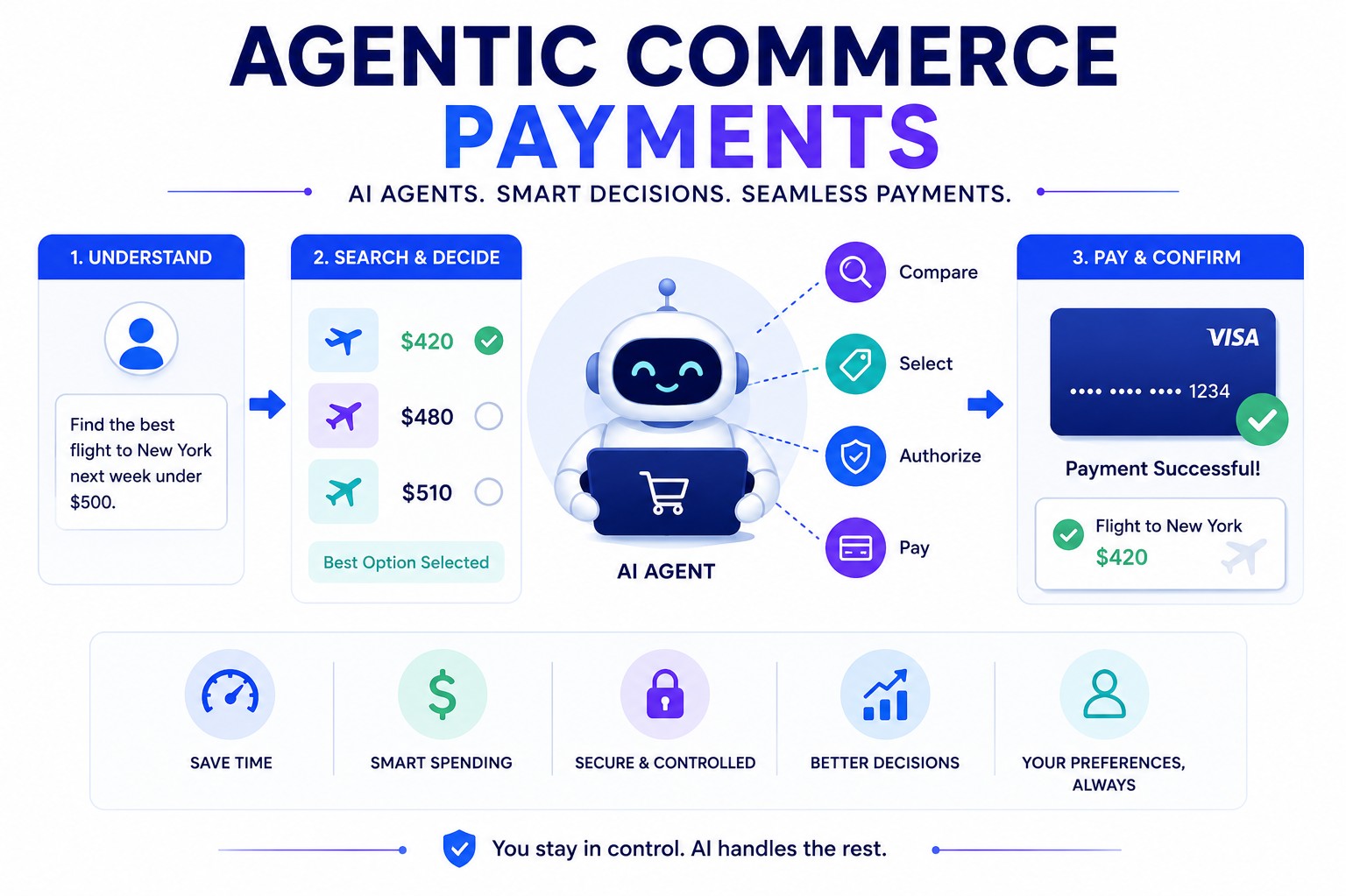
The process begins when a user grants an AI agent permission to perform specific commercial activities.
The agent receives defined objectives, such as purchasing office supplies below a certain budget, renewing software subscriptions automatically, or booking business travel based on company policies.
Using APIs, Open Banking connections, payment gateways, merchant platforms, and real-time market data, the AI searches for suitable options, evaluates available choices, and selects the most appropriate solution.
Before initiating payment, the agent verifies spending limits, payment authorization policies, merchant trust, and security requirements.
Once approved, the payment is completed through secure digital payment infrastructure while maintaining complete transaction records.
Key Components of Agentic Commerce
Several technologies work together to enable Agentic Commerce.
Artificial intelligence provides reasoning and decision-making capabilities. Large language models interpret user instructions and communicate naturally with digital platforms. Payment APIs connect AI agents with banking systems and payment gateways, while Open Banking enables secure account-to-account transactions.
Identity verification, digital wallets, fraud detection systems, and consent management ensure that autonomous transactions remain secure and compliant.
Together, these technologies create a trusted environment for AI-driven commerce.
Benefits for Consumers
Agentic Commerce significantly improves convenience.
Consumers no longer need to manually compare prices across multiple websites or manage routine purchases.
AI agents can automatically identify the best deals, monitor price changes, optimize subscription spending, renew essential services, and recommend purchases aligned with personal preferences.
Because users define spending rules and approval requirements, they retain full control over financial decisions while reducing administrative effort.
Benefits for Businesses
Businesses gain access to highly personalized commerce experiences.
AI agents can interact directly with merchant systems, reducing checkout friction and improving conversion rates.
Companies can automate procurement, supplier payments, invoice processing, expense management, and recurring purchasing workflows.
Businesses also benefit from improved operational efficiency, lower transaction costs, and more intelligent customer engagement.
As AI becomes more capable, entirely new business models based on autonomous purchasing may emerge.
Payment Infrastructure Behind Agentic Commerce
Secure payment infrastructure is essential for autonomous commerce.
Agentic payment systems rely on payment gateways, digital wallets, tokenized payment credentials, Open Banking APIs, account-to-account payments, real-time payment networks, and virtual payment cards.
Dynamic spending controls, transaction monitoring, biometric authentication, and consent management ensure that AI agents operate only within authorized financial boundaries.
These safeguards enable trusted autonomous transactions without compromising customer security.
Security and Trust
Security remains the most important consideration for Agentic Commerce.
Organizations must ensure AI agents cannot exceed authorized spending limits or access financial information without permission.
Encryption, tokenization, Strong Customer Authentication (SCA), multi-factor authentication, behavioral analytics, and continuous fraud monitoring protect autonomous payment activities.
Transparent audit trails also allow users to review every decision and transaction performed by their AI agents.
Building trust will be critical for widespread adoption.
Artificial Intelligence and Autonomous Decision-Making
Artificial intelligence is the engine that powers Agentic Commerce.
Machine learning helps AI understand purchasing preferences, optimize product recommendations, predict future needs, and continuously improve decision-making accuracy.
Generative AI enables conversational interactions, allowing users to communicate naturally with their digital assistants.
Reinforcement learning further improves autonomous purchasing strategies based on previous outcomes and changing market conditions.
These capabilities enable AI agents to make increasingly sophisticated commercial decisions.
Industries Embracing Agentic Commerce
Many industries are exploring Agentic Commerce solutions.
E-commerce retailers are developing AI shopping assistants, while financial institutions are integrating intelligent payment agents into digital banking platforms.
Travel companies automate itinerary planning and bookings, procurement teams optimize supplier purchasing, healthcare providers manage recurring medical supplies, and enterprise organizations streamline operational spending.
Subscription businesses, marketplaces, and software providers are also adopting agentic technologies to improve customer experiences.
Challenges and Considerations
Despite its enormous potential, Agentic Commerce presents several challenges.
Organizations must establish clear governance policies, define spending permissions, protect customer privacy, prevent unauthorized transactions, and comply with financial regulations.
AI transparency is equally important so users understand why purchasing decisions are made.
Building interoperable payment standards and trusted digital identity systems will also be essential for widespread adoption.
Responsible AI governance will determine the long-term success of autonomous commerce.
Future of Agentic Commerce & Payments
The future of commerce will increasingly involve collaboration between humans and AI agents.
Digital assistants will evolve into trusted financial managers capable of negotiating prices, optimizing recurring spending, coordinating supply chains, and executing payments across multiple financial institutions.
Open Banking, embedded finance, blockchain, digital identity, biometric authentication, and real-time payment networks will further expand the capabilities of autonomous commerce.
As technology matures, Agentic Commerce is expected to become a standard component of digital financial ecosystems.
Businesses that invest early in AI-ready payment infrastructure will be well positioned to lead this transformation.
Choosing the Right Agentic Commerce Platform
Organizations evaluating Agentic Commerce platforms should consider AI capabilities, payment integrations, Open Banking support, API quality, identity verification, fraud prevention, regulatory compliance, scalability, explainable AI features, developer tools, and security controls.
A robust platform should allow businesses to automate commercial workflows while maintaining transparency, customer trust, and operational resilience.
Selecting the right technology partner will be key to successful adoption.
Conclusion
Agentic Commerce & Payments represents the next major evolution in digital commerce, combining artificial intelligence with modern payment infrastructure to automate purchasing and financial decision-making. By enabling AI agents to securely search, evaluate, purchase, and pay within user-defined limits, businesses can deliver faster, smarter, and more personalized commerce experiences.
As Open Banking, embedded finance, and intelligent automation continue to evolve, Agentic Commerce will redefine how consumers and organizations interact with digital marketplaces. Companies that embrace this emerging technology today will be better prepared to compete in the increasingly autonomous economy of tomorrow.
Comments
No comments yet. Be the first to share your thoughts.
Leave a comment