
Introduction
Commerce has evolved dramatically over the last two decades. Businesses have moved from physical storefronts to digital marketplaces, from manual transactions to automated payments, and from traditional customer service to AI-powered interactions. Today, a new transformation is emerging that could redefine how buying and selling occur across the digital economy: Agentic Commerce.
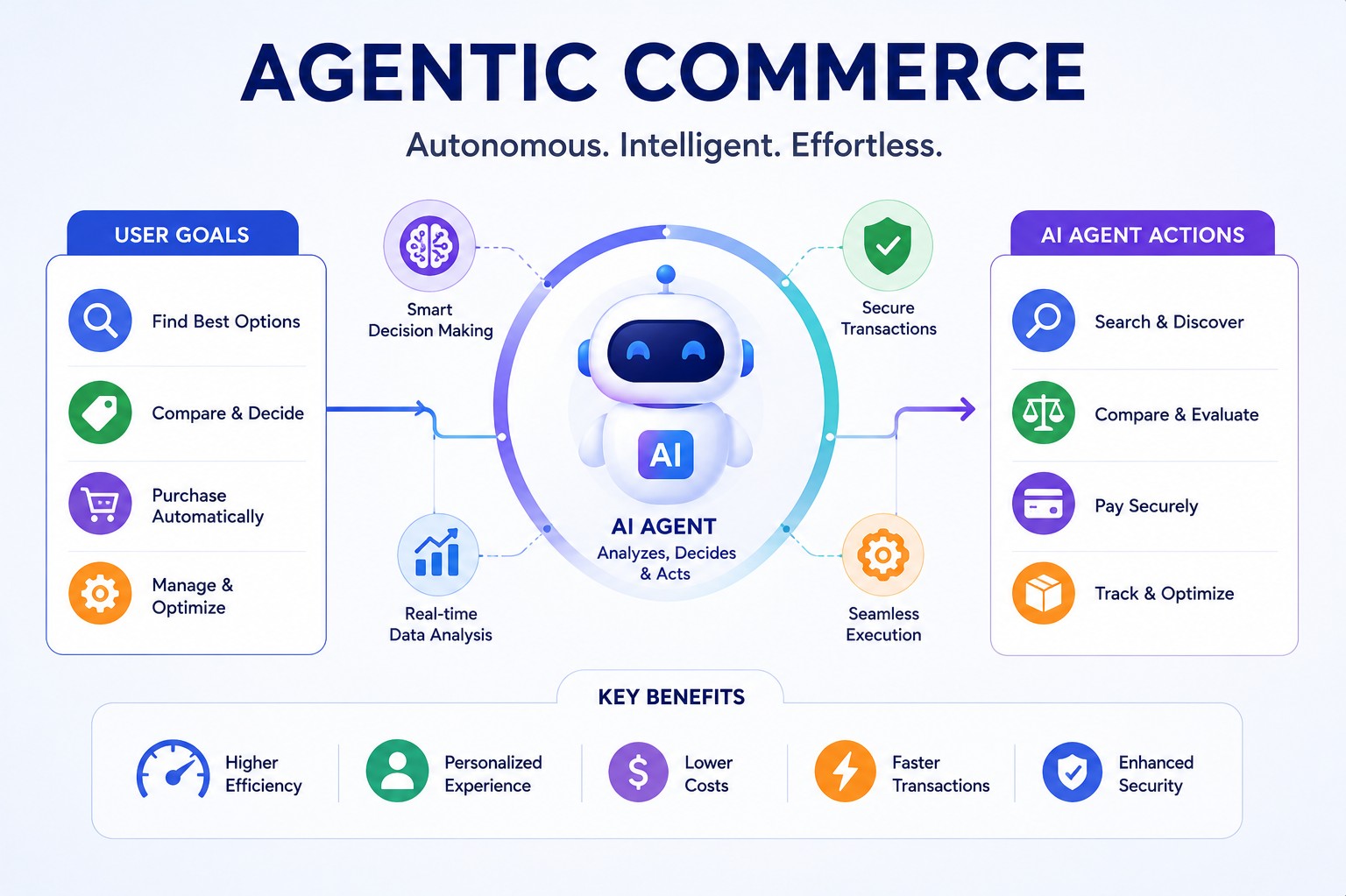
Agentic Commerce refers to a model where artificial intelligence agents can independently perform commercial activities on behalf of users or businesses. Instead of customers manually searching, comparing, and purchasing products, intelligent software agents can make decisions, execute transactions, and optimize outcomes based on predefined goals and preferences.
As artificial intelligence becomes increasingly sophisticated, Agentic Commerce is poised to reshape e-commerce, payments, financial services, and customer experiences worldwide.
What Is Agentic Commerce?
Agentic Commerce is a commerce framework where AI-powered agents act autonomously to perform purchasing, negotiation, payment, and decision-making activities.
These intelligent agents can analyze data, understand user preferences, evaluate options, and execute transactions with minimal human intervention.
For example, an AI agent may:
- Book travel arrangements
- Purchase business software
- Reorder inventory
- Compare service providers
- Manage subscription renewals
- Optimize procurement decisions
The objective is to automate commercial activities while improving efficiency and personalization.
Why Agentic Commerce Is Emerging
Several technological advancements are driving the rise of Agentic Commerce.
These include:
- Artificial intelligence
- Large language models
- Real-time payment systems
- Embedded finance
- Digital identity solutions
- API-driven ecosystems
Consumers increasingly expect convenience and personalization. Businesses seek operational efficiency and cost reduction.
Agentic Commerce addresses both needs by enabling intelligent systems to perform routine and complex commercial tasks automatically.
This shift represents the next evolution of digital commerce.
How Agentic Commerce Works
The foundation of Agentic Commerce is the AI agent.
The process generally follows these steps:
- The user defines goals or preferences.
- The AI agent gathers relevant information.
- Available options are analyzed and compared.
- Decisions are made based on predefined criteria.
- Transactions are executed automatically.
- Results are monitored and optimized continuously.
Unlike traditional automation, agentic systems can adapt to changing circumstances and make context-aware decisions.
This flexibility allows them to handle increasingly sophisticated commercial activities.
Key Components of Agentic Commerce
Several technologies work together to support Agentic Commerce.
Artificial Intelligence
AI enables decision-making, learning, and optimization.
Digital Payments
Modern payment systems facilitate automated transaction execution.
APIs and Integrations
Application programming interfaces connect agents with marketplaces, banks, and service providers.
Digital Identity
Identity verification helps establish trust and authorization.
Data Analytics
Agents rely on large volumes of data to improve decision quality.
Together, these technologies create intelligent and autonomous commerce ecosystems.
Benefits of Agentic Commerce
Agentic Commerce offers significant advantages for consumers and businesses alike.
Increased Efficiency
Routine purchasing decisions can be automated.
Better Decision-Making
AI agents analyze large datasets faster than humans.
Personalized Experiences
Recommendations align closely with user preferences.
Reduced Operational Costs
Automation lowers manual workloads and administrative expenses.
Faster Transactions
Purchases and payments occur almost instantly.
These benefits are driving growing interest across industries.
Agentic Commerce in E-Commerce
E-commerce is expected to be one of the largest beneficiaries of Agentic Commerce.
Instead of manually browsing products, consumers may increasingly rely on AI agents to:
- Find the best deals
- Compare product features
- Evaluate reviews
- Negotiate pricing
- Complete purchases
This transformation could significantly change how online retailers attract and engage customers.
Businesses may need to optimize not only for human shoppers but also for AI decision-makers.
Transforming B2B Procurement
Business procurement processes often involve repetitive tasks, supplier evaluations, and extensive administrative work.
Agentic Commerce can automate many of these functions.
AI agents may:
- Monitor inventory levels
- Source suppliers
- Compare pricing
- Negotiate contracts
- Execute purchases
This automation improves efficiency while reducing procurement costs and delays.
Organizations can focus on strategic initiatives rather than routine purchasing activities.
Agentic Commerce and Payments
Payments are a critical component of Agentic Commerce.
Autonomous purchasing requires secure and reliable payment infrastructure capable of supporting machine-initiated transactions.
Emerging payment technologies supporting Agentic Commerce include:
- Real-time payments
- Embedded finance
- Open banking
- Digital wallets
- Programmable payments
- Smart contracts
These innovations enable AI agents to complete transactions safely and efficiently.
Payment providers are increasingly preparing for this new transaction model.
Security and Trust Considerations
Autonomous transactions introduce important security challenges.
Users must trust AI agents with sensitive financial and purchasing decisions.
Key safeguards include:
- Strong authentication
- Permission controls
- Transaction monitoring
- Fraud detection systems
- Data encryption
- Regulatory compliance
Trust will be a fundamental requirement for widespread adoption.
Organizations implementing Agentic Commerce must prioritize transparency and security.
Challenges Facing Agentic Commerce
Despite its potential, Agentic Commerce faces several obstacles.
Regulatory Uncertainty
Governments are still developing frameworks for AI-driven decision-making.
Liability Questions
Responsibility for agent actions remains a developing legal area.
Data Privacy Concerns
Agents require access to significant amounts of user information.
Integration Complexity
Businesses must connect multiple systems and technologies.
Addressing these challenges will be essential for long-term success.
The Role of Financial Institutions
Banks, fintech companies, and payment providers will play a critical role in Agentic Commerce.
Financial institutions are developing infrastructure that supports:
- Autonomous payments
- AI-driven financial services
- Embedded banking experiences
- Intelligent transaction monitoring
These capabilities will enable AI agents to operate securely within regulated financial ecosystems.
As adoption increases, financial institutions may become key enablers of autonomous commerce networks.
Future Trends in Agentic Commerce
Several trends are expected to shape the future of Agentic Commerce.
These include:
- AI-powered shopping assistants
- Autonomous procurement systems
- Intelligent financial agents
- Machine-to-machine payments
- Programmable commerce platforms
- Real-time decision engines
As artificial intelligence continues evolving, the capabilities of commercial agents will expand significantly.
The distinction between human-driven and machine-driven commerce may become increasingly blurred.
Conclusion
Agentic Commerce represents the next major evolution of digital commerce. By enabling AI agents to make decisions, execute transactions, and optimize purchasing activities autonomously, businesses and consumers can achieve greater efficiency, personalization, and convenience.
While challenges related to regulation, security, and trust remain, the potential benefits are substantial. As artificial intelligence, payment technologies, and digital ecosystems continue advancing, Agentic Commerce is likely to become a fundamental component of the future digital economy.
Organizations that embrace this emerging model early will be well-positioned to capitalize on the opportunities created by autonomous commerce and intelligent financial interactions.
Comments
No comments yet. Be the first to share your thoughts.
Leave a comment