
Introduction
For online businesses, payments are more than a transaction they are the final step in the customer journey and one of the most important drivers of revenue. A smooth payment experience can increase conversions and customer satisfaction, while payment failures can lead to abandoned carts, lost sales, and damaged brand reputation.Many businesses begin with a single payment gateway. While this approach is simple, it may create limitations as transaction volumes grow and operations expand into new markets. Downtime, processing issues, regional restrictions, and declining authorization rates can all affect payment performance.This is why many merchants are adopting a multiple payment gateways strategy. By integrating more than one payment gateway, businesses can improve reliability, increase payment success rates, and create a more resilient payment infrastructure.
As digital commerce becomes increasingly global, multiple payment gateways are rapidly becoming a best practice rather than an optional upgrade.
What Are Multiple Payment Gateways?
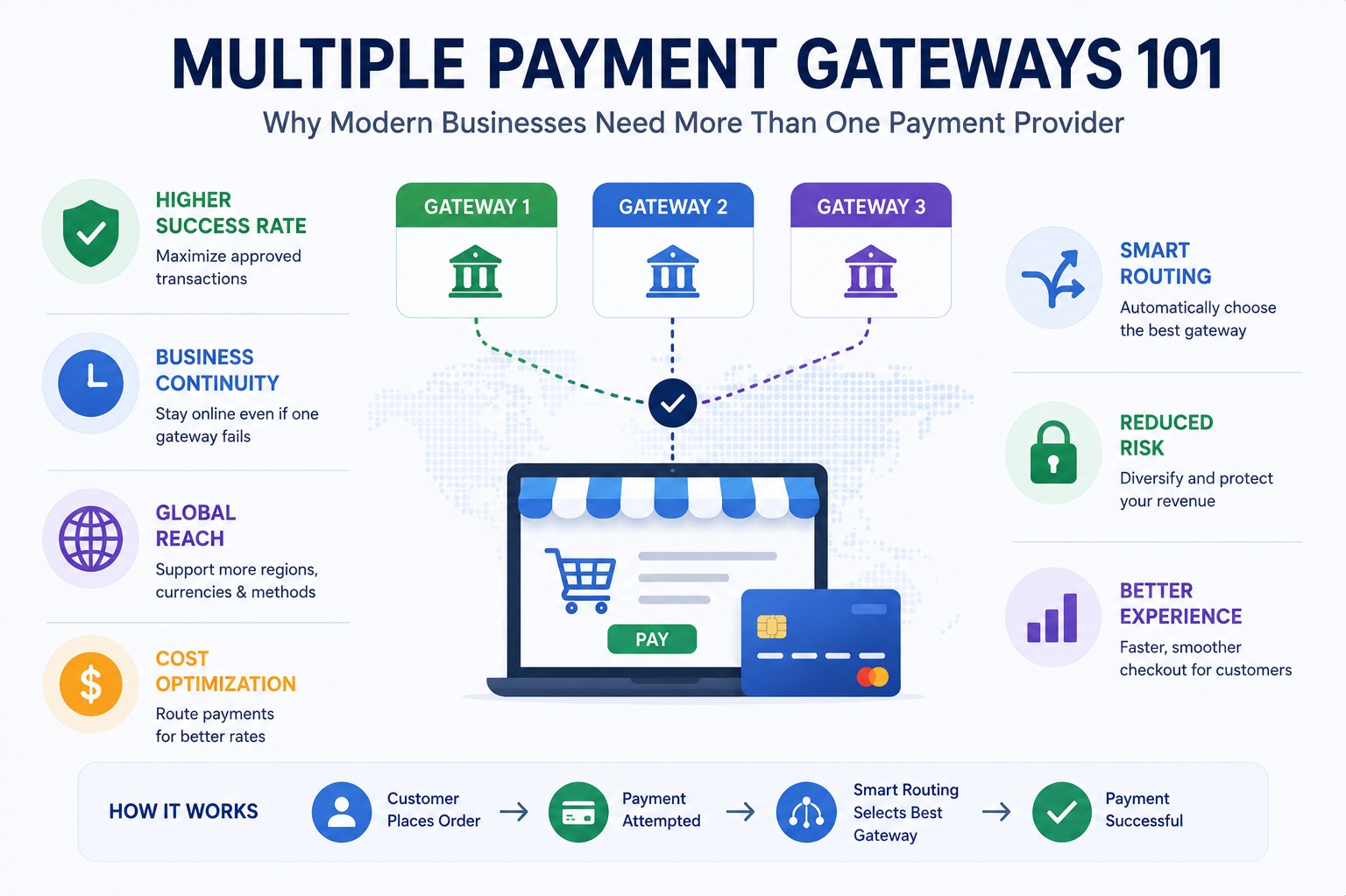
Multiple payment gateways refer to the use of two or more payment gateways within a business’s payment ecosystem.
Instead of sending every transaction through a single provider, merchants can route payments across different gateways based on various criteria such as:
- Customer location
- Payment method
- Currency
- Transaction value
- Gateway performance
- Processing costs
This approach provides greater flexibility and reduces dependency on a single provider.
Understanding the Role of a Payment Gateway
A payment gateway acts as the technology bridge between customers, merchants, banks, and payment networks.
When a customer submits payment information, the gateway securely transmits transaction data for authorization and processing.
Key functions include:
- Payment authorization
- Data encryption
- Fraud prevention
- Transaction routing
- Payment authentication
- Settlement support
Without a payment gateway, businesses would struggle to process digital payments securely and efficiently.
Why Businesses Use Multiple Payment Gateways
As companies grow, relying on a single payment gateway can create operational challenges.
A gateway outage, processing issue, or regional limitation may directly affect revenue generation.
Multiple payment gateways help businesses:
- Improve payment reliability
- Reduce downtime risks
- Increase authorization rates
- Support global expansion
- Optimize payment routing
- Improve customer experiences
These advantages contribute directly to business growth and operational resilience.
Improving Payment Success Rates
One of the biggest benefits of multiple payment gateways is the ability to improve transaction approval rates.
Different gateways often perform differently depending on:
- Card issuer relationships
- Geographic regions
- Payment methods
- Banking networks
If one gateway experiences a decline or authorization issue, transactions can be redirected through another provider.
This intelligent routing helps maximize successful transactions and reduce lost revenue.
Even small improvements in approval rates can significantly impact profitability.
Enhancing Business Continuity
Technical disruptions can occur at any time.
A single gateway outage may prevent customers from completing purchases, creating immediate revenue losses.
With multiple payment gateways in place, businesses can maintain operations even when one provider experiences downtime.
Backup routing capabilities help ensure payment acceptance remains available.
This redundancy is particularly important for businesses that process high transaction volumes or operate internationally.
Supporting Global Expansion
International customers often use different payment methods and banking systems.
A gateway that performs well in one country may not provide optimal coverage in another.
Multiple payment gateways allow businesses to:
- Support regional payment preferences
- Improve local transaction approvals
- Offer localized checkout experiences
- Process multiple currencies
This flexibility helps merchants expand into new markets more effectively.
Global businesses frequently rely on multiple gateway strategies to optimize international payment performance.
Optimizing Customer Experience
Customers expect fast, secure, and reliable payment experiences.
Payment failures or lengthy processing times can negatively affect customer satisfaction and increase cart abandonment rates.
Using multiple payment gateways helps businesses maintain smoother checkout experiences by minimizing disruptions.
Customers benefit from:
- Faster payment processing
- Higher transaction success rates
- More payment options
- Improved reliability
Better payment experiences often translate into higher conversion rates and stronger customer loyalty.
Reducing Payment Risk
Payment ecosystems face various risks including:
- Technical failures
- Fraud attempts
- Regulatory changes
- Provider outages
- Operational disruptions
A multiple payment gateways strategy reduces concentration risk by distributing transactions across multiple providers.
This diversification strengthens overall payment resilience and helps businesses respond more effectively to unexpected challenges.
Risk reduction is one of the primary reasons large merchants adopt multi-gateway architectures.
Smart Payment Routing
Modern payment systems increasingly rely on intelligent routing technology.
Smart routing engines analyze factors such as:
- Gateway availability
- Historical approval rates
- Transaction costs
- Geographic performance
- Customer location
The system then selects the optimal gateway for each transaction.
This automated decision-making improves efficiency while maximizing transaction success.
Smart routing is often one of the most valuable capabilities within a multi-gateway strategy.
Managing Costs Effectively
Payment processing costs can vary between providers.
Some gateways may offer more competitive pricing for specific regions, currencies, or payment methods.
Multiple payment gateways allow businesses to route transactions strategically and optimize processing expenses.
Cost management becomes increasingly important as transaction volumes grow.
By balancing performance and pricing, merchants can improve profitability while maintaining strong customer experiences.
Challenges of Multiple Payment Gateways
While the benefits are substantial, implementing multiple payment gateways also introduces complexity.
Businesses may face challenges such as:
- Additional integrations
- Vendor management requirements
- Reconciliation complexity
- Reporting consolidation
- Technical maintenance
Organizations should carefully evaluate infrastructure requirements before adopting a multi-gateway approach.
Payment orchestration platforms can help simplify management and reduce operational overhead.
The Role of Payment Orchestration
Payment orchestration platforms have become increasingly popular among businesses using multiple payment gateways.
These platforms provide a centralized layer that connects merchants with multiple payment providers.
Benefits include:
- Unified integrations
- Smart routing capabilities
- Centralized reporting
- Improved fraud management
- Simplified provider management
Payment orchestration helps businesses maximize the benefits of multiple gateways while minimizing complexity.
Future Trends in Multiple Payment Gateways
As digital commerce evolves, multi-gateway strategies are expected to become more sophisticated.
Emerging technologies influencing payment optimization include:
- Artificial intelligence
- Machine learning
- Real-time analytics
- Open banking
- Payment orchestration
- Dynamic transaction routing
These innovations will help businesses improve authorization rates, reduce costs, and enhance customer experiences.
The future of payment infrastructure is increasingly intelligent, automated, and distributed.
Conclusion
Multiple payment gateways have become an essential component of modern payment infrastructure. By reducing dependency on a single provider, businesses can improve transaction success rates, enhance customer experiences, support global expansion, and strengthen operational resilience.
Although managing multiple gateways requires careful planning and technology investment, the long-term benefits often outweigh the added complexity. As digital commerce continues to expand, businesses that embrace multi-gateway strategies will be better positioned to optimize payments, protect revenue, and scale successfully in competitive global markets.
Comments
No comments yet. Be the first to share your thoughts.
Leave a comment