
Introduction
The modern financial system is one of the most interconnected networks in the world. Every day, trillions of dollars move across borders through banks, payment providers, investment firms, insurance companies, fintech platforms, and capital markets. While this interconnectedness supports global economic growth, it also introduces significant risks that can affect financial stability on a worldwide scale.To manage these risks and maintain confidence in financial systems, a network of global financial regulators oversees the rules, standards, and practices governing financial institutions and markets. These regulatory bodies work to promote transparency, protect consumers, reduce systemic risks, and ensure that financial markets operate fairly and efficiently.
As financial innovation accelerates and digital technologies reshape banking and payments, the role of global financial regulators has become increasingly important.
What Are Global Financial Regulators?
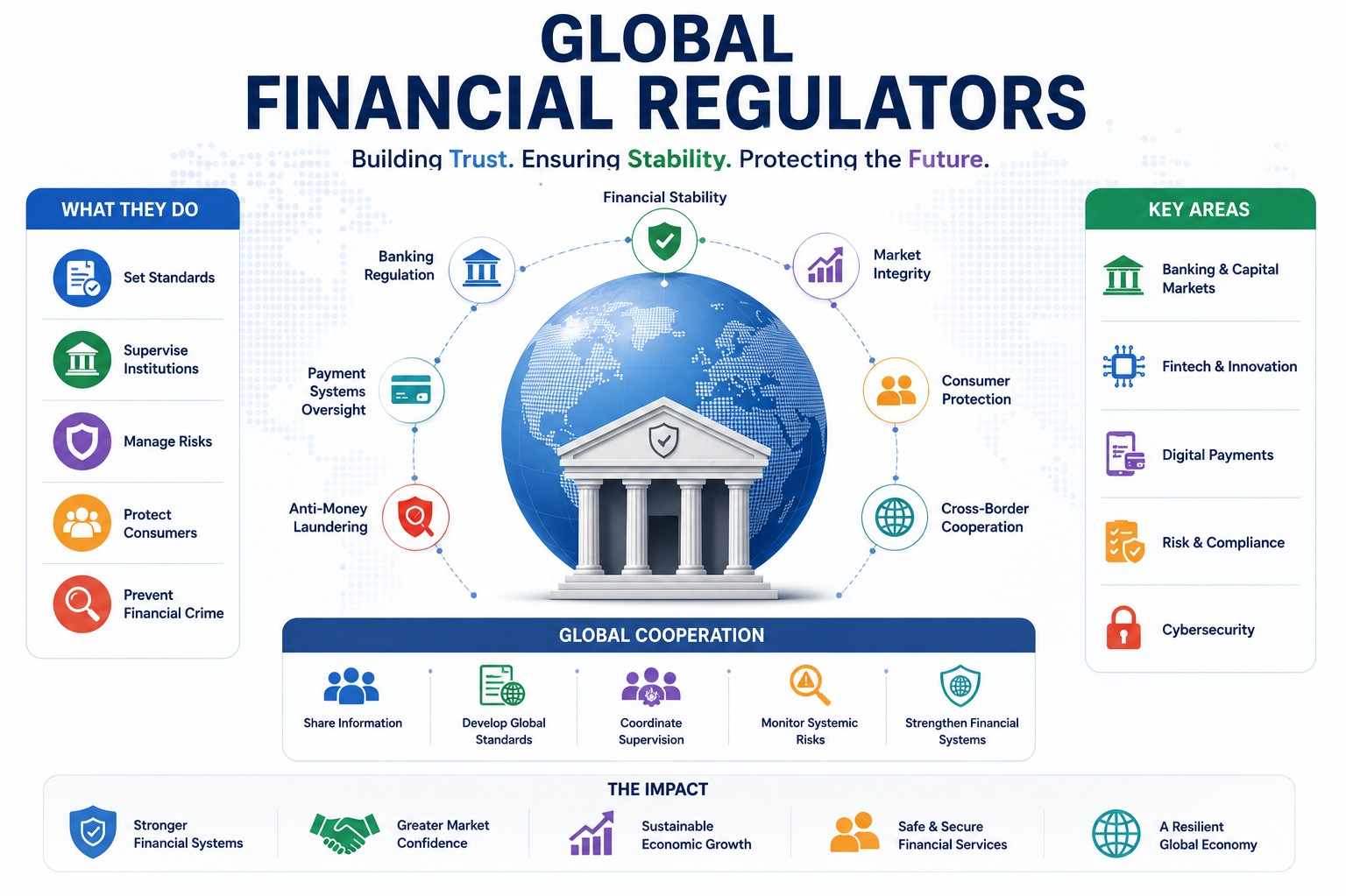
Global financial regulators are international organizations and regulatory authorities responsible for developing standards, coordinating supervision, and promoting stability across the global financial system.
Unlike national regulators that oversee financial activities within a specific country, global regulatory organizations focus on creating frameworks that support consistency and cooperation across international markets.
These regulators help establish best practices for banking, payments, securities markets, anti-money laundering efforts, risk management, and financial crime prevention.
Their work ensures that financial institutions operate within internationally recognized standards while supporting global economic stability.
Why Global Financial Regulation Matters
Financial markets no longer operate solely within national boundaries.
Banks provide international services, fintech companies serve customers globally, and payment networks facilitate transactions across multiple jurisdictions. A disruption in one market can quickly affect institutions and economies around the world.
Global financial regulators help address these challenges by promoting cooperation between countries and encouraging consistent regulatory approaches.
Their efforts contribute to:
- Financial stability
- Consumer protection
- Market integrity
- Systemic risk reduction
- Cross-border cooperation
- Financial crime prevention
Without international coordination, managing risks within the global financial ecosystem would be significantly more difficult.
The Importance of Financial Stability
Financial stability is one of the primary objectives of global financial regulation.
A stable financial system allows consumers, businesses, and governments to access financial services confidently. It also supports investment, economic growth, and international trade.
Major financial crises have demonstrated the consequences of inadequate oversight. Market disruptions can lead to bank failures, liquidity shortages, reduced investor confidence, and broader economic challenges.
Global financial regulators work continuously to identify vulnerabilities, strengthen financial institutions, and develop safeguards that reduce the likelihood of systemic crises.
Banking Regulation on a Global Scale
Banking remains one of the most heavily regulated sectors of the financial industry.
Global regulatory standards help ensure banks maintain sufficient capital, manage risks effectively, and operate safely under changing economic conditions.
International regulatory frameworks often address:
- Capital adequacy
- Liquidity management
- Risk assessment
- Corporate governance
- Stress testing
- Operational resilience
These standards help strengthen banking systems while reducing the likelihood of widespread financial instability.
As banking becomes increasingly digital, regulators continue adapting their frameworks to address emerging risks.
The Growing Role of Fintech Regulation
Fintech innovation has transformed financial services dramatically.
Digital banking, embedded finance, blockchain technologies, artificial intelligence, and open banking have created new opportunities for consumers and businesses. However, these innovations also introduce regulatory challenges.
Global financial regulators are increasingly focused on balancing innovation with risk management.
Areas receiving significant regulatory attention include:
- Digital payments
- Electronic money institutions
- Cryptocurrency markets
- Digital identity solutions
- Artificial intelligence applications
- Consumer data protection
Effective fintech regulation helps encourage innovation while protecting financial system integrity.
Anti-Money Laundering and Financial Crime Prevention
Financial crime remains a major concern for regulators worldwide.
Money laundering, terrorist financing, fraud, sanctions evasion, and cybercrime pose significant threats to financial systems.
Global regulatory organizations promote anti-money laundering standards designed to help financial institutions identify and prevent illicit activities.
Financial institutions are expected to implement:
- Customer due diligence
- Know-your-customer procedures
- Transaction monitoring
- Suspicious activity reporting
- Sanctions screening
These measures contribute to safer and more transparent financial ecosystems.
Payment Systems and Regulatory Oversight
The growth of digital payments has created new regulatory priorities.
Consumers increasingly rely on mobile wallets, digital banking platforms, online marketplaces, and real-time payment networks. As transaction volumes increase, regulators focus on ensuring payment systems remain secure, efficient, and resilient.
Global financial regulators support standards related to:
- Payment security
- Operational resilience
- Consumer protection
- Cross-border payments
- Payment infrastructure
- Fraud prevention
Strong oversight helps maintain trust in digital financial services and supports continued innovation within the payments industry.
Challenges Facing Global Financial Regulators
The financial landscape continues to evolve rapidly.
Technological innovation, geopolitical uncertainty, cybersecurity threats, and changing consumer behaviors create ongoing regulatory challenges.
One major difficulty is balancing innovation with oversight. Excessive regulation may slow technological progress, while insufficient oversight can expose markets to increased risks.
Cross-border coordination also remains complex because countries often have different legal frameworks, economic priorities, and regulatory approaches.
Despite these challenges, international cooperation remains essential for effective financial governance.
The Impact of Technology on Regulation
Technology is transforming both financial services and regulatory practices.
Regulatory technology, often referred to as RegTech, enables financial institutions and regulators to improve compliance monitoring, reporting, and risk management processes.
Artificial intelligence and data analytics help identify suspicious activities, monitor market behavior, and strengthen supervisory capabilities.
As financial systems become increasingly digital, regulators are investing in technology-driven oversight tools that support more efficient supervision and risk detection.
This technological evolution is expected to play an increasingly important role in the future of financial regulation.
Global Regulatory Cooperation
International cooperation is essential for effective financial regulation.
Financial institutions frequently operate across multiple jurisdictions, making coordinated oversight necessary. Regulators share information, develop common standards, and collaborate on risk assessments to strengthen global financial stability.
Cooperation helps address challenges such as:
- Cross-border banking risks
- International payment systems
- Financial crime
- Cybersecurity threats
- Systemic market risks
By working together, regulators can respond more effectively to emerging threats and market developments.
Future Trends in Global Financial Regulation
The future of financial regulation will be shaped by continued innovation and increasing globalization.
Several trends are expected to influence regulatory priorities:
- Digital asset regulation
- Artificial intelligence governance
- Open banking frameworks
- Real-time payment oversight
- Cybersecurity resilience
- Climate-related financial risks
- Cross-border payment modernization
Regulators will likely continue adapting their frameworks to address these evolving challenges while supporting economic growth and financial innovation.
Organizations that proactively align with regulatory expectations will be better positioned for long-term success.
Conclusion
Global financial regulators play a critical role in maintaining the stability, integrity, and security of the international financial system. Through regulatory standards, cross-border cooperation, risk management frameworks, and oversight initiatives, these organizations help protect consumers, strengthen financial institutions, and support sustainable economic growth.
As banking, payments, and fintech continue to evolve, the importance of global financial regulation will only increase. Organizations operating in the modern financial ecosystem must understand regulatory expectations and prioritize compliance as a core component of their business strategy.
In an increasingly interconnected world, effective global financial regulation remains essential for fostering trust, resilience, and innovation across the international financial landscape.
Comments
No comments yet. Be the first to share your thoughts.
Leave a comment