
Introduction
In today’s global financial ecosystem, businesses and individuals regularly send and receive money across borders. Whether processing supplier payments, managing international payroll, collecting customer funds, or conducting cross-border transactions, accuracy is critical.
A single error in banking information can result in delayed payments, failed transactions, additional fees, and administrative complications. This is where an IBAN checker becomes an essential tool.
An IBAN checker helps verify the structure and validity of an International Bank Account Number (IBAN) before a payment is processed. By identifying mistakes early, organizations can improve payment efficiency, reduce operational risks, and ensure smoother international banking experiences.
As cross-border payments continue to grow worldwide, IBAN verification has become an important part of modern payment infrastructure.
What Is an IBAN Checker?
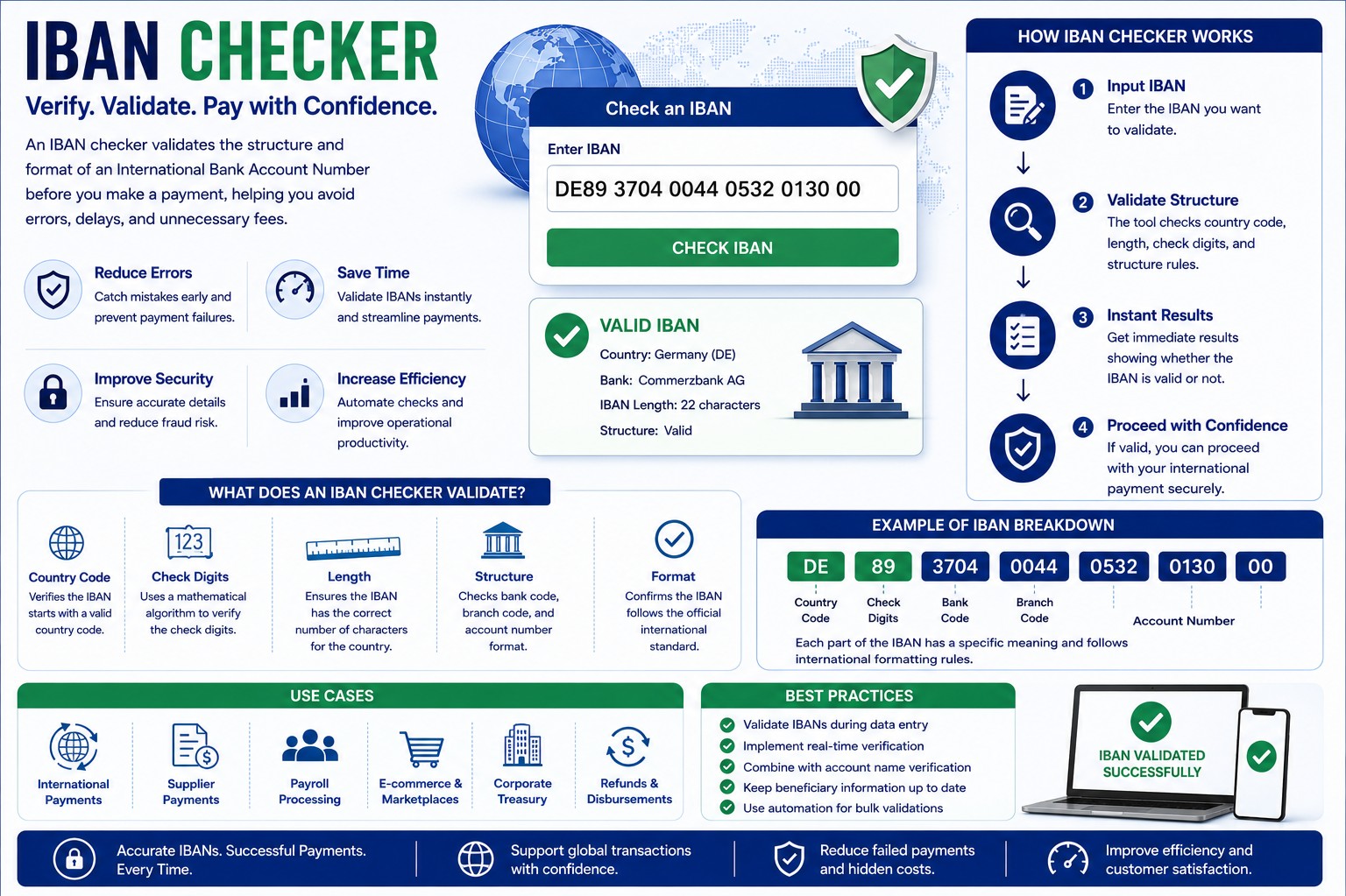
An IBAN checker is a validation tool designed to verify whether an International Bank Account Number follows the correct format and structure required by international banking standards.
The tool analyzes an IBAN to ensure it contains:
- A valid country code
- Correct check digits
- Appropriate bank identifiers
- Proper account structure
- The correct number of characters for the issuing country
An IBAN checker does not typically verify account ownership or account balances. Instead, it confirms that the account number is structured correctly according to official IBAN standards.
This validation helps reduce payment errors before funds are transferred.
Understanding the Importance of IBAN Validation
International payments involve multiple financial institutions, payment networks, and regulatory requirements.
When account details are entered incorrectly, transactions may be rejected or delayed. In some cases, funds may require manual investigation before they can be recovered.
IBAN validation helps prevent these issues by identifying formatting errors before payment instructions are submitted.
For businesses processing large transaction volumes, even a small reduction in payment failures can result in significant operational savings and improved customer satisfaction.
Accurate payment information remains one of the most important foundations of efficient banking operations.
How an IBAN Checker Works
Every IBAN follows a standardized international format.
An IBAN checker uses mathematical validation algorithms to analyze the account number and confirm that it complies with the required structure.
The validation process typically includes:
Country Code Verification
The checker confirms that the IBAN begins with a valid country code recognized within the international banking system.
Length Validation
Each participating country has a specific IBAN length. The tool verifies that the submitted IBAN contains the correct number of characters.
Check Digit Validation
Check digits serve as an error-detection mechanism. The IBAN checker performs calculations to confirm these digits are valid.
Structure Analysis
The tool reviews bank identifiers, branch information, and account components according to country-specific formatting rules.
If any element fails validation, the system flags the IBAN as potentially incorrect.
Benefits of Using an IBAN Checker
Organizations and individuals can gain numerous advantages from IBAN verification.
One of the most significant benefits is the reduction of payment errors. Incorrect account details can create delays, increase costs, and require manual intervention.
An IBAN checker improves accuracy by identifying issues before transactions are submitted.
Additional benefits include:
- Faster payment processing
- Reduced transaction failures
- Improved operational efficiency
- Lower administrative costs
- Enhanced customer experience
- Better compliance support
- Increased payment accuracy
These advantages make IBAN validation a valuable component of modern payment operations.
IBAN Checkers and Business Payments
Businesses that process international transactions frequently rely on IBAN validation tools.
Organizations managing supplier payments, employee payroll, customer refunds, and cross-border settlements often handle thousands of account records.
Manual verification can be time-consuming and prone to human error.
By integrating an IBAN checker into payment workflows, businesses can automate validation processes and improve overall payment reliability.
This automation becomes particularly valuable for multinational companies operating across multiple jurisdictions.
Supporting SEPA Payments
The Single Euro Payments Area (SEPA) relies heavily on IBANs for payment processing.
SEPA enables euro-denominated payments to move efficiently between participating countries using standardized banking information.
An IBAN checker helps ensure that account details submitted within the SEPA framework are valid and correctly formatted.
Accurate IBAN validation supports smoother payment execution and reduces the risk of rejected transactions.
As SEPA payment volumes continue to grow, validation tools play an increasingly important role in maintaining operational efficiency.
Reducing Payment Fraud Risks
While an IBAN checker is not a dedicated fraud prevention solution, it contributes to payment security.
Fraudulent or incorrect account details may be identified during the validation process if they fail structural verification.
Organizations can combine IBAN validation with additional security measures such as:
- Account ownership verification
- Beneficiary screening
- Transaction monitoring
- Anti-money laundering controls
- Know-your-customer procedures
Together, these safeguards create a stronger payment security framework.
IBAN Checkers in Digital Banking
Digital banking platforms increasingly incorporate IBAN validation as part of their customer onboarding and payment workflows.
When users enter account information, automated validation can immediately identify errors and request corrections.
This improves user experiences while reducing payment processing issues.
Fintech companies, payment service providers, and digital banks use IBAN checkers extensively to support automated financial services and improve transaction success rates.
As digital banking adoption continues to accelerate, validation technologies are becoming increasingly important.
Compliance and Regulatory Considerations
Financial institutions operate within strict regulatory environments.
Accurate payment information supports compliance with anti-money laundering requirements, transaction monitoring obligations, and financial reporting standards.
Although an IBAN checker does not replace compliance controls, it helps improve data quality throughout payment systems.
Higher-quality payment data contributes to better operational oversight and more effective regulatory compliance processes.
For financial institutions handling large transaction volumes, maintaining accurate account information is a critical operational priority.
Challenges and Limitations
While IBAN checkers provide significant benefits, they do have limitations.
A valid IBAN does not guarantee that the account is active or belongs to the intended recipient.
The checker confirms only that the account structure complies with official formatting standards.
Organizations processing high-value payments often require additional verification measures to confirm beneficiary details and account ownership.
Therefore, IBAN validation should be viewed as one component of a broader payment verification strategy.
The Future of IBAN Verification
As global payment systems become increasingly digital, demand for automated validation solutions will continue to grow.
Artificial intelligence, machine learning, and advanced payment technologies are expected to enhance verification capabilities further.
Future IBAN checkers may integrate directly with real-time payment networks, open banking platforms, and digital identity systems.
These innovations could improve payment accuracy, reduce fraud risks, and streamline international banking operations even further.
As cross-border commerce expands, robust verification tools will remain essential to payment efficiency.
Conclusion
An IBAN checker is a valuable tool that helps businesses, financial institutions, and consumers verify bank account information before processing international payments. By validating account structures, reducing errors, and supporting operational efficiency, IBAN checkers contribute significantly to modern payment infrastructure.
As global banking becomes increasingly interconnected, accurate payment information is more important than ever. Organizations that implement reliable IBAN validation processes can reduce transaction failures, improve customer experiences, strengthen compliance efforts, and support seamless cross-border financial operations.
In a world driven by digital payments and international commerce, IBAN checkers have become an indispensable part of secure and efficient banking.
Comments
No comments yet. Be the first to share your thoughts.
Leave a comment