
Introduction
In today’s global economy, businesses are increasingly operating across multiple countries, serving international customers, managing remote workforces, and collaborating with suppliers worldwide. As companies expand beyond domestic markets, the ability to send money efficiently across borders has become a critical business requirement.This is where cross-border payouts play a vital role.
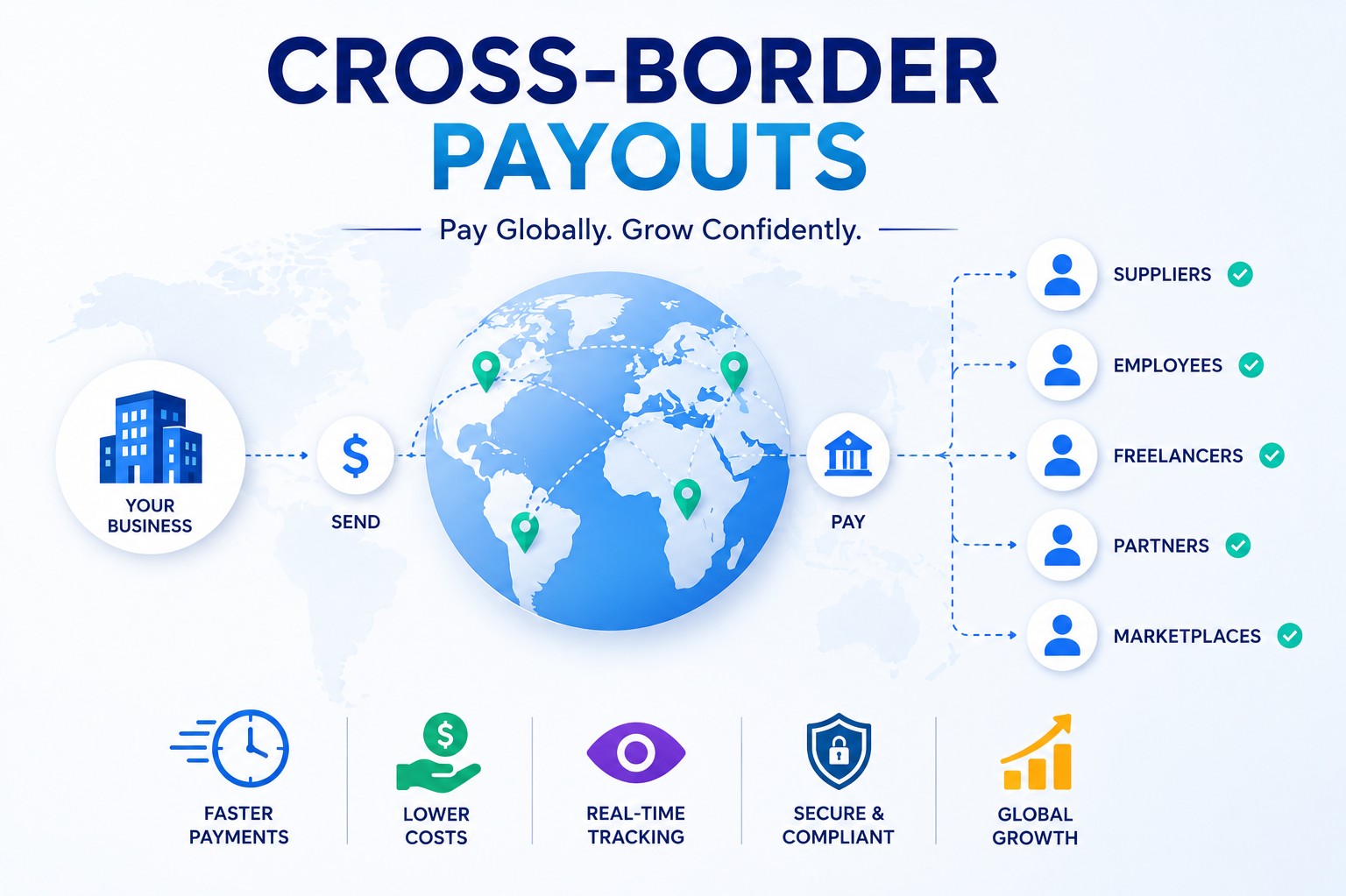
Cross-border payouts refer to the transfer of funds from a business or organization to recipients located in different countries. These payouts can include supplier payments, freelancer compensation, employee salaries, marketplace settlements, affiliate commissions, insurance claims, and customer refunds.
Traditionally, international payouts have been associated with high fees, lengthy settlement times, limited transparency, and complex banking processes. However, advancements in fintech, real-time payment infrastructure, digital wallets, Virtual IBANs, and blockchain technology are transforming how businesses manage global disbursements.
Today, cross-border payouts are becoming faster, more transparent, and more cost-effective, helping organizations operate efficiently in an increasingly interconnected world.
What Are Cross-Border Payouts?
Cross-border payouts involve sending funds from one country to recipients in another country.
Unlike consumer remittances, cross-border payouts are typically business-driven transactions that support commercial operations and financial obligations.
Common examples include:
- Paying international suppliers
- Distributing marketplace earnings
- Freelancer and contractor payments
- Global payroll processing
- Affiliate commission payouts
- Insurance settlements
- Customer refunds
- Vendor payments
These transactions often involve multiple currencies, financial institutions, and regulatory requirements.
Why Cross-Border Payouts Matter
Global business growth depends on the ability to move money efficiently.
Companies need reliable payout solutions to:
- Support international expansion
- Strengthen supplier relationships
- Pay global workforces
- Improve customer experiences
- Enhance operational efficiency
- Manage international cash flow
Delayed or expensive payouts can negatively impact business relationships and operational performance.
Efficient payout infrastructure helps organizations remain competitive in global markets.
Challenges in Traditional Cross-Border Payouts
Although international payments have existed for decades, traditional payout methods still present several challenges.
High Transaction Costs
Cross-border transactions often involve:
- Wire transfer fees
- Correspondent banking charges
- Foreign exchange costs
- Processing fees
These expenses can significantly increase operational costs, especially for businesses making frequent international payments.
Slow Settlement Times
Traditional international transfers may take several business days to reach recipients.
Delays often occur due to:
- Multiple intermediary banks
- Banking cut-off times
- Regulatory reviews
- Currency conversion processes
Slow settlements can disrupt cash flow and create uncertainty.
Limited Transparency
Businesses frequently struggle to track international payments throughout the transaction lifecycle.
This lack of visibility can lead to:
- Payment status uncertainty
- Increased support inquiries
- Reconciliation challenges
Currency Conversion Complexity
Managing multiple currencies introduces exchange rate risks and additional costs.
Fluctuating rates can impact payment values and profitability.
Regulatory Compliance
Cross-border payouts must comply with various regulations, including:
- Anti-Money Laundering (AML)
- Know Your Customer (KYC)
- Sanctions screening
- Tax reporting requirements
Compliance adds complexity to international payment operations.
How Modern Cross-Border Payouts Work
Modern payout solutions leverage advanced technology to streamline international money movement.
A typical payout process includes:
Payment Initiation
The business submits payout instructions through a payment platform or API.
Validation and Compliance Checks
Recipient information is verified, and compliance screenings are performed.
Currency Conversion
If necessary, funds are converted into the recipient’s preferred currency.
Payment Routing
The system identifies the most efficient payout route.
Settlement
Funds are delivered through local banking networks, digital wallets, or alternative payment methods.
Reporting
Businesses receive transaction status updates and settlement confirmations.
This automated process improves speed, accuracy, and transparency.
Popular Cross-Border Payout Methods
Bank Transfers
Bank transfers remain one of the most widely used payout methods.
They offer broad global reach but may involve higher costs and longer settlement times.
Local Bank Transfers
Many payout providers leverage local banking networks to improve efficiency and reduce fees.
This approach often delivers faster payouts than traditional international wires.
Digital Wallets
Recipients can receive funds through digital wallets, providing convenient access to money without relying solely on bank accounts.
Virtual IBAN Infrastructure
Virtual IBANs simplify international payment collection and distribution by creating localized payment experiences while maintaining centralized account management.
Real-Time Payment Networks
Instant payment systems are enabling faster international payouts through interconnected payment rails.
Stablecoin and Blockchain-Based Payouts
Some organizations are exploring blockchain technology and stablecoins to facilitate faster global settlements.
These solutions can reduce intermediary involvement and improve transaction efficiency.
Benefits of Modern Cross-Border Payout Solutions
Faster Payments
Advanced payout platforms significantly reduce settlement times.
Businesses can deliver funds to recipients within hours or even minutes in some payment corridors.
Reduced Costs
Optimized routing and local payment infrastructure help minimize transaction fees and foreign exchange expenses.
Improved Transparency
Real-time tracking provides visibility into payment status and processing timelines.
Better Recipient Experience
Recipients benefit from faster access to funds and greater flexibility in receiving payments.
Automation and Scalability
Businesses can automate large-scale payout operations, reducing manual workloads and operational risks.
Industries Driving Cross-Border Payout Growth
E-Commerce
Online marketplaces distribute funds to sellers operating in multiple countries.
Gig Economy Platforms
Freelancers and contractors require efficient international payment solutions.
Travel and Hospitality
Travel companies frequently process international refunds, commissions, and supplier payments.
Financial Services
Fintech companies and payment providers facilitate global fund transfers for businesses and consumers.
Technology Companies
Software and SaaS providers often manage international partner and affiliate payout programs.
The Role of Artificial Intelligence
AI is increasingly improving cross-border payout operations.
AI-powered systems help organizations:
- Detect fraudulent transactions
- Monitor compliance risks
- Optimize payment routing
- Predict settlement delays
- Improve foreign exchange management
These capabilities enhance both efficiency and security.
Regulatory Considerations
Cross-border payouts operate within a complex regulatory environment.
Businesses must ensure compliance with:
- AML regulations
- KYC requirements
- Data protection laws
- International sanctions
- Tax reporting obligations
Working with regulated payment providers helps reduce compliance risks.
Future Trends in Cross-Border Payouts
Real-Time Global Payments
The industry is moving toward instant international transactions supported by interconnected payment networks.
Embedded Finance
Businesses are integrating payout capabilities directly into software platforms and applications.
Stablecoin Adoption
Stablecoins are gaining attention as a mechanism for faster and more efficient global settlements.
Open Banking Integration
Open banking is improving connectivity between financial institutions and payment providers.
AI-Powered Automation
Artificial intelligence will continue enhancing fraud detection, compliance monitoring, and payout optimization.
Conclusion
Cross-border payouts have become a fundamental component of global business operations. As organizations expand internationally, the need for fast, transparent, and cost-effective payout solutions continues to grow.
Modern technologies such as Virtual IBANs, real-time payment networks, AI-powered payment platforms, and blockchain-based infrastructure are transforming international disbursements and eliminating many of the inefficiencies associated with traditional payment methods.
Businesses that invest in modern cross-border payout solutions can improve operational efficiency, reduce costs, strengthen global relationships, and deliver better experiences for employees, suppliers, partners, and customers. In an increasingly connected world, efficient cross-border payouts are no longer just a convenience they are a strategic business advantage.
Comments
No comments yet. Be the first to share your thoughts.
Leave a comment