
Introduction
As businesses expand across borders, managing international payments becomes increasingly complex. Companies must receive customer payments from different countries, pay overseas suppliers, handle multiple currencies, and maintain transparent financial records. Traditional banking systems often make these tasks expensive and time-consuming due to multiple intermediaries, varying payment standards, and lengthy settlement times.To address these challenges, many businesses are adopting Dedicated IBAN Setup solutions. A dedicated International Bank Account Number (IBAN) gives a business its own unique account identifier for receiving and sending payments. Unlike shared collection accounts, a dedicated IBAN belongs specifically to one customer or business, making payment tracking, reconciliation, and financial management much simpler.
Whether you are an e-commerce company, SaaS provider, marketplace, importer, exporter, or multinational enterprise, a dedicated IBAN can improve payment efficiency while supporting global business growth.
What Is a Dedicated IBAN?
A Dedicated IBAN is a unique International Bank Account Number assigned exclusively to a single individual or business. It allows payments to be received directly into a designated account rather than through a shared banking arrangement.
Each dedicated IBAN is linked to one account holder, providing greater transparency and ownership over incoming and outgoing transactions.
Businesses can use dedicated IBANs to receive domestic and international payments, collect customer funds, pay suppliers, and manage financial operations more efficiently.
Unlike pooled accounts, every transaction is automatically associated with the correct account holder, reducing reconciliation challenges.
Why Businesses Choose Dedicated IBAN Setup
As businesses grow internationally, managing payments across multiple countries becomes increasingly difficult.
Dedicated IBANs simplify this process by providing businesses with identifiable bank account details that customers and partners can use for payments. This creates a more professional payment experience while reducing manual administration.
Businesses also benefit from improved financial visibility, faster reconciliation, simplified accounting, and better control over incoming funds.
For organizations processing large payment volumes, dedicated IBANs significantly improve operational efficiency.
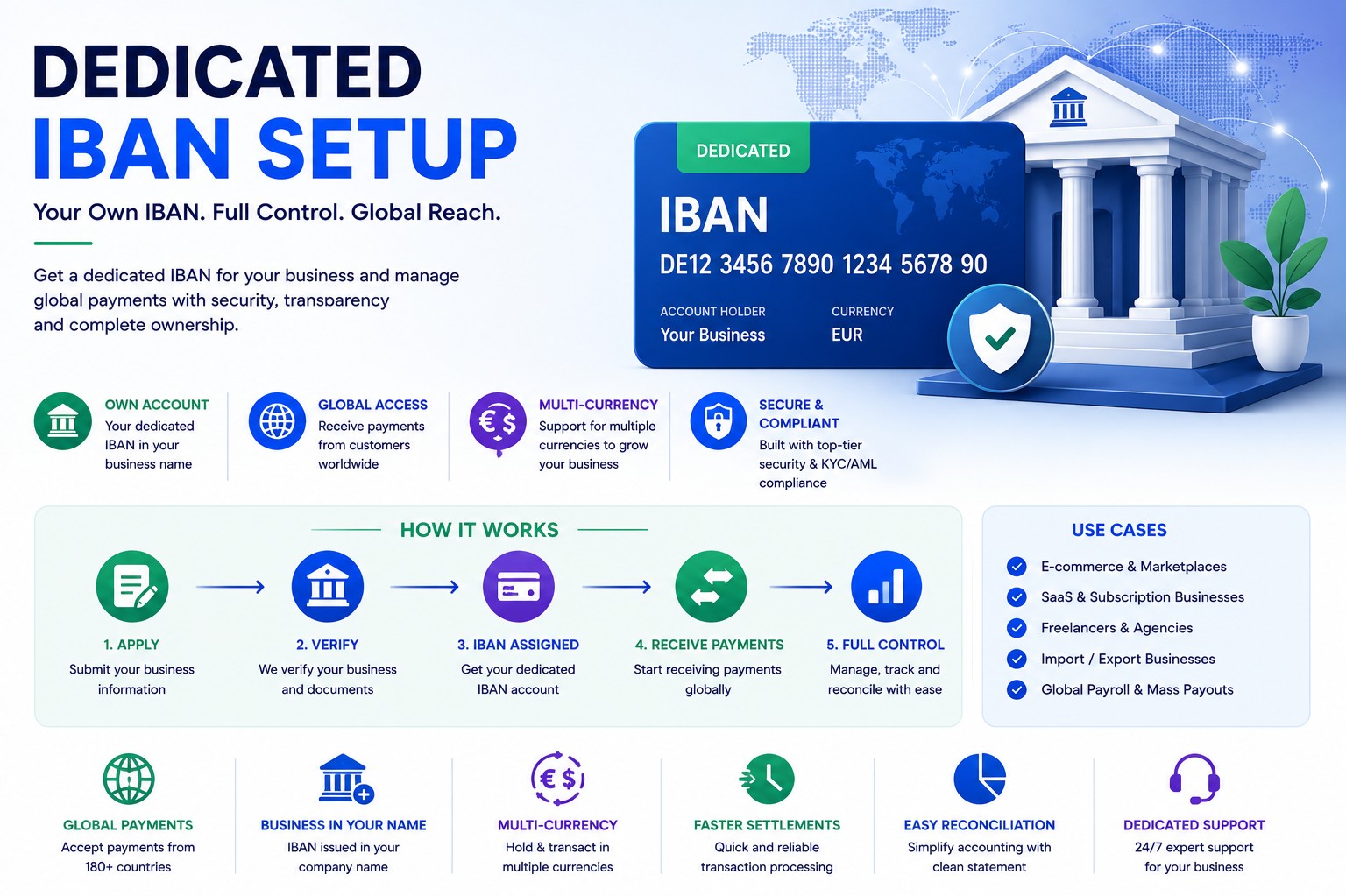
How Dedicated IBAN Setup Works
The setup process begins when a business applies through a financial institution or fintech provider offering dedicated IBAN services.
During onboarding, the provider verifies the company’s identity, ownership structure, and regulatory documentation through Know Your Customer (KYC) and Anti-Money Laundering (AML) procedures.
Once approved, the business receives its own dedicated IBAN, which can then be shared with customers, suppliers, and business partners.
Payments sent to this IBAN are automatically credited to the assigned account, enabling accurate payment tracking and reconciliation.
Many providers also offer online dashboards and APIs that allow businesses to monitor transactions in real time.
Key Features of Dedicated IBANs
Dedicated IBAN solutions provide several features designed to support modern business banking.
Businesses receive unique account identifiers that improve payment accuracy and simplify customer collections. Many providers also support multiple currencies, allowing companies to receive payments from international customers without maintaining separate banking relationships in every country.
Integration with payment platforms, accounting software, and ERP systems further enhances operational efficiency by automating financial workflows.
Real-time transaction reporting gives finance teams better visibility into cash flow and account activity.
Benefits of Dedicated IBAN Setup
One of the biggest advantages of a dedicated IBAN is simplified payment reconciliation. Since every payment arrives through a unique account number assigned to a specific business, matching incoming transactions becomes much easier.
Dedicated IBANs also improve customer confidence by providing professional banking details that clearly identify the payment recipient.
Businesses benefit from faster collections, improved cash flow visibility, lower administrative costs, and more accurate financial reporting.
As payment volumes increase, these efficiencies become even more valuable.
Dedicated IBAN vs Shared IBAN
Although both options support payment collection, they operate differently.
A shared IBAN is used by multiple customers or businesses, requiring payment references or virtual account identifiers to distinguish transactions.
A dedicated IBAN belongs exclusively to one account holder, making payment identification straightforward and reducing reconciliation complexity.
For businesses processing frequent international payments, dedicated IBANs typically provide greater transparency and operational efficiency.
Multi-Currency Capabilities
Many dedicated IBAN providers offer multi-currency functionality, enabling businesses to receive and hold funds in various currencies.
This reduces foreign exchange complexity while allowing organizations to serve international customers more effectively.
Businesses can often convert currencies when needed or maintain balances in multiple currencies depending on their operational requirements.
Multi-currency support is particularly valuable for exporters, marketplaces, SaaS companies, and multinational organizations.
Cross-Border Payment Benefits
Dedicated IBANs simplify international transactions by providing standardized banking details recognized across participating countries.
Businesses can receive customer payments more efficiently, reduce transfer delays, and improve payment transparency.
Cross-border collections also become easier because customers can send funds using familiar banking infrastructure.
Combined with modern payment networks, dedicated IBANs contribute to faster and more reliable global payment experiences.
Security and Compliance
Financial institutions offering dedicated IBAN services maintain strict security and regulatory standards.
Customer verification procedures, transaction monitoring, encryption, and fraud prevention technologies help protect both businesses and their customers.
Providers also comply with AML, KYC, sanctions screening, and applicable financial regulations.
These safeguards support secure payment processing while maintaining regulatory compliance across international markets.
Integration with Business Systems
Modern dedicated IBAN solutions integrate easily with accounting software, ERP platforms, treasury management systems, and payment gateways.
Through APIs, businesses can automate payment reconciliation, transaction reporting, account management, and financial workflows.
Automation reduces manual data entry while improving reporting accuracy and operational efficiency.
Integrated financial ecosystems help organizations scale their operations without increasing administrative complexity.
Who Should Use a Dedicated IBAN?
Dedicated IBANs are suitable for a wide range of businesses that receive or send international payments.
E-commerce companies use them to collect payments from global customers. SaaS providers manage subscription collections more efficiently, while marketplaces simplify merchant settlements.
Importers, exporters, logistics companies, freelancers, digital agencies, and multinational corporations also benefit from dedicated IBAN infrastructure.
Any business handling regular cross-border transactions can improve efficiency through dedicated account management.
Challenges to Consider
Although dedicated IBANs provide many advantages, businesses should evaluate provider capabilities carefully.
Availability varies by country and financial institution. Some providers offer dedicated IBANs only in selected jurisdictions or currencies.
Businesses should also understand account fees, foreign exchange costs, API capabilities, compliance requirements, and customer support before selecting a provider.
Choosing the right financial partner ensures long-term operational success.
Future of Dedicated IBAN Solutions
The future of dedicated IBAN services is closely linked with Open Banking, embedded finance, and API-driven banking infrastructure.
Businesses increasingly expect real-time payments, automated reconciliation, virtual account management, and seamless ERP integration.
Artificial intelligence is also enhancing fraud detection, payment monitoring, and financial analytics.
As digital banking continues evolving, dedicated IBAN solutions will become even more flexible, scalable, and globally connected.
Conclusion
A Dedicated IBAN Setup provides businesses with a secure and efficient way to manage international payments. By assigning a unique IBAN to a single account holder, organizations gain greater payment transparency, simplified reconciliation, faster collections, and stronger financial control.
Whether supporting global e-commerce, subscription billing, supplier payments, or international expansion, dedicated IBANs help businesses streamline operations while improving customer confidence.
As cross-border commerce and digital banking continue to grow, dedicated IBAN solutions will remain an essential component of modern financial infrastructure, enabling businesses to operate more efficiently in an increasingly connected global economy.
Comments
No comments yet. Be the first to share your thoughts.
Leave a comment