
Introduction
The financial services industry has undergone a remarkable digital transformation over the past decade. Consumers now expect banking experiences that are fast, personalized, and seamlessly integrated into their everyday digital lives. Traditional banking systems, which were once isolated and difficult to integrate with external applications, are evolving into open ecosystems that encourage innovation and collaboration. At the center of this transformation is the Open Banking APIs.
Open Banking APIs allow banks to securely share financial data and payment capabilities with authorized third-party providers after receiving customer consent. Instead of relying on outdated manual processes or proprietary integrations, businesses and fintech companies can connect directly with banking systems through standardized APIs.
From payment initiation and account aggregation to budgeting apps and lending platforms, Open Banking APIs are enabling a new generation of financial products and services. As adoption grows across the globe, these APIs are becoming the foundation of modern digital banking.
What Is an Open Banking API?
An Open Banking API (Application Programming Interface) is a secure digital interface that enables authorized third-party applications to access banking services and customer financial data with explicit customer consent.
Rather than giving external providers unrestricted access to banking systems, APIs provide controlled communication channels that allow approved applications to retrieve information or initiate payments safely.
Depending on the regulatory framework and bank capabilities, Open Banking APIs can support services such as account information access, payment initiation, transaction history retrieval, balance inquiries, and identity verification.
This secure connectivity encourages innovation while allowing customers to remain in control of their financial information.
How Open Banking APIs Work
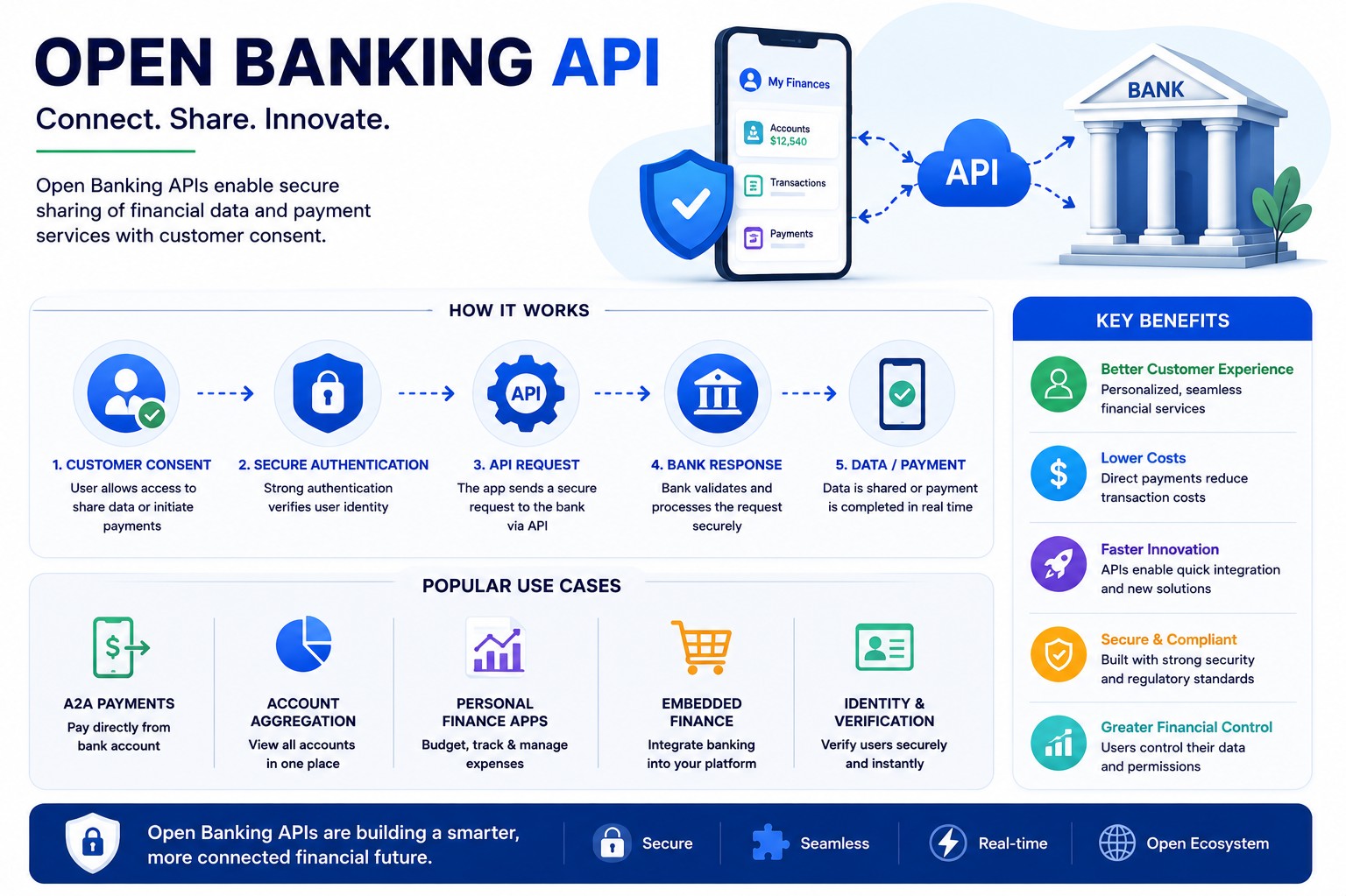
The Open Banking process begins when a customer grants permission for an authorized application to access specific banking data or initiate payments.
After consent is provided, the application communicates with the bank through standardized APIs. The bank authenticates the request, verifies permissions, and securely exchanges the requested information or processes the payment instruction.
Throughout the process, authentication protocols, encryption, and security standards help protect customer information and prevent unauthorized access.
The result is a seamless digital experience where financial services can be integrated into various applications without compromising security.
Why Open Banking APIs Matter
Open Banking APIs are reshaping financial services by making banking infrastructure more accessible.
Traditionally, banks controlled nearly all financial products and customer interactions. Today, APIs allow fintech companies, payment providers, retailers, and software developers to build innovative services on top of existing banking infrastructure.
Consumers benefit from greater choice, improved financial visibility, and more personalized digital experiences. Businesses gain access to faster payment methods, automated financial processes, and new opportunities for innovation.
This collaborative approach is driving competition and accelerating digital transformation across the banking industry.
Key Features of Open Banking APIs
Open Banking APIs support a wide range of financial capabilities.
One of the most important functions is Account Information Services (AIS), which allow authorized applications to retrieve account balances, transaction histories, and financial data.
Another major capability is Payment Initiation Services (PIS), enabling customers to make direct account-to-account payments without relying on traditional card networks.
Many APIs also support identity verification, customer authentication, transaction notifications, and consent management.
These capabilities enable businesses to develop integrated financial experiences while maintaining high security standards.
Benefits for Consumers
Consumers are among the biggest beneficiaries of Open Banking APIs.
Users can connect multiple bank accounts to a single financial management application, giving them a comprehensive view of their finances. Budgeting tools can automatically categorize expenses, monitor spending patterns, and provide personalized financial insights.
Open Banking also simplifies payments by allowing secure bank-to-bank transfers directly from customer accounts.
Perhaps most importantly, consumers retain control over their data by deciding which applications can access their financial information and for how long.
Benefits for Businesses
Businesses are increasingly adopting Open Banking APIs to improve operational efficiency and customer experiences.
Payment initiation APIs reduce dependence on traditional card networks, lowering transaction costs and improving settlement times. Financial data APIs simplify accounting, reconciliation, lending decisions, and cash flow management.
Companies can also integrate banking services directly into their digital platforms, creating seamless user experiences without requiring customers to switch between multiple applications.
These efficiencies support business growth while reducing operational complexity.
Open Banking APIs and Embedded Finance
Embedded finance has become one of the fastest-growing applications of Open Banking APIs.
Businesses can integrate banking capabilities such as payments, lending, account verification, and financial management directly into non-financial platforms.
For example, e-commerce platforms can initiate direct bank payments, accounting software can reconcile transactions automatically, and marketplaces can streamline seller onboarding using banking APIs.
This integration creates frictionless financial experiences while opening new revenue opportunities for businesses.
Open Banking APIs and A2A Payments
Account-to-Account (A2A) payments are one of the most impactful use cases for Open Banking APIs.
Instead of processing transactions through card networks, customers can authorize direct bank transfers using secure API connections.
A2A payments often reduce transaction fees, improve payment speed, and lower fraud risks because customers authenticate directly with their banks.
As real-time payment infrastructure expands globally, Open Banking APIs are expected to accelerate A2A payment adoption across multiple industries.
Security in Open Banking APIs
Security is fundamental to Open Banking.
Banks and API providers use encryption, tokenization, secure authentication protocols, and strong customer authentication (SCA) to protect sensitive financial information.
Customer consent is central to every interaction. Users must explicitly authorize data sharing, and permissions can generally be revoked at any time.
Continuous monitoring, fraud detection systems, and API security frameworks further strengthen protection against cyber threats.
These measures help ensure that innovation does not compromise financial security.
Compliance and Regulatory Frameworks
Open Banking is supported by regulatory initiatives in many countries.
In Europe, the Payment Services Directive 2 (PSD2) established requirements for banks to provide secure API access to licensed third-party providers. Similar Open Banking frameworks have emerged in regions including the United Kingdom, Australia, Brazil, and parts of Asia.
Financial institutions must comply with regulations covering customer authentication, data privacy, cybersecurity, consent management, and licensing requirements.
Compliance ensures that Open Banking ecosystems remain secure, transparent, and trustworthy.
Challenges of Open Banking APIs
Despite their significant advantages, Open Banking APIs present several challenges.
API standardization remains inconsistent across different regions and financial institutions. Integration complexity may vary depending on banking infrastructure and technical maturity.
Consumer awareness is another challenge, as many users remain unfamiliar with Open Banking and data-sharing permissions.
Cybersecurity also requires ongoing attention as financial ecosystems become increasingly interconnected.
Addressing these challenges will be critical for continued industry growth.
Artificial Intelligence and Open Banking
Artificial intelligence is enhancing Open Banking capabilities by analyzing financial data more effectively.
AI-powered applications can generate personalized financial recommendations, detect fraudulent activity, automate lending decisions, and improve customer support.
Machine learning algorithms also help optimize payment routing, identify unusual account activity, and improve risk assessment.
As AI technologies mature, they will significantly increase the value generated through Open Banking APIs.
Future Trends in Open Banking APIs
Open Banking is evolving into the broader concept of Open Finance, where APIs extend beyond banking to include investments, insurance, pensions, and other financial services.
Embedded finance will continue integrating banking capabilities into everyday digital experiences. Real-time payments, AI-driven financial assistants, and programmable banking services will further transform how businesses and consumers interact with financial institutions.
API-first banking strategies are also becoming increasingly common as banks modernize legacy infrastructure.
These developments will create more connected, intelligent, and customer-centric financial ecosystems.
Conclusion
Open Banking APIs have become one of the most important drivers of financial innovation. By enabling secure data sharing and direct access to banking services, they are creating new opportunities for fintech companies, businesses, banks, and consumers alike.
From payment initiation and account aggregation to embedded finance and AI-powered financial services, Open Banking APIs are transforming the way financial products are developed and delivered.
As adoption continues to grow and Open Finance expands globally, organizations that embrace Open Banking APIs will be better positioned to deliver innovative customer experiences, improve operational efficiency, and compete in the rapidly evolving digital economy.
Comments
No comments yet. Be the first to share your thoughts.
Leave a comment