
TL;DR
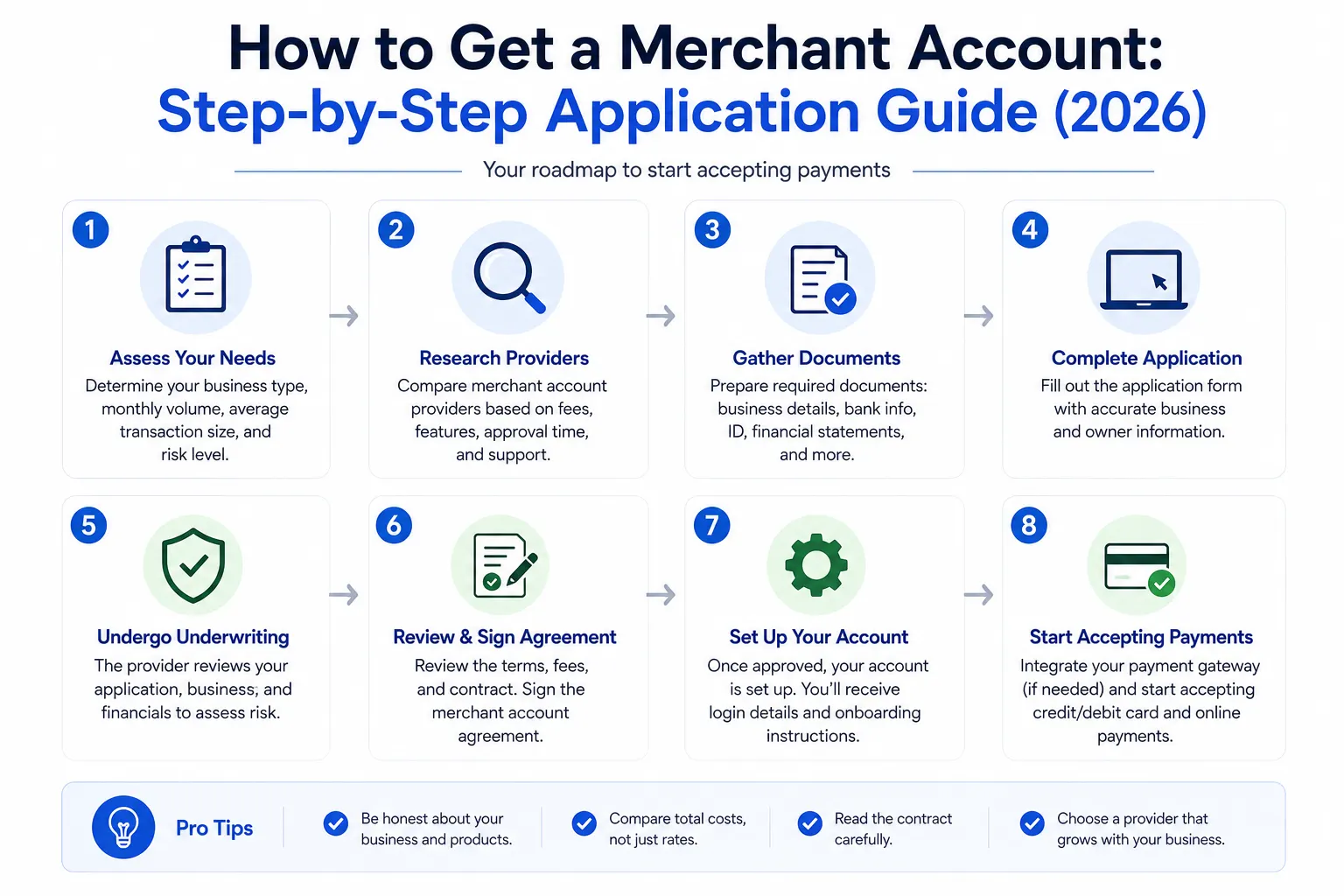
- Getting a merchant account involves six steps: classifying your risk profile, preparing documents, choosing the right provider type, submitting the application, clearing underwriting, and setting up your payment gateway integration.
- Incomplete documentation is the single biggest cause of rejected applications, cited in 38% of rejections in 2026, ahead of high chargeback ratios (27%) and MATCH list flags (19%).
- Standard merchant accounts are approved in 3-7 days on average. High-risk merchant accounts take 7-21 days. Offshore high-risk accounts average 19 days due to added compliance checks.
- High-risk merchants who apply to standard PayFac platforms waste underwriting time and risk a MATCH list flag if the account is later terminated, apply to a specialist high-risk provider from the start.
- In 2026, Visa VAMP and Mastercard CE3.0 compliance tooling has become part of the underwriting conversation for high-risk accounts, demonstrating it proactively improves approval odds and reserve terms.
Before You Apply: Understanding What Underwriters Actually Evaluate
Applying for a merchant account is not like signing up for a payment wallet or a PayFac platform, there is a human underwriting decision behind every application, and underwriters are assessing financial risk, not just identity. They want to know: if this merchant generates chargebacks they can’t cover, how exposed is the acquirer?
That framing shapes everything. A clean application isn’t just one with complete paperwork, it’s one that makes the risk picture legible and reassuring. Merchants who understand what underwriters are looking for prepare differently, and they get better terms.
The five things every underwriter evaluates, regardless of account type, are industry classification (your MCC), monthly processing volume and average ticket size, chargeback history from any prior processing, personal and business credit profile, and the clarity and verifiability of your business model. High-risk merchant accounts add two more layers: the acquirer’s own risk appetite for your specific MCC, and whether you can demonstrate active chargeback and fraud management tooling.
Classify Your Risk Profile and Choose Your Account Type
This is the step most merchants skip, and it creates the most problems downstream. Applying to the wrong provider type wastes time, triggers unnecessary credit pulls, and, in the worst case, results in account termination and a MATCH list flag that follows the business for five years.
Identify your Merchant Category Code before contacting any provider. Your MCC determines your risk tier more than any other single factor. If your business is in retail e-commerce, SaaS, or professional services, you’re in standard territory. If you’re in iGaming, adult content, forex, nutraceuticals, CBD, MLM, subscription billing with a high refund rate, or firearms, you need a specialist high-risk merchant account, not a standard one.
Merchant Account Types: Quick Comparison
| Account Type | Approval | Pricing Model | Best For | Volume Fit | High-Risk Suitable |
|---|---|---|---|---|---|
| PayFac / Aggregator | Same-day | Flat-rate blended (e.g. 2.9% + $0.30) | Early-stage, standard-risk merchants | Below ~$50K/mo | ✗ No |
| Dedicated Standard | 3-7 days | Interchange-plus available; contractual protections | Established standard-risk merchants stepping up from PayFac | Above $100K/mo | ✗ No |
| High-Risk Dedicated | 7-21 days | 3-7% per transaction; rolling reserve 5-15% for 90–180 days | Elevated-risk MCCs, only appropriate path regardless of volume | Any volume | ✓ Yes |
| Offshore High-Risk | 14-21+ days | Higher rates + compliance and FX costs; multi-currency settlement available | High-risk merchants declined domestically or requiring cross-border multi-currency settlement | Any volume | ✓ Yes |
Prepare Your Document Package
Incomplete documentation causes more rejections than any other single factor, 38% of all application rejections in 2026 cite missing or insufficient paperwork. Preparing a complete, organized document package before submitting is the highest-leverage thing an applicant can do.
Standard merchant account – required documents:
- Government-issued photo ID for all beneficial owners (25%+ ownership stake)
- Business registration certificate or Articles of Incorporation
- Employer Identification Number (EIN) or equivalent tax registration
- 3 months of business bank statements
- Voided business check or bank letter confirming account details
- Business website URL with visible refund/returns policy, contact information, and product descriptions
Additional documents for high-risk merchant accounts:
- 6 months of business bank statements (not 3)
- 3-6 months of prior processing statements if available, showing transaction volume and chargeback ratio
- Detailed business model description, including fulfillment timelines, subscription terms, and refund policy
- Certificate of PCI DSS compliance or SAQ completion
- Proof of 3DS2 authentication capability on the payment gateway
- If chargeback ratio has been elevated: a chargeback remediation plan with specific measures already implemented
For cross-border payment operations: If you’re applying for multi-currency or international processing capability, also prepare evidence of legal business registration in your primary trading jurisdictions and any licenses required to operate in regulated markets (gaming licenses, financial services licenses, etc.).
One additional document worth preparing proactively is a clear explanation of any gaps in processing history. If there was a period where the business didn’t process, due to a prior account termination, a business model pivot, or a platform migration, underwriters will ask. Having a written explanation ready prevents a hold on the application while you scramble to respond.
Choose the Right Provider and Application Channel
With your risk classification confirmed and documents ready, shortlist providers appropriate to your account type and submit your application through their preferred channel.
For standard merchant accounts, most full-stack acquirers offer a direct online application portal. Larger merchants ($300K+/month) are often better served by making initial contact through the provider’s sales channel to negotiate terms before formal underwriting begins, this is particularly true for interchange-plus pricing, rolling reserve terms, and settlement speed.
For high-risk merchant accounts, the application process typically begins with a pre-screening call or inquiry form rather than a direct online submission. Providers use this to assess fit before pulling credit and running a formal underwriting process. Skipping this step and submitting a cold application package often results in the application sitting in queue for days before being routed correctly.
When shortlisting providers, verify these four things before submitting any application. First, confirm the provider holds their own acquiring license rather than operating as an ISO reselling another bank’s BIN, direct acquirers offer greater stability. Second, confirm they actively underwrite your specific MCC, some high-risk providers specialize narrowly (iGaming only, or nutraceuticals only) and will decline adjacent industries. Third, for high-risk applicants in 2026, confirm the provider has built-in VAMP monitoring and pre-chargeback alert integration (Ethoca or Verifi), these are now compliance requirements, not optional add-ons. Fourth, request a reference from at least two merchants in your same MCC who have processed with them for 12 months or more.
Submit the Application
The application itself asks for the information in your document package, plus a description of your business model, your projected monthly volume, and your average transaction size. Answer every field completely, partial information delays underwriting. Vague answers to the business model question are one of the most common causes of clarification requests that extend the timeline by days.
If the provider offers a dedicated application support contact, use them. High-risk applications in particular benefit from a human point of contact who can flag potential issues before they become formal declines.
Once submitted, most providers acknowledge receipt within one business day and provide a timeline estimate for underwriting completion. For standard accounts, this estimate is usually reliable. For high-risk accounts, treat the stated timeline as an optimistic baseline, it assumes no clarification requests, no documentation gaps, and no extended credit review.
Navigate the Underwriting Review
This is the stage where most delays occur and where proactive communication pays off. Underwriters may request:
- Additional documentation to verify the business address, website ownership, or corporate structure
- A personal credit check on beneficial owners (common for businesses with less than 2 years of trading history)
- A more detailed explanation of your chargeback history if your ratio in prior processing statements was above 0.5%
- Evidence of MATCH list clearance if there’s any ambiguity in the application
Respond to any underwriter requests within 24 hours where possible. Delays in responding are interpreted as organizational red flags, not just scheduling inconveniences. If you receive a clarification request you don’t understand, ask the provider for specifics, “what format does this document need to be in?” is a reasonable question and saves time versus submitting the wrong thing.
For high-risk applicants, the underwriting review is also where reserve terms are set. This is negotiable before approval, not after. Bring your chargeback data and your fraud prevention tooling documentation into this conversation. A merchant who can demonstrate an active Ethoca/Verifi integration and a chargeback ratio below 0.5% over the prior 6 months has real leverage to negotiate a lower reserve percentage or shorter release schedule, even for an elevated-risk MCC.
Account Setup and Payment Gateway Integration
Once approved, the acquirer issues your merchant ID (MID) and provides connection credentials for your payment gateway. This is where the payment processing stack comes together, the merchant account (settlement layer) needs to be connected to a compatible payment gateway (routing and encryption layer) before you can go live.
If you’ve already selected and integrated a gateway during the application process, go-live can happen within one to two business days of approval. If you haven’t selected a gateway yet, that selection needs to happen now. For standard merchant accounts, most full-stack acquirers offer their own gateway or have preferred integration partners. For high-risk merchant accounts, confirm gateway compatibility before approval, not all high-risk payment gateway providers integrate with all acquirers.
Before processing your first live transaction, confirm these four things are in place: 3DS2 is configured and tested, chargeback monitoring alerts are active and connected to your acquirer’s dispute resolution process, your refund policy is clearly visible at checkout, and your descriptor (the text that appears on customer bank statements) is recognizable and matches your business name. Unrecognizable descriptors are a direct and preventable cause of friendly fraud chargebacks.
When Your Application Is Declined: What to Do Next
A decline is not necessarily final, and the path forward depends on the reason.
If the decline is for incomplete documentation, resubmit with the missing items addressed, this is the most straightforward fix. If the decline is for a high chargeback ratio from prior processing, work with a chargeback management provider to demonstrate active remediation before reapplying. If the decline is because your MCC is outside the provider’s underwriting appetite, apply to a provider that specifically underwrites your category rather than reapplying to the same provider.
If a MATCH list flag is identified during underwriting, the process is more complex. MATCH listings can be challenged if the underlying termination was disputed or if the listing is past its five-year expiry. For merchants who are legitimately listed due to prior chargebacks, a specialist high-risk acquirer, particularly an offshore merchant account provider, may still underwrite the business at higher reserve terms, since offshore acquiring banks don’t always check MATCH in the same way domestic US or EU acquirers do.
Pros and Cons: Applying Early vs Waiting Until You’re Ready
Applying early (lower volume, limited processing history):
- Faster path to accepting online payments and digital payments
- Standard accounts available quickly through PayFac platforms with minimal friction
- Reserve terms tend to be less favorable; rates are less negotiable at lower volume
Waiting until you can negotiate (established volume, clean processing history):
- Stronger negotiating position on interchange-plus pricing
- 6+ months of clean processing history meaningfully improves high-risk approval odds and reserve terms
- A demonstrated chargeback ratio below VAMP’s 0.5% threshold makes the underwriting conversation materially easier
The right answer depends on whether you need to process now to generate revenue, or whether you have the runway to build processing history on a PayFac platform first before migrating to a dedicated merchant account.
Frequently Asked Questions
How long does it take to get a merchant account?
PayFac/aggregator accounts are typically approved same-day to within one business day. Standard dedicated merchant accounts take 3-7 days. High-risk merchant accounts average 7-21 days. Offshore high-risk accounts take the longest, averaging around 19 days due to additional compliance checks.
What documents do I need to apply for a merchant account?
At minimum: government-issued ID for beneficial owners, business registration documents, EIN or tax registration, 3 months of business bank statements, and a voided business check. High-risk applicants additionally need 6 months of bank statements, prior processing statements, a detailed business model description, and evidence of PCI DSS and 3DS2 compliance.
Can I get a merchant account with bad credit?
Personal or business credit issues don’t automatically disqualify an application, but they may result in higher reserve terms or a conditional approval. Some high-risk specialist acquirers specifically underwrite merchants with imperfect credit histories, typically with higher processing rates and larger rolling reserves.
What is the MATCH list and how does it affect my application?
The MATCH (Member Alert to Control High-Risk Merchants) list is a Mastercard-maintained database of merchants terminated for excessive chargebacks or fraud. An active MATCH listing makes obtaining a standard merchant account with most domestic acquirers extremely difficult for five years from the listing date.
Do I need a merchant account if I use a PayFac platform?
Not a dedicated one, PayFac platforms operate a master merchant account and onboard you as a sub-merchant. You’re effectively sharing an account with other businesses. This is convenient but means you have no individual underwriting, no negotiated rates, and no contractual termination protections.
How does getting a merchant account differ for high-risk businesses?
The document requirements are more extensive, the underwriting timeline is longer, and the approval process involves additional evaluation of fraud tooling and chargeback management capability. In 2026, demonstrating active VAMP and CE3.0 compliance readiness during the application process improves both approval odds and the reserve terms offered.
What processing rate should I expect from a new merchant account?
Standard merchants on interchange-plus pricing see effective rates of 0.5%-1.8%. High-risk merchants typically see 1.5%-3.5% at account opening, with rates improving after 6-12 months of clean processing history.
Comments
No comments yet. Be the first to share your thoughts.
Leave a comment