
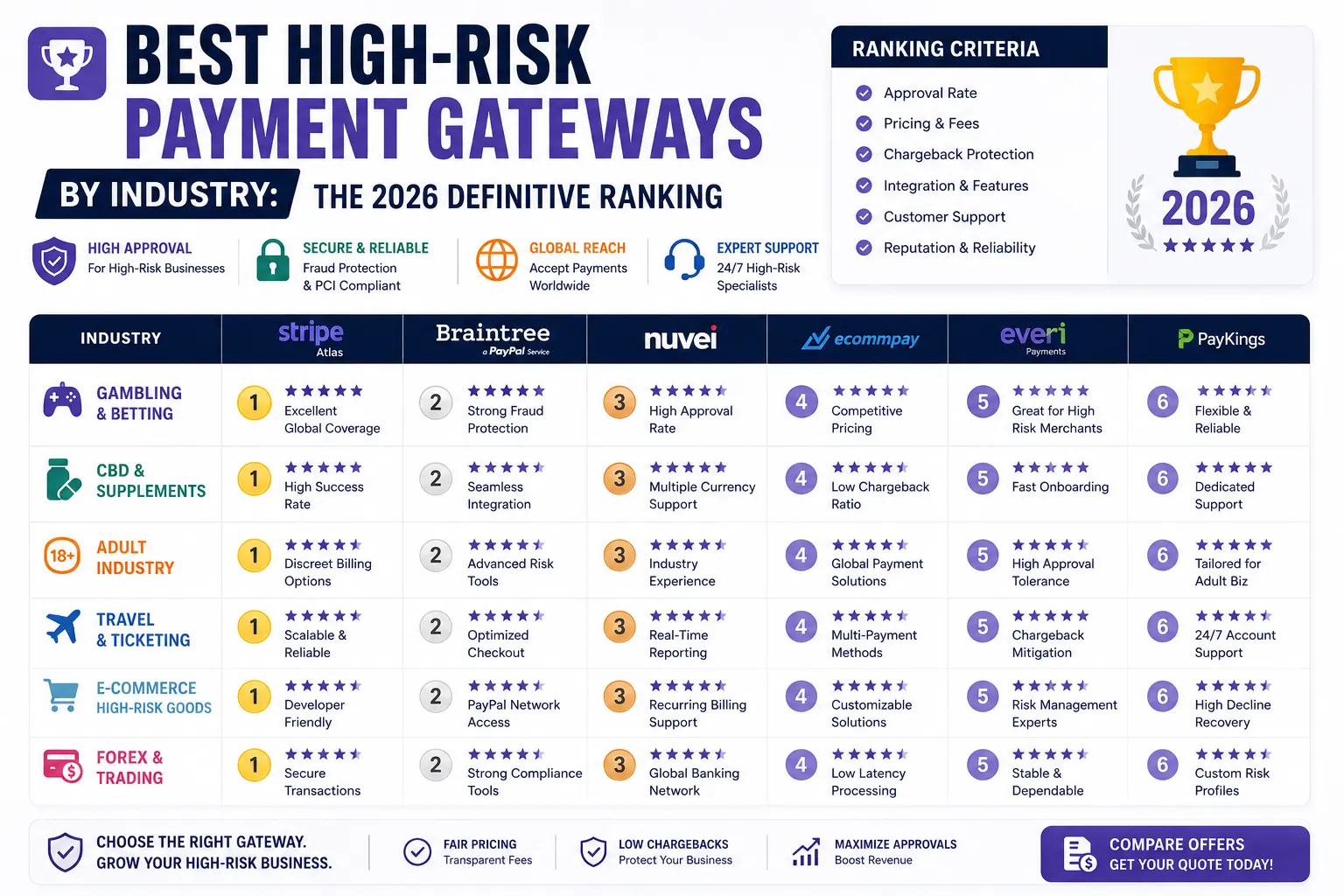
TL;DR:
There is no single “best” high-risk payment gateway. The right choice depends entirely on your industry vertical, processing volume, geography, and chargeback history. This guide ranks the top payment gateways by industry segment for 2026, with fee benchmarks, key selection criteria, and red flags to avoid.
Introduction
The high-risk payment gateway market has never been more crowded, or more confusing. The world of e-commerce payments is moving towards $8.1 trillion in total volume by 2026, and businesses operating in high-risk industries cannot afford to leave their payment infrastructure to chance. From iGaming operators and forex brokers to CBD retailers and subscription services, every regulated vertical faces a different combination of chargeback risk, regulatory complexity, and acquirer appetite.
Chargeback volume is projected to surge 41% from 238 million to 337 million between 2023 and 2026, outpacing ecommerce growth rates. By 2026, chargeback fraud is expected to result in $28.1 billion in losses for merchants, a 40% increase from $20 billion in 2023. That pressure is reshaping how payment providers underwrite high-risk merchants, which gateways survive regulatory scrutiny, and what fees are truly competitive in each vertical.
This definitive 2026 ranking cuts through the noise. Each industry section gives you the processing rate benchmarks, the most important selection criteria, and the key risks that determine whether a gateway will still be serving your vertical six months from now.
2026 High-Risk Gateway Market: Key Data
Before the rankings, understand the landscape these numbers describe.
Global market statistics (2026):
| Metric | Data Point | Source |
|---|---|---|
| High-risk payments market size (2025) | $62.4 billion | DataIntelo |
| Projected market size (2034) | $148.7 billion | DataIntelo |
| CAGR (2026–2034) | 10.1% | DataIntelo |
| Global chargeback volume (2026 proj.) | 337 million transactions | Mastercard |
| Chargeback fraud losses (2026) | $28.1 billion | Ethoca |
| Friendly fraud share of all chargebacks | 75% | Chargeflow |
| Merchants reporting rising friendly fraud (2024) | 72% | Chargebacks911 |
| Ecommerce chargeback rate increase (Q1 2023–Q1 2024) | +222% | Sift |
First-party fraud is now the leading fraud type globally, representing 36% of all reported fraud in 2024, up from 15% in 2023, representing a $132 billion risk to ecommerce. These numbers explain why acquiring banks continue to tighten underwriting requirements and why choosing the right payment gateway for your specific vertical matters more in 2026 than at any point in the past decade.
How We Rank High-Risk Payment Gateways
Each gateway in this ranking is assessed against six criteria:
- Industry fit: does the gateway’s acquiring bank network actively serve this vertical?
- Processing rate range: what is the realistic fee range post-underwriting?
- Rolling reserve terms: percentage, hold period, and step-down availability?
- Geographic coverage: which card networks, currencies, and jurisdictions are supported?
- Chargeback management tools: does the gateway offer alerts, 3DS2, and dispute dashboards?
- Account stability: what is the provider’s track record for sudden terminations in this vertical?
Fee Benchmarks by Industry Vertical (2026)
Understanding what competitive looks like in your sector is the foundation of every provider comparison.
| Industry Vertical | Min Rate | Max Rate | Rolling Reserve | Hold Period |
|---|---|---|---|---|
| iGaming / Online Gambling | 5.0% | 9.0% | 10%-15% | 90-180 days |
| Adult Content | 6.0% | 9.0% | 10%-12% | 120-180 days |
| Forex / CFD Trading | 3.5% | 6.5% | 5%-12% | 60-180 days |
| CBD / Nutraceuticals | 3.5% | 6.0% | 5%-10% | 90-180 days |
| Crypto Exchanges | 3.0% | 6.0% | 5%-9% | 90-150 days |
| Subscription / Continuity | 3.5% | 5.5% | 5%-7% | 90-120 days |
| Travel / Ticketing | 3.0% | 5.0% | 4%-7% | 60-120 days |
Rankings by Industry Vertical
1. iGaming & Online Gambling
Why it’s the hardest vertical: iGaming operators face some of the most restrictive payment processing environments in any industry. Licensed operators in regulated jurisdictions still struggle to find payment processors willing to work with them at reasonable rates. Card network rules require operators to have valid gambling licences in every jurisdiction they accept payments from, and acquiring banks exit the vertical frequently, often without notice.
What to prioritise in a gateway:
- Multi-jurisdictional licence compatibility (MGA, UKGC, Curaçao, Kahnawake)
- Player deposit UX, abandon rates spike with high-friction checkout flows
- Alternative payment method (APM) support: e-wallets, bank transfers, crypto
- Real-time chargeback alert integration (Ethoca, Verifi)
- Multi-acquirer routing to prevent single-bank dependency
Fee reality: iGaming operators typically pay 5-9% with 10-15% rolling reserves, and settlement takes 3-7 days. Processors exit the gambling vertical with minimal notice. Operators with MGA or UKGC licences achieve rates toward the lower end; unlicensed or offshore-only operators face rates at the top of the range.
Top gateway criteria for 2026: Acquirer relationships in Malta, Isle of Man, Gibraltar, and UK. Support for Trustly and local instant bank transfers in EU markets. Dedicated iGaming risk management team.
2. Adult Content & Entertainment
Why it’s a high-compliance vertical: After major card networks implemented new compliance requirements for adult platforms, many processors exited the category entirely. The ones that remain charge premium rates with aggressive reserve policies.
The 2026 compliance environment is particularly demanding. As of January 2026, the VAMP ratio threshold is set at 0.9% for merchants and 0.3% for acquirers. Non-compliance can result in immediate processing termination and potential card network blacklisting. Mastercard’s policy on non-face-to-face adult content came into force in October 2021, requiring documented age and identity verification for all people depicted and those uploading content.
What to prioritise in a gateway:
- Acquirer with explicit adult content programme (not conditional tolerance)
- Age and identity verification integration (mandatory post-2021 Mastercard rules)
- Discreet billing descriptors to reduce friendly fraud chargebacks
- Content moderation infrastructure support
- Subscription billing engine with clear cancellation flows
Fee reality: Rates of 6-9% with 10-12% rolling reserves are standard for new accounts. Established platforms with low chargeback ratios and strong KYC compliance can negotiate toward 5-7%.
Top gateway criteria for 2026: Proven 18+ content policy compliance, Verifi and Ethoca alert coverage, billing descriptor customisation, and multi-currency support for creator payouts.
3. Forex, CFD & Financial Services
Why it requires specialist acquirers: Forex brokers operate across multiple regulatory jurisdictions simultaneously. EU-regulated brokers with MiFID II authorisation face different underwriting requirements than brokers licensed in Vanuatu or the Seychelles, and the gap affects processing rates significantly.
MDR rates for forex broker card processing typically range from 3.5% to 6.5%, depending on the broker’s regulatory jurisdiction, processing history, chargeback ratio, and monthly processing volume. Well-established EU-regulated brokers with MiFID II authorisation and clean processing history can achieve rates at the lower end. New brokers or those with elevated chargeback histories will typically be offered rates at the higher end or above.
What to prioritise in a gateway:
- Acquirers in regulated jurisdictions (UK, EU, Australia, UAE)
- 3DS2 Strong Customer Authentication for EU card payments (PSD2 mandatory)
- Multi-currency settlement in GBP, EUR, USD, and local currencies
- Deposit velocity controls to prevent card-testing fraud
- High average ticket size support (forex deposits regularly exceed $1,000)
Rolling reserves for forex accounts typically range from 5% to 12% of monthly processing volume, held for 60 to 180 days. Brokers with CySEC or FCA regulation routinely achieve better reserve terms than those operating from offshore jurisdictions.
Top gateway criteria for 2026: FCA/CySEC acquirer relationships, SEPA and SWIFT settlement, APM support for LATAM and APAC markets, and real-time fraud scoring on deposit flows.
4. CBD, Nutraceuticals & Supplements
The regulatory complexity: CBD and nutraceutical merchants are classified as high-risk not because of fraud history, but because of product-level regulatory uncertainty. Processors classify CBD under restricted MCCs and charge 5-8% with reserves, even though CBD is federally legal in the US and legal across the EU.
The key underwriting variable in 2026 is product compliance documentation, lab certificates, Certificates of Analysis (COAs), and compliance with FDA labelling rules for supplements. Merchants who provide this documentation proactively reduce their underwriting time and often improve their initial rate offer.
What to prioritise in a gateway:
- Acquirers with an active CBD/nutraceutical programme (not provisional approvals)
- Support for subscription and continuity billing models
- Chargeback ratio monitoring with early intervention alerts
- Integration with fulfilment systems for delivery confirmation (reduces dispute rates)
- Multi-state compliance support for US-based operations
Fee reality: Higher-risk verticals like CBD and nutraceuticals experience notably elevated chargeback levels, which keeps base rates in the 3.5-6% range even for merchants with clean histories.
5. Cryptocurrency Exchanges & Web3 Platforms
The dual-risk environment: Crypto businesses face two overlapping risk profiles, the inherent volatility of the asset class and the regulatory uncertainty of operating across jurisdictions with inconsistent crypto licensing frameworks.
UAE (Dubai Free Zones, RAK, ADGM) is now a strong choice for crypto, fintech, and Web3 businesses. UAE licensing plus a local or regional bank account ensures smoother approval. Malta and Cyprus are common choices for forex and fintech operations in the EU.
What to prioritise in a gateway:
- Fiat on-ramp and off-ramp support for card-to-crypto flows
- AML and KYC infrastructure compatible with FATF Travel Rule requirements
- Real-time fraud scoring on fiat deposit transactions
- Multi-currency and multi-blockchain settlement options
- Regulatory licensing in at least one major jurisdiction (EU MiCA compliance preferred)
Fee reality: Entry-level crypto exchange accounts see rates of 3-6% with 5-9% rolling reserves. VASP-licensed exchanges in regulated jurisdictions achieve rates toward the lower end.
6. Subscription Commerce & Continuity Billing
Why this vertical is mid-risk in 2026: Subscription merchants are not inherently high-risk, but many are classified that way due to high friendly fraud rates, complex cancellation flows, and free-trial-to-paid conversion models that generate disputes.
72% of merchants experienced rising friendly fraud in 2024, where customers dispute legitimate transactions. This type of fraud has become normalised among consumers who view chargebacks as an easier alternative to returns. Clear transaction descriptors, proactive communication, and detailed order documentation help combat friendly fraud.
What to prioritise in a gateway:
- Native recurring billing engine with dunning management
- Network tokenisation support for card-on-file transactions
- Subscription pause and reactivation flows to reduce cancellation-driven chargebacks
- Real-time billing descriptor customisation
- Chargeback alert integration (Verifi Order Insight, Ethoca Consumer Clarity)
Fee reality: 3.5-5.5% with 5-7% reserves. Subscription merchants with chargeback ratios below 0.5% and clean processing history of 6+ months regularly negotiate rate reductions and reserve step-downs.
7. Travel, Ticketing & Hospitality
Why it’s cyclically high-risk: Travel merchants face concentrated chargeback exposure during disruption events, flight cancellations, hotel closures, tour operator collapses. The COVID-era mass chargeback wave permanently changed how acquirers underwrite travel businesses.
What to prioritise in a gateway:
- Acquirers with explicit travel merchant programmes
- Delayed settlement options for bookings made far in advance
- Chargeback insurance or representment services
- APM support for APAC and LATAM markets (bank transfer, e-wallets)
- Multi-currency pricing to minimise cross-border conversion costs
Fee reality: 3-5% with 4-7% reserves. Established OTAs and ticketing platforms with strong brand recognition and documented refund policies achieve rates toward the lower end.
Pros and Cons: High-Risk Payment Gateways vs Standard Gateways
Pros
- Vertical approval: specialist high-risk gateways serve industries that Stripe, PayPal, and Square reject outright
- Regulatory alignment: specialist providers understand the compliance requirements in your vertical and build them into their onboarding
- Multi-acquirer routing: most high-risk gateway platforms route across multiple banks, improving approval rates and resilience
- Global payment acceptance: high-risk gateways typically support more currencies, local payment methods, and cross-border transactions than standard providers
- Chargeback management tools: integrated dispute alerts and representment workflows are standard, not add-ons
Cons
- Higher processing fees: 3-9% versus 1.5-2.9% for standard merchant accounts
- Rolling reserves: restrict working capital for the first 6-12 months
- Variable underwriting timelines: full approval can take 1-3 weeks even when an instant quote is issued within minutes
- Account instability risk: acquirer exits from high-risk verticals happen without warning; multi-gateway redundancy is essential
- Contract complexity: early termination clauses, reserve policies, and volume commitments require careful legal review
What Changed in 2026: Industry Updates Every Merchant Must Know
VAMP is now the unified Visa monitoring programme:
On April 1, 2025, Visa retired VDMP, VFMP, and the previous VAMP programmes and replaced them with one enhanced VAMP programme introducing stricter fraud and dispute thresholds. As of January 2026, the threshold limits are set at 0.9% for merchants and 0.3% for acquirers. Exceeding this threshold triggers fines and can lead to acquirer termination.
AI fraud detection is now a baseline requirement, not a differentiator:
The gateways that are winning underwriting approval from top-tier banks in 2026 are those with AI-driven fraud scoring built into the transaction flow, not bolted on as an optional add-on.
Card-to-crypto settlement is emerging as a structural alternative:
For the first time, merchants in restricted industries can accept standard Visa and Mastercard payments from customers and receive settlement in USDC, USDT, Bitcoin, or other cryptocurrencies directly to their wallet. This matters because the traditional payment processing system has spent two decades punishing these industries. This model bypasses rolling reserves entirely for merchants willing to hold or convert crypto settlement.
Offshore merchants face tighter bank scrutiny globally:
Merchant offshore structures require more documentation in 2026, including corporate structure diagrams, beneficial ownership declarations, and proof of banking relationships in the operating jurisdiction. Providers with established offshore banking networks in Cyprus, Malta, UAE, and Seychelles are better positioned to onboard these structures quickly.
How to Use This Guide to Find Your Gateway
The right payment gateway for your business sits at the intersection of four variables: your vertical, your monthly volume, your existing processing history, and your geographic footprint. Use the fee benchmarks in this guide to identify whether a quote you’ve received is competitive. Use the selection criteria to build your provider shortlist. Use the red flags to eliminate providers early.
Comparing verified, up-to-date high-risk payment providers across all seven verticals covered in this guide is exactly what TheFinRate’s payment gateway directory is built for. Filter by industry, geography, and volume tier to build a shortlist that matches your actual risk profile, not a generic high-risk category.
FAQ
Which industry has the highest payment gateway fees in 2026?
Adult content and iGaming consistently carry the highest effective processing costs, with rates reaching 9% and reserves of 10-15% for new accounts.
Can a business operate in multiple high-risk verticals on one merchant account?
It depends on the acquiring bank. Some high-risk processors support multi-vertical merchant accounts, but most prefer to underwrite each vertical separately. Operating multiple verticals under one MID without disclosure is a contract violation.
Is a high-risk payment gateway different from a high-risk merchant account?
Yes. A merchant account is the bank relationship that holds your settlement funds. A payment gateway is the technical infrastructure that captures and transmits card data. You need both, some providers bundle them; others supply them separately.
How often should I renegotiate my gateway terms?
Review your terms at the 6-month mark and again at 12 months. Clean processing history is your strongest negotiating asset, and most high-risk payment providers have discretionary authority to improve rates and reduce reserves for merchants who demonstrate it.
Comments
No comments yet. Be the first to share your thoughts.
Leave a comment