
Introduction
The financial services industry is undergoing a profound transformation. Traditional banking models are evolving as technology companies, fintech startups, e-commerce platforms, and digital businesses increasingly seek to offer financial services directly to their customers. Consumers today expect seamless financial experiences integrated into the platforms they already use, whether they are shopping online, managing business operations, booking travel, or using mobile applications.At the heart of this transformation is Banking as a Service (BaaS), a model that allows non-bank organizations to embed banking capabilities into their products and services through APIs. Instead of building a bank from scratch or obtaining costly banking licenses, businesses can leverage a Banking as a Service Platform to access regulated financial infrastructure and launch innovative financial products quickly.
As embedded finance continues to reshape the global financial landscape, Banking as a Service Platforms have emerged as one of the most important building blocks of digital banking innovation.
What Is a Banking as a Service Platform?
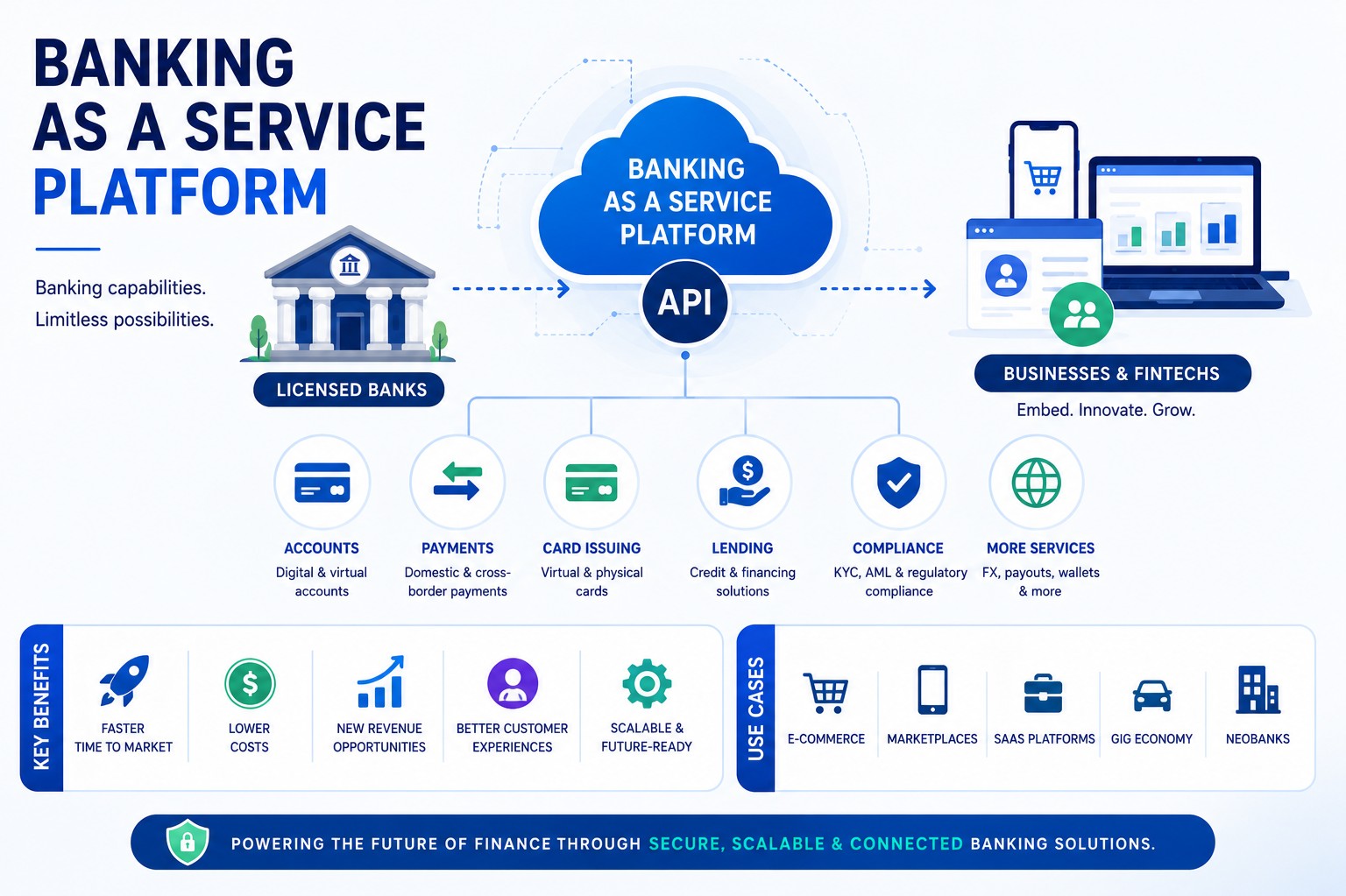
A Banking as a Service Platform is a technology infrastructure that enables licensed banks to provide their banking capabilities to third-party businesses through APIs and cloud-based services.
These platforms act as intermediaries between regulated financial institutions and companies that want to offer banking products without becoming banks themselves.
Through a BaaS platform, businesses can integrate services such as:
- Digital bank accounts
- Payment processing
- Card issuing
- Virtual accounts
- Money transfers
- Lending services
- Foreign exchange solutions
- Account verification
This allows fintech companies, marketplaces, software providers, and digital brands to deliver financial services directly within their own applications and customer experiences.
Why Banking as a Service Matters
Historically, launching a banking product required significant investment, regulatory approvals, compliance expertise, and technical infrastructure.
BaaS dramatically lowers these barriers.
Companies can now leverage existing banking infrastructure while focusing on customer experience, product innovation, and business growth. This approach accelerates time-to-market and reduces development costs.
For consumers, the result is more convenient and integrated financial experiences. Rather than navigating multiple providers, users can access financial services directly within the platforms they already trust and use daily.
This shift is fueling the rapid growth of embedded finance worldwide.
How a Banking as a Service Platform Works
The Banking as a Service ecosystem typically involves three key participants.
The first participant is the licensed bank, which holds regulatory approvals and provides the underlying financial infrastructure.
The second participant is the BaaS platform provider, which develops APIs, compliance tools, and integration capabilities that connect businesses to banking services.
The third participant is the business or fintech company that uses the platform to offer financial products to end users.
When a customer performs an action such as opening an account, making a payment, or receiving funds, the request travels through the BaaS platform to the licensed banking partner.
The entire process occurs seamlessly behind the scenes while maintaining regulatory compliance and security standards.
Core Services Offered by BaaS Platforms
Modern Banking as a Service Platforms provide a wide range of financial capabilities.
Account Infrastructure
Businesses can offer digital bank accounts, IBANs, virtual accounts, and multi-currency wallets without becoming regulated banks.
Payment Services
Platforms support domestic and international payments, real-time transfers, ACH transactions, SEPA payments, and cross-border settlements.
Card Issuing
Organizations can launch physical and virtual debit cards, prepaid cards, expense cards, and embedded payment solutions.
Lending Capabilities
Some BaaS providers enable businesses to offer credit products, working capital financing, and installment payment solutions.
Compliance Services
Built-in compliance tools help businesses manage KYC, AML, transaction monitoring, and regulatory reporting requirements.
These services create a comprehensive banking infrastructure that businesses can access through simple API integrations.
Banking as a Service and Embedded Finance
One of the biggest drivers of BaaS adoption is embedded finance.
Embedded finance refers to the integration of financial services directly into non-financial platforms. Instead of directing users to external banks or payment providers, businesses can offer financial products natively within their applications.
For example:
- Marketplaces can provide seller accounts and payouts.
- SaaS platforms can offer embedded banking features.
- E-commerce companies can launch branded payment cards.
- Ride-hailing platforms can provide driver wallets.
- Gig economy platforms can enable instant earnings access.
BaaS makes these experiences possible by providing the underlying banking infrastructure.
Benefits for Businesses
Organizations adopting Banking as a Service Platforms gain several strategic advantages.
Faster Time-to-Market
Businesses can launch financial products in weeks rather than years.
Lower Development Costs
Companies avoid building expensive banking infrastructure from scratch.
New Revenue Opportunities
Embedded financial services create additional revenue streams through payments, cards, lending, and account services.
Enhanced Customer Experience
Financial services become seamlessly integrated into existing customer journeys.
Scalability
Cloud-based BaaS platforms support rapid growth and global expansion.
These benefits explain why businesses across multiple industries are embracing embedded financial services.
Benefits for Fintech Companies
Fintech startups particularly benefit from BaaS platforms because they can focus on innovation instead of regulatory complexity.
Rather than securing banking licenses and building core banking systems, fintech companies can leverage existing infrastructure and concentrate on delivering differentiated products.
This approach has significantly accelerated fintech innovation globally, enabling startups to compete with traditional financial institutions more effectively.
Many successful neobanks and digital financial platforms rely heavily on Banking as a Service infrastructure.
Challenges and Risks
Despite its advantages, Banking as a Service presents several challenges.Regulatory compliance remains a major concern. Financial institutions and platform providers must ensure adherence to evolving regulations related to anti-money laundering, data protection, consumer protection, and operational resilience.Operational risks also increase as multiple parties become involved in delivering financial services.
Additional challenges include:
- Third-party dependency
- Cybersecurity risks
- Regulatory oversight
- Data privacy requirements
- Service availability concerns
Organizations must carefully evaluate providers and implement robust governance frameworks.
Emerging Trends in Banking as a Service
The BaaS industry continues evolving rapidly.
Artificial intelligence is improving fraud detection, compliance monitoring, and customer onboarding processes. Open banking initiatives are creating greater interoperability between financial institutions and digital platforms.
Embedded finance adoption continues accelerating as businesses seek new ways to engage customers and generate revenue.
Other emerging trends include:
- Real-time payments
- Multi-currency account solutions
- Embedded lending
- Banking APIs for SMEs
- AI-driven financial services
- Global payment orchestration
These innovations are expanding the capabilities of modern Banking as a Service Platforms.
The Future of Banking as a Service
The future of banking is increasingly platform-driven.
Consumers will continue demanding financial services that are integrated seamlessly into their everyday digital experiences. Businesses will increasingly seek ways to monetize customer relationships through embedded financial products.
Banking as a Service Platforms will play a central role in enabling this transformation.
As APIs become more sophisticated and regulatory frameworks mature, BaaS will support a new generation of financial products that are more accessible, personalized, and efficient than traditional banking services.
Organizations that embrace this model early will be well-positioned to capitalize on the ongoing evolution of digital finance.
Conclusion
Banking as a Service Platforms are reshaping the financial services industry by making banking infrastructure accessible through APIs and cloud-based technologies. They enable businesses, fintech companies, and digital platforms to launch financial products quickly while leveraging the expertise and regulatory capabilities of licensed banks.
As embedded finance, open banking, and digital transformation continue accelerating, BaaS will remain a critical enabler of innovation across the global financial ecosystem. Businesses that understand and leverage Banking as a Service today will be better prepared to compete in the increasingly connected and technology-driven future of finance.
Comments
No comments yet. Be the first to share your thoughts.
Leave a comment