
Introduction
The banking industry has undergone a dramatic transformation over the past decade. Financial services that once required manual processes, branch visits, and lengthy integrations can now be accessed instantly through digital platforms. Behind this evolution lies one of the most important innovations in modern finance: Banking API Integration.
As businesses increasingly demand real-time financial services, seamless payment experiences, and automated banking operations, APIs have become the bridge connecting banks, fintech companies, enterprises, and consumers. Banking APIs allow different systems to communicate securely, enabling organizations to access banking services without building complex infrastructure from scratch.
From payment initiation and account verification to transaction monitoring and embedded finance, Banking API Integration is reshaping how financial services are delivered. It has become a cornerstone of digital banking, open banking, and fintech innovation worldwide.
What Is Banking API Integration?
Banking API Integration refers to the process of connecting applications, platforms, or business systems with banking services through Application Programming Interfaces (APIs).
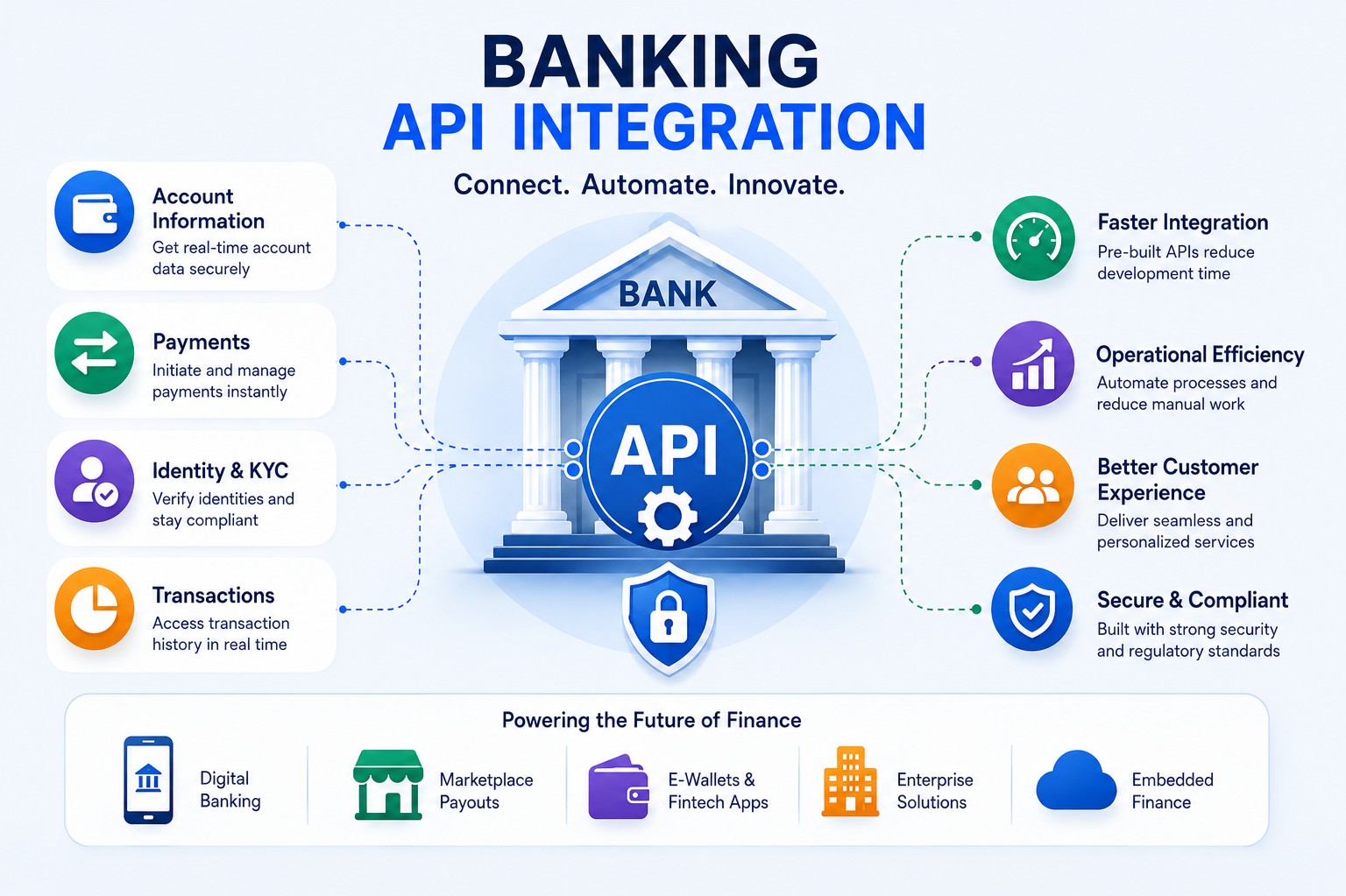
An API acts as a secure communication layer that allows software systems to exchange information and perform actions without direct human intervention. Through banking APIs, businesses can access account information, initiate payments, verify customers, retrieve transaction data, and automate financial workflows.
Instead of relying on manual banking processes, organizations can integrate financial services directly into their applications, websites, or enterprise systems. This creates faster, more efficient, and highly scalable financial operations.
As digital ecosystems continue expanding, API connectivity has become essential for delivering modern banking experiences.
The Evolution of Banking APIs
Historically, banks operated within closed systems where customer data and banking services remained isolated from external applications. Businesses seeking integration often faced lengthy development cycles, custom connections, and limited functionality.
The rise of fintech innovation and open banking regulations changed this landscape significantly. Financial institutions began exposing services through secure APIs, allowing authorized third parties to interact with banking infrastructure in a controlled manner.
This shift accelerated innovation across the financial industry. Companies could now build new products and services on top of existing banking systems rather than creating entirely new infrastructures.
Today, APIs are central to many of the world’s most successful financial platforms.
How Banking API Integration Works
Banking APIs enable secure communication between a bank’s infrastructure and an external application. When a customer performs an action such as viewing an account balance or making a payment, the application sends a request through the API.
The bank validates the request, processes the action, and returns the appropriate response. This entire process occurs in seconds while maintaining security, compliance, and data integrity.
Modern API integrations typically use secure authentication mechanisms, encryption protocols, and access controls to ensure that only authorized applications can access sensitive financial information.
The result is a seamless experience where banking services become embedded directly into digital platforms.
Key Types of Banking APIs
Different APIs support different banking functions. Account Information APIs allow applications to access account balances, transaction histories, and financial data with customer consent.
Payment APIs enable businesses to initiate transfers, process payments, and automate collections directly from their platforms. These capabilities are essential for digital wallets, e-commerce solutions, and payment service providers.
Identity and verification APIs help businesses validate customer information, perform KYC checks, and support regulatory compliance requirements. Other APIs focus on lending, card issuance, foreign exchange services, and treasury management.
Together, these integrations create a comprehensive banking ecosystem that supports a wide range of financial services.
Banking API Integration and Open Banking
Open Banking has been one of the biggest drivers of API adoption in the financial industry. Open banking frameworks require banks to provide secure access to customer financial data through standardized APIs, provided customers give their consent.
This approach promotes competition and innovation by allowing fintech companies and third-party providers to build services around banking data. Consumers benefit from greater financial transparency, personalized services, and enhanced control over their information.
Banking API Integration is the technological foundation that makes open banking possible. Without APIs, secure data sharing and payment initiation would be significantly more difficult to achieve.
As open banking expands globally, API connectivity continues to grow in importance.
The Role of APIs in Embedded Finance
Embedded finance has become one of the fastest-growing segments of financial technology. Businesses outside the traditional banking sector are increasingly integrating financial services directly into their products and customer experiences.
Ride-sharing applications offer driver wallets. Marketplaces provide seller accounts. Software platforms enable business payments. E-commerce companies launch branded financial products.
Banking APIs make these capabilities possible by connecting non-financial platforms to regulated banking infrastructure.
Instead of redirecting customers to external financial institutions, businesses can offer financial services natively within their ecosystems, creating more convenient and engaging user experiences.
Benefits of Banking API Integration
Organizations adopting banking APIs gain significant operational and strategic advantages. One of the most immediate benefits is automation. Processes that previously required manual intervention can be executed instantly through API-driven workflows.
APIs also improve customer experiences by enabling real-time financial services and seamless interactions. Businesses can launch new products faster while reducing development costs and operational complexity.
Another major advantage is scalability. API-based infrastructures allow organizations to expand services, enter new markets, and handle growing transaction volumes without rebuilding core systems.
These benefits have made Banking API Integration a critical component of digital transformation strategies across industries.
Security and Compliance Considerations
Because banking APIs handle sensitive financial data, security remains a top priority. Financial institutions implement strong authentication protocols, encryption standards, and monitoring systems to protect customer information.
Compliance is equally important. Organizations must ensure that API integrations adhere to regulations related to data privacy, anti-money laundering requirements, customer consent management, and cybersecurity standards.
Successful API strategies require a balance between accessibility and security. Businesses that prioritize both can create trusted financial experiences while maintaining regulatory compliance.
As cyber threats continue evolving, secure API management will remain a critical focus area.
Challenges of Banking API Integration
Despite their advantages, banking APIs present several challenges. Integration complexity can vary depending on the bank, technology stack, and regulatory environment. Organizations often need specialized expertise to manage implementation effectively.
Differences in API standards across institutions can also create interoperability challenges. While open banking initiatives are helping standardize connectivity, variations still exist across markets and providers.
Reliability is another important consideration. Businesses that depend heavily on API connectivity must ensure high availability and robust contingency planning to minimize disruptions.
Addressing these challenges is essential for maximizing the value of API-driven banking services.
Future Trends in Banking API Integration
The future of banking is increasingly API-driven. Real-time payments, open finance, embedded banking, and Banking-as-a-Service models are expanding the role of APIs across financial ecosystems.
Artificial intelligence is expected to enhance API functionality by enabling smarter financial insights, predictive analytics, and automated decision-making. Open finance initiatives will extend API connectivity beyond traditional banking into investments, insurance, pensions, and broader financial services.
The growth of cloud-native banking platforms will further accelerate API adoption, enabling faster innovation and greater flexibility for businesses and financial institutions alike.
As financial ecosystems become more interconnected, APIs will continue serving as the foundation of digital financial experiences.
Conclusion
Banking API Integration has become a critical enabler of modern financial services. By allowing secure communication between banks, fintech companies, and business applications, APIs support automation, innovation, and seamless customer experiences.
From open banking and embedded finance to real-time payments and digital transformation initiatives, APIs are reshaping how financial services are delivered and consumed. Organizations that embrace Banking API Integration can improve efficiency, accelerate growth, and unlock new opportunities in an increasingly connected financial world.
As technology continues advancing and customer expectations evolve, Banking API Integration will remain at the heart of the future banking ecosystem.
Comments
No comments yet. Be the first to share your thoughts.
Leave a comment