
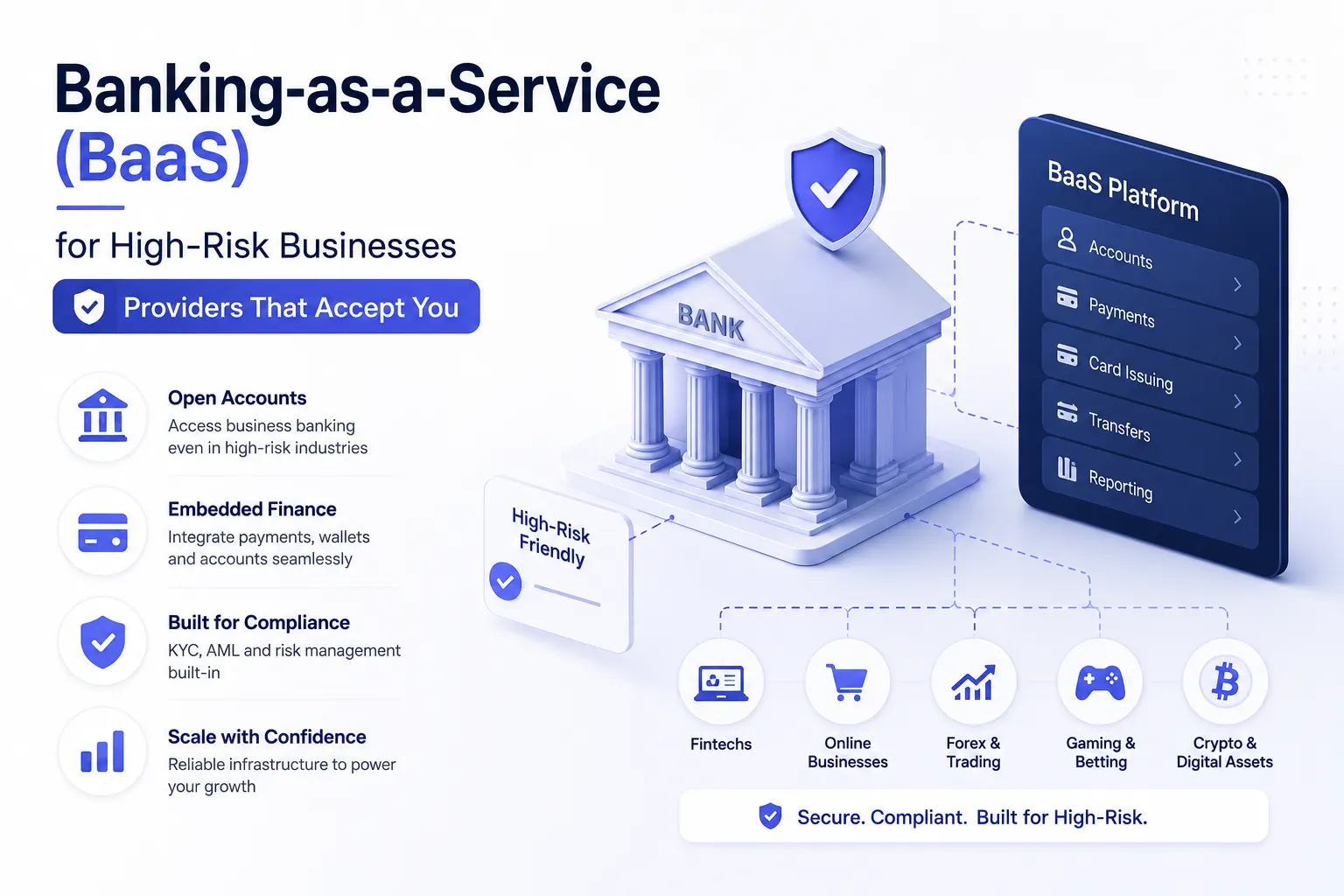
Banking-as-a-Service (BaaS) offers an alternative by providing access to banking infrastructure, payment processing, merchant accounts, card issuing, and compliance tools through specialized providers.
For high-risk merchants, BaaS can simplify access to essential financial services that are often difficult to obtain through traditional banking channels.
However, not every BaaS provider supports high-risk industries, making it important to evaluate providers carefully before choosing a long-term partner.
TL;DR BaaS gives high-risk businesses access to banking infrastructure, merchant accounts, payment gateways, card issuing, and compliance tools, through licensed providers via API. Not all BaaS platforms accept high-risk merchants. This blog covers which ones do, what the real costs are, and how to evaluate providers after the Synapse collapse changed what due diligence means in 2026.
What Is Banking-as-a-Service and Why Does It Matter for High-Risk Merchants?
Banking-as-a-Service (BaaS) is a model that allows non-bank businesses to offer regulated financial services by connecting to licensed banking infrastructure through APIs. Instead of obtaining a banking license themselves, businesses integrate capabilities like payment accounts, payment gateways, card issuing, lending, and compliance tooling directly into their product.
For high-risk merchants, this matters for one fundamental reason: traditional banks use reputation risk assessments to decline entire verticals. BaaS providers, particularly those that hold their own licenses rather than relying on sponsor bank relationships, are often more willing to underwrite businesses in iGaming, CBD, cryptocurrency, forex, adult content, and nutraceuticals.
The global BaaS market is currently estimated at $35–45 billion in 2026, with projections suggesting it could reach $75–90 billion by 2030–2031. Annual growth remains in the 16–18% range, driven less by hype and more by a structural change in how digital products are built.
This growth reflects a real shift. Financial services are increasingly embedded inside broader ecosystems rather than offered as standalone products, and high-risk merchants are finally gaining access to infrastructure that mainstream banking previously blocked.
The Synapse Collapse: What It Changed for High-Risk BaaS Buyers in 2026
Before evaluating any BaaS provider for high-risk payment processing, you need to understand what happened with Synapse in 2024 and why it changed due diligence requirements permanently.
Synapse, a US-based BaaS middleware provider, collapsed in 2024, exposing severe structural risks in the three-party BaaS model where a technology layer sits independently between the business partner and the sponsor bank.
When it failed, client funds were frozen and businesses lost access to their payment processing operations with no clear recovery path. The lesson for high-risk merchants evaluating BaaS providers in 2026 is direct: only work with providers that either hold their own banking license or maintain direct, transparent relationships with their banking partners.
Platforms like Griffin and Solaris SE operate directly as the regulated entity, effectively eliminating the intermediary risk that led to Synapse’s failure.
Middleware-only providers create a single point of failure that can freeze your merchant services and payment processing operations overnight.
BaaS Providers That Accept High-Risk Merchants in 2026
Not all BaaS platforms are built equally, and fewer still will accept high-risk merchant categories. Here is how the major providers stack up.
| Provider | License Type | High-Risk Acceptance | Best For | Region |
|---|---|---|---|---|
| Solaris SE | Own EU banking license | Yes – crypto, fintech-adjacent | Enterprise high-risk, EU-focused | Europe |
| Griffin | Own UK banking license | Selective – regulated fintech | UK-based high-risk platforms | UK |
| Unit | Sponsor bank model (direct) | Startup-friendly, moderate risk | US fintech, SMB platforms | USA |
| Marqeta | Card issuing via partner banks | Selective – card-issuing focus | High-risk card programs | Global |
| Treezor | Own French EMI license | Yes – iGaming adjacent, crypto | EU high-risk platforms | Europe |
| Intergiro | Swedish EMI license | Yes – broader high-risk coverage | Offshore and EU merchants | Europe/Global |
A significant regulatory development in April 2026 changed the high-risk BaaS landscape. The FDIC and OCC adopted a joint final rule prohibiting adverse action based on reputation risk alone, directly reopening bank sponsor appetite for crypto, cannabis-adjacent, and politically sensitive fintech verticals. This means BaaS providers that previously had difficulty finding sponsor bank partners for high-risk categories now have more viable pathways.
What High-Risk Businesses Actually Get From BaaS
Understanding what BaaS delivers in practical terms helps you evaluate whether it fits your payment processing needs as a high-risk or offshore merchant.
Core BaaS Capabilities for High-Risk Merchants
- Dedicated IBAN and account infrastructure: multi-currency accounts with GBP, EUR, USD, and additional currencies depending on provider
- Payment gateway access: SEPA, SWIFT, ACH, FasterPayments, Visa/Mastercard rails without needing a direct bank relationship
- Card issuing: customizable debit and prepaid cards for merchant disbursements, payouts, and branded payment programs
- KYC/AML automation: embedded compliance tooling at onboarding and transaction monitoring level
- Chargeback management: integrated dispute handling relevant for high-risk payment categories
- Offshore merchant account pathways: access to acquiring relationships in multiple jurisdictions through BaaS provider licensing
What BaaS Does NOT Replace
BaaS provides banking infrastructure, it does not replace a dedicated high-risk payment provider for card acquiring. You still need a specialist merchant account for card payment processing in high-risk categories. BaaS covers the banking rails, accounts, and card issuing layer. A high-risk payment gateway and merchant account handle card transaction acquiring separately.
Key BaaS Market Data for 2026
| Metric | Value | Source |
|---|---|---|
| BaaS Market Size (2026 estimate) | $35–45 billion | SDK.finance, April 2026 |
| Projected Market Size (2030–2031) | $75–90 billion | SDK.finance, April 2026 |
| Annual Growth Rate | 16–18% | Multiple analyst sources |
| Alternate 2032 projection | $70.8 billion | Sumsub, March 2026 |
Pros and Cons of BaaS for High-Risk Businesses
Pros
- Access to banking infrastructure without obtaining a banking license
- API-driven integration, connect to payment rails, accounts, and compliance tools via single setup
- Faster time to market than building direct bank relationships
- Compliance tooling included, KYC, AML, transaction monitoring built in
- Multi-currency support for cross-border payment processing and offshore merchant operations
- Licensed-first providers offer greater operational stability than middleware models post-Synapse
- April 2026 FDIC/OCC rule change reopens bank appetite for previously restricted high-risk verticals
Cons
- Not all BaaS providers accept high-risk verticals, significant variation in underwriting appetite
- Rolling reserves still apply at the acquiring bank level for high-risk categories
- Middleware-only providers carry structural collapse risk, Synapse set the precedent
- Compliance failures at the client level can trigger account termination at the platform level
- Enterprise BaaS providers require significant processing volume for viable economics
- BaaS does not cover card acquiring, separate high-risk merchant account still required
BaaS vs. Traditional High-Risk Payment Providers: Which Do You Need?
| Capability | BaaS Provider | High-Risk Payment Provider |
|---|---|---|
| Bank accounts and IBANs | Yes | No |
| Card payment acquiring | No | Yes |
| Payment gateway | Partial | Yes |
| KYC/AML tooling | Yes | Partial |
| Card issuing | Yes | No |
| Offshore merchant accounts | Partial | Yes |
| Chargeback management | Partial | Yes |
| Multi-currency settlement | Yes | Yes |
For most high-risk businesses, the answer is both. BaaS provides the banking infrastructure layer. A specialist high-risk payment provider handles card acquiring and payment gateway services. Together they create a complete, independent payment processing stack that does not depend on any single point of failure.
How to Evaluate a BaaS Provider as a High-Risk Merchant
With the Synapse collapse as fresh context, due diligence on BaaS providers is more rigorous in 2026. Here is what matters most.
Key Evaluation Criteria
- License structure: does the provider hold its own banking or EMI license, or operate through a sponsor bank? Owned licenses reduce intermediary risk significantly
- High-risk vertical acceptance: confirm in writing that your specific product category is permitted, not just implied
- AML/KYC infrastructure: is compliance embedded in the platform or outsourced to client businesses?
- Multi-currency and offshore capability: critical for offshore merchants operating across multiple jurisdictions
- Reserve and fund protection: how are client funds held and protected in the event of provider failure?
- API documentation and integration depth: developer-ready APIs reduce time to market and ongoing maintenance costs.
Final Verdict
BaaS is a genuine infrastructure breakthrough for high-risk merchants that have spent years being denied basic banking services. In 2026, with a cleaner regulatory framework post-Synapse and the FDIC/OCC rule change reducing arbitrary reputation-based denials, the landscape for high-risk businesses accessing BaaS has genuinely improved.
The caveat is precision in provider selection. Choose licensed-first providers over middleware models. Confirm high-risk vertical acceptance explicitly. Understand that BaaS covers the banking layer, card acquiring still needs a dedicated high-risk merchant account and payment gateway alongside it.
For high-risk businesses that get this combination right, the result is the same banking-grade financial infrastructure that low-risk businesses take for granted, accessed on their own terms.
Frequently Asked Questions
Can high-risk businesses get BaaS accounts in 2026? Yes, but provider selection matters significantly. Platforms like Solaris SE, Treezor, Intergiro, and Griffin with their own banking or EMI licenses are more willing to underwrite high-risk verticals than sponsor-bank-dependent middleware providers. The April 2026 FDIC/OCC rule change has also reduced bank-level resistance to high-risk categories.
Does BaaS replace a high-risk merchant account? No. BaaS provides banking infrastructure, accounts, IBANs, payment rails, and card issuing. Card payment acquiring still requires a separate high-risk merchant account and payment gateway from a specialist high-risk payment provider.
What happened with Synapse and why does it matter? Synapse was a BaaS middleware provider that collapsed in 2024, freezing client funds and exposing the structural risk of three-party BaaS models. In 2026, this makes it essential to choose BaaS providers that hold their own licenses or maintain direct, transparent sponsor bank relationships.
Which BaaS providers accept offshore merchants? Intergiro, Treezor, and Solaris SE have the strongest track record for offshore merchant and cross-border payment processing use cases, particularly for EU and international operations.
Comments
No comments yet. Be the first to share your thoughts.
Leave a comment