
Introduction
The digital economy has transformed how people buy, sell, and exchange services. Instead of traditional one-to-one business transactions, consumers increasingly interact through digital platforms that connect multiple buyers and sellers in a single ecosystem. From e-commerce giants and food delivery applications to freelance marketplaces and ride-hailing platforms, online marketplaces have become a dominant force in global commerce.At the center of every successful marketplace lies a sophisticated payment infrastructure known as Marketplace Payments. These payment systems do far more than simply move money between parties. They manage payment collection, split transactions, seller onboarding, regulatory compliance, fraud prevention, currency conversion, and payout distribution.
As marketplace business models continue expanding across industries, efficient payment management has become a critical competitive advantage. Businesses that provide seamless payment experiences can improve customer trust, attract more sellers, and scale more effectively in increasingly competitive markets.
Understanding marketplace payments is therefore essential for platform operators, fintech providers, merchants, and businesses seeking to participate in the rapidly growing platform economy.
What Are Marketplace Payments?
It refer to payment processes that facilitate transactions between multiple parties operating within a digital platform.
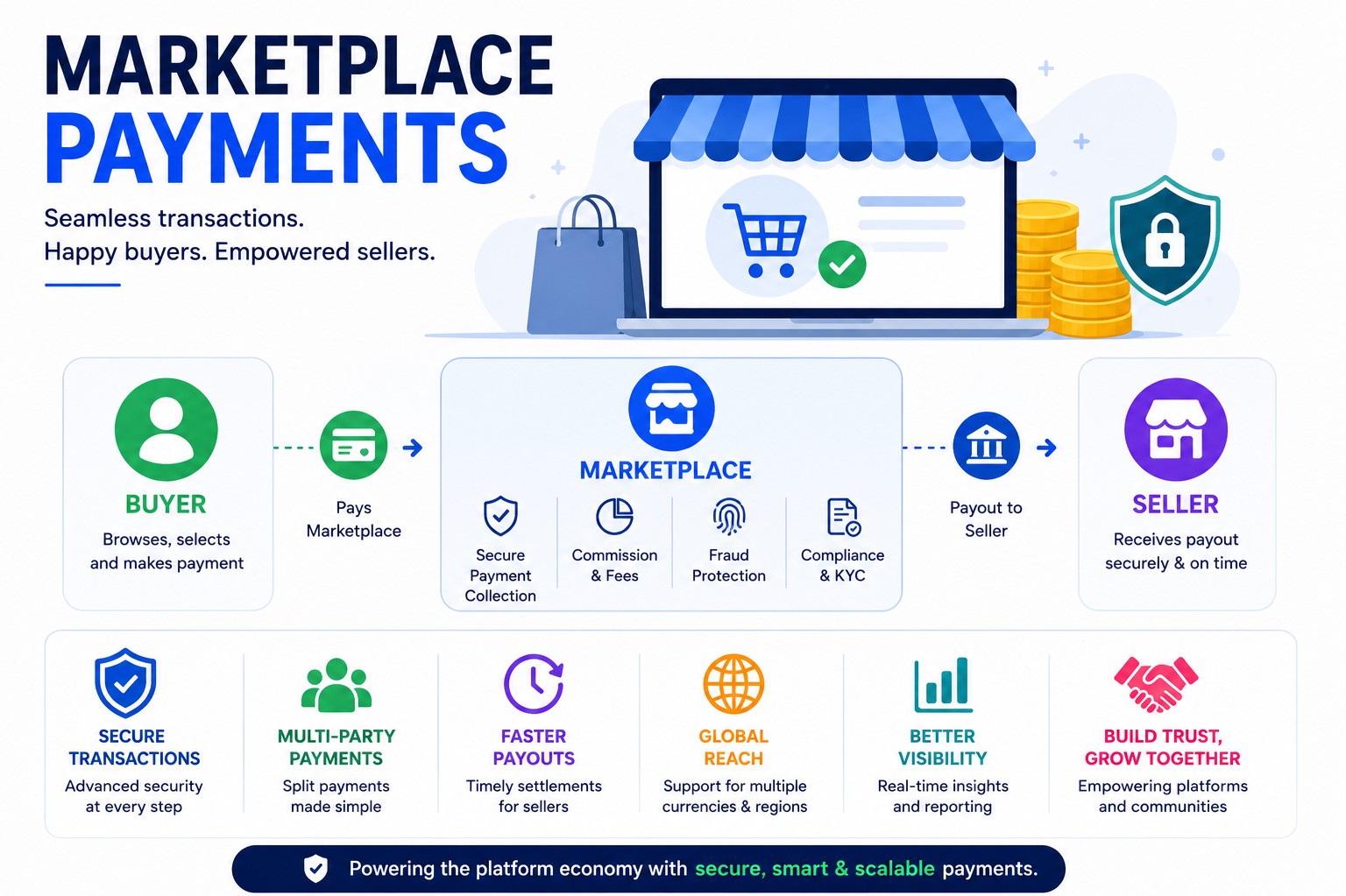
Unlike traditional e-commerce stores where a customer pays a single merchant, marketplace transactions typically involve three participants:
- The buyer
- The seller or service provider
- The marketplace platform
The platform acts as an intermediary that facilitates the transaction while often collecting a commission or service fee.
Marketplace payment systems must therefore handle complex payment flows, ensuring that funds are collected securely, fees are deducted accurately, and payouts are distributed to the appropriate parties.
This multi-party structure makes marketplace payments significantly more complex than conventional payment processing.
Why Marketplace Payments Matter
Payments are the foundation of marketplace trust.
Customers expect fast, secure, and convenient checkout experiences. Sellers want timely payouts and transparent fee structures. Marketplace operators need visibility into transactions while ensuring compliance with financial regulations.
Without an efficient payment infrastructure, even the most innovative marketplace can struggle to scale.
A well-designed marketplace payment solution helps:
- Improve customer satisfaction
- Increase seller retention
- Simplify financial operations
- Reduce fraud risks
- Support international expansion
- Automate revenue collection
As competition intensifies across digital platforms, payment experiences increasingly influence marketplace success.
How Marketplace Payments Work
The payment journey begins when a customer purchases a product or service through a marketplace platform.
The customer submits payment using a supported method such as a card, digital wallet, bank transfer, or alternative payment solution.
Instead of sending funds directly to the seller, the payment is typically processed through the marketplace’s payment infrastructure. The platform may temporarily hold funds, deduct commissions, calculate taxes, and perform compliance checks.
After these processes are completed, the remaining balance is transferred to the seller according to predefined payout schedules.
This structure allows marketplaces to manage risk, handle disputes, and ensure smooth transaction processing.
The Importance of Split Payments
One of the defining features of payments is the ability to perform split payments.
In many transactions, a single payment must be divided among multiple recipients. For example, an online marketplace may deduct a commission before sending the remainder to the seller. A travel booking platform may distribute funds among hotels, service providers, and platform operators.
Automated split payment capabilities simplify this process by ensuring that each participant receives the correct amount without manual intervention.
This functionality is essential for scaling marketplace operations efficiently.
Seller Onboarding and Verification
Marketplace operators must verify sellers before enabling payment processing.
Financial regulations require platforms to conduct identity verification procedures and comply with Know Your Customer (KYC) requirements. These processes help prevent fraud, money laundering, and unauthorized activities.
Seller onboarding typically involves collecting:
- Business information
- Identity documents
- Banking details
- Tax information
- Compliance documentation
Automating onboarding workflows can significantly improve seller acquisition while maintaining regulatory compliance.
As marketplaces expand globally, efficient verification processes become increasingly important.
Marketplace Payments and Compliance
Compliance is one of the most challenging aspects of marketplace payment management.
Platforms operating across multiple countries must navigate varying financial regulations, tax requirements, data privacy laws, and anti-money laundering standards.
Regulatory obligations often include:
- KYC verification
- AML monitoring
- Transaction reporting
- Data protection compliance
- Tax collection requirements
Failure to meet these obligations can result in financial penalties, operational restrictions, and reputational damage.
Consequently, many marketplaces rely on specialized payment providers that offer built-in compliance capabilities.
Cross-Border Marketplace Payments
Many digital marketplaces operate internationally, connecting buyers and sellers from different countries.
Cross-border transactions introduce additional complexity, including:
- Currency conversion
- Local payment preferences
- International regulations
- Settlement delays
- Foreign exchange costs
Modern marketplace payment providers address these challenges through multi-currency processing, local acquiring networks, and global payout capabilities.
By simplifying international transactions, marketplaces can reach broader audiences and support global growth strategies.
Security Challenges in Payments
The large volume of transactions processed by marketplaces makes them attractive targets for fraudsters.
Common risks include:
- Account takeover attacks
- Stolen payment credentials
- Fake seller accounts
- Chargeback fraud
- Money laundering schemes
To address these threats, platforms increasingly deploy advanced security technologies such as artificial intelligence, machine learning, transaction monitoring, behavioral analytics, and tokenization.
Strong security measures not only protect financial assets but also strengthen trust among buyers and sellers.
Emerging Trends in Marketplace Payments
The payments landscape is evolving rapidly.
Embedded finance is enabling platforms to offer financial services directly within their ecosystems. Real-time payment networks are improving payout speed and liquidity management. Open banking is creating new account-to-account payment opportunities.
Artificial intelligence is enhancing fraud detection, transaction monitoring, and operational automation.
Meanwhile, virtual accounts and digital wallets are helping marketplaces improve payment visibility and streamline financial operations.
These innovations are transforming into strategic growth enablers rather than simple transaction-processing tools.
The Future of Marketplace Payments
The future of payments will be defined by greater automation, intelligence, and connectivity.
Payment systems will become increasingly integrated into marketplace experiences, reducing friction for both buyers and sellers. AI-driven financial workflows will automate reconciliation, risk management, and payout optimization.
Real-time settlement capabilities will become standard expectations, while embedded financial services will create new revenue opportunities for platform operators.
As digital platforms continue reshaping global commerce, marketplace payments will remain one of the most important components of marketplace success.
Conclusion
Payments are the financial backbone of today’s platform economy. By facilitating secure, compliant, and efficient transactions between buyers, sellers, and platform operators, they enable marketplaces to scale while delivering exceptional user experiences.
As technologies such as embedded finance, artificial intelligence, open banking, and real-time payments continue evolving, marketplace payment systems will become even more powerful and sophisticated. Organizations that invest in modern payment infrastructures will be better positioned to attract users, streamline operations, and compete successfully in the rapidly expanding world of digital marketplaces.
In the modern platform economy, efficient marketplace payments are not just a necessity they are a critical driver of growth, trust, and long-term success.
Comments
No comments yet. Be the first to share your thoughts.
Leave a comment