
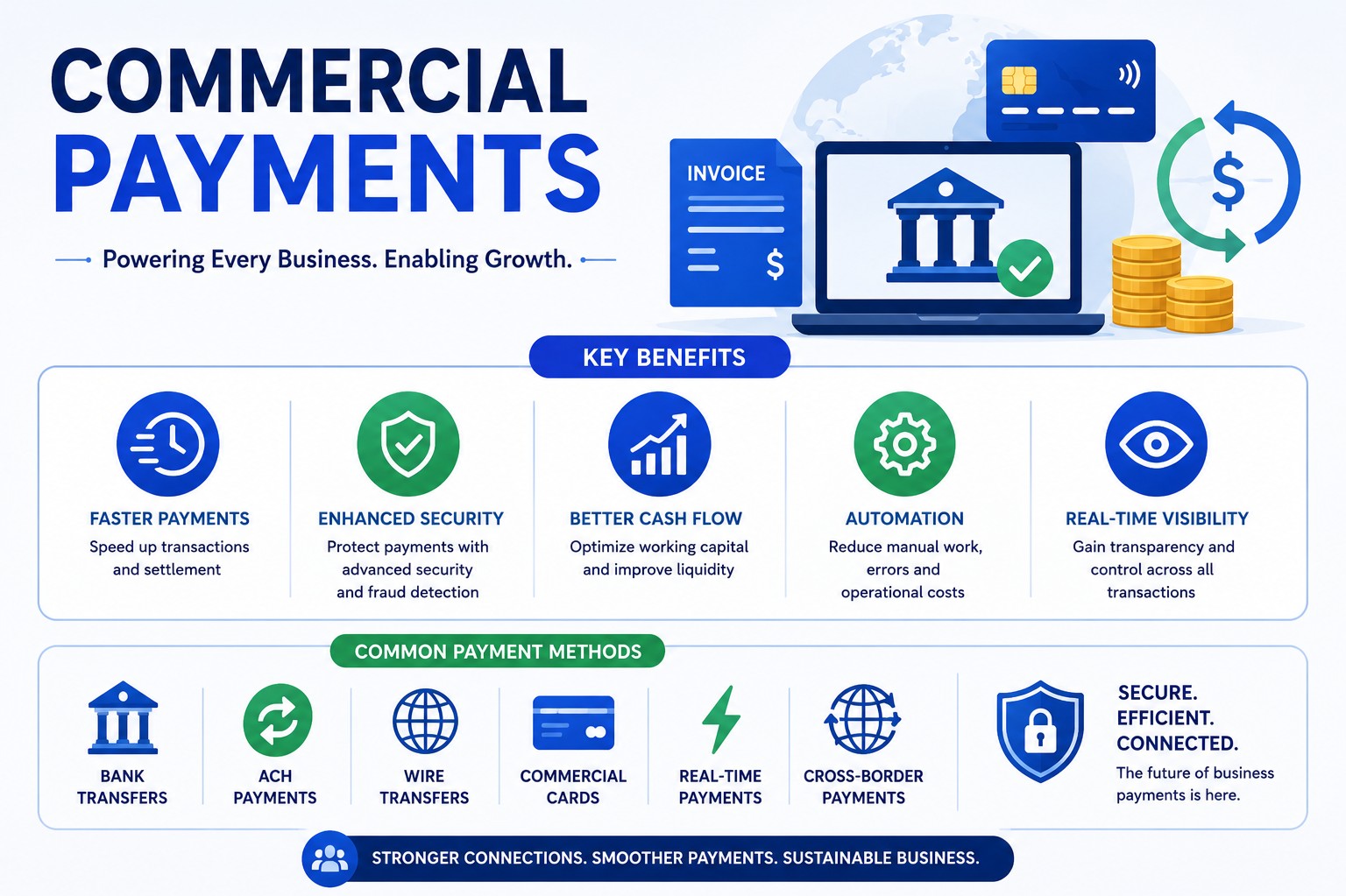
Introduction
Every business transaction involves the movement of money. Whether a company is paying suppliers, collecting customer payments, managing employee expenses, or settling international invoices, efficient payment processes are critical to maintaining healthy operations. These financial transactions collectively fall under the category of Commercial Payments, a cornerstone of modern business and corporate finance.
As businesses expand globally and embrace digital transformation, they have evolved far beyond traditional checks and bank transfers. Today, organizations rely on sophisticated payment technologies that enable faster settlements, automated reconciliation, enhanced security, and real-time visibility into cash flows.
The increasing demand for efficiency, transparency, and scalability is driving significant innovation in the commercial payments landscape. From virtual cards and real-time payments to embedded finance and artificial intelligence, businesses are rethinking how money moves across their ecosystems.
Understanding commercial payments is becoming increasingly important for finance professionals, corporate treasurers, fintech providers, and organizations seeking to optimize their financial operations.
What Are Commercial Payments?
Commercial payments refer to financial transactions conducted between businesses, governments, financial institutions, and other organizations for commercial purposes.
Unlike consumer payments, which typically involve individuals purchasing goods or services, commercial payments support operational and strategic business activities. These payments may include supplier invoices, payroll transactions, tax payments, procurement expenses, recurring subscriptions, and international trade settlements.
Commercial payments form the foundation of business relationships and play a critical role in ensuring that organizations can operate efficiently while maintaining strong cash flow management.
The volume and complexity of these transactions often require specialized payment infrastructure and financial management solutions.
Why Commercial Payments Matter
Efficient payment systems directly impact business performance.
Delayed payments can strain supplier relationships, disrupt supply chains, and create cash flow challenges. Manual payment processes increase administrative costs and introduce the risk of human error. Poor visibility into payment activities can make forecasting and financial planning more difficult.
Commercial payments help organizations maintain operational continuity by ensuring funds move accurately and efficiently between stakeholders.
As businesses become increasingly global and digital, payment efficiency has become a competitive advantage rather than simply an operational necessity.
Organizations that optimize their payment processes often benefit from improved liquidity management, stronger supplier relationships, and greater operational agility.
The Evolution of Commercial Payments
Historically, businesses relied heavily on paper-based payment methods such as checks and manual bank transfers.
While these methods served organizations for decades, they often involved lengthy processing times, limited visibility, and significant administrative workloads.
The rise of electronic banking introduced new efficiencies through wire transfers, Automated Clearing House (ACH) payments, and digital treasury systems.
Today, commercial payments are being transformed by emerging technologies such as:
- Real-time payment networks
- Virtual cards
- Open banking
- Embedded finance
- Artificial intelligence
- Payment automation platforms
These innovations are helping businesses process transactions faster while improving accuracy and transparency.
Common Types of Commercial Payments
Businesses use various payment methods depending on their operational requirements and transaction volumes.
Bank Transfers
Bank transfers remain one of the most widely used commercial payment methods. They enable secure movement of funds between business accounts domestically and internationally.
ACH Payments
ACH payments provide a cost-effective solution for recurring transactions such as payroll, vendor payments, and subscription billing.
Wire Transfers
Wire transfers are commonly used for high-value domestic and international transactions that require rapid settlement and enhanced security.
Commercial Cards
Corporate credit cards, purchasing cards, and virtual cards help businesses manage expenses while providing detailed transaction reporting and control capabilities.
Real-Time Payments
Real-time payment systems enable immediate fund transfers, supporting faster settlement cycles and improved cash flow management.
Each payment method serves specific business needs and contributes to a broader commercial payment strategy.
Commercial Payments and Cash Flow Management
Cash flow is often described as the lifeblood of a business.
Effective commercial payment processes help organizations optimize working capital by controlling when funds are received and disbursed. Businesses can improve liquidity by accelerating receivables, automating collections, and managing payment schedules strategically.
Real-time visibility into payment activity enables finance teams to make informed decisions regarding investments, borrowing, and operational expenditures.
As economic conditions become increasingly dynamic, strong cash flow management capabilities are more important than ever.
The Role of Automation
Automation is becoming a defining characteristic of modern commercial payments.
Manual processes can consume significant time and resources, particularly for organizations handling large transaction volumes. Automated payment systems reduce administrative burdens by streamlining approval workflows, invoice matching, reconciliation, and reporting.
Benefits of payment automation include:
- Reduced processing costs
- Faster payment execution
- Improved accuracy
- Enhanced compliance
- Better financial visibility
- Stronger operational efficiency
As businesses pursue digital transformation initiatives, payment automation is often among the highest-priority investments.
Commercial Payments in Global Business
Globalization has significantly increased the complexity of commercial payments.
Organizations conducting international business must navigate multiple currencies, regulatory requirements, banking systems, and settlement processes. Cross-border payments often involve higher costs, longer processing times, and increased compliance obligations.
Modern payment providers are addressing these challenges through innovative solutions such as virtual accounts, multi-currency wallets, local payment rails, and cross-border payment platforms.
These technologies help businesses expand internationally while maintaining efficient financial operations.
Security Challenges in Commercial Payments
As commercial payments become increasingly digital, cybersecurity risks continue to grow.
Fraudsters target businesses through invoice fraud, business email compromise attacks, account takeover schemes, and payment diversion scams. Financial losses can be substantial, particularly for organizations lacking robust security controls.
Businesses are responding by implementing:
- Multi-factor authentication
- Transaction monitoring
- AI-powered fraud detection
- Payment verification processes
- Employee security training
- Vendor validation procedures
Strong security frameworks are essential for protecting financial assets and maintaining trust within commercial payment ecosystems.
Emerging Trends Shaping Commercial Payments
Several trends are expected to influence the future of commercial payments.
Artificial intelligence is helping organizations improve fraud detection, payment optimization, and financial forecasting. Open banking is creating new opportunities for direct account-to-account payments and enhanced financial connectivity.
Embedded finance is integrating payment capabilities directly into business software platforms, reducing friction and improving user experiences.
Meanwhile, real-time payment adoption continues accelerating worldwide, enabling businesses to access funds faster and manage liquidity more effectively.
These innovations are transforming commercial payments from a back-office function into a strategic business capability.
The Future of Commercial Payments
The next generation of commercial payments will be increasingly intelligent, automated, and interconnected.
Finance teams will leverage AI-driven systems to manage payment workflows, optimize cash positions, and identify operational efficiencies. Payment infrastructures will become more transparent and responsive, supporting instant transactions across domestic and international markets.
Organizations will increasingly prioritize solutions that combine speed, security, automation, and data-driven insights.
As digital transformation continues reshaping business operations, commercial payments will remain at the center of corporate financial innovation.
Conclusion
Commercial Payments are the foundation of modern business operations, enabling organizations to move money efficiently across suppliers, customers, employees, and partners. As businesses face growing demands for speed, transparency, and operational efficiency, payment processes are becoming increasingly strategic.
Advancements in automation, real-time payments, artificial intelligence, and embedded finance are redefining how commercial transactions are executed and managed. Businesses that embrace these innovations will be better positioned to improve cash flow, reduce operational costs, strengthen security, and support long-term growth.
In an increasingly digital economy, commercial payments are no longer simply a financial necessity—they are a critical driver of business performance and competitive advantage.
Comments
No comments yet. Be the first to share your thoughts.
Leave a comment